Nine years had passed since anyone heard Dante Marino laugh, and in his world, silence was more terrifying than gunfire.
Men lowered their voices when he entered a room. They avoided jokes at all costs. They knew better than to surprise him, better than to stand too close, better than to breathe too loudly in his presence. And yet somehow, on a rainy Thursday in October, I walked into an execution with paperwork in my hand and told Chicago's most feared Mafia boss not to ruin a freshly cleaned rug.
My name is Emily Davis, and at thirty-one, exhaustion had destroyed whatever instinct for self-preservation I was supposed to have.
I worked as Dante Marino's personal secretary because his company paid me twelve thousand dollars a month, and eight thousand of that went directly toward the private residential facility caring for my younger brother. Daniel was twenty-four years old and had not walked unassisted since a drunk driver hit his car when he was nineteen. The facility on the North Side had gardens and nurses who knew his name and a room with a window that faced the morning sun, and it cost more every month than most people in Chicago earned in three. I paid it because Daniel was the only family I had left, and because when he smiled at me on Sunday afternoons, the whole broken world made a little bit of sense again.
Dante was thirty-eight and controlled an empire hidden behind legitimate shipping companies, restaurants, gambling operations, warehouses, and enough shell corporations to make an accountant cry. Nine years earlier, a car bomb meant for him had killed his wife, Clara, and according to everyone around him, whatever humanity Dante had possessed was buried with her.
He never smiled.
Never joked.
Never raised his voice.
That frightened people more than shouting ever could.
Most secretaries lasted three weeks. I lasted because fear required energy, and between my brother's medical bills, terrible coffee, and twelve-hour workdays, I didn't have any left.
The morning I was hired, eleven months before the rainy Thursday, I sat in the waiting room of Marino Shipping's downtown office with a résumé that listed three failed office jobs and a degree in English literature I had never used. The receptionist, Gloria, looked at my cheap navy suit and my scuffed shoes and whispered that the last secretary had left after nineteen days and the one before that after twelve, and that Mr. Marino did not tolerate mistakes, lateness, or questions.
"Does he tolerate breathing?" I asked.
Gloria stared at me. "Try not to do it loudly."
Dante interviewed me himself. He sat behind a desk the size of a small boat and read my résumé without expression, and when he finally looked up, his grey eyes were the coldest thing I had ever seen.
"Why do you want this job?" he asked.
"Because it pays twelve thousand a month," I said. "And my brother lives in a facility that costs eight."
He did not react. Most employers would have called that oversharing. Dante Marino simply set the résumé down and said, "You will work twelve hours a day. You will not ask questions about the business. You will not repeat anything you hear in this office. If you do, you will not be fired. Do you understand?"
"Perfectly," I said. "Being fired would be the least of my problems."
Something moved in his face then, so briefly I almost missed it. Not a smile. Just a pause, like a man who had expected a different answer and did not know what to do with the one he got.
"You start Monday," he said.
I learned the rules quickly. The coffee had to be black, scalding, and on his desk at exactly eight in the morning. The spreadsheets had to balance to the cent. The door to his office was never to be opened without knocking, unless the building was on fire, and even then Gloria suggested knocking first. The men who came to see him were to be announced by first name only, never by title, and if any of them raised their voice, I was to press the small white button under my desk and say nothing at all.
I broke the knocking rule within the first week, because a delivery man had left a box of printer paper in the hallway and I tripped over it carrying a stack of files, and the files went everywhere, and I pushed the door open with my elbow to catch myself. Dante looked up from his desk. The room went cold. I stood there with papers stuck to my skirt and said, "I apologize, Mr. Marino. The printer paper attacked me first."
He stared at me for five seconds. Then he said, "Clean it up."
I did. I kept the job. Three weeks passed, then three months, then six, and somewhere along the way the office stopped holding its breath every time I walked past Dante's door. Tommy, one of his enforcers, started bringing me coffee from the good place on the corner instead of the burnt sludge from the break room. Gloria started saving me the good parking spot. Even the guards at the elevator nodded at me in the mornings, which Gloria told me was the closest thing to a promotion anyone in that building ever got.
But Dante never smiled. He never joked. He never raised his voice. He signed papers, took phone calls in a voice so quiet I had to strain to hear it through the door, and looked out the rain-covered windows of his office like a man watching a country he no longer lived in.
I knew about Clara. Everyone in the building knew about Clara. She had been twenty-nine when the car bomb went off, nine years ago, in a parking garage downtown. The bomb had been meant for Dante. He had been fifteen minutes late that night because a meeting ran long, and Clara had gone down to the car first. The men who planted it were never found. Dante had not laughed since the day they buried her, and the people who loved him had stopped expecting him to.
I did not expect him to either. I expected to keep typing his letters, balancing his spreadsheets, and paying Daniel's bills until I was old and grey and the facility sent me a nicer Christmas card. That was the plan. It was a small plan, and a tired one, but it was mine.
Then came the rainy Thursday.
It started like any other day. I arrived at seven forty-five with wet hair and a coffee that tasted like burnt toast, and Gloria told me Mr. Marino had already been in his office for an hour, which meant something was wrong, because Dante Marino was never early unless someone was about to have a very bad day.
At nine, Tommy came up the elevator looking like a man walking to his own funeral. He stopped at my desk and whispered, "Is he in a bad mood?"
"He's always in a bad mood," I said, without looking up from my spreadsheet. "It's his resting state. Like a statue, but with more paperwork."
"If I don't come back out—" Tommy began nervously.
"I'll cancel your dentist appointment Tuesday," I told him, still typing. "And I'll mail your final check to your mother."
His face went blank. "You don't even know my mother."
"I know her address. It's in your file. I file everything, Tommy. It's literally my job."
He swallowed hard and knocked on Dante's door. The door opened. The door closed. I went back to my spreadsheet, because spreadsheets do not care about fear, and numbers are the only honest things in a building full of men who lie for a living.
Three minutes later, something heavy crashed inside Dante's office.
I moved my coffee farther from the edge of my desk.
Then my spreadsheet showed me something far worse: three million dollars missing from a South Side operation.
I stared at the numbers. I ran them again. I checked the transfers, the dates, the accounts, and the routing, and the hole was still there, neat and undeniable, three million dollars gone from a South Side warehouse account into a shell company I had never seen before. The thief had been embarrassingly careless. He had routed the money through a company registered under his own mother's maiden name, Bellini Holdings, and I found it in twelve minutes, because whoever did it had apparently never met a woman who balanced spreadsheets for a living.
The name on the transfers was Salvatore Genovese, one of Dante's oldest captains. A man who had known Dante's father. A man who had carried Clara's casket.
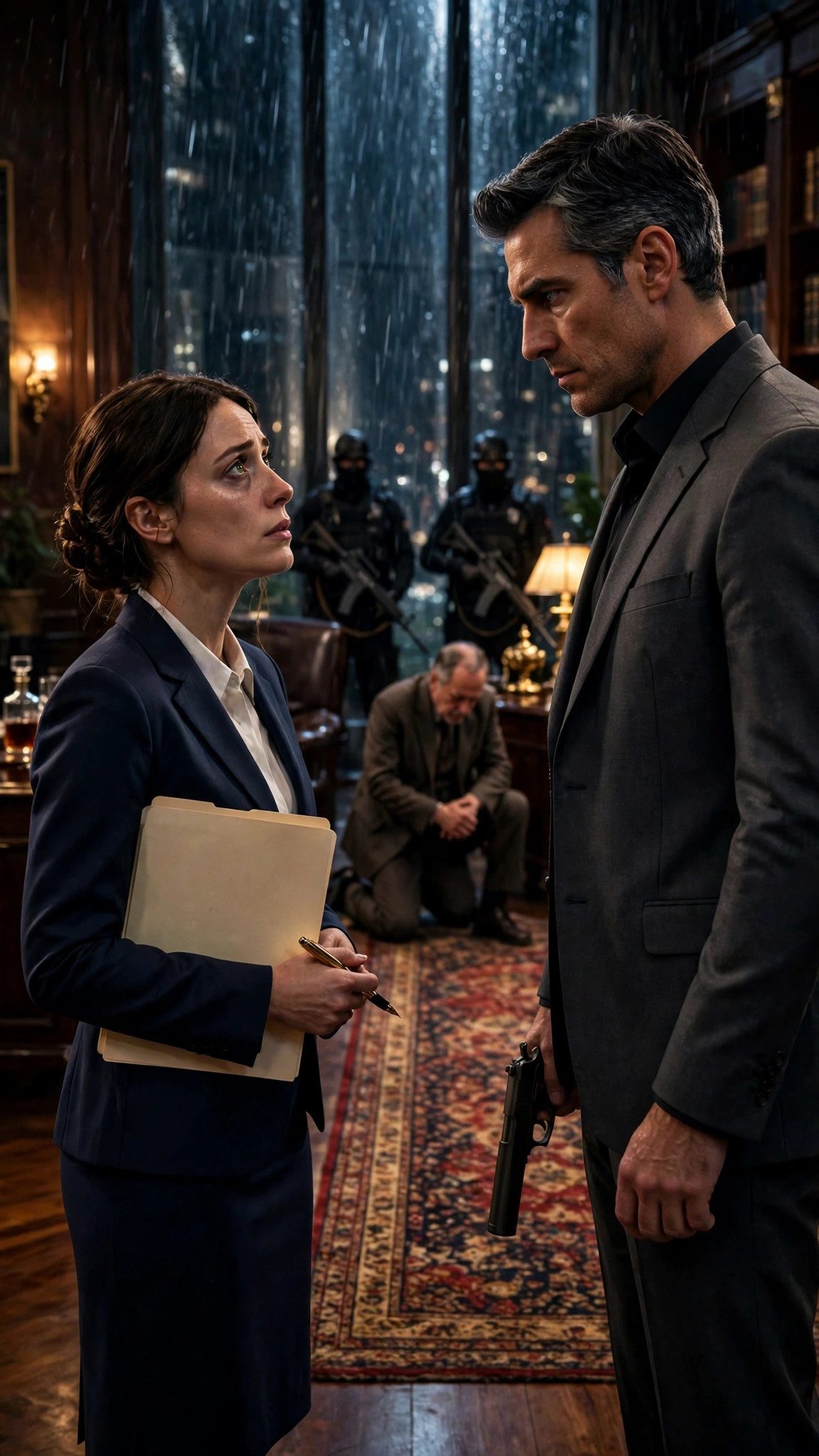
At 11:45, I grabbed the folder Dante needed to sign before the federal auditors arrived downstairs and walked straight into his office without knocking.
Sal was on his knees.
Two guards stood behind him.
Dante faced the rain-covered windows with a suppressed pistol hanging loosely from one hand.
Every person in that room looked terrified.
Except me.
"Mr. Marino," I said, placing the folder on his desk. "I need your signature."
Dante slowly turned. "I am handling a personnel issue."
"The IRS arrives in two hours. If these forms aren't signed, payroll gets frozen, and your employees become extremely unpleasant when direct deposit fails."
Sal looked at me desperately. "Emily, please tell him—"
"Sal, we are not friends."
The guards stared at me like I had volunteered to die.
Dante's eyes narrowed. "Leave."
"I will after you sign."
I extended his Montblanc pen toward him. "I already traced Sal's theft. He used his mother's maiden name. It took twelve minutes. Honestly, that's insulting."
Silence swallowed the room.
Dante stepped toward me.
His gun was still in his hand.
Then I noticed the Persian rug beneath Sal's knees and sighed.
"Actually, one more thing."
Dante stopped. "What?"
"Please shoot him at the warehouse."
Every face turned toward me.
"We had these rugs professionally cleaned Tuesday," I continued. "They charge double for blood. I spent forty minutes arguing about the biohazard fee last month, and frankly, Sal is not worth the surcharge."
For ten unbearable seconds, Dante simply stared at me.
Ten seconds is not a long time. I know this because I have timed it: ten seconds is how long the elevator takes from the lobby to the fourteenth floor, and ten seconds is how long Daniel's smile lasts when I walk into his room on Sundays before the nurses wheel him to the garden. But standing in Dante Marino's office with a gun in his hand and a thief on his knees, ten seconds felt like a year of Sundays.
My mind, unhelpfully, chose that moment to run through my entire life like a spreadsheet with the totals highlighted in red. The facility bill was due on Friday: eight thousand dollars, and my salary would not arrive until Monday, and I had already moved money from my own food budget to cover the gap. Daniel's physiotherapist had called on Tuesday to say he was making progress with the standing frame, and I had cried in the supply closet for three minutes before wiping my eyes and going back to my desk. My mother had died when I was twenty-two, my father two years before that, and Daniel was the only person in the world who still said my name like it meant something good.
I thought about the morning I had driven to the facility in the rain and found Daniel sitting by the window with a blanket over his legs, watching the traffic on the highway. He had pointed at a red truck and said, "Em, look. That one's fast." He was twenty-four years old and he still got excited about trucks, and the nurse had told me his memory was coming back in pieces, little bright fragments surfacing like fish in dark water. He remembered the car accident in flashes. He remembered our mother singing in the kitchen. He did not remember that he would never walk unassisted again, and some days I was grateful for that, and some days it broke my heart so cleanly I could hear it.
I thought about the first time I brought him a photograph of the office, because he asked me what my days looked like, and I told him about Gloria and Tommy and the terrible coffee, and he laughed and said, "You work for a gangster, Em. That's the coolest thing anyone in our family has ever done." I had not corrected him. I had not told him that the gangster in question was the most feared man in Chicago, or that I filed paperwork for men who disappeared, or that my hands shook every time I carried a folder into Dante's office. I had told him the coffee was terrible, which was true, and that my boss never smiled, which was also true, and Daniel had said, "Maybe he just needs someone to be funny at him," and I had laughed so hard the nurse came in to check on us.
Ten seconds. I thought about all of that in ten seconds, while Dante Marino stared at me, and I decided that if I was going to die in that office, at least I would die having said something honest about the rug. The rug really had been cleaned on Tuesday. The biohazard fee really was double. Sal really was not worth the surcharge. If those were my last words, they were at least accurate, and accuracy had always been the one thing I could offer the world.
Tommy's face, from the corner of my eye, had gone the color of old paper. One of the guards had his hand on his weapon. Sal was crying silently into his own hands, and I remember thinking, with a strange detached clarity, that Sal had been the one to carry Clara's casket nine years ago, and that Dante remembered that too, and that maybe that was the only reason Sal was still breathing.
Then something happened to his face.
His mouth twitched.
His chest moved once.
A strange, broken sound escaped his throat.
The guards reached toward their weapons.
Sal stopped crying.
And I suddenly realized that the sound coming from Dante Marino, the man who had not laughed since his wife died nine years ago, was getting louder.
He was laughing.
And in that moment, with a gun still in his hand and a thief on his knees and the rain hammering the windows, I understood two things with perfect clarity. The first was that I had just done something no one in Chicago had managed in nine years. The second was that my life, which had been small and tired and carefully balanced like one of my spreadsheets, was never going to be small again.