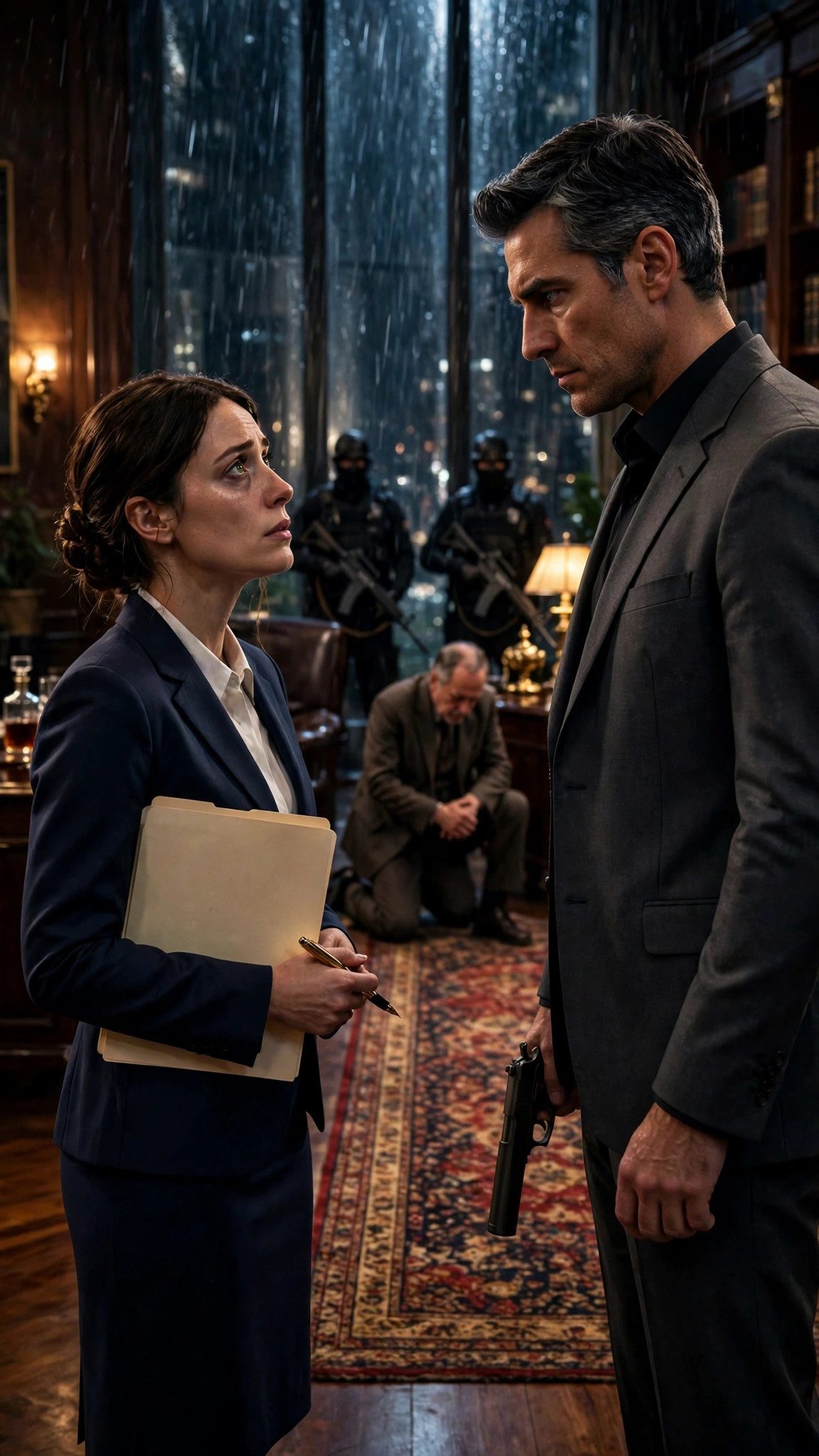
The folder sat on my desk for exactly eleven minutes before Dante's office door opened.
He stood in the doorway in his charcoal suit, his face unreadable, and looked at the folder the way a man looks at a letter he already knows is bad news.
"Bring it in, Miss Davis," he said.
I brought it in. He closed the door behind me, which he never did, and I understood that whatever happened next would not be witnessed by anyone, and that was either a kindness or a warning, and I did not know which.
He sat down. He opened the folder. He read my note, and then he read the transfers, line by line, in silence, and I stood there with my hands clasped in front of me and tried to remember how to breathe quietly.
"Three million dollars," he said at last.
"Yes, sir. From the South Side operation, over six weeks. Routed through Bellini Holdings. Bellini was Sal Genovese's mother's maiden name. I checked the incorporation papers. The company was registered four months ago by a law firm that also handles the Castellano family's real estate."
Dante looked up. "The Castellanos."
"Yes, sir. And there's more. The forty thousand from last week was the same pattern, smaller. Whoever is doing this has been testing the route with small amounts before moving the larger ones. It's careful work, but the routing is sloppy. They used Sal's mother's name. That's either arrogance or desperation."
"Or a frame," Dante said quietly.
I blinked. "Sir?"
"Sal Genovese has been with this family for forty years. He carried my father's casket. He carried my wife's casket. A man does not steal three million dollars and sign his mother's name to it unless he wants to be caught, or unless someone else wants him caught."
I had not considered that. I had considered the numbers, and the routing, and the twelve minutes it took to trace them, but I had not considered that the numbers might be a message rather than a theft.
"Find out which," Dante said. "Quietly. Do not tell anyone. Not Gloria. Not Tommy. No one."
"How am I supposed to find out quietly, Mr. Marino? I balance spreadsheets. I don't investigate people."
"You found three million dollars in twelve minutes," he said. "You will manage."
He dismissed me with a nod, and I went back to my desk and sat down and stared at my screen until the cursor blurred, and then I did the only thing I knew how to do. I followed the money.
It took me the rest of the day. Bellini Holdings had received eleven transfers in six weeks, and every one of them had been forwarded within forty-eight hours to a second company, a gambling operation on the West Side called Meridian Entertainment, and Meridian Entertainment was owned, through three more layers of shell companies, by a man named Vincent Castellano.
Vincent Castellano. The name Gloria had whispered on my first day. The rival. The man who had been circling the Marino empire for nine years, waiting for a weakness.
The money trail told a story, and the story was this: someone inside Dante's family was feeding Castellano three million dollars, and they were doing it through Sal Genovese's name.
But when I dug deeper, the story changed. The transfers out of the South Side account had been authorized by a signature I recognized, because I filed it every week: Sal's signature, yes, but the handwriting on the authorization forms was wrong. Sal's handwriting was shaky and old-fashioned, the handwriting of a man who had learned to write with a fountain pen. The handwriting on these forms was younger, hurried, and it slanted the wrong way.
I pulled Sal's personnel file. I compared the signatures. They did not match.
Someone had forged Sal's signature. Someone had used his mother's maiden name to register the shell company. Someone wanted Dante to believe that Salvatore Genovese, his oldest captain, had stolen three million dollars.
And the only person with both the access and the motive, I realized with a cold feeling in my stomach, was someone who wanted Sal dead, because Sal was the one man in the family who would never betray Dante, and a dead loyal captain would leave a hole nothing could fill.
I printed everything. I put it in a second folder. I wrote on the top sheet: "The signatures do not match. Someone forged them. — E.D."
It was nearly eight o'clock by then, and the office had gone quiet. Gloria had left at six. Tommy had gone home to his mother, or so he claimed. The cleaning crew worked two floors down, and the only sounds on the fourteenth floor were the rain and the hum of my computer and the occasional murmur of Dante's voice through his office door, low and steady, talking to someone on the phone in a language I did not recognize.
I was packing my bag to leave when his door opened.
"Miss Davis," he said. "Come in. Bring the folder."
I brought the folder in. He had loosened his tie, which I had never seen him do, and there were two cups of coffee on his desk, one of them clearly meant for me, because it had milk in it, and Dante Marino drank his coffee black.
"Sit," he said.
I sat. It was the first time I had ever sat in the chair across from his desk. It was a good chair, leather, the kind that costs more than my monthly rent, and I tried not to look impressed.
"Tell me about your brother," he said.
I stared at him. "Sir?"
"Daniel. The facility. The standing frame. Tell me."
So I told him. I told him about the accident, about the drunk driver who walked away with a suspended sentence, about the five years Daniel had spent learning to do everything differently, about the garden and the morning sun and the red truck. I told him about the eight thousand dollars a month, and the way the facility raised its prices every January, and the way I had learned to cook exactly seven cheap meals so I could send every spare dollar north.
Dante listened without interrupting. When I finished, he was quiet for a long moment, and then he said, "My mother used to say that a family is only as strong as its weakest member. She said it after my father died, when the family was falling apart and everyone was looking for someone to blame. She was right."
"Your mother sounds like a wise woman, Mr. Marino."
"She was," he said. "She died three years ago. She never forgave me for Clara, and she never forgave herself for raising a son who could not protect his wife."
I didn't know what to say to that. So I said the only true thing I could think of. "My mother used to say that guilt is just love with nowhere to go."
He looked at me for a long time. Then he picked up the folder and opened it, and we went through the transfers together, line by line, until nearly ten o'clock. He asked sharp questions. I gave sharp answers. Twice he almost smiled, and twice he caught himself, and the second time I said, "You know, Mr. Marino, smiling won't kill you. I checked. There's no medical literature on it."
"Miss Davis," he said, in a voice that was almost warm, "you are going to get yourself fired."
"You can't fire me," I said. "Who else is going to find your three million dollars?"
He actually laughed then. Just once, short and surprised, like a man who had been ambushed by his own happiness. And for a moment, sitting in that quiet office with the rain against the windows and two cups of coffee going cold on the desk, I forgot that he was the most feared man in Chicago. He was just a man, tired and lonely, who had not laughed in nine years and was learning how again.
When I finally left the building that night, I noticed a black car parked across the street with its lights off. I noticed it because I notice everything now; it is a habit I developed somewhere between the rug and the laugh. The car stayed there until I turned the corner, and when I looked back, it was gone.
I told myself it was nothing. A man waiting for someone. A driver on a break. Nothing.
But I wrote down the license plate anyway, on the back of a grocery receipt, because spreadsheets had taught me that small discrepancies matter, and a black car with its lights off, parked across from a Mafia boss's office at ten o'clock at night, was a discrepancy.
I put the receipt in my pocket and drove home through the rain, and I did not sleep well that night.
That evening, Dante summoned Sal to the office.
I was not invited in. I sat at my desk and listened to the murmur of voices through the door, and I watched Tommy pace the hallway, and I watched the rain start again outside the windows. After an hour, the door opened, and Sal came out. He looked older than he had that morning. His shoulders were bent. He stopped at my desk.
"Miss Davis," he said quietly. "Mr. Marino told me what you found. The signatures."
"I'm sorry, Sal."
"Don't be sorry." He took a breath. "I need to tell you something, and I need you to tell Mr. Marino, because I am too ashamed to say it to his face. My son, Marco, he owes money. Gambling. Four hundred thousand dollars to Castellano's men. They came to my house last month. They said if I did not help them move money through the South Side accounts, they would break Marco's legs. Then they said they would do worse."
He looked down at his hands. "I did not steal the money, Miss Davis. But I gave them my mother's name. I told them Bellini, because they asked for a name that would look like family business, and I was frightened, and I am an old man who loves his son more than his own honor. They forged my signature. They moved the money. And I let them, because I was afraid."
"Sal," I said softly, "why didn't you tell Mr. Marino?"
"Because Mr. Marino's wife died nine years ago, and the men who killed her were never found, and I was afraid that if I told him Castellano was inside his house, he would burn the whole city down looking for him." Sal's voice broke. "And I was afraid he would kill Marco for the debt. Marco is a fool, Miss Davis, but he is my son."
I put my hand over his, just for a moment, because he was an old man crying at my desk and I did not know what else to do.
"Go home, Sal," I said. "I'll tell him."
He nodded and walked to the elevator, and I carried the second folder into Dante's office.
Dante was standing at the window again, looking out at the rain. He did not turn around.
"Well?" he said.
I told him everything Sal had told me. The debt. The threats. The name. The forged signatures. When I finished, Dante stood very still for a long time, and I watched his reflection in the window, and I saw something in his face I had never seen before. Not anger. Not silence. Grief, maybe. Or the look of a man who has just understood that the war he thought ended nine years ago never ended at all.
"Castellano," he said.
"Yes, sir."
"He killed my wife. I have always believed it, but I could never prove it. And now he is inside my house, using my oldest captain's son to steal from me, and he thinks I will kill Sal for it. He thinks I will do his work for him."
"What will you do, Mr. Marino?"
Dante turned from the window. His eyes were grey and cold and absolutely clear.
"I will not kill Sal," he said. "Sal is a frightened old man who loves his son. I will not give Castellano what he wants. Tomorrow morning, I am going to call the FBI agent who has been trying to build a case against Castellano for three years, and I am going to give him everything. The transfers. The signatures. The shell companies. And then I am going to pay Marco Genovese's debt myself, because a man who owes Castellano four hundred thousand dollars is a man Castellano owns, and I do not let other men own my people."
He paused. "And you, Miss Davis, are going to help me, because you are the only person in this building who sees the numbers clearly."
"Me, sir?"
"You found three million dollars in twelve minutes," he said. "You found a forgery no one else noticed. You made me laugh. I have decided that you are the most dangerous person in this office, Miss Davis, and I would rather have you on my side than against me."
I should have been frightened. I should have asked to go back to my spreadsheets and my twelve-hour days and my quiet, invisible life. But I looked at Dante Marino standing in the rain-light of his office, a man who had not laughed in nine years and had just chosen mercy over murder, and I heard myself say the most honest thing I had said in years.
"All right, Mr. Marino," I said. "But if I'm going to help you catch a man who killed your wife, I'm going to need better coffee."
His mouth twitched. Just once. Like a muscle remembering an old habit.
"Done," he said.
And that was how I, Emily Davis, a thirty-one-year-old secretary who had walked into an execution with paperwork in her hand, became the woman who was going to help Chicago's most feared Mafia boss take down the man who had destroyed his life.
I just didn't know yet that Castellano already knew my name.