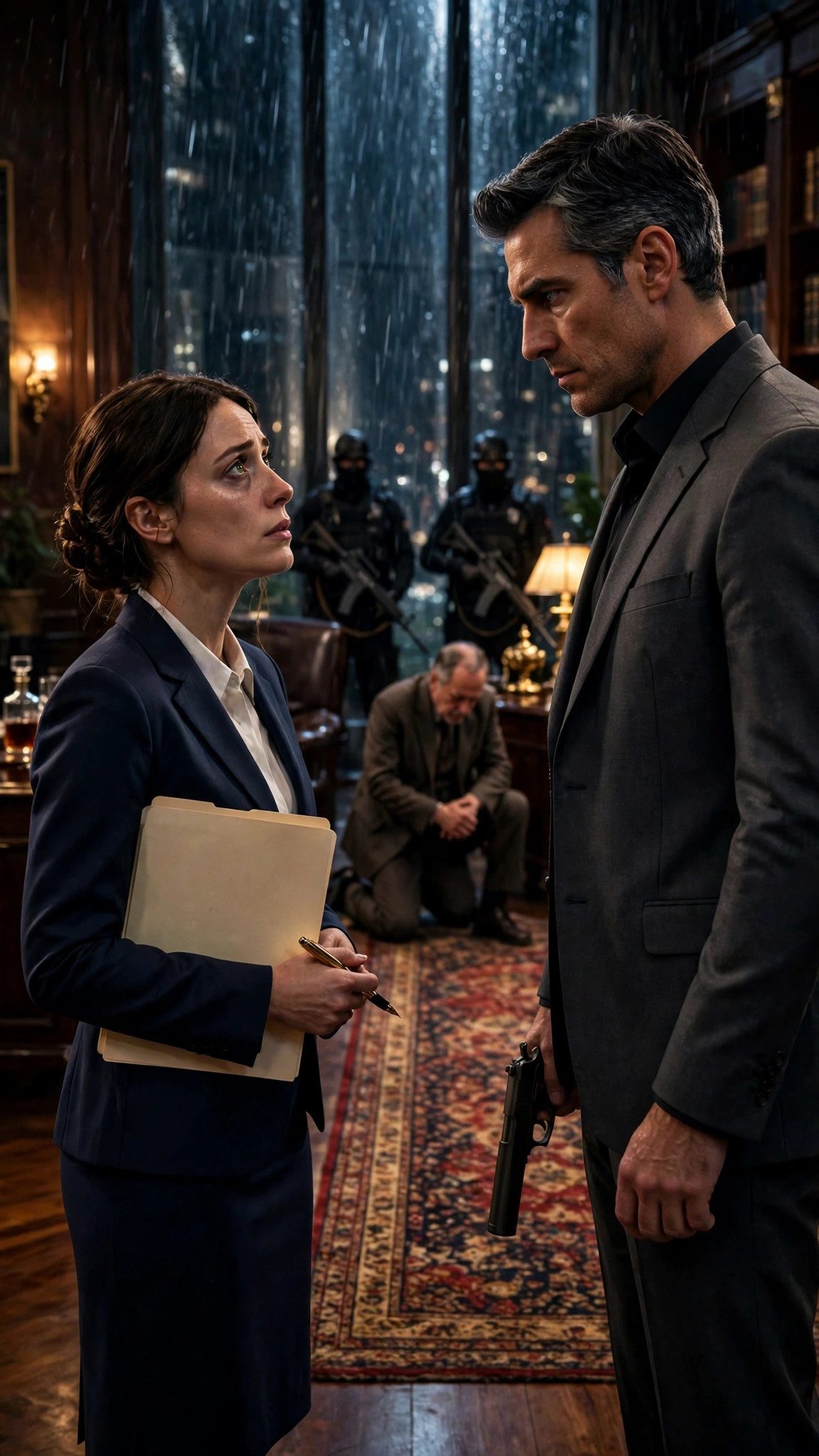
The trial of Vincent Castellano took four months, and in those four months, my life changed in ways I had never expected.
The first change was the simplest one: Dante started laughing. Not often, and not loudly, but sometimes, in the middle of an ordinary afternoon, I would say something dry about a spreadsheet or a delivery man or the break room coffee, and his shoulders would shake once, and his mouth would twitch, and a sound would escape him that was almost a laugh, like a man clearing his throat after nine years of silence. Gloria kept a tally on a sticky note on her monitor. By Christmas, the tally said fourteen.
The second change was harder: the family did not know what to make of a boss who laughed.
Tommy told me about it one morning, in a whisper, while Dante was on the phone. "Some of the captains are nervous," he said. "They say a laughing boss is a soft boss. They say Castellano's men are already saying Dante has gone weak."
"Has he?" I asked.
Tommy thought about it. "He paid Marco's debt. He spared Sal. He called the FBI. In the old days, Castellano would have been dead by now, and Sal with him, and nobody would have asked questions." He paused. "But you know what? The old days got Clara killed. Maybe soft is better than dead."
The third change was the trial itself. Agent Reyes called me twice a week. I testified about the transfers, about the forged signatures, about the twelve minutes it took to find three million dollars. Sal testified about his son's debt and the threats. Dominic Voss testified about everything: the shell companies, the gambling operation, the bomb. And Aldo Ferrante, the man who had planted the bomb nine years ago, testified that Castellano had paid him fifty thousand dollars and told him to make it look like an accident.
I sat in the courtroom on the day Voss testified, in the back row, where no one would notice me, and I listened to a man describe, in a flat and tired voice, how he had helped plan the murder of a twenty-nine-year-old schoolteacher he had never met. Dante sat in the front row, perfectly still, his hands folded, and he did not look at Voss once. He looked at the judge. He looked at his own hands. And when Voss finished, Dante stood up and walked out of the courtroom, and I followed him, because someone had to, and we stood in the hallway together while he stared out the window at the Chicago skyline.
"Did it help?" I asked. "Hearing it?"
"No," he said. "It didn't bring her back. Nothing brings her back." He was quiet for a moment. "But it helped to hear someone say it out loud. For nine years, it was only in my head. Now it's in a courtroom, on the record, and everyone knows. That's something."
"That's a lot," I said.
He nodded. "Agent Reyes says Castellano will get life. No parole. The gambling operation is gone. The shell companies are frozen. His men are turning on each other like rats in a sinking ship."
"And Sal?" I asked.
"Sal is in Milwaukee," Dante said. "He runs the warehouse. He calls me every Sunday. He tells me about the tomato plants. Maria sends me biscotti every month, and I eat them at my desk, and I pretend not to enjoy them."
I smiled. "You're a terrible liar, Mr. Marino."
"I know," he said. "It's a recent development."
The fourth change was the one I had not expected at all. One evening in February, Dante called me into his office and closed the door, and he set a folder on his desk, the way I had set a folder on his desk a hundred times before.
"This is for Daniel," he said.
I opened the folder. Inside was a trust document, drawn up by the best lawyer in Chicago, establishing a fund in Daniel's name. It would pay for his care for the rest of his life, in full, no matter what happened to me, no matter what happened to Dante, no matter what happened to the family. There was a house, too, a small house with a garden not far from the facility, where Daniel could live with a full-time nurse when he was ready, and where I could visit him on Sundays without signing in at a front desk.
I stared at the document for a long time. My hands were shaking.
"I can't accept this," I said.
"Yes, you can," Dante said. "And you will. Because it's not a gift, Emily. It's a debt. You gave me back something I thought I had lost forever. You gave me back my laugh. You gave me back my mercy. You gave me back the part of me that died with Clara. A trust fund is the least I can do."
"It's too much," I whispered.
"It's not enough," he said. "It will never be enough. But it's a start."
I signed the papers. My hand shook so badly the signature looked nothing like my own, and Dante pretended not to notice, and when I finished, he stood up and walked around the desk, and he did something he had never done before. He hugged me.
It was not a romantic hug. It was the hug of a man who had carried nine years of grief alone and had finally found someone strong enough to help him carry it. I hugged him back, and I cried into his charcoal suit, and he did not move, and he did not tell me to stop, and when I finally pulled away, he handed me a tissue from the box on his desk, because he had learned where I kept them.
"Thank you," I said.
"No," he said. "Thank you."
The following Sunday, Dante asked me to go somewhere with him. He did not say where. Enzo drove, and we went north, out of the city, to a small cemetery on a hill where the grass was green even in February and the wind smelled like snow.
Clara Marino's grave was simple. A grey stone with her name and two dates, and a small vase with white roses that someone, Dante, had clearly been replacing every week for nine years. He stood in front of it for a long time, his hands in his pockets, and I stood a few steps behind him, because some moments do not belong to anyone but the person living them.
"I used to come here every Sunday," he said finally. "For nine years. I would stand here and I would tell her about the week. About the business. About the men who betrayed me and the men who stayed. I never told her about you. I didn't know how."
He turned to look at me. "I think she would have liked you, Emily. She was funny, like you. She left notes in my coat pockets. She once told a man with a gun to wipe his feet before he came into our house, because she had just mopped the floor. She was fearless in the exact way you are fearless, which is to say she was too tired and too stubborn to be afraid."
"Thank you," I said quietly. "That might be the nicest thing anyone has ever said to me."
"I want you to know," Dante said, looking back at the stone, "that I loved her. I will always love her. What I feel now, what I'm beginning to feel, it doesn't replace her. It doesn't erase her. But she would not want me to be silent forever. She used to say that silence was just grief that hadn't found its voice yet."
He knelt down then, and he touched the stone, just once, with his fingertips, and he said, very quietly, "I laughed, Clara. For the first time in nine years, I laughed. A secretary made a joke about your rug, and I laughed, and I think you would have liked that. I think you would have liked her."
We stood there for a while longer, in the cold and the quiet, and then we walked back to the car together, and I understood that I had just witnessed something sacred: a man saying goodbye to nine years of silence, not by forgetting the woman he loved, but by finally allowing himself to live again.
That spring, Dante began to change the family. He sold the gambling operations. He closed the shell companies. He turned the warehouses into legitimate logistics businesses, and the restaurants into restaurants, and the shipping companies into shipping companies, and he told his captains, in a meeting I was not invited to but heard about from Tommy in great detail, that the Marino family was going legitimate, and that anyone who did not like it was free to leave, and that anyone who stayed would be paid well and would never be asked to do anything that would put them in a courtroom.
Half of them left. The other half stayed. Tommy stayed. Enzo stayed. Sal called from Milwaukee and said he was proud. And Gloria, who had worked in that building for eleven years, told me she had never seen anything like it.
"He's building something new," she said. "A family that doesn't need silence to survive."
In April, the jury found Vincent Castellano guilty on all counts: murder, conspiracy, racketeering, fraud. The judge sentenced him to life in prison without parole. Aldo Ferrante got thirty years. Dominic Voss got eight, in exchange for his testimony, and Agent Reyes told me he would be out in five with good behavior, and that he had asked for a job in the prison library, which seemed fitting for a man who had spent his life keeping other people's secrets.
On the day of the sentencing, Dante and I stood on the steps of the courthouse, and the reporters shouted questions, and the cameras flashed, and Dante did not answer any of them. He just stood there in his charcoal suit, looking up at the sky, and when the shouting died down, he turned to me and said, "It's over, Emily. Really over this time."
I believed him. I believed him because his shoulders were straighter than they had been in eleven months, and because he was smiling, not laughing, just smiling, a small and certain thing, like a man who had finally put down a weight he had carried for nine years.
That night, we had dinner at a small Italian restaurant on the North Side, just the two of us, and he ordered pasta, which was the first time I had ever seen him eat anything other than grilled chicken, and he laughed twice, once at something I said about the waiter, and once at nothing at all, just because the evening was warm and the food was good and the world, for once, felt kind.
And I sat across from him, in a little restaurant with candles on the tables and the smell of garlic in the air, and I thought about the rainy Thursday, and the rug, and the gun, and the ten seconds that had changed everything, and I understood, finally, what mercy costs.
The following Sunday, Daniel moved into the small house.
It was not a grand house. It had three rooms, a garden with a fence, and a ramp at the front door that the builders had installed without being asked, because Dante had told them, in his quiet way, that the man who lived there deserved to come and go as he pleased. There was a full-time nurse named Grace, a kind woman with grey hair who had worked at the facility for ten years and who knew Daniel's routines better than I did. There was a room with a window that faced the morning sun, and a shelf for Daniel's model trucks, and a red truck already sitting on the shelf, waiting for him, because Dante had remembered.
I brought Daniel over in the morning, and he wheeled himself through the front door, and he looked around at the garden and the ramp and the shelf, and he said, "Em. This is mine?"
"It's yours," I said. "For as long as you want it."
He cried then, quietly, the way he always cried when he was happy, and I cried too, and Grace pretended to be very busy in the kitchen, and Dante stood in the doorway with his hands in his pockets, watching us, and I saw his mouth twitch, just once, like a muscle remembering an old habit.
We spent the whole day there. Daniel picked the room with the morning sun. He put the red truck on the shelf himself. He told Grace about the harmonica player, and she laughed, and he told Dante about the standing frame, and Dante listened like it was the most important thing in the world. And when the sun went down, I drove home, and I sat in my car for a long time before going inside, because I wanted to remember exactly how the day had felt: warm, and safe, and full of light.
The next Sunday, Dante came to the house for lunch. He brought the model truck himself, a red one, in a box with a bow on it that looked like Gloria had tied it, and Daniel opened it at the table and held it up like it was made of gold. Grace made roast chicken and potatoes, and Dante ate two helpings, and when I raised an eyebrow at him, he said, "Don't tell Gloria. She thinks I only eat grilled chicken." Daniel laughed so hard he nearly knocked over his glass, and Dante laughed too, and for a moment, sitting at that small table in that small house with the garden outside and the sun coming through the window, I thought: this is what a family looks like. Not perfect. Not unbroken. But warm, and safe, and full of light.
It costs everything you thought you knew about yourself. It costs your silence. It costs your certainty. It costs the armor you built around your heart to survive. And in return, it gives you back the one thing you thought you had lost forever.
It gives you back your life.