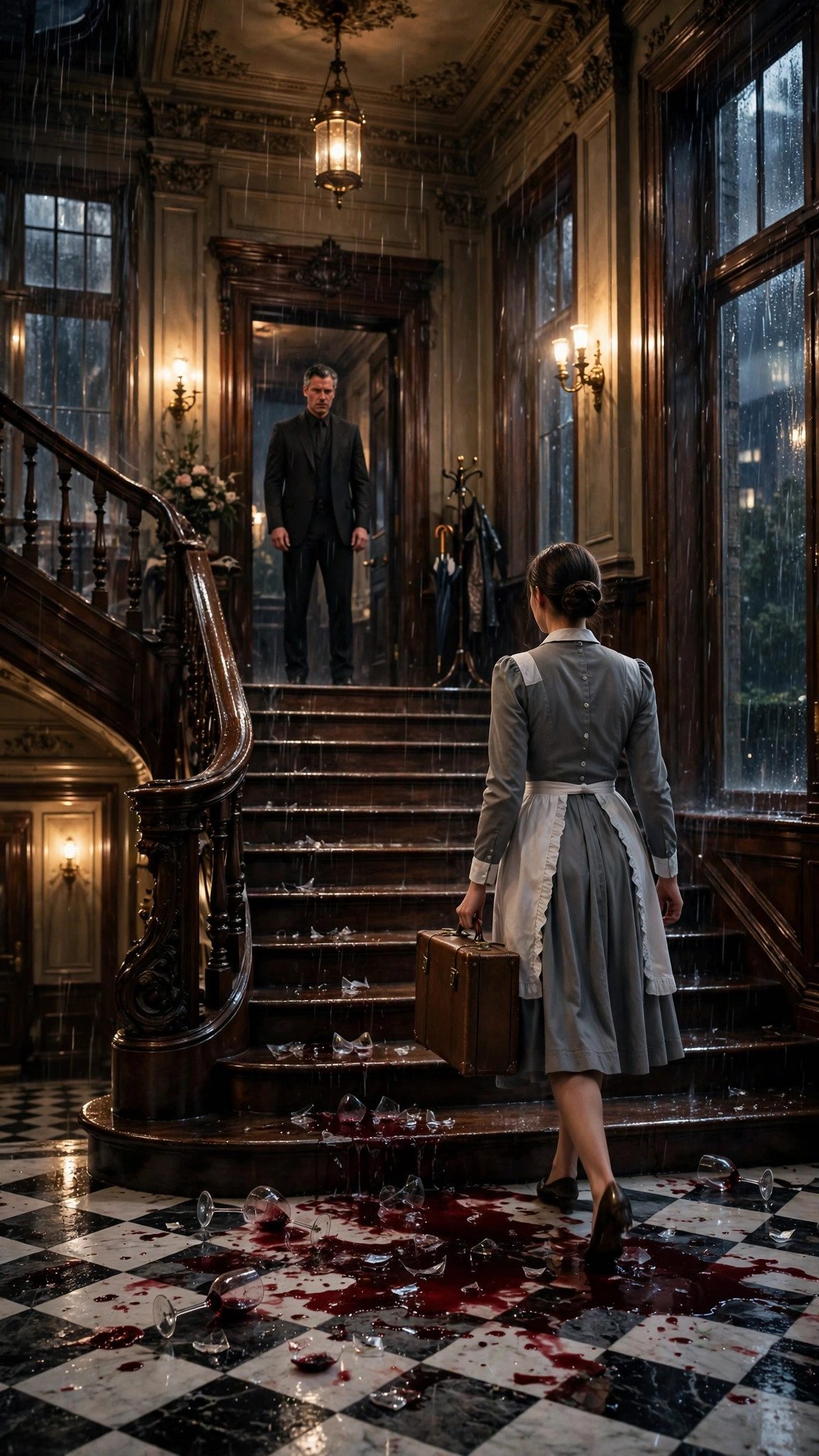
The wine glass was still falling when Gabriel Rossi understood that his house had stopped breathing.
It hit the marble floor of the front hall and shattered, red wine spreading across the white stone like a wound, and the sound of it went up the old wooden staircase and came back down again, and somewhere in that echo Gabriel heard five years of quiet evenings collapse into a single second.
"Hazel!"
His voice filled the hall. It was the voice that had made dock foremen go pale and rival bosses sign papers they did not want to sign, and it bounced off the high ceiling and died against the closed doors.
No one answered.
Gabriel stood in the doorway with rain running off his shoulders and stared at the empty place where she always stood. Every night for five years, when he came home from the docks, Hazel had been there at the foot of the stairs with a tray, or in the doorway of the dining room with his plate already covered, or just at the edge of his sight, quiet as dust in sunlight. She had never once been late. She had never once been absent. She had never once raised her voice, asked for anything, or looked at him the way other people looked at him, with fear or hunger or calculation.
Tonight the tray was on the hall table, untouched. The plate under its silver cover was still warm. And on the second step of the old wooden staircase, where she must have paused, there was a single dark hairpin, and beside it, a smear of red wine where her shoe had slipped.
She had left without saying goodbye.
Gabriel Rossi was thirty-eight years old, and he had been the head of the Rossi family since the night his father was murdered on the docks when Gabriel was twenty-six. He ran the Chicago docks the way his father had run them and his grandfather before him, with a handshake that meant something and a memory that forgave nothing. Men who knew him said his name the way you said the name of a coming storm, quietly, and then you checked the sky. He had a build like an oncoming storm, broad shoulders under a tailored black suit, dark hair going grey at the temples, and eyes the color of a winter sea just before it breaks.
He had never once, in twelve years of running this family, been afraid of anything.
He was afraid now.
He took the stairs two at a time, calling her name, and threw open the door of her small room at the back of the second floor. The room was neat the way she always kept it, the narrow bed made with hospital corners, the grey uniform hanging on its hook, the white apron folded on the chair. The drawer of the little desk stood open. Inside it there was nothing but a worn prayer card and a photograph of a woman with Hazel's eyes, her mother, who had been a maid in this house before her.
Her coat was gone. Her shoes were gone. The cheap suitcase she had arrived with five years ago was gone.
On the desk, weighted down by the prayer card, there was a folded piece of paper. Gabriel's hands, which had never shaken while holding a gun, shook as he opened it.
It was not a letter. It was a list, written in her neat, small handwriting, the handwriting of a woman who had learned early that taking up too much space was dangerous.
"Mr. Rossi," it began, and he had to stop reading for a moment, because in five years she had never once called him by his first name, and she had never once called him anything but that, either, and now the formality of it cut him worse than any insult could have.
"Mr. Rossi. The pantry is stocked for the week. The silver is polished. Sebastian's blue sweater is in the wash and his lunchbox is on the second shelf. The roses in the garden need water on Thursday. Thank you for five years. Please do not look for me. Hazel."
That was all. No explanation. No farewell. No reason.
Gabriel read it three times, and each time it made less sense, and then he did the thing he had not done in twelve years. He sat down on the narrow bed of his maid, in his wet suit, and put his face in his hands.
It was a Thursday in late October, and the rain had been falling since noon, and the city outside the tall windows of the Rossi house was grey and cold. But Gabriel was not thinking about the rain. He was thinking about the morning, twelve hours earlier, when everything had still been in its place.
The morning had begun the way every morning had begun for five years. He had come down the old wooden stairs at seven, and the smell of coffee had been waiting for him, and Hazel had been in the dining room setting his plate, and she had not looked up when he entered, because she never looked up first. That was her way. She kept her distance from everyone. She moved through the house like a shadow that had learned to be useful, quiet, precise, invisible when you wanted her invisible and there the moment you needed her.
"Good morning, Mr. Rossi," she had said, the way she always said it, soft and even, and she had set his coffee down on his right, exactly where he liked it, and the eggs exactly the way he liked them, and she had not asked him anything, because she never asked him anything.
He had said, "Your food is good," the way he always said it, hiding the warmth of his voice behind the flat words, because a man in his position did not say the things he actually thought, and what he actually thought every morning was that this was the only ten minutes of his day that belonged to him.
She had nodded, the way she always nodded, and gone back to the kitchen.
And then his uncle Vittorio had arrived with the lawyers, and the morning had turned into business, and Gabriel had forgotten, the way he always forgot, that the quiet woman in the kitchen was the reason the house felt like a home and not a fortress.
Vittorio Rossi was sixty-two years old, his father's younger brother, the underboss of the family, a man with silver hair and a smile that never reached his eyes. He had brought the contracts for the Bellini wedding, and he had spread them across the dining room table while Hazel cleared Gabriel's plate, and he had talked about alliances and shipping routes and the future of the family as if it were a ledger to be balanced.
"Andrea Bellini is a good match," Vittorio had said, tapping the contract with one manicured finger. "Her family owns the north warehouses. The wedding is in six weeks. The invitations go out on Monday. It is time, Gabriel. You have been a widower for five years. The family needs an heir. Sebastian needs a mother."
Gabriel had looked at the contracts and felt nothing. He had felt nothing about the wedding for weeks, ever since the engagement had been announced, and he had told himself that feeling nothing was the same as being at peace.
"It is done," he had said. "Send the invitations."
Vittorio had smiled, and Hazel had carried the plates into the kitchen, and Gabriel had noticed, the way you notice a cloud passing over the sun, that her hands were shaking.
He had not asked her why. He never asked her why. That was the arrangement between them, unspoken and five years old: she did not ask him about his life, and he did not ask her about hers. She served his food, kept his house, looked after his son, and in return he paid her well, protected her, and never once asked her what she was thinking when she stood at the window in the evening and looked out at the rose garden.
That night, after dinner, he had gone to his study to work, and she had brought him a glass of wine, the way she always did, and she had set it down on his desk without a word, and he had said, "Your food is good," the way he always did, and she had nodded, the way she always did, and then she had done something she had never done before.
She had stopped at the door. She had turned. She had looked at him for a long moment, really looked at him, with those beautiful, cold, quiet eyes, and for one second Gabriel had the feeling that she was memorizing his face, the way you memorize a face you do not expect to see again.
"Is something wrong, Hazel?" he had asked.
"No, Mr. Rossi," she had said. "Everything is fine."
And then she had gone down the old wooden stairs, and the heavy old bell by the front door had rung, and the glass of wine he had given her — no, the glass she had carried for him, the glass she had set down and then picked up again, because her hands were shaking — had fallen from her tray and shattered on the marble floor.
He had found her at the foot of the stairs, standing very still, looking down at the broken glass, and she had said, very quietly, "I did not want to see a woman whom I loved with all my heart be with another man."
No. That was wrong. She had not said it out loud. Gabriel realized, standing in her empty room with her note in his hand, that she had not said it out loud at all. She had only thought it, and he had only imagined it, and the truth was worse than the imagining, because the truth was that she had said nothing at all. She had looked at the broken glass. She had looked at him. And then she had turned, and walked down the wooden stairs, and gone out into the rain without looking back.
And he had let her go. He had stood there in the hall, the most feared man in Chicago, and he had watched his shy maid walk out of his house, and he had not called her back, because he had not known what to call her back with. He had not known what she was to him. He had not known, until the moment she was gone, that the quiet woman who kept his food warm and his house clean and his son safe was the only person in his life who had ever loved him without wanting anything from him.
Now the house was empty, and the rain was falling, and the roses in the garden needed water on Thursday, and Sebastian was asleep upstairs, and Gabriel Rossi, who had never begged any person for anything in his life, was sitting on his maid's narrow bed holding a list of instructions, and he did not know where she had gone, or why, or whether he would ever see her again.
He stood up. He folded the note and put it in his pocket. He went down the old wooden stairs, and the wood creaked under his feet with every step, the way it always had, the way it had creaked on the night five years ago when his wife Angela had fallen down these same stairs and died.
And as he reached the front hall, his phone rang.
He almost did not answer it. He was already reaching for his coat, already planning to drive through every street in Chicago until he found her. But something about the ring — the hour, the insistence of it — made him stop.
"Rossi," he said.
The voice on the other end was a nurse's voice, tired and careful, the voice of a woman who had delivered bad news so many times that she had learned to deliver it gently, which only made it worse.
"Mr. Rossi," she said. "I am calling about Hazel. About Hazel Marino. Her cancer has spread throughout her body. You need to come to the hospital now."
Gabriel stood in the hall with the phone against his ear and the shattered wine glass at his feet, and the whole world rearranged itself in a single second.
Cancer. That was why she had left. That was why her hands had been shaking. That was why she had looked at him the way she had looked at him, memorizing his face. She had not left because she was angry, or because she wanted more, or because she was tired of serving him. She had left because she was dying, and she had decided to die quietly, the way she had lived quietly, without asking anyone for anything.
And he understood, all at once, that he had been wrong about everything. She had not been his maid. She had been the woman who had loved him for five years without ever saying so. And he had been planning to marry another woman in six weeks, and he had never once told Hazel what she was to him, and now she was in a hospital bed, and her cancer had spread throughout her body, and the nurse was telling him to come now, and he did not know if now would be soon enough.
He did not remember putting the phone down. On his way to the front door he passed the foot of the stairs and stopped, because above him, on the second floor, a small light had come on, and a small voice called down through the dark.
"Dad?"
Sebastian stood at the top of the old wooden stairs in his pajamas, rubbing his eyes, his dark hair sticking up on one side the way it always did when he woke suddenly. He was eight years old, and he had his mother's smile and his father's stubborn chin, and Hazel had been the one who had taught him to read, and the one who had bandaged his scraped knees, and the one who had sat beside his bed on the nights when he was afraid of thunderstorms.
"Is Hazel gone?" the boy asked, and his voice was very small. "I heard the glass break. I heard you call her name."
Gabriel went up the stairs and knelt in front of his son, and the wet of his suit soaked through to the boy's pajamas when Sebastian leaned against him, and Gabriel held him the way he had not held him since the boy was small enough to carry.
"She is sick, Sebastian," he said, and his voice was rough. "Very sick. I am going to her now. I am going to bring her home."
"Promise?" Sebastian whispered.
"I promise," Gabriel said, and it was the first promise he had made in years that he meant with his whole heart. "Go back to bed. Rosa will sit with you. I will call you the moment I know anything."
The boy nodded and went back to his room, and Gabriel stood in the dark hall for one more second, listening to the creak of the old wooden stairs under his own feet, and thinking about the night five years ago when those same stairs had taken his wife, and thinking that he would not let them take Hazel too.
He did not remember taking his coat. He remembered the rain on his face as he ran to his car, and he remembered the sound of his own voice, shouting at his driver to move, and he remembered thinking, with a clarity that cut through everything else, that if he lost her now, without ever having told her, he would never forgive himself, not in this life and not in any other.
His heart's happiness had come a little late. But it was finally there, beating hard against his ribs, telling him to run.
And Gabriel Rossi ran.