Andrea Bellini arrived at the Rossi house on a Tuesday morning in a black car with a driver, and she came through the front door the way a woman comes through a door she already considers her own, with her chin up and her shoulders back and her blonde hair shining in the October light.
She was thirty years old, and she was beautiful in the expensive way, the way that comes from good schools and good doctors and a family that had owned the north warehouses for three generations. She wore a cream coat that cost more than Hazel earned in a year, and she carried a leather handbag that clicked when she set it down, and she smiled at Gabriel with a smile that had been practiced in front of a mirror.
"Gabriel," she said, and she kissed him on both cheeks, the way people in her world did, and Gabriel stood very still and let her, because that was what the engagement required.
Hazel watched from the doorway of the dining room, holding a tray of coffee, and she felt something cold settle in her stomach, something she had been feeling for weeks, ever since the engagement had been announced, and she understood, all at once, that this was real. This was not a contract on a table. This was a woman, in his house, in his arms, and in six weeks she would be his wife, and Hazel would be the maid who served them breakfast.
"Your coffee, Miss Bellini," Hazel said, very quietly, and she set the cup down on the table, and Andrea looked at her the way you look at a chair, briefly, without really seeing her, and said, "Thank you," without looking up.
That was the moment Hazel understood that she had to leave. Not because Andrea was cruel — Andrea was not cruel, she was only indifferent, the way rich people are indifferent to the people who serve them — but because Hazel could not bear to stand in that dining room for the next forty years and watch Gabriel Rossi love another woman. She could not bear to serve their breakfast and make their beds and raise their children, knowing that she had loved him first, and silently, and for nothing.
She went back to the kitchen, and she stood at the sink with her hands in the dishwater, and she thought about the clinic, and about the doctor's voice, and about the word he had used, the word that had been sitting in her chest like a stone for six weeks.
Cancer.
The doctor had been kind. He had been young, and tired, and he had held her hand while he told her, and he had said that there were treatments, and that they could try, and that medicine had come a long way, but he had also said, very gently, that the cancer had already spread throughout her body, and that she should not wait, and that she should tell her family, and that she should make her arrangements.
She had no family. She had no arrangements to make. She had a drawer with a prayer card and a photograph and a gold earring wrapped in white cloth, and she had a little house on the south side that her mother had left her, and she had five years of memories in a house that was not hers.
She decided, standing at the sink with her hands in the dishwater, that she would leave that night. She would pack her suitcase. She would leave a note. She would go to her mother's little house, and she would call the doctor, and she would do whatever the doctor said, and if the treatments worked, then they worked, and if they did not, then she would die in her own house, quietly, without being a burden to anyone.
It was the right decision. She knew it was the right decision. And it broke her heart anyway.
She remembered the clinic as clearly as if it had happened that morning. She had sat in a small white room with a poster of a beach on the wall, and the doctor had come in with a folder, and he had sat down across from her, and he had not rushed, and that was how she had known it was bad, because doctors only take their time when the news is the kind that changes everything.
"Hazel," he had said, "the cancer has spread. It is in your lymph nodes, and we have found it in your liver. I will not lie to you. This is serious. But I want you to understand something. Medicine has changed. There is a new treatment, an immunotherapy, and there is a surgeon at Northwestern who has done this operation a hundred times. It will not be easy. It will be expensive. It will take months. But there is a real chance, Hazel. Not a small chance. A real one."
"How much does it cost?" she had asked, because that was the first thing she thought of, because she was a maid, and maids think about money first, because money is the thing that decides everything else.
"Do not think about the money yet," the doctor had said. "First, tell your family. Tell the people who love you. You should not face this alone."
She had nodded. She had thanked him. She had walked out of the clinic into the October sunshine, and she had stood on the sidewalk for a long time, watching the traffic go by, and she had thought about who the people who loved her were, and she had realized, with a sadness so deep it felt like falling, that the only person in the world who loved her was a man she could never tell.
She had gone back to the house that day, and she had made Gabriel's dinner, and she had kept his food warm, and she had not said a word, because that was what she did. She kept things. She kept the house. She kept the secret about Angela. She kept her love. And now she would keep her cancer, too, until the day she left, and then she would keep it alone, in her mother's little house, where no one would have to watch her die.
What she did not know was that Andrea Bellini had already noticed her.
Andrea had noticed her on the second day of the engagement, when she had come to the house for lunch and Gabriel had been late, and Hazel had brought the coffee, and Gabriel had come in, and his eyes had gone to Hazel first, before they had gone to Andrea, and Andrea had seen it, and she had filed it away, the way women in her world file away the things they do not yet understand.
Later that same week, Andrea had asked Vittorio, very casually, over lunch in the garden room, "Who is the maid? The quiet one. The one with the dark hair."
"Hazel," Vittorio had said, and he had waved his hand as if she were not worth discussing. "Her mother worked here before her. She is nobody. She keeps the house. She has been here five years. She is invisible."
"She is not invisible," Andrea had said, and her voice had been very calm. "He looks at her. I have seen it. A man does not look at a maid the way he looks at her."
Vittorio had laughed, a short, sharp laugh, and he had said, "Gabriel does not look at maids, my dear. Gabriel looks at his future wife. You are worrying about nothing."
But Andrea had not been worrying about nothing, and she had known it, and she had watched Hazel for the rest of the lunch, the way Hazel moved through the room without making a sound, the way she set the plates down without rattling them, the way she kept her eyes down, and Andrea had thought, with the cold clarity of a woman who has been raised to read rooms, that this quiet maid was the most dangerous woman in Chicago, because she was the only woman Gabriel Rossi had ever looked at the way a man looks at a woman he loves.
Andrea had said nothing about it. She had smiled. She had eaten her lunch. And she had decided, in that moment, that if Gabriel Rossi was going to marry her, he was going to marry her with his eyes open, and if his eyes were on someone else, then she needed to know.
She did not know yet what she would do with that knowledge. She only knew that it was there, and that it mattered, and that the wedding in six weeks was not as certain as the invitations said it was.
Upstairs, in the study, Gabriel was learning how little the right decision mattered.
Andrea had brought the wedding planner with her, a thin woman named Mrs. Alden with a leather notebook and a voice like a metronome, and the two of them had spread the plans across Gabriel's desk, and they talked about flowers and music and seating charts, and Gabriel sat behind his desk and listened, and felt as if he were watching his own life happen to someone else.
"The ceremony will be in the cathedral," Mrs. Alden said, "and the reception in the ballroom at the Drake. Four hundred guests. The Bellini family has already confirmed the north warehouse alliance. The invitations go out on Monday."
"Four hundred guests," Gabriel repeated, and he thought about the rose garden, and about the quiet house, and about the way Hazel's hands had shaken that morning when she had set down his coffee.
"Is something wrong, darling?" Andrea asked, and she put her hand on his arm, and her hand was soft and manicured, and it felt like nothing at all.
"No," Gabriel said. "Nothing is wrong."
But something was wrong, and he knew it, and he had known it for weeks, and he did not have a name for it. The name for it was standing in his kitchen with her hands in the dishwater, and he did not know it yet, because he had spent five years training himself not to know it.
Vittorio came in the afternoon, as he always did, and he looked at the wedding plans, and he smiled his thin smile, and he said, "The family is pleased, Gabriel. This marriage will make us stronger than we have ever been. The Bellinis bring the north warehouses, and we bring the docks, and together no one in Chicago will be able to touch us."
"And Sebastian?" Gabriel asked. "What does Sebastian get from this marriage?"
"A mother," Vittorio said, as if it were obvious. "The boy needs a mother. Andrea will be good to him. She has a kind heart."
Gabriel thought about Sebastian, who was eight years old, and who had been raised by Hazel as much as by anyone, and who had asked him once, very seriously, whether Hazel was going to be his mother one day, and Gabriel had not known what to say, and he had said, "Hazel is Hazel, and she loves you very much," and the boy had nodded, as if that were answer enough.
He thought about asking Vittorio what he thought of Hazel. He did not. He had never asked anyone what they thought of Hazel. Hazel was not a subject for conversation in this house. Hazel was the air. Hazel was the floor. Hazel was the thing you only noticed when it was gone.
That evening, after Andrea had gone home and the wedding planner had gone home and Vittorio had gone home, Gabriel sat alone in his study, and Hazel brought him his dinner on a tray, the way she always did, and she set it down on his desk, and she did not look at him, and he did not look at her, and the silence between them was five years old and as solid as a wall.
"Your food is good," he said, the way he always did.
"Thank you, Mr. Rossi," she said, the way she always did.
And then she went to the door, and she stopped, and she turned, and she looked at him, and Gabriel saw something in her eyes that he had never seen before. It was not sadness. It was not anger. It was goodbye.
He did not recognize it. He had never seen goodbye in her eyes before. He saw it, and he did not understand it, and he said, "Is something wrong, Hazel?"
"No, Mr. Rossi," she said. "Everything is fine."
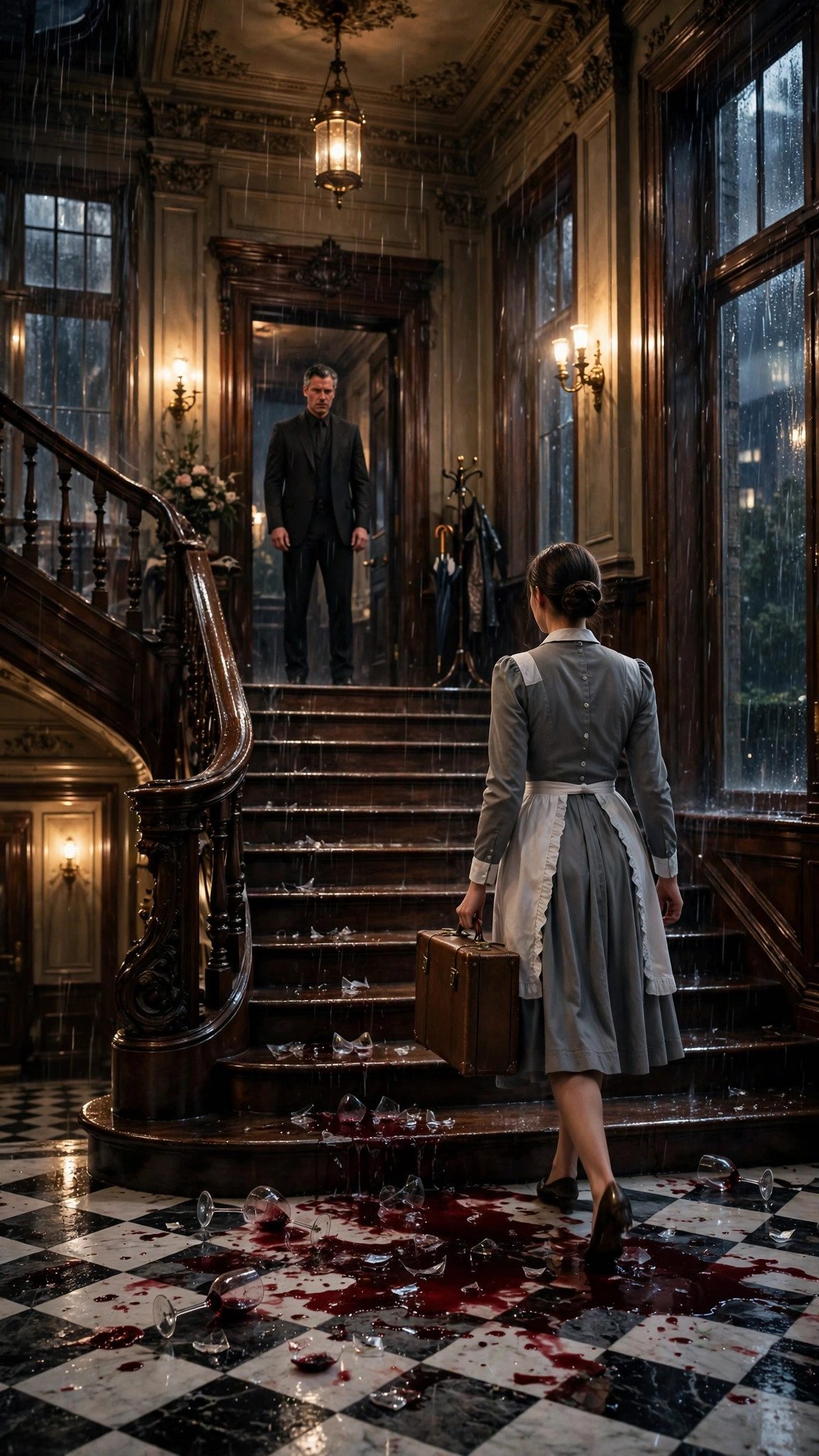
And she went down the old wooden stairs, and the heavy old bell by the front door rang, and the glass of wine fell, and she walked out into the rain, and Gabriel Rossi, who had spent five years not seeing the woman who loved him, finally saw her, and it was too late.
Or so he thought.
In the hospital, six weeks after the doctor had told her, Hazel lay in her bed and listened to the machines, and she thought about the wedding planner's leather notebook, and about Andrea Bellini's cream coat, and about the four hundred guests, and she thought about how she had almost made it. She had almost left quietly. She had almost disappeared without anyone knowing. She had written the note. She had packed the suitcase. She had walked out into the rain.
And then the nurse had called the number on her emergency card, and Gabriel had come running through the rain, and now he was standing in the doorway of her hospital room, soaking wet, and he was looking at her the way he had looked at her in the rose garden five years ago, and she did not know what to do.
"Mr. Rossi," she whispered. "You should not be here."
"Do not call me that," he said, and his voice broke. "Not now. Not here. My name is Gabriel. You have known my name for five years, Hazel. Say it."
She looked at him, and her eyes filled with tears, and she said, very softly, "Gabriel."
And the sound of her own voice saying his name, for the first time in five years, broke something open inside her chest, something she had kept locked away for so long that she had forgotten it was there.
"I am sorry," she whispered. "I did not want you to know. I did not want to be a burden. I am sick, Gabriel. The doctors say the cancer has spread. I left because I could not watch you marry another woman, and because I did not want you to watch me die."
Gabriel came to the side of her bed, and he took her hand, and his hand was warm and rough, and he held it the way he had held it in the rose garden five years ago, gently, as if it might break.
"Listen to me," he said. "I am not marrying Andrea Bellini. I am not marrying anyone. Do you understand me, Hazel? I have spent five years not seeing you, and I will not spend one more day that way. You are not a burden. You are the only person in my life who has ever loved me without wanting anything from me, and I will not let you die alone in a hospital bed. Do you hear me? I will not let you."
And outside the hospital room, in the hallway, a nurse was walking past with a tray, and a doctor was speaking in a low voice on the phone, and the rain was still falling on the city, and none of them knew that in that small room, a mafia boss who had never begged any person for anything in his life was about to beg for the first time.
But before he could speak, the door of the hospital room opened again, and a shadow appeared in the doorway, a man with sharp eyes like a blade, holding a gun, reeking of alcohol, and he pointed the gun at Hazel's bed, and he said, "I was given an order to kill her. And nobody is going to stop me."