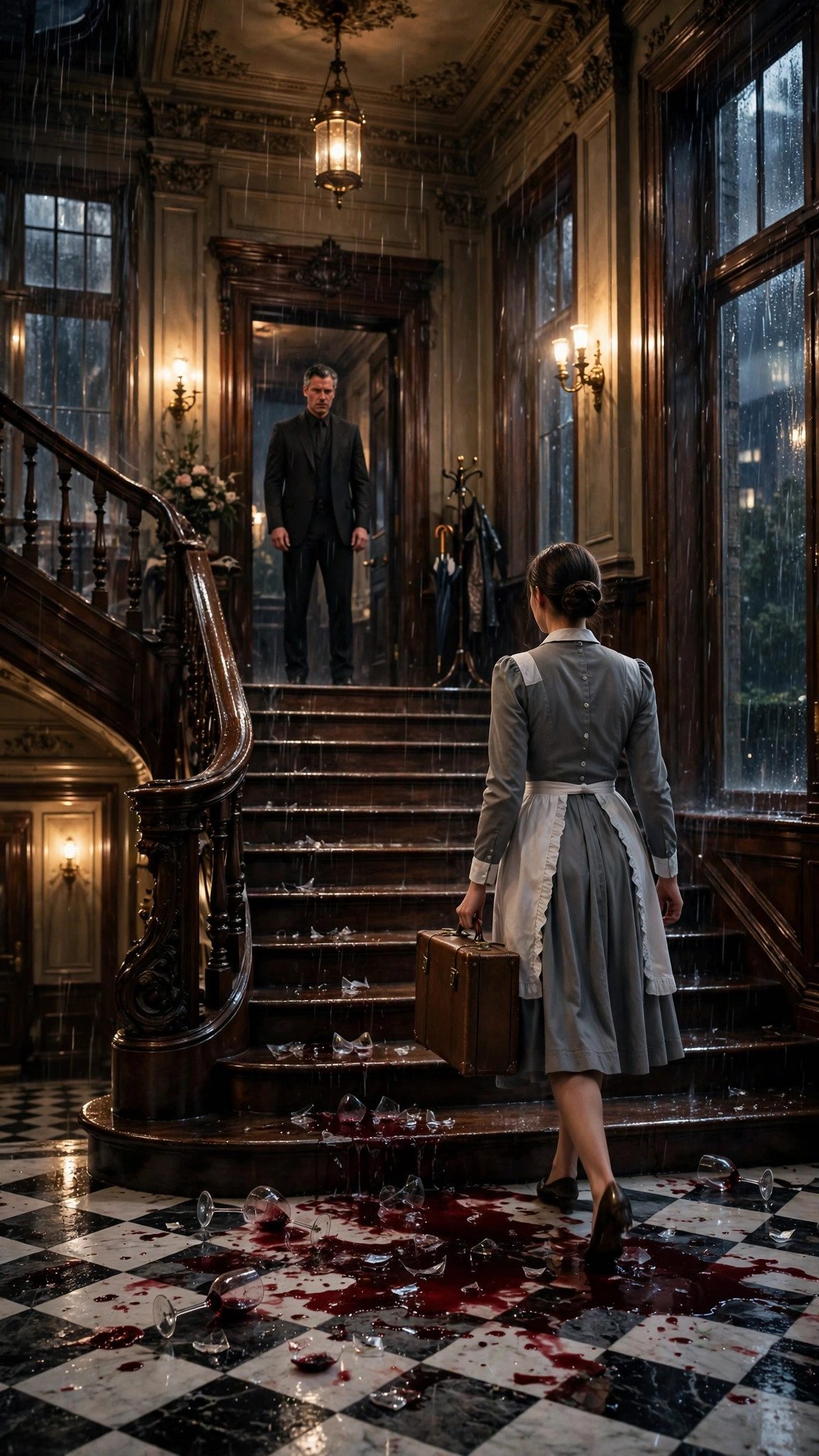
Vittorio Rossi came to the hospital at midnight, and he came the way he always came to places where he did not belong, smiling, unhurried, with two of his men behind him, as if he were arriving at a dinner party and not walking into the ruin of his life.
He had heard about the gunman, of course. Men like Vittorio always hear about everything. Eddie Russo had been picked up by the police two blocks from the hospital, and he had talked, and the talk had traveled, the way talk always travels in their world, fast and unstoppable, and by midnight the whole family knew that Hazel the maid had spoken, and that Gabriel knew, and that the night Angela Rossi died was no longer a closed book.
Gabriel met him in the hallway outside Hazel's room. The FBI agents were already there, standing quietly by the elevators, and Daniel Reyes was there, and the nurses had cleared the corridor, and the only sound was the rain against the windows and the soft beeping of the machines behind Hazel's door.
"Gabriel," Vittorio said, and he smiled his thin smile, the smile that had never reached his eyes. "My boy. I heard about the maid. I heard she is sick. I came to see if there was anything I could do."
"Do not call me your boy," Gabriel said, and his voice was very quiet, and very cold. "And do not pretend you came here for Hazel. You came here to find out what she told me. So let me save you the trouble. She told me everything, Vittorio. She told me about the stairs. She told me about the folder. She told me about the money you were stealing from the docks. She told me about the night you pushed my wife down the stairs and watched her die."
Vittorio's smile did not move. It stayed exactly where it was, thin and practiced, and his eyes stayed calm, and he said, "The maid is sick, Gabriel. She is dying. Dying people say strange things. They dream. They imagine. You cannot believe the word of a dying maid over the word of your own blood."
"I believe her," Gabriel said. "And I have more than her word."
He held out his hand. In his palm, wrapped in a piece of white cloth, was a small gold earring shaped like a rose.
Hazel had given it to him an hour earlier, in the hospital room, with shaking hands, and she had told him where she had found it, on the top step of the old wooden staircase, the morning after Angela died, and she had told him what it meant, and Gabriel had held it in his hand, and he had felt the weight of five years of silence in that one small piece of gold.
"Angela lost this earring the night she died," Gabriel said. "She lost it at the top of the stairs, in the struggle, when you grabbed her. Hazel found it the next morning. She kept it for five years. She kept it because she knew, even then, that one day the truth would matter. And today, Vittorio, the truth matters."
Vittorio looked at the earring. For the first time in the conversation, his smile faltered, just a little, just for a second, and his eyes went to the floor, and then back to Gabriel, and he said, very softly, "You have always been sentimental, Gabriel. Your father was the same. It will be the death of you."
"No," Gabriel said. "It will be the death of you. Because I am not going to kill you, Vittorio. I want you to understand that. I have wanted to kill you since the moment Hazel told me. I have imagined it a hundred times in the last hour. But I am not going to do it. I am going to let the law take you. I am going to let the police arrest you, and I am going to let a jury hear what you did, and I am going to let you spend the rest of your life in a prison cell, thinking about the woman you murdered on those stairs."
Vittorio laughed, a short, sharp laugh. "The law? You are a Rossi, Gabriel. We do not use the law. The law is for other people. We settle our own debts."
"We settled our debts the old way for a hundred years," Gabriel said, "and look where it brought us. My father murdered on the docks. My wife murdered on the stairs. A maid dying in a hospital bed because she was too afraid to tell the truth. No more, Vittorio. It ends tonight. It ends with you."
Daniel Reyes stepped forward then, and he was a tall man with grey hair and tired eyes, and he had been waiting for this moment for a very long time, and he said, "Vittorio Rossi, you are under arrest for the murder of Angela Rossi, and for conspiracy, and for the attempted murder of Hazel Marino. You have the right to remain silent."
Vittorio looked at Reyes. He looked at the FBI agents. He looked at Gabriel. And then he did something Gabriel had never seen him do before. He looked afraid.
"You cannot do this to me," Vittorio said, and his voice was shaking now. "I am the underboss of this family. I built the docks with your father. I made you what you are, Gabriel. Without me, there is no family."
"Without you," Gabriel said, "there is a family. A family that does not murder its own wives on the stairs. A family that does not threaten its maids into silence. A family that my son can be proud of. Take him away, Agent Reyes."
The agents came forward. They put the handcuffs on Vittorio Rossi, and they led him down the hallway, past the nurses and the security guard, past the window where the rain was falling, and Vittorio looked back once, over his shoulder, and he said, "You will regret this, Gabriel. The family will not follow a man who turns his own blood over to the police."
"The family will follow a man who tells the truth," Gabriel said. "And if it does not, then it is not a family worth leading."
In the days that followed, Gabriel learned that he had been right, and that he had been wrong, both at once.
He called a meeting of the capos, the heads of the family, in the dining room of the Rossi house, the same room where Vittorio had spread the wedding contracts across the table, and he told them everything. He told them about Angela. He told them about the stairs. He told them about the money Vittorio had been stealing from the docks for years, the money Angela had found in the folder she had been carrying the night she died, the folder Vittorio had taken from her body and burned. He told them about Hazel, and about the earring, and about Eddie Russo, and about the five thousand dollars.
He expected anger. He expected shouting. He expected half the room to walk out.
Instead, there was silence. And then old Don Enrico, who had known Gabriel's father, who had been at the docks for fifty years, stood up, slowly, and he said, "I have known for five years that Angela did not fall. I have known it in my bones. I did not say it, because I was afraid, and I am ashamed of that fear. But I am not afraid anymore. Gabriel is right. The family that murders its own wives is not a family. It is a curse. And I will follow the man who broke the curse."
One by one, the other capos stood. One by one, they said the same thing. And by the end of the morning, the Rossi family had voted, eleven to one, to stand behind Gabriel, and to turn the docks legitimate, and to cut every tie with the old ways, and to let the law do what the law was meant to do.
The one vote against was cast by a man named Sal Ferraro, who had been Vittorio's closest friend for thirty years, and who left the house that morning without a word, and who was never seen in Chicago again.
Eddie Russo told the police everything. He sat in a small room at the federal building with Agent Reyes, and he talked for six hours, and he told them about the night Angela died, and about the money Vittorio had paid him over the years to keep his mouth shut, and about the men Vittorio had hired to watch Hazel, and about the five thousand dollars for the hospital job, and about the daughter in Ohio, and by the end of it, the agents had enough to charge Vittorio with murder, and with conspiracy, and with the attempted murder of Hazel Marino, and with a dozen counts of fraud and theft from the docks.
"Will I go to prison?" Eddie asked Reyes, at the end of it, and his voice was very small.
"You will testify," Reyes said. "And if you testify truthfully, and if you go to Ohio, and if you never come back to Chicago, the judge will take that into account. I cannot promise you freedom, Eddie. But I can promise you a chance. That is more than Vittorio ever gave anyone."
Eddie nodded. He signed his statement. And the next morning, he got on a bus to Ohio, and he went to see his daughter, and he did not look back.
Three months later, Vittorio Rossi stood in a courtroom in downtown Chicago, and a jury of twelve men and women listened to Hazel's testimony, and to Eddie's testimony, and to the evidence of the stolen money, and to the story of the gold earring, and they found him guilty on every count. The judge sentenced him to life in prison, without the possibility of parole, and Vittorio stood in the dock in his grey suit, and he looked at Gabriel across the courtroom, and he said nothing at all, and the guards led him away, and Gabriel watched him go, and he felt no triumph, and no joy, only a great, quiet sadness, for the uncle he had once loved, and for the wife he had lost, and for the five years that could never be given back.
When they were gone, Gabriel stood alone in the hallway for a long time, listening to the rain, and thinking about the stairs. The old wooden stairs in his house, the stairs that had creaked under his feet that morning, and under Hazel's feet that night, and under Angela's feet five years ago, on the last night of her life. He thought about how much those stairs had seen, and how much they remembered, and he thought about how he was going to tear them out, every last board, and burn them, and build new stairs, stairs that had never known a murder, stairs that his son could run down in the morning without the house remembering.
He went back into Hazel's room. She was awake, and Sebastian was asleep in the chair beside her bed, and Rosa was dozing on the bench by the window, and the machines were beeping softly, and the room was warm and quiet.
"It is done," Gabriel said, very gently, and he sat down beside her bed, and he took her hand. "Vittorio has been arrested. He will never hurt you again. He will never hurt anyone again."
Hazel looked at him, and her eyes were full of tears, and she said, "I was so afraid, Gabriel. For five years, I was so afraid. And now it is over, and I do not know how to feel."
"Feel safe," Gabriel said. "That is all you have to feel. Safe. You are safe now, Hazel. I promise you. No one will ever threaten you again. No one will ever make you afraid again. Not while I am alive."
She nodded, and she closed her eyes, and she slept, and Gabriel sat beside her bed all night, holding her hand, watching the machines, listening to the rain, and thinking about the morning, and about what he was going to do when the sun came up.
In the morning, Andrea Bellini came to the hospital. She came alone, without her driver, without her handbag, in a plain grey coat, and she asked the nurse for Hazel's room, and she stood in the doorway for a moment, looking at the sleeping woman in the bed, and at Gabriel sitting beside her, and she understood, finally and completely, that she had never had a chance, and that she had never really wanted one, because a marriage made of contracts and warehouses was not a marriage at all.
"Gabriel," she said, very quietly. "I came to tell you that I have spoken to my father. The engagement is over. The alliance is over. There will be no wedding, and there will be no hard feelings. My father understands. He has seen the way you look at her. Everyone has seen it. Everyone except you."
Gabriel stood up. He went to the door. He looked at Andrea, this beautiful, expensive woman who had been chosen for him by his family, and he said, "I am sorry, Andrea. I truly am. You deserved better than a man who was already in love with someone else."
"You did not choose me," Andrea said, and she smiled, a real smile this time, the first real smile Gabriel had ever seen on her face. "And that is all right. I did not choose you either, Gabriel. My family chose you. And now I am free to choose for myself, for the first time in my life. So thank you. Thank you for being honest with me. And take care of her. She is the bravest woman I have ever met."
She turned, and she walked down the hallway, and Gabriel watched her go, and he thought about how strange it was that the end of his engagement felt like the beginning of his life.
He went back into the room. Hazel was awake. Sebastian was awake. The sun was coming up outside the window, pale and gold, and the rain had stopped, and the city was shining, and Gabriel Rossi, who had spent five years not seeing the woman who loved him, looked at her, and he said, "Hazel. I have something to ask you. And this time, I am going to ask it properly, in the daylight, with no guns and no secrets between us."
He knelt beside her bed. He took her hand. And he said, "Will you marry me?"