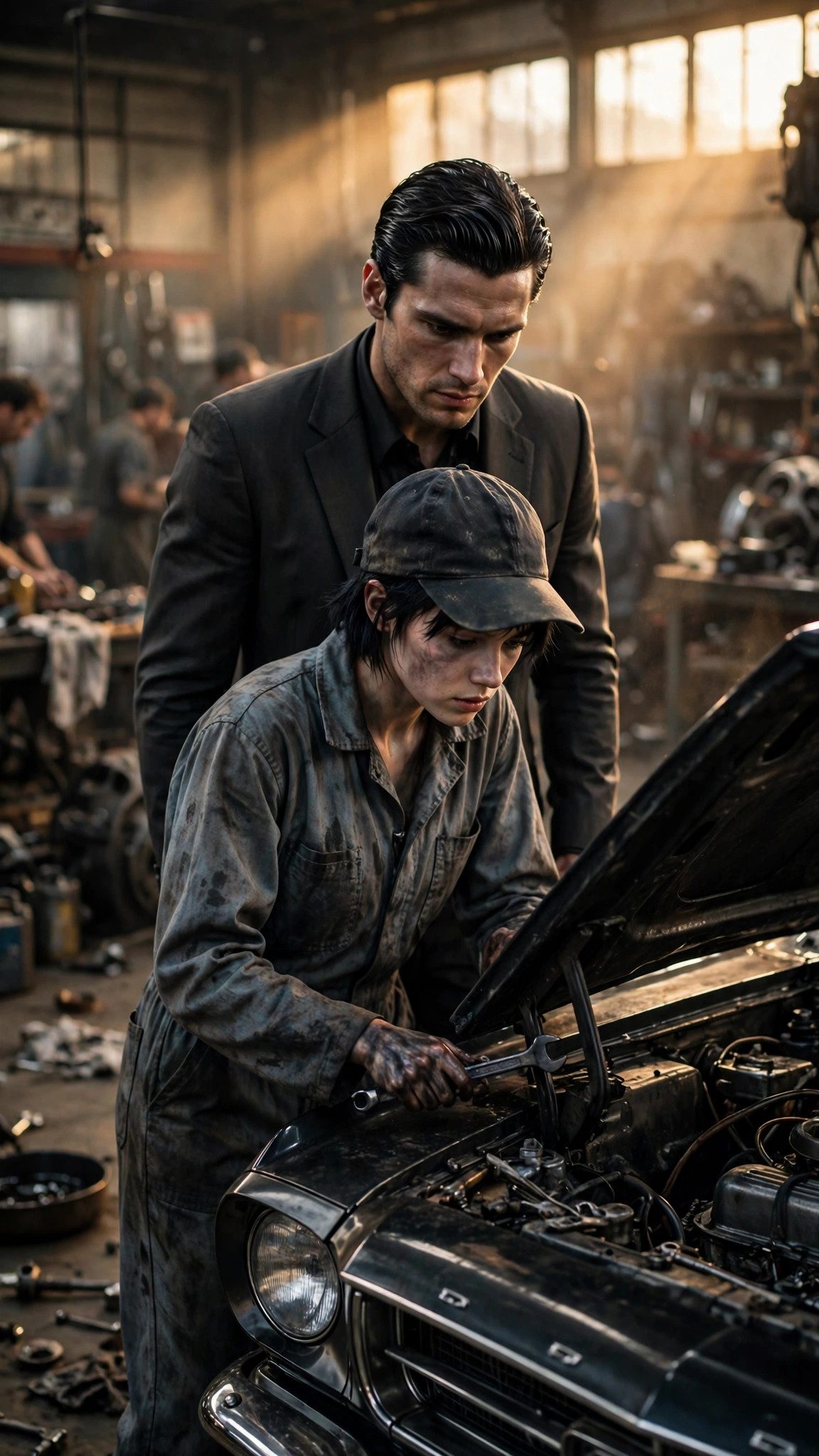
The second time Dante Moretti asked me to come to his office at six, I thought he was going to fire me.
I had spent the whole day waiting for it. The investigator had come to the shop. He had looked at me. He had left a card. And I knew that Dante Moretti did not miss things like that. He had been watching me for weeks, and he had seen the investigator, and he had put the pieces together, and now he was going to ask me the question I had been dreading for seven months.
Instead, he poured two glasses of whiskey, pushed one across the desk toward me, and said, "Sit down, Eli. I want to tell you something."
I sat down. I did not touch the whiskey. Eli Ross did not drink whiskey with the boss. Eli Ross did not drink whiskey with anyone.
"My father bought that Mustang in 1967," Dante said, looking out the window at the garage below. "He was twenty-four years old, and he had just come to America from Sicily with nothing but a suitcase and a name nobody in Chicago had ever heard. He worked in a garage, like this one. He fixed cars. He saved every dollar. And when he had enough, he bought that Mustang, brand new, off the lot. He drove it for forty years."
He was quiet for a moment.
"My father taught me two things," he said. "The first was that a man is only as good as his word. The second was that you never lie to the people who trust you with their lives. He said those were the only two rules that mattered, and everything else was just noise."
He turned his chair around and looked at me.
"I broke the first rule once," he said. "When I was twenty-two, I made a promise to a man I had no business making a promise to, and when it came time to keep it, I couldn't. A good man died because of it. I have carried that with me for sixteen years, and I will carry it for the rest of my life. That is why I do not lie. That is why I do not let the people around me lie. Because I know what a lie costs."
I swallowed. "Why are you telling me this, sir?"
"Because I want you to understand something," he said. "I know you are lying to me, Eli. I have known since the day you fixed the Mustang. And I have not thrown you out, because the work you do is honest, even if the name you do it under is not. But I need to know what I am protecting. Because that is what I am doing, whether you understand it or not. I am protecting you. And I do not protect people I do not understand."
My hands were shaking. I put them under the desk where he could not see them.
"I'm not a criminal, sir," I said. "I haven't stolen anything. I haven't hurt anyone. I'm just —" I stopped. "I'm just a girl who didn't want to marry a man who frightened her. That's all."
Dante was very still. "A girl," he said. Not a question. A statement. As if he had already known, and was simply waiting for me to say it out loud.
I nodded. I could not speak. Seven months of holding it in, and now it was out, and the whole world felt like it was tilting sideways.
"How old are you?" he asked.
"Twenty-five."
"And the man? Marcus Bellamy. How old is he?"
"Forty-six."
"And your father arranged it."
"Yes."
"Why?"
"Because Marcus owns trucking companies and warehouses and restaurants, and my father owns construction and politics, and together they would own more of Chicago than either of them could own alone." I took a breath. "I was the price. I was always the price."
Dante was quiet for a long time. Then he stood up and walked to the window again, and he stood there with his hands behind his back, looking out at the garage, and I sat in his office with my heart hammering, and I waited for him to tell me to leave.
"You know what my father used to say about the Mustang?" he asked, without turning around. "He said a car will tell you the truth about the man who owns it. If he takes care of it, it runs clean. If he neglects it, it falls apart. He said you can learn everything you need to know about a man by listening to his engine."
He turned around.
"I have been listening to you for seven months, Eli. And your engine runs clean. You show up on time. You do the work right. You don't steal. You don't cause trouble. You fix things nobody else can fix. That tells me everything I need to know about who you are — whatever your name is."
"My name is Elena," I said. "Elena Russo."
"Elena," he said, and the way he said it — slow, careful, like he was trying it on — made something in my chest ache. Nobody had said my real name in seven months. Nobody had said it like it belonged to me.
"Elena Russo," he said again. "Well, Elena. You can keep working here. But from now on, there will be no more lies between us. If Marcus Bellamy's men come back, you tell me. If your father comes looking, you tell me. If anything changes, you tell me. Do you understand?"
"Yes, sir."
"And one more thing." He walked back to his desk and sat down, and his eyes found my face, and he held my gaze, and he did not look away. "I don't want you to be afraid in my shop. Fear makes people careless. Careless people make mistakes. And mistakes get people killed. So whatever you are afraid of, you bring it to me, and we will deal with it together. Is that clear?"
"Yes, sir," I said, and my voice broke a little on the last word, and I hated that it broke, because Eli Ross never let his voice break, but Elena Russo had been holding hers together for seven months, and it was getting harder every day.
I left his office that night and walked down the metal stairs, and the garage was empty and dark, and I stood in the middle of it, surrounded by cars I had fixed and engines I had saved, and I realized something that frightened me more than Marcus Bellamy ever had.
I was starting to trust Dante Moretti.
It was a terrible thing to realize, because trust was the most dangerous thing a person in my position could feel. Trust meant letting someone close. Trust meant giving someone the power to hurt you. And Dante Moretti was the most dangerous man in Chicago, and he had just told me he was protecting me, and some part of me believed him.
I went back to my room above the laundromat, and I sat on my mattress, and I took Michael's tool roll out of my duffel bag, and I opened it, and I looked at his wrenches, and I thought about what he would say if he were here.
He would say: "Listen. The engine tells you what's wrong."
And I listened. I listened to my own heart, hammering in my chest, and I listened to the fear, and the hope, and the guilt, all tangled together, and I tried to figure out what was wrong.
What was wrong was that I was lying to the one man who had ever told me the truth about himself. Dante Moretti had told me about his father, and the Mustang, and the promise he had broken, and the man who had died because of it. He had shown me something real. And I had shown him almost nothing.
What was wrong was that I wanted to tell him everything. I wanted to tell him about the night I cut my hair, and the laundry-room window, and the $684, and the bus to the West Side. I wanted to tell him about Michael, and my mother, and the father who had sold me to Marcus Bellamy for trucking routes and warehouse contracts. I wanted to tell him all of it, and I wanted him to look at me the way he had looked at me in the garage — like he had finally seen me — and not look away.
But I could not. Not yet. Because the moment Dante Moretti knew everything, the moment he knew who Elena Russo really was, he would have to choose what to do about it. And men like Dante Moretti did not make choices lightly. And whatever choice he made, it would change everything.
So I kept working. I kept fixing his cars. I kept my head down, even though he had told me I did not have to be afraid, and even though some part of me wanted to believe him. I fixed the Lamborghini. I fixed the armored SUV. I fixed a vintage Ferrari that had not run in eleven years, and when the engine finally turned over, Dante was standing behind me, and he put his hand on my shoulder — just for a second, just a brief, warm weight — and he said, "Good work, Elena."
He said my name. My real name. In front of the whole garage.
And nobody in that garage said a word, because nobody in that garage was stupid enough to ask Dante Moretti why he had just called his quiet young mechanic by a woman's name.
But Tony Mercer looked at me, and his eyes were wide, and I saw him put the pieces together — the cap, the silence, the showers I never took, the hands that were too small, the voice that was too careful — and I saw the moment he understood.
He did not say anything. He just nodded, once, slowly, and he went back to work.
The test drive happened on a Wednesday, three days after Dante called me Elena for the first time in front of the whole garage. The Mustang was finished — the vacuum line replaced, the engine tuned, the oil changed — and Dante came down to the floor in the late afternoon, and he stood beside the car, and he said, "Come with me, Elena. I want to hear it on the road."
I had never been in a car with Dante Moretti before. I had never been anywhere with him except his office and the garage floor. I got into the passenger seat, and he got behind the wheel, and he turned the key, and the engine came alive — smooth, deep, no hesitation, no cough — and he smiled, just a little, and he pulled out of the garage and onto the street, and we drove.
We drove west, out of the city, toward the lake, and the sun was going down, and the Mustang ate the road like it had been waiting sixteen years to run free. Dante did not speak for a long time. He just drove, with one hand on the wheel, listening to the engine the way I listened to engines — the way Michael had taught me to listen.
"My father drove this car to my mother's funeral," he said finally, without looking at me. "Forty years old, and he drove it himself, because he said she would have wanted it that way. She loved this car. She used to say it was the only thing he owned that had never lied to him."
"Is that true?" I asked. "That a car never lies?"
"A car can't lie," he said. "It can break. It can fail. But it can't pretend to be something it's not. People do that. Cars don't."
We drove in silence for a while after that, and I watched the city slide past the window, and I thought about the night I had cut my hair, and the laundry-room window, and the $684, and how far I had come from that night — from a girl who was afraid of her own shadow to a woman sitting in a 1967 Mustang beside the most dangerous man in Chicago, talking about his father, and not being afraid at all.
"Thank you," I said, finally. "For fixing — for letting me fix it. For trusting me with it."
He glanced at me, just for a second, and then he looked back at the road. "You earned it, Elena," he said. "Nobody gives you anything in this world. You earn it, or you don't have it. Remember that."
"I will," I said, and I meant it.
When we got back to the shop, Tony was waiting by the steel door, and he looked at the Mustang, and he looked at me getting out of the passenger seat, and he looked at Dante, and he did not say a word. He just nodded, once, slowly, the way he had nodded the day Dante called me Elena in front of everyone.
Later that week, Tony told me something else, when we were alone in the shop after closing, putting tools away. He told me about the day Salvatore Moretti died, and how Dante had taken over the family business at twenty-two, and how the older men — the capos, the lieutenants, the men who had worked for his father for decades — had looked at this twenty-two-year-old boy and decided he was too young, too soft, too much like his mother.
"They tested him," Tony said, wiping down a workbench. "One of them — I won't say his name — he skimmed money from the docks. Thought the kid wouldn't notice. Dante noticed in three days. He called the man into his office, and he laid the numbers out on the desk, and he gave him a choice: pay it back, every dollar, and leave Chicago, or face the family. The man paid it back. He left that night. And after that, nobody tested Dante Moretti again."
"Why are you telling me this?" I asked.
"Because I want you to understand who you're dealing with," Tony said. "Dante Moretti is not a cruel man. But he is not a soft man, either. He notices things. He remembers things. And when he decides something, it stays decided. So if he has decided to protect you, Elena — and I think he has — then you are safer than you have ever been in your life. But don't mistake his protection for permission to lie to him again. He will not forgive that twice."
"I won't," I said. "I promise."
Tony nodded, and he picked up his lunchbox, and he walked to the door, and before he went out, he turned back and said, "Your brother would be proud of you, kid. The way you fixed that Mustang. He'd be proud."
I stood in the empty garage after he left, with tears running down my face, and I did not wipe them away, because there was nobody there to see them, and because for the first time in four years, someone had said Michael's name like he was a person who mattered, and not just a memory I carried alone.
That night, I lay awake on my mattress, staring at the water stain on the ceiling, and I thought about Dante Moretti's father, and the Mustang, and the two rules that mattered. A man is only as good as his word. You never lie to the people who trust you with their lives.
I had broken both rules, every day, for seven months.
And Dante Moretti had looked at me anyway, and he had said my name, and he had not looked away.
I did not know what that meant. But I knew it meant something. And I knew that whatever happened next, I would not be invisible anymore.
I just didn't know whether that was going to save me — or destroy me.