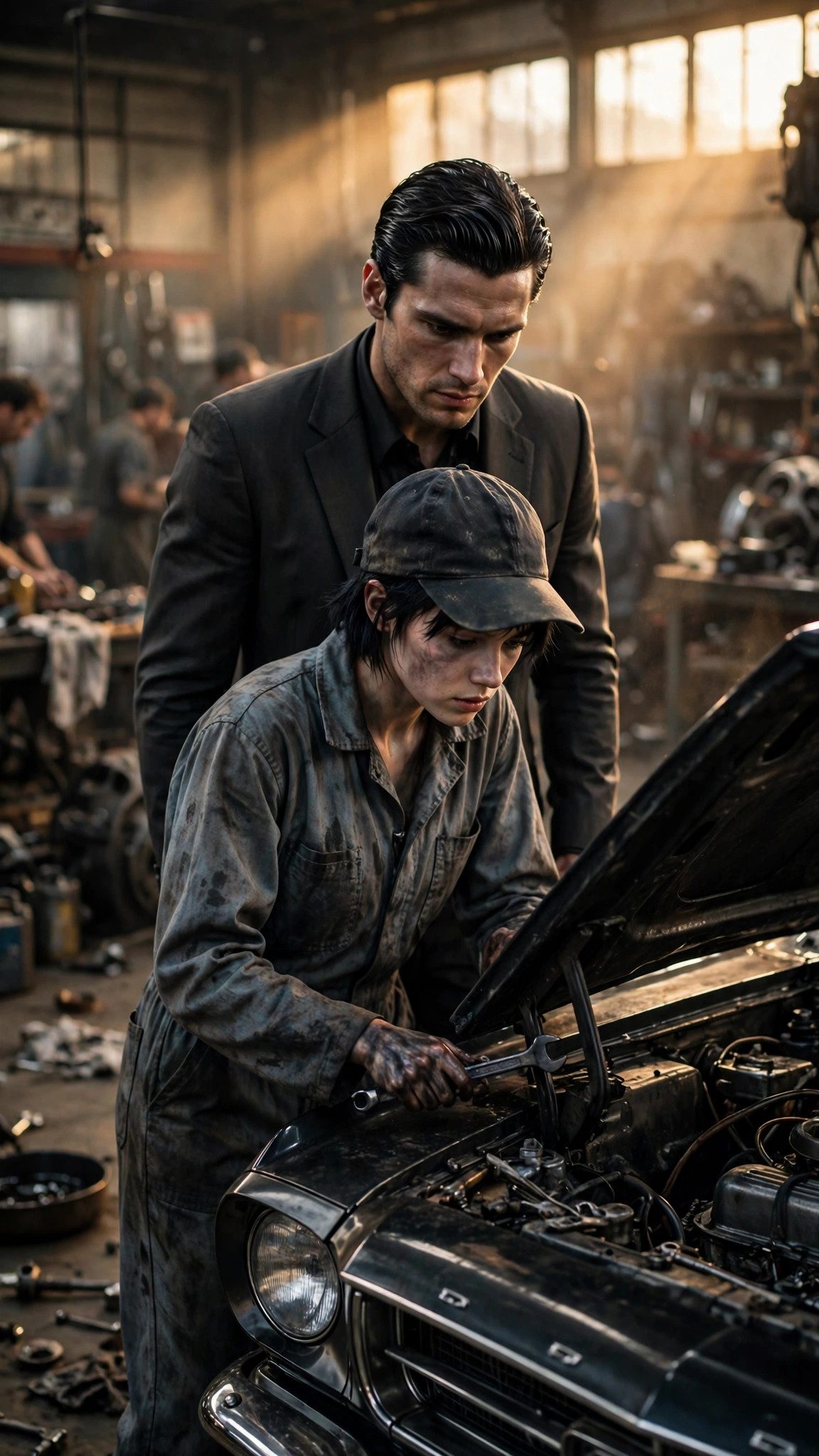
The black 1967 Mustang belonged to Dante Moretti the way a man's hands belong to him — it was not a car, it was a part of him, and everyone in the shop knew it.
It had come into the garage on a Tuesday morning, towed in on a flatbed, and Tony had stood in front of it with his arms crossed for a full minute before he said a word.
"That's Mr. Moretti's car," he told us. "His father's car, actually. His father bought it new in 1967 and drove it until the day he died, and Mr. Moretti has kept it running ever since. It does not leave this shop until it runs perfect. Not good. Perfect. Understand?"
We understood. For three days, the Mustang sat in bay four, and one mechanic after another tried to find out why it was misfiring, and one after another, they failed.
Ray tried first. He replaced the spark plugs, the wires, the distributor cap, and the fuel filter, and the engine still hesitated every time it turned over. Eddie tried next. He cleaned the carburetor, checked the timing, replaced the ignition coil, and the engine still stumbled, just for a fraction of a second, like a man catching his breath before a lie.
Tony tried last. He spent a whole afternoon under the hood, and when he came out, his face was gray, and he wiped his hands on a rag and shook his head.
"I don't know what's wrong with it," he said, and that was the first time I had ever heard Tony Mercer say those words. "I've been fixing engines for thirty years, and I don't know what's wrong with this one."
I was working ten feet away, on a pickup truck with a bad transmission, and I was not supposed to be listening. Eli Ross did not listen. Eli Ross kept his head down and his hands busy. But I had been listening anyway, because the Mustang's engine had been turning over all morning, and every time it did, I heard something the other mechanics had missed.
It was not a misfire. Not exactly. It was a hesitation, so small you could miss it if you were not listening for it — a tiny pause hidden beneath the growl of the engine, like a heartbeat skipping once and then catching itself. I had heard that sound before. Michael had taught me that sound, years ago, on a summer afternoon in our father's garage, when a customer's old Ford kept stalling and nobody could figure out why.
"Listen," Michael had said, putting his hand on my shoulder. "It's not the spark. It's not the fuel. It's air. Something's letting air in where it shouldn't. A vacuum line. Probably cracked. Probably old. Find the crack, and you find the problem."
I stood at my bench with a wrench in my hand, and I listened to the Mustang turn over again, and I heard it — the hesitation, the tiny gasp of air where it did not belong — and before I could stop myself, before Eli Ross could remind me to keep my mouth shut, I said, "Again."
Tony frowned. "What?"
"Start it again."
He stared at me. The whole garage stared at me. I had never spoken to Tony like that. I had never spoken to anyone in that shop like that. Eli Ross did not give orders. Eli Ross did not tell the shop manager what to do.
But the words were already out, and I could not take them back, so I put down my wrench and I walked over to the Mustang, and I said, "Start it again. Please."
Tony looked at me for a long moment, and then he nodded at Ray, and Ray turned the key, and the engine growled, and there it was — the hesitation, the tiny gasp, the crack in the vacuum line letting air in where it should not be.
"Eleven minutes," I said, and I went to work.
It took me eleven minutes to find it. A hairline fracture in an old vacuum line, buried under the intake assembly, so fine you could miss it if you blinked. I pulled the line out, held it up to the light, and showed Tony the crack.
"Well, I'll be damned," he said.
A smile escaped me before I could stop it. That was my mistake. Eli Ross never smiled. Eli Ross kept his head down and his mouth shut and his hands busy, and Eli Ross never, ever smiled at his own work in front of the boss.
The garage went silent. Heavy footsteps crossed the concrete behind me, slow and deliberate, and every mechanic suddenly found something else to look at. Tony's expression changed first, and the blood drained from my face before I even turned around.
Dante Moretti was standing directly behind me. And for the first time in seven months, the most dangerous man in Chicago was looking at Eli Ross like he had finally seen me.
I already told you what happened next. He asked me my name. He told me to come to his office at six. I told him the truth — the first piece of it — about the man who wanted to marry me. I told him his name.
Marcus Bellamy.
Dante Moretti stared at me for a long time after I said it, and his face did not change, and that frightened me more than anger would have. Anger I understood. Anger was honest. This was something else. This was a man filing a name away in a place where names went to be dealt with.
"How long has he been looking for you?" he asked.
"Seven months," I said. "Since the night I left."
"And your father?"
"My father arranged the marriage," I said. "He thinks Marcus is good for the family. He thinks I am ungrateful."
"Are you?"
"No," I said. "I am twenty-five years old, and Marcus Bellamy is forty-six, and he grabbed my wrist under a dinner table and told me I would learn to stop saying no to him. I am not ungrateful. I am afraid."
Dante was quiet for a moment. Then he stood up from his desk and walked to the window, and he looked out at the garage below, at the men working under the cars, at the Mustang sitting in bay four with its hood open.
"Do you know what I do, Eli?" he asked, without turning around.
"I know you own this shop," I said.
"I own more than this shop," he said. "I own a great deal of Chicago. And I have built everything I own on one rule: nobody lies to me. Not my men. Not my enemies. Not the people who work under my roof."
"I understand, sir."
"Do you?" He turned around. "Because you have been lying to me for seven months. Every day. Every hour. And I want to know why I should let you keep working here."
My throat closed up. I had rehearsed this moment a hundred times, lying awake on the thin mattress above the laundromat, and in every version I had a better answer than the one I had now, which was no answer at all.
"I fix your cars," I said finally, and my voice was barely above a whisper. "I fix them well. Nobody else could fix the Mustang. I did. That is the truth. Everything else —" I stopped. "Everything else is the lie I had to tell to stay alive."
He looked at me for a long time. Then he sat back down behind his desk, and he folded his hands, and he said, "Come back tomorrow at six. We will talk again."
"Yes, sir."
"And Eli —" He paused. "From now on, you work on the cars I bring in personally. Not the walk-ins. Not the regulars. My cars. Understand?"
"Yes, sir."
I walked out of his office on legs that did not feel like mine, and I went down the metal stairs, and I went back to my bench, and I worked until the shop closed, and I did not speak to anyone, and nobody spoke to me.
That night, I lay awake on my mattress above the laundromat, staring at the water stain on the ceiling, and I thought about what had just happened. Dante Moretti knew I was hiding. He knew I was lying. And instead of throwing me out — instead of doing what a man like him was supposed to do — he had given me his cars. He had moved me closer, not further away.
I did not know what that meant. I did not know if it meant he was curious, or suspicious, or if he had already decided what to do with me and was simply waiting for the right moment. All I knew was that the invisible days were over. Dante Moretti had finally seen me, and there was no going back to being unseen.
The next morning, I came to work at six, and Tony was waiting for me at my bench with a set of keys in his hand.
"Mr. Moretti wants you on the Ferrari," he said. "The red one. It came in last night. He says it's yours."
"The Ferrari?" I stared at him. "Tony, I've never worked on a Ferrari."
"You fixed the Mustang," Tony said. "That's all he needs to know. Go."
The Ferrari was a 1988 Testarossa, red as blood, with an engine that purred like a sleeping animal when it ran and coughed like a dying one when it didn't. It took me two hours to find the problem — a failing fuel pump, starving the engine at high revs — and when I was done, the engine sang, and I stood there with my hands on my hips, and I felt something I had not felt in seven months: pride. Not the pride of Elena Russo, the obedient daughter, who had never been allowed to be proud of anything. The pride of a mechanic who had fixed something hard, and fixed it well, and knew it.
Dante came down to the floor that afternoon, and he walked over to the Ferrari, and he stood beside me, and he did not say anything for a long time. Then he said, "Start it."
I started it. The engine turned over clean, no hesitation, no cough, just a smooth, deep growl that filled the whole garage. Dante listened with his eyes closed, the way a man listens to music, and then he opened his eyes, and he looked at me, and he nodded once.
"Good," he said. "Tomorrow, the Lamborghini."
And that was how it went, day after day, week after week. The Mustang. The Ferrari. The Lamborghini. The armored SUV with the bulletproof glass. Each car harder than the last, each one a test, and I passed every test, because engines did not lie, and I did not lie to engines. I gave them everything I had, and they gave me the only thing I had left: a reason to get up in the morning.
But Dante was watching me now, and I knew it. I could feel his eyes on me when he walked the floor. I could feel him studying my hands, my face, the way I moved. He was looking for the lie, and he was patient, and he was thorough, and I knew that sooner or later, he was going to find it.
There was one afternoon, about two weeks after the Mustang, when Dante came down to the floor while I was working on the Ferrari, and he stood beside me for a long time without saying anything, and then he asked me a question no one in that shop had ever asked me before.
"Where did you learn to do this?" he said. "Not the basics. Anybody can learn the basics. I mean the listening. The way you hear things other mechanics miss. Where did you learn that?"
I kept my eyes on the engine. "My brother taught me," I said, and it was the first time I had said the word "brother" out loud in seven months, and it hurt more than I expected it to. "He died four years ago. A drunk driver. On the Kennedy."
Dante was quiet for a moment. "I'm sorry," he said, and he said it like he meant it, like it was not just something people said when they did not know what else to say.
"He taught me everything," I said. "He said an engine tells you what's wrong if you know how to listen. He said most people don't listen. They guess. And guessing is how you break things worse."
"He was right," Dante said. "Most people don't listen. Not to engines. Not to anything."
He stood there for a moment longer, and then he nodded, once, and he walked away, and I went back to work, and my hands were shaking, and I did not know why. It was just a question. It was just a few words. But nobody had asked me about Michael in four years, and nobody had ever listened to the answer the way Dante Moretti listened — like every word mattered, like he was filing it away somewhere safe.
What I did not know was that someone else was looking for me too — and they were closer than I thought.
It was a Thursday, three weeks after the Mustang, and I was working on a Bentley in bay two when a black car pulled up outside the shop, and a man got out who did not belong there. He was not a mechanic. He was not a customer. He was wearing a suit that cost more than my room above the laundromat, and he had the flat, bored eyes of a man who was paid to find people who did not want to be found.
He walked into the shop, and he looked around, and his eyes passed over me once, and then came back, and stopped.
"I'm looking for someone," he said to Tony. "A young woman. Twenty-five. Black hair. About five foot six. She disappeared from Lake Forest seven months ago. Her family is very worried about her."
My hands went still on the engine. My heart was beating so hard I was sure everyone in the garage could hear it.
Tony frowned. "We don't have any women working here, pal. Just mechanics."
The man smiled, and it was not a kind smile. "Are you sure about that? Because I've been to twelve garages this month, and this is the first one where somebody got very quiet when I walked in."
He looked straight at me. And I looked straight back at him, and I kept my face blank, and I kept my voice low, and I said, "I don't know any woman, sir. I'm just a mechanic."
He studied me for a long moment. Then he nodded, slowly, and he handed Tony a card.
"If you see her," he said, "call this number. There's a reward. A large one."
He walked out, and the garage exhaled, and Tony looked at me, and I looked at Tony, and neither of us said a word.
But that night, when I got back to my room above the laundromat, I packed my duffel bag. Just in case. Because Marcus Bellamy's men had found Moretti Motorworks, and that meant they were close, and close was too close, and I had to be ready to run again.
I did not run that night. I stayed, because running meant giving up the only safe place I had ever had, and because Dante Moretti had finally seen me, and some part of me — the part I did not want to name — did not want to disappear again.
But I slept with my shoes on, and my duffel bag by the door, and Michael's tool roll under my pillow, and I dreamed about engines that would not start, and men in suits who knew my name, and a black Mustang that kept misfiring no matter how many times I fixed it.