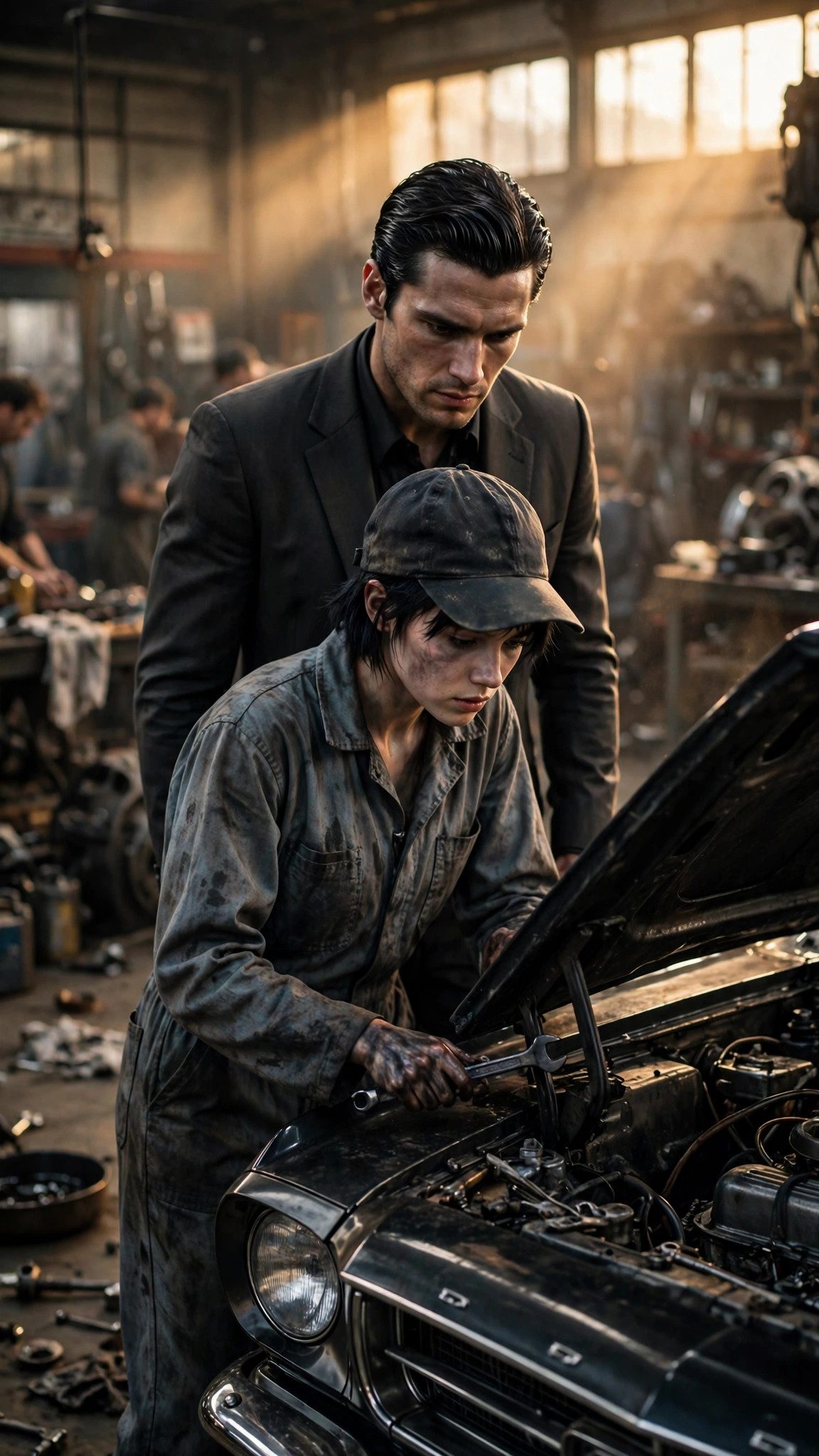
The morning after Marcus Bellamy walked into my shop, Dante Moretti called a man I had never heard of, and by noon, that man was sitting in Dante's office, drinking coffee out of a paper cup, and looking at me like I was the most interesting thing he had seen all week.
"Agent Daniel Reyes," Dante said. "FBI. Organized crime. He has been building a case against Marcus Bellamy for two years, and he has been getting nowhere, because nobody who knows anything about Marcus Bellamy is willing to talk."
Agent Reyes was in his forties, with gray at his temples and tired eyes, and he looked like a man who had spent a very long time waiting for someone to tell him the truth.
"Miss Russo," he said, "I want you to understand something before we start. Everything you tell me today is voluntary. You can stop at any time. You can leave at any time. And nothing you say here will be used against you. I am not interested in you. I am interested in Marcus Bellamy, and in the men who protect him. Do you understand?"
"Yes," I said.
"Good. Then let's start at the beginning. Tell me about the dinner."
So I told him. I told him about the dinner table, and Marcus's hand on my wrist, and the whisper in my ear. I told him about my father's silence. I told him about the three refusals, and the wedding that had been arranged without my consent, and the night I cut my hair, and the laundry-room window, and the $684, and the bus to the West Side. I told him about Michael's tool roll, and the room above the laundromat, and the seven months I had spent as Eli Ross, fixing engines in Dante Moretti's garage.
Agent Reyes listened without interrupting, and he took notes, and every so often he asked a question — a date, a name, a place — and I answered, and the more I talked, the easier it got, like a door opening a little wider with every word.
When I was finished, he put down his pen, and he looked at me, and he said, "Miss Russo, do you know what Marcus Bellamy's trucking companies actually move?"
"No," I said. "I know he owns them. I don't know what they carry."
"They carry whatever pays," Reyes said. "Stolen goods. Untaxed cigarettes. Weapons, sometimes. And for the last three years, they have been carrying something else — fentanyl, coming up from Mexico through Texas, hidden in legitimate shipments, distributed through warehouses that Marcus owns. We have known it for two years. We have never been able to prove it, because every driver who might have talked has either disappeared or changed his story."
He leaned forward.
"But you are not a driver, Miss Russo. You are his intended wife. You sat at his dinner table. You were inside his house. You heard things. And more importantly, your father —" He paused. "Your father is a city alderman with connections to the zoning board, the building permits office, and the police department's licensing division. Marcus Bellamy's warehouses did not get their permits by accident. Somebody signed for them. Somebody looked the other way. And I think you know who that somebody was."
I did know. I had always known. My father had spent twenty-five years telling me that politics was about relationships, and that relationships were about favors, and that favors were about family. I had never understood what he meant until now. He meant that he had traded his daughter for warehouse permits and trucking contracts, and he had called it love.
"I will testify," I said. "I will tell the truth about everything I saw and heard. But I want something in return."
"What?" Reyes asked.
"I want my father to have a chance to do the right thing," I said. "Before you arrest him. I want to talk to him first. Alone."
Reyes looked at Dante. Dante looked at me. And then Dante nodded, slowly.
"That can be arranged," Reyes said.
It was arranged for the next day, at noon, in Dante's office. My father came alone, in a black car, and he walked up the metal stairs with his shoulders hunched, and he looked smaller than I remembered. Smaller, and older, and more frightened than I had ever seen him.
He sat down across from me, and he looked at my short hair, and my coveralls, and my grease-stained hands, and his face crumpled.
"Elena," he said. "My God. What have you done to yourself?"
"I saved myself," I said. "That is what I did."
He was quiet for a long time. Then he said, "Your mother would be ashamed of you."
"No," I said, and my voice was steady, and I was surprised by how steady it was, because I had waited seven months to say this, and now it was finally coming out. "My mother would be ashamed of you. She told me once, on the last good day before she got sick, that a woman's life belonged to her, and nobody else had the right to spend it. Do you remember that, Father? Do you remember the day she said that? Because I do. I remember every word."
His eyes filled with tears. "I was trying to protect this family," he said. "Marcus Bellamy is a powerful man. If I had refused him, he would have destroyed us. The construction contracts. The political connections. Everything your grandfather built. Everything I built. I did what I had to do."
"You sold me," I said. "You heard him grab my wrist at your own dinner table, and you said nothing. You watched him whisper in my ear, and you said nothing. You arranged my wedding to a man who frightened me, and you said nothing. You did not protect this family, Father. You protected yourself."
He put his face in his hands, and his shoulders shook, and for a moment he looked like a man who had finally understood what he had done.
"I am going to give you a choice," I said, "because nobody ever gave me one. Agent Reyes is going to arrest Marcus Bellamy. He is going to arrest the men who work for him. And he is going to come for you, too, because you signed the permits and you took the favors and you looked the other way. But if you cooperate — if you tell the truth about everything, about the permits, about the contracts, about Marcus — then maybe, just maybe, you will not spend the rest of your life in prison. That is your choice, Father. Not mine. Yours."
He looked up at me, and his face was wet, and he said, "Why are you doing this? After everything, why are you giving me a chance?"
"Because I am not you," I said. "And because my mother raised me better than that."
He nodded, slowly, and he wiped his eyes, and he said, "I'll do it. I'll tell them everything."
Agent Reyes came in then, and my father went with him, and I stood at the window of Dante's office, watching them walk out to the black car, and I felt something I had not felt in a very long time: not relief, exactly, and not happiness, but something quieter. Something like the end of a long, loud noise. Something like silence, after seven months of holding my breath.
Before the raid, there were two days of waiting, and waiting was the hardest part. Agent Reyes interviewed Tony and Ray as witnesses — they had seen Marcus in the shop, they had heard the threats — and both men told the truth, plainly and without embellishment, the way mechanics talk about engines: this is what happened, this is what I saw, this is what he said.
"He threatened my daughter," Tony told Reyes, and his voice shook a little when he said it. "He said accidents happen to men who get in the way. I have a daughter in college, Agent. I am not a brave man. But I stood there, and I did not move, because that girl — Elena — she works in my shop, and she is one of mine, and nobody threatens one of mine."
Reyes wrote it all down, and he thanked them, and he told them they might have to testify, and Tony said, "Then I'll testify," and Ray said, "Me too," and Eddie, who had come in even though nobody had asked him to, said, "Me too. I was there. I heard him."
On the second day of waiting, Dante drove me to Lake Forest, to my father's house, to collect my mother's things. I had not been back since the night I crawled through the laundry-room window, and the house looked smaller than I remembered, and colder, and the garden my mother had loved was overgrown with weeds.
Dante waited in the car while I went inside. The house was empty — my father was staying with his lawyer, preparing his statement — and I walked through the rooms slowly, touching the furniture, looking at the photographs on the walls. My mother's piano was still in the living room, covered with a white sheet, and I lifted the sheet, and I ran my fingers over the keys, and I could almost hear her playing, the way she used to on Sunday afternoons, when the whole house smelled like her cooking and the world still made sense.
I went up to her bedroom, and I opened her closet, and I found the box she had kept on the top shelf — letters, photographs, a small gold locket with my picture in it, and a note she had written to me on my sixteenth birthday, the last birthday before she got sick. The note said: "Elena, my love. Be brave. Be kind. And never let anyone make you smaller than you are. Your life belongs to you. Love, Mama."
I sat on her bed with the note in my hands, and I cried, for the first time since the night I cut my hair. I cried for my mother, and for Michael, and for the girl I had been, and the woman I was becoming, and for all the years I had spent being small because someone else needed me to be.
When I came out of the house, Dante was standing beside the car, waiting, and he did not ask me what had happened inside. He just opened the car door for me, and he said, "Take your time, Elena. There is no hurry."
On the drive back to the city, I told him about my mother — about the piano, and the garden, and the note — and he listened, the way he always listened, like every word mattered, and when I was finished, he said, "Your mother sounds like she was a wise woman."
"She was," I said. "She was the wisest person I ever knew. And my father —" I stopped. "My father forgot everything she taught him, the day she died. I think that is the saddest thing about all of this. Not what he did to me. That he forgot her."
Dante was quiet for a long time. Then he said, "You didn't forget her, Elena. And that is what matters."
When we got back to the shop, Agent Reyes was waiting in Dante's office with a folder full of papers, and he laid them out on the desk — photographs of the warehouses, bank records, phone logs — and he said, "Tomorrow morning, Miss Russo. Six a.m. We move at six. And when it's over, Marcus Bellamy will never frighten you again."
I looked at the photographs, and the bank records, and the phone logs, and I thought about the night Marcus had squeezed my wrist under a dinner table and whispered in my ear, and I thought about my mother, and Michael, and the note in the box on the top shelf of her closet, and I said, "Good. Let it be tomorrow."
Three days later, the FBI raided Marcus Bellamy's warehouses. They found the fentanyl, hidden in crates of restaurant supplies, exactly where Agent Reyes said it would be. They found the ledgers, and the bank records, and the phone calls, and the drivers who were finally willing to talk, now that someone had gone first.
Marcus Bellamy was arrested at his office in the Loop, in front of his lawyers and his secretaries and the men who had once lowered their voices when they said his name. He was charged with drug trafficking, racketeering, and conspiracy. The news ran the story for a week. The powerful man who owned trucking companies and warehouses and restaurants turned out to be a criminal, and the city was shocked, and I was not shocked at all, because I had known it since the night he squeezed my wrist under a dinner table and whispered in my ear.
My father cooperated. He told Agent Reyes everything — the permits, the contracts, the favors, the money. He resigned from the city council. He pleaded guilty to corruption, and he was sentenced to three years in federal prison, with the possibility of parole after eighteen months. It was more mercy than he had ever shown me, and I did not know how to feel about that, except that it felt like justice, and justice was something I had not believed in for a very long time.
I visited him once, before he went away. He was sitting in a small room in a federal building downtown, in a suit that did not fit him as well as it used to, and he looked at me, and he said, "I am proud of you, Elena. I know I have no right to say that. But I am."
"Thank you, Father," I said, and I meant it, because even broken things can be true.
After that, I went back to the shop. I went back to the engines. I went back to the work that had saved me, and I did it as Elena Russo now, not as Eli Ross — my hair growing out, my voice my own again, my name my own again. Tony Mercer did not say a word about it. He just handed me a work order one morning and said, "The Ferrari's back, Elena. It's yours."
And Dante Moretti — Dante watched me, the way he had always watched me, but now there was something different in the way he looked at me. Not suspicion. Not curiosity. Something softer. Something that made my heart beat faster when he walked into the garage, and made me stand a little straighter when he came to my bay, and made me wonder, for the first time in seven months, whether being seen was really the danger I had thought it was.
Or whether it was the beginning of something I had never dared to hope for.