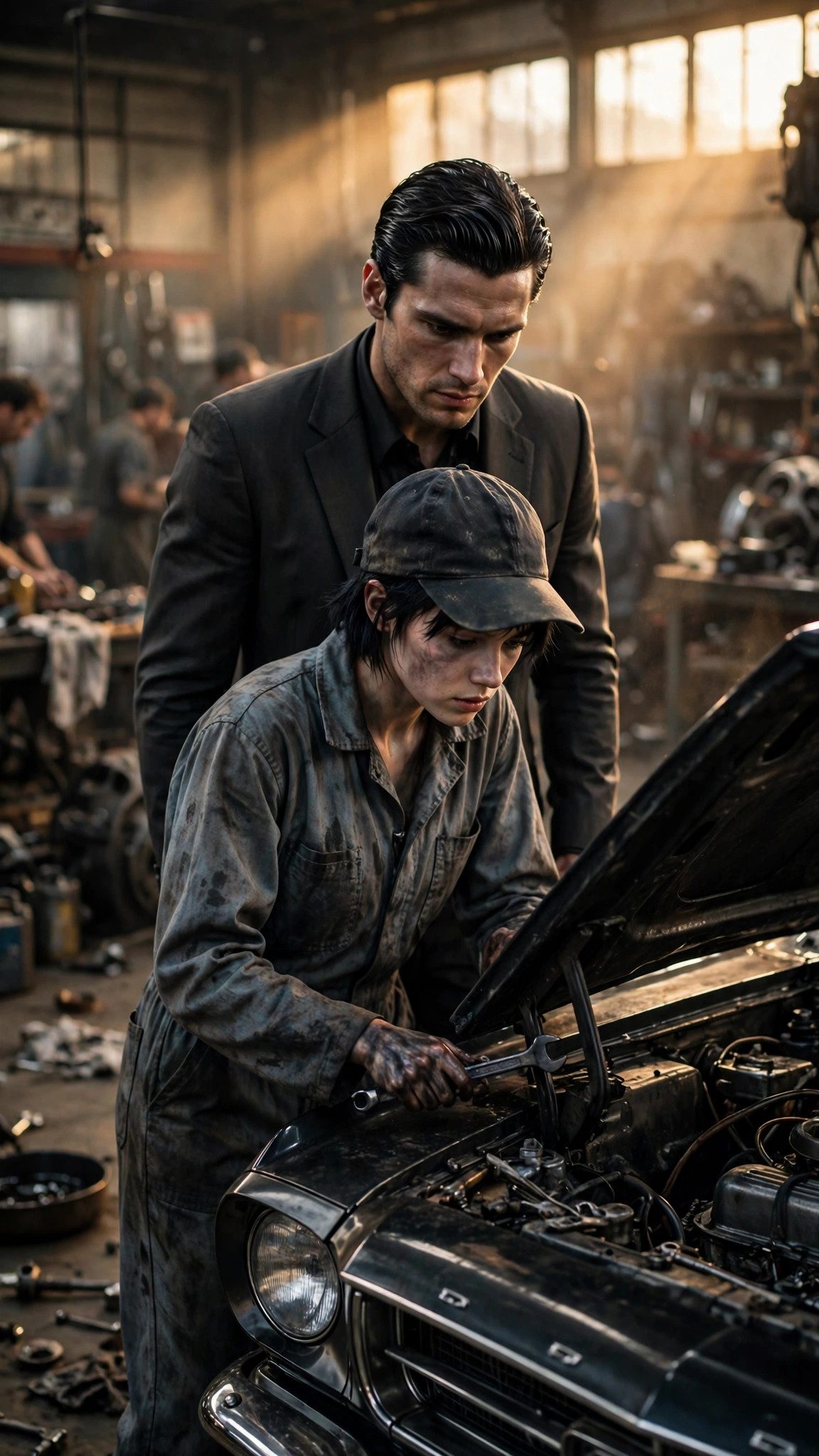
The first thing I did, when Marcus Bellamy was in prison and my father was cooperating and the danger was finally over, was cut my hair again.
Not the way I had cut it that night at 12:43 a.m., in a panic, with shaking hands, in front of the mirror in my father's house. This time I went to a real salon, on Michigan Avenue, and I sat in a real chair, and a woman with kind eyes asked me what I wanted, and I said, "Something that looks like me."
She cut it short — shorter than it had been before, a clean, sharp cut that framed my face and made my dark eyes look bigger — and when she was done, I looked in the mirror, and I saw a woman I recognized. Not Elena Russo, the obedient daughter. Not Eli Ross, the quiet young mechanic. Someone new. Someone who had survived both of them.
I went back to the shop that afternoon, and Tony Mercer took one look at me, and he laughed — a real laugh, the first time I had ever heard him laugh — and he said, "Well, I'll be damned. You look like you, Elena."
"I feel like me," I said, and it was true.
Dante was in his office when I got back, and I knocked on the door, and he said, "Come in," and I walked in, and he looked up from his desk, and he stared at me for a long moment, and then he stood up, slowly, and he walked around the desk, and he stopped in front of me, and he looked at my hair, and my face, and my hands — clean, for once, no grease under my nails — and he said, very quietly, "There you are."
"Here I am," I said.
"Do you know what I have been thinking about, Elena?" he asked. "I have been thinking about my father, and the Mustang, and the two rules that mattered. A man is only as good as his word. You never lie to the people who trust you with their lives. And I have been thinking about the fact that I spent sixteen years carrying the weight of a promise I broke, and I told myself that was the price of the life I chose. But you —" He paused. "You spent seven months living a lie to stay alive, and the moment you did not have to lie anymore, you told the truth. You told Agent Reyes everything. You gave your father a choice. You did not run. You did not hide. You stood in my shop and you faced Marcus Bellamy, and you did not flinch. That is not the behavior of a liar, Elena. That is the behavior of a woman who is braver than anyone I have ever known."
I did not know what to say. My throat had closed up, and my eyes were stinging, and I stood there in his office, and I waited.
"I want to ask you something," he said. "And I want you to answer honestly, because I will only ask it once."
"Yes," I said.
"I am going to legitimize my businesses," he said. "All of them. The shop. The restoration work. Everything. I have been thinking about it for a long time, and what happened with Marcus — what you did, standing up to him, choosing the law instead of revenge — it showed me that there is another way to live. My father built an empire on his word. I want to build something on mine. But I cannot do it alone. I need someone I trust. Someone who understands engines, and people, and what it means to start over. Someone who is not afraid to tell me the truth."
He took a breath.
"Elena Russo, will you run Moretti Motorworks with me? Not as my mechanic. As my partner."
I stared at him. "Your partner?"
"The shop is yours as much as it is mine," he said. "You saved it. You saved the Mustang. You saved the Ferrari. You saved me from making a mistake I would have regretted for the rest of my life, when I almost threw you out for lying to me. I want you beside me, Elena. Not behind me. Beside me."
I thought about the night I cut my hair, and the laundry-room window, and the $684, and the bus to the West Side. I thought about the room above the laundromat, and the thin mattress, and the water stain on the ceiling. I thought about Michael, and his tool roll, and the wrench with my initials scratched into the handle. I thought about the seven months I had spent as Eli Ross, invisible and afraid, and the moment Dante Moretti had finally looked at me and said my name.
"Yes," I said. "Yes, I will."
He smiled then — a real smile, slow and warm, and it changed his whole face, and I realized, in that moment, that I had never actually seen Dante Moretti smile before. Not once, in seven months. And now he was smiling at me, and the most dangerous man in Chicago looked, for one shining moment, like a man who had finally found something he had been looking for for a very long time.
We did it together. We legitimized the businesses, one by one, with lawyers and accountants and more paperwork than I had ever seen in my life. We kept the shop. We expanded it. We hired more mechanics, and we paid them well, and we told them the truth about what we did and what we didn't do. We opened a restoration school in the back of the shop, for young people who wanted to learn how to fix engines the way Michael had taught me — by listening, by being patient, by understanding that a machine will always tell you what's wrong if you know how to hear it.
I named the school after Michael. The Michael Russo School of Restoration. On the first day, I stood in front of twelve students, and I held up his tool roll, and I said, "My brother taught me that engines don't lie. People lie. But engines always tell the truth. If you learn to listen, you will never be lost."
One of the students was a girl, sixteen years old, with grease already on her hands and a look in her eyes I recognized — the look of someone who had been told she did not belong somewhere, and was determined to belong there anyway. I gave her Michael's wrench, the one with my initials on it, and I said, "This is yours now. Take care of it. And take care of yourself."
She looked at me like I had just handed her the world, and in a way, I suppose I had.
My father wrote to me from prison, once a month, long letters in his careful handwriting, about the books he was reading and the men he was meeting and the things he was learning about himself. I wrote back. I told him about the shop, and the school, and the students. I told him about Dante. He wrote back and said, "Your mother would be proud of you, Elena. I am proud of you, too. I know I have no right to say that. But I am."
I believed him. I chose to believe him. Because forgiveness is not about the person you forgive. It is about the person you become when you let go.
And Dante — Dante changed, too. Not all at once, and not completely, because men like Dante Moretti do not change all at once. But slowly, day by day, the man who had built his empire on silence and fear began to build something else. He began to laugh, sometimes, when the students did something clever. He began to come down to the floor in the afternoon, not to watch, but to work — to get his hands dirty, to fix something with his own hands, the way his father had taught him. He began to talk about the future, not as a thing to be defended, but as a thing to be built.
The school's first class had twelve students, and I remember every one of them. There was the sixteen-year-old girl with grease already on her hands, who reminded me of myself at her age — stubborn, and angry, and determined to prove she belonged. There was a boy of nineteen who had dropped out of college and did not know what to do with his hands, until he held a wrench for the first time and something in his face changed. There was a woman of forty who had raised three children alone and had always wanted to fix her own car, and nobody had ever taught her how.
I taught them the way Michael had taught me — not from a book, but from the engine itself. "Listen," I told them, on the first day, tapping the side of my head the way he used to. "The engine tells you what's wrong. You just have to learn how to hear it." And they listened. They leaned over the hoods with their eyes closed, the way I had once leaned over them, and they heard it — the hesitation, the gasp, the tiny wrongness hidden beneath the sound — and their faces lit up, one by one, like lamps being switched on in a dark house.
Tony helped me run the school, in his own way. He came in on Saturdays, even though he did not have to, and he taught the students about safety, and about honesty, and about the three rules: show up on time, do the work right, and don't ask questions about the cars that come in after dark — except now, he added, "And if anyone ever threatens you, or frightens you, or tries to make you smaller than you are, you come to me, or to Elena, or to Mr. Moretti, and we will deal with it. Because nobody in this shop stands alone. Not anymore."
The girl — her name was Sofia, and she was sixteen, and she had her mother's dark eyes and her father's stubborn chin — became my best student. She could hear a misfire from across the room. She could find a cracked vacuum line in eleven minutes, the same as I had, all those months ago, on the Mustang. On the last day of her first term, I gave her Michael's wrench, and she held it like it was made of gold, and she said, "I'll take care of it, Miss Elena. I promise." And I believed her, because I had seen that look before — in my own mirror, at 12:43 a.m., on the night I cut my hair.
Dante watched all of this from the doorway of the school, most days, with his arms crossed and a look on his face I had never seen before he met me — something soft, and proud, and a little bit amazed, like a man who had spent his whole life building walls and had just discovered, to his surprise, that he liked what was on the other side of them.
It was Tony, I found out much later, who had helped Dante plan the evening on the roof. Tony who had carried the table up the stairs. Tony who had lit the candles. Tony who had told Dante, in his blunt, refrigerator-built way, "If you love her, tell her. Don't wait. Men like us, we wait too long, and then it's too late, and then we spend the rest of our lives wishing we hadn't."
Dante had listened. And that was how I found myself, one evening, a year after Marcus Bellamy was arrested, standing beside a vintage Porsche at the end of the day, with Dante Moretti beside me, not saying anything for a long time, because he was gathering his courage, the way I had once gathered mine, in front of a mirror, with scissors in my hand.
One evening, a year after Marcus Bellamy was arrested, Dante came to my bay at the end of the day, and he stood beside me while I finished working on a vintage Porsche, and he did not say anything for a long time. Then he said, "Elena. Come with me."
He took me up to the roof of the shop, where someone — Tony, I found out later, with the help of every mechanic in the building — had set up a small table with two chairs, and candles, and a view of the Chicago skyline turning gold in the evening light.
"I have been thinking about my father's two rules," Dante said, as we sat down. "A man is only as good as his word. You never lie to the people who trust you with their lives. And I have been thinking about the fact that I have spent my whole life keeping my word to everyone except myself. I promised myself I would never love anyone, because love makes you vulnerable, and vulnerable people get hurt. But then you walked into my shop, Elena, and you fixed my father's Mustang, and you looked me in the eye, and you told me the truth, and I realized that I had been wrong about everything."
He reached across the table, and he took my hand, and his hand was warm, and steady, and it did not shake.
"Elena Russo," he said. "I love you. I have loved you since the day you stood in my garage, covered in grease, and told me to start the engine again. I loved you when you were Eli Ross, and I love you now that you are Elena, and I will love you for the rest of my life, whatever your name is, whatever you become. Will you marry me?"
I looked at him — this man, this dangerous, complicated, honorable man, who had looked at me when no one else would, who had said my name like it was something to be proud of — and I thought about the girl who had cut her hair at 12:43 a.m., and the woman who had crawled through a laundry-room window with $684 and a tool roll, and the mechanic who had fixed a Mustang with a hairline fracture in a vacuum line, and I realized that every single one of them had been leading me here, to this roof, to this table, to this man, to this moment.
"Yes," I said. "Yes, Dante. I will marry you."
We were married six months later, in the garden behind the shop, under a fig tree that Tony had planted the year the shop opened. It was a small wedding — Tony, and Ray, and Eddie, and the students from the school, and Agent Reyes, who came in a suit and cried during the vows and pretended he hadn't. My father could not come, because he was still in prison, but he sent a letter, and I read it the morning of the wedding, and it said, "Your mother would have loved this day. I love you, Elena. Be happy. You have earned it."
I wore a simple white dress, and I carried a bouquet of white roses, and in my pocket, I carried Michael's wrench, the one with my initials on it, because I wanted him there, in some small way, on the day I finally stopped running.
Dante wore a charcoal suit, and he looked at me the way he had looked at me in the garage, seven months after I cut my hair — like he had finally seen me — and this time, I did not look away.
After the ceremony, we danced in the garden, under the string lights, while the students played music too loudly and Tony grilled food and the whole shop celebrated, and Dante held me close, and he whispered in my ear, "You know what my father used to say about the Mustang? He said a car will tell you the truth about the man who owns it. Well, Elena — you told me the truth about myself. And I have never been more grateful for anything in my life."
I smiled, and I leaned my head against his chest, and I listened to his heartbeat, steady and strong, and I thought about engines, and how they tell you what's wrong if you know how to listen, and how sometimes, if you listen carefully enough, they tell you what's right, too.
Seven months after I cut off my hair, bound my chest, and vanished before my forced wedding, Chicago's most feared crime boss finally looked straight at me.
And he never looked away again.
The End.
THE END