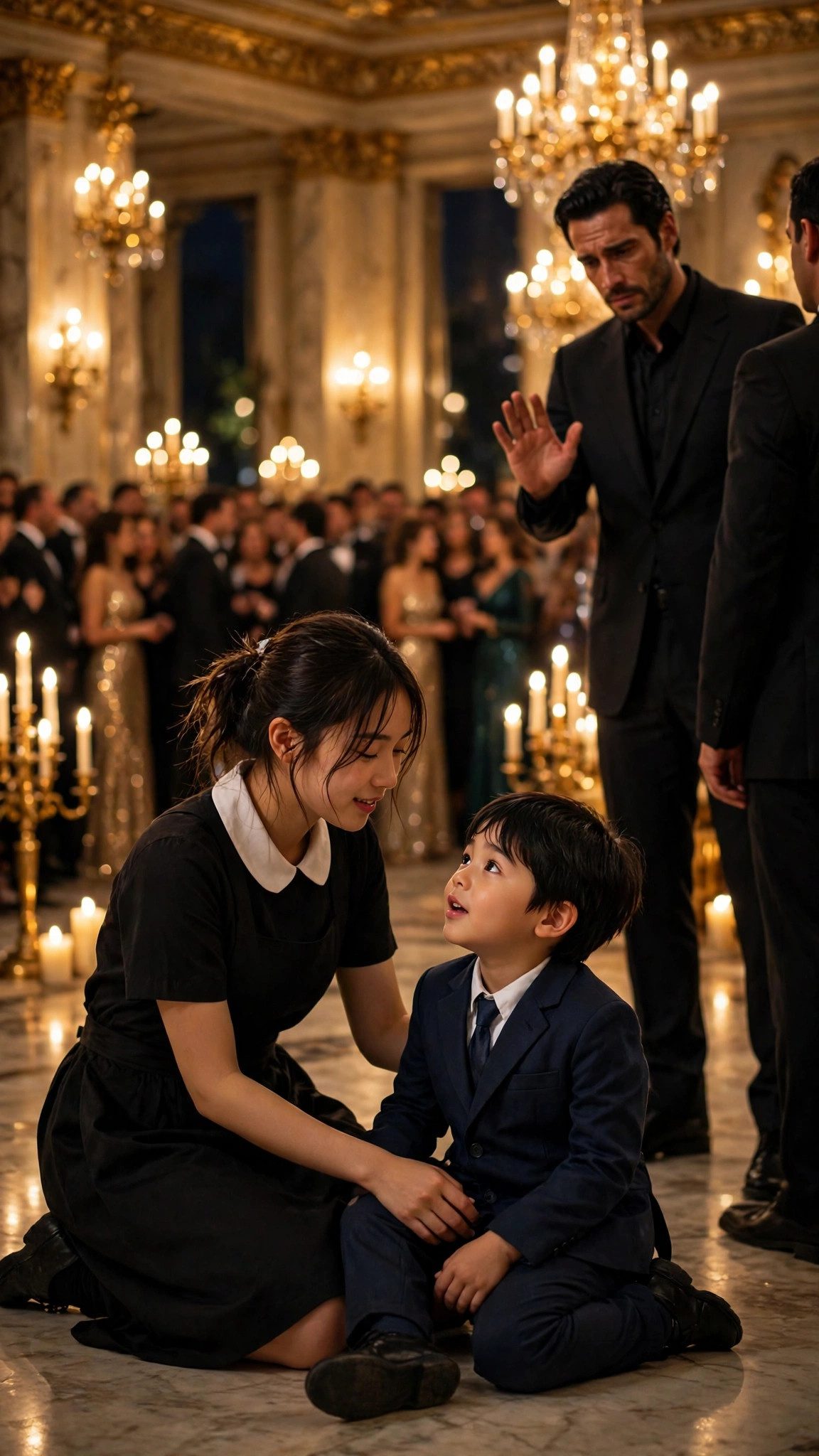
Emma Carter had learned the lighthouse song before she learned to read.
She was four years old the first time her mother sang it to her, in a kitchen so small the two of them could barely turn around without bumping elbows. The apartment was on the third floor of a brick building on the South Side, where the radiators clanked all winter and the windows rattled whenever a truck went past, and the song was the one beautiful thing in it. Her mother, Grace, would lift her onto the counter while the soup simmered, and sing in a low, sweet voice about a little sailor and a lighthouse that kept its light burning through every storm, and Emma would fall asleep with her cheek against her mother's shoulder, safe in a way she would spend the rest of her life trying to find again.
"Sleep, my little sailor," her mother sang, "the lighthouse keeps the light. Sleep, my little sailor, and I will keep you through the night."
Grace Carter had learned the song at St. Agnes Home for Girls, where she grew up after her own parents died. The woman who ran the home, Mrs. Delaney, sang it to every frightened little girl who arrived with a suitcase and no one left in the world. It was not a famous song. It was not on the radio. It belonged to that one drafty old house and the girls who had slept under its roof, and Grace carried it with her the way other people carried photographs.
At St. Agnes, Grace had shared a narrow bed with another girl, a thin, serious child with dark hair and a laugh that could fill a whole room. Her name was Serena. Serena Whitfield, who had lost her parents in a car accident and who talked, even at twelve years old, about the family she would build one day, the children she would have, the charity she would start for children who carried grief the way she carried it, quietly and everywhere.
The two girls made a promise in that narrow bed, the way children do, with their pinkies linked and their voices hushed so Mrs. Delaney would not hear. Whoever got out first, whoever built a good life first, would come back for the other. They would never forget each other. They would never forget the song.
Serena got out first. She was adopted at fourteen by a kind couple from Lake Forest, and she went to college, and she married a young man named Preston Hale, and she built the life she had dreamed about in that narrow bed. Grace got out at sixteen, into a job as a seamstress, and then into a marriage that did not last, and then into a small apartment on the South Side with a daughter named Emma and a sewing machine that never stopped.
But the promise held. Serena never forgot Grace. Every Christmas, a card arrived with no return address, and inside it there was always money, folded carefully, and a short note in Serena's neat handwriting. "For Emma's shoes." "For Emma's school books." "For the winter coat." Grace never told Emma where the money came from. She only said, "We have a friend. A good friend. And one day, if you ever need help, you go to the big house in Lake Forest, and you tell them Grace Carter sent you."
Emma was twenty-five when her mother died. It was fast and unfair, the way some illnesses are — a cough that would not go away, a doctor's face going still, a word Emma had never wanted to hear. Grace spent her last month in a hospital bed by a window, and Emma sat beside her every day, holding her hand, and Grace sang the lighthouse song to her daughter one final time, her voice so thin it was barely more than breath.
"Go to the big house," Grace whispered, when she could still speak. "The Hales. Serena is gone now, I know that. I read it in the paper. But her husband is a good man underneath the fear. He has a little boy who does not speak. You will know what to do. You always knew the song better than I did."
Emma did not understand what her mother meant. Not then. She only knew that after the funeral, after the small apartment was emptied and the sewing machine was sold and the bills were paid, she had nowhere to go and no one left in the world except a name and an address. So she put on her plainest black dress, the one she wore to the funeral, and she took a bus to Lake Forest, and she walked up the long driveway to the biggest house she had ever seen, and she asked the housekeeper for work.
The housekeeper was a woman named Mrs. Delaney — no relation to the Mrs. Delaney of St. Agnes, though Emma thought about the coincidence for a long time afterward, the way the world sometimes folds back on itself. This Mrs. Delaney looked Emma up and down, at her cheap shoes and her plain dress and her hands, which were red from scrubbing, and said, "We need a girl for the upstairs rooms. The pay is fair. The rules are simple. You do not speak to Mr. Hale unless he speaks to you. You do not enter the boy's rooms. You do not ask questions about the family."
"I understand," Emma said.
She understood the rules. What she did not understand, not for a long time, was that the house itself was grieving. The Lake Forest estate was beautiful in the way only very expensive things can be beautiful — marble floors, gold chandeliers, gardens that stretched farther than Emma could see — and it was also the saddest place she had ever worked. The curtains were always half-drawn. The grand piano in the music room sat closed and silent, its keys covered. The nursery at the top of the stairs had a small bed that was always made and never slept in, because Oliver slept in a narrow cot in his father's dressing room, close enough to hear Preston breathing at night.
Emma cleaned the upstairs rooms six days a week. She dusted the portrait of Serena Hale in the hallway, a woman with dark hair and a laugh in her eyes, and she thought about her mother's friend, the girl from the narrow bed at St. Agnes, and she wondered whether Serena had ever sung the lighthouse song in this house, to her own little boy, before she died. She did not know that Serena had. She did not know that the song had lived in these rooms for years, sung every night at bedtime, until the night the singing stopped.
She saw Oliver for the first time on her third day. She was carrying fresh linens down the second-floor hallway when a small door opened and a boy in a navy suit stepped out, his hands folded in front of him, his eyes wide and watchful. He looked at her the way a deer looks at a road, frozen and listening, and Emma stopped where she was and did not move, because something in his face told her that sudden movements were dangerous.
"Hello," she said softly. "I am Emma. I clean the upstairs rooms."
He did not answer. He only looked at her, and then he looked past her, down the hallway, and then he went back into his room and closed the door without a sound.
Mrs. Delaney found her standing there a moment later. "That is Master Oliver," she said, her voice low. "He does not speak. He has not spoken in two years, since his mother died. Do not try to make him speak. The doctors say it will only make it worse. You leave him alone, and you do your work, and that is all."
Emma nodded. But she could not leave him alone, not entirely. She began to notice things. The way Oliver left his door open a crack when she was cleaning the hallway, just wide enough to hear her footsteps. The way he stood at the top of the stairs when she hummed under her breath while she worked — she had always hummed while she worked, old songs her mother taught her, and she did not realize she was doing it until she caught him listening. The way he left things for her: a smooth stone on the windowsill, a drawing of a lighthouse in blue crayon, a small wooden boat on the shelf in the nursery.
She never touched him. She never tried to make him speak. She only hummed, and she cleaned, and she left a biscuit on the nursery windowsill on the days when he seemed sadder than usual, and she thought about her mother, and about Serena, and about the promise made in a narrow bed at St. Agnes, and she wondered if this was what her mother had meant. You will know what to do.
She had been working at the estate for eleven months when the invitation to the Winter Gala went out. Mrs. Delaney told the staff they would all be needed that night, serving champagne and clearing plates for four hundred guests, and Emma was assigned to the service entrance, carrying trays and staying out of sight, the way maids are supposed to.
She did not plan to step forward. She did not plan to do anything at all except her work. But then she heard Preston Hale tap his champagne glass, and she heard him offer marriage to any woman who could make his son speak, and she heard the desperation in his voice, the voice of a man who had tried everything and had nothing left, and she thought about her mother singing in a small kitchen on the South Side, and about Serena singing in this house to a little boy who had gone silent, and she thought about the promise, and before she knew what she was doing, her feet were moving, and she was walking out from behind the waitstaff, toward a six-year-old boy in a navy suit, with a song in her throat that she had carried since she was four years old.
She did not do it for the money. She did not do it for the marriage. She did it because the song had been waiting eleven months to be sung in that house, and because a little boy who had not spoken in two years deserved to hear his mother's voice again, even if it came through a stranger's mouth.
That was the truth. And the truth, Emma would learn, was the most dangerous thing she could have brought into Preston Hale's house. Because in that house, the song was not the only secret. And the people who had been keeping the other secrets had been keeping them for a very long time.
One afternoon in her second month at the estate, Emma found the sheet music.
She was dusting the music room, wiping the closed lid of the grand piano, when she noticed that the piano bench had a hinged seat, and inside it, beneath a stack of old programs from charity concerts, there was a folder of handwritten sheet music. The top page was titled, in a neat, looping hand, "The Lighthouse Song." Beneath the title, in smaller writing, it said, "For Oliver, when he is afraid. Love, Mama."
Emma sat down on the piano bench and stared at the page for a long time, her hands shaking. The melody was written out in careful notes, and the lyrics were exactly the ones her mother had sung to her in the small kitchen on the South Side. Word for word. Note for note. The song had lived in this house. Serena had sung it here, in this very room, to her own little boy, before she died. And Emma's mother had sung the same song, hundreds of miles away, to her own little girl, because two girls in a narrow bed at St. Agnes had promised never to forget it.
She put the folder back exactly where she had found it, and she never told anyone about it. It felt too sacred to share, too private to explain. But from that day on, whenever she cleaned the music room, she would open the piano bench for a moment, just to look at the folder, and to remind herself that the song was not a coincidence. It was a thread, running from St. Agnes to the South Side to Lake Forest, tying two families together across thirty years.
Winter came early that year. Snow fell over the Lake Forest estate in thick, silent drifts, and the gardens turned white, and the lake beyond the trees turned gray and still. Oliver began leaving drawings on the nursery windowsill every Friday, always the same subject: a lighthouse, drawn in blue crayon, with yellow light spilling from its top. Sometimes the lighthouse stood on a cliff. Sometimes it stood in the middle of the sea. Sometimes there was a small boat beside it, and sometimes there was a small boy standing at its door. Emma kept every drawing, tucking them carefully into a drawer in her room, and she never asked him why he drew them. She only made sure the windowsill was clean every Friday morning, so that he would always have a place to leave them.
In the weeks that followed, Emma learned the rhythms of the house the way a musician learns a song. She learned that Mrs. Delaney took her tea at exactly six in the morning, and that the cook, a broad woman named Rosa, hummed opera while she kneaded bread. She learned which floorboards creaked on the second floor, and which windows stuck in the rain, and which of the upstairs rooms caught the morning light first. She learned that Preston Hale left the house at seven every morning and returned at seven every evening, and that he always stopped in the nursery doorway on his way upstairs, just to look at his son sleeping, before going to his own room alone.
She also learned that the house had rules no one had written down. The grand piano was never to be opened. The nursery door was never to be closed all the way. The portrait of Serena in the hallway was to be dusted every day, without fail, and the fresh flowers beneath it were to be changed every Monday. Emma followed the rules without question, because rules were the price of a roof and a wage, and because she had learned, in the small apartment on the South Side, that a job was a gift you did not waste.
But she broke one rule, once, and only once. On a rainy Thursday afternoon, when the house was empty and the staff were downstairs, she opened the grand piano and pressed a single key. The note rang out through the silent music room, clear and true, and she stood there with her hand on the keys, thinking about Serena, and about the song, and about the little boy upstairs who had not spoken in two years. Then she closed the lid gently, and she went back to her work, and she never opened the piano again.