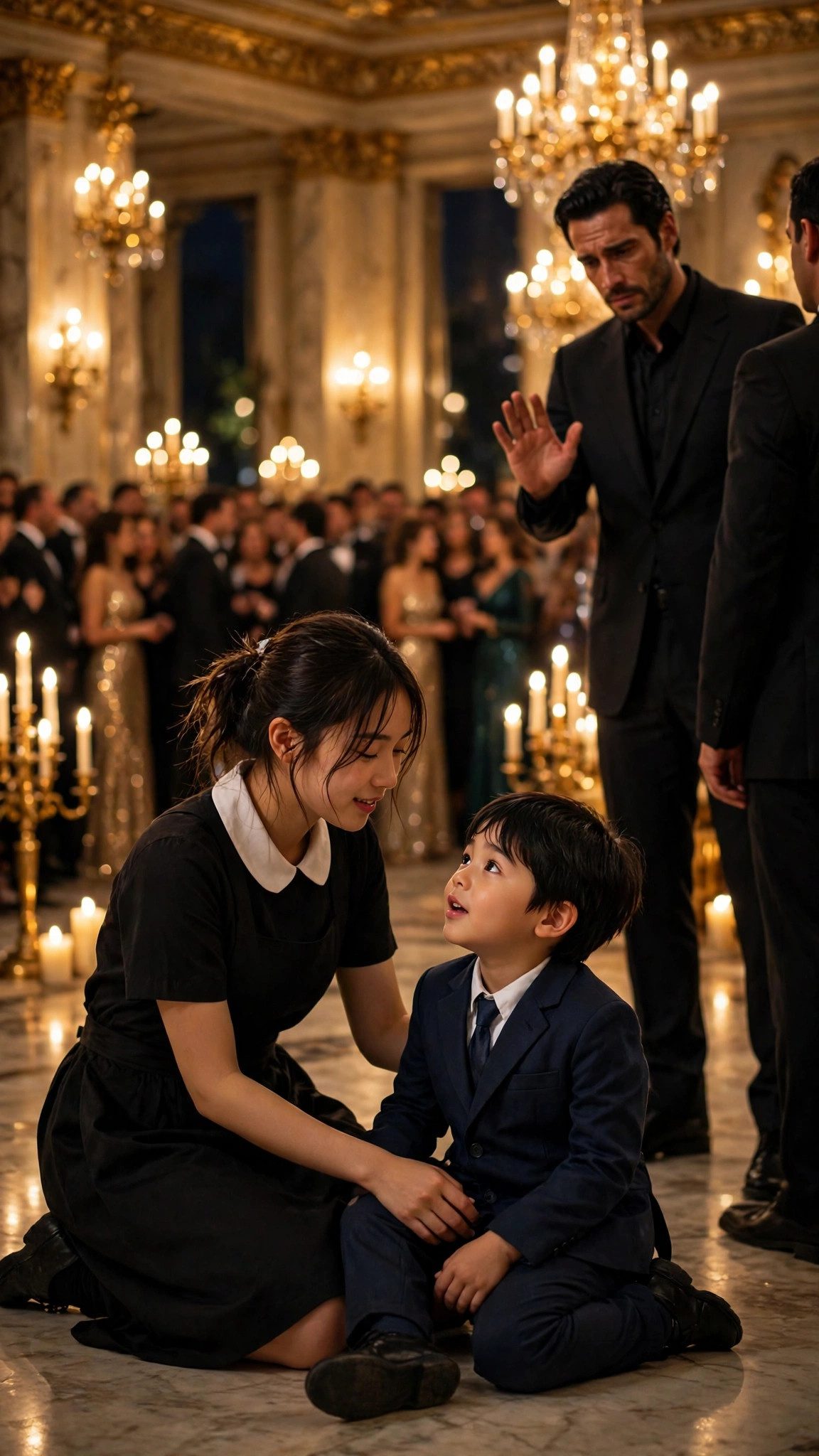
By the time I stood beneath the chandeliers and offered marriage to any woman who could make my silent son speak, half the ballroom thought Chicago's most feared mafia boss had finally lost his mind. The other half stopped breathing when the maid stepped forward, bent beside my six-year-old boy, and whispered the first line of a song I had not heard since my wife died.
My name is Preston Hale, and for years men had feared the sound of my voice. I had built an empire through private clubs, warehouses, political favors, and deals nobody discussed in daylight. In Chicago, some called me a businessman, some called me a criminal, but nobody called me helpless. Until my son stopped speaking.
Oliver was six years old and had not said a single word in two years. Not since the hospital. Not since he stood beside his mother Serena's bed while rain streaked the windows and machines breathed their cold mechanical rhythm around her. He screamed once when she died, a sound so raw a nurse began crying, and then something inside him simply closed. Doctors gave it names. Traumatic mutism. Severe grief response. Childhood withdrawal. I gave them money. Specialists from Boston, New York, Los Angeles, and Chicago came through my house carrying polished credentials and careful optimism. I sent Oliver to clinics, equine programs, private therapists, even an exclusive treatment center overseas. Nothing changed. Money had always moved obstacles for me. It could buy loyalty. Silence. Protection. Sometimes justice. But it could not buy one word from my son.
That night, four hundred people filled the ballroom of my Lake Forest estate for the annual Hale Foundation Winter Gala. Serena had created the charity before she got sick because she believed children carrying invisible grief deserved help whether their families had money or not. I had promised her I would keep it alive. So there I stood beneath gold chandeliers surrounded by men in tuxedos, women covered in diamonds, politicians, attorneys, businessmen, and people who smiled at me because they were terrified not to. Across the room, Oliver sat alone in a navy suit. His hands rested quietly in his lap. Guests kept looking toward him, then quickly away. I hated their pity. Mostly because I shared it.
I tapped my champagne glass with a spoon. The ballroom fell silent immediately.
"Thank you for coming," I said. "Serena believed healing should never belong only to the rich." At my wife's name, something tightened inside my chest. "She believed children deserved patience. Grace. Time." My eyes found Oliver. He did not move. "For two years, my son has not spoken." Nobody whispered now. "I have hired every specialist money could reach. I have flown him across countries. I have been told to wait, to push, to stop pushing, to trust, to accept." A bitter laugh almost escaped me. I set down my glass. Then I said something I had not planned to say.
"Enough."
Several people shifted uneasily. "If anyone in this room can make my son speak tonight, I will give them anything they ask." A nervous laugh came from somewhere near the back. I looked directly toward it. The laughter died. Then desperation outran whatever pride I had left. "Anything," I repeated. "Money. Property. Protection." My voice lowered. "And if the person is an unmarried woman…" The entire room seemed to lean toward me. "I'll marry her."
Gasps rippled through the ballroom. My consigliere stared at me as if I had just started a war. Then someone near the service entrance moved. A young maid stepped out from behind a line of waitstaff. She wore a plain black uniform, cheap shoes, and no jewelry. I recognized her vaguely. Emma Carter. She cleaned the upstairs rooms. One of my guards reached for her arm.
"Let her through," I said.
Emma walked toward Oliver. No fear. No performance. She knelt beside him, but she did not touch him. Then she began to hum. My blood turned cold. I knew that melody. Serena used to sing it to Oliver every night before bed. No one outside our family knew that song. Emma leaned closer and whispered the first lyric. Oliver's head snapped toward her. His lips trembled. And then, after two years of absolute silence, my son opened his mouth.
"Mommy?"
The word cracked through the ballroom like a gunshot, and for one stunned second nobody moved at all. Four hundred people stood frozen beneath the chandeliers, champagne glasses half-raised, diamonds catching the light, and every eye in the room fixed on a six-year-old boy in a navy suit who had just spoken for the first time in two years.
I do not remember crossing the floor. I remember the carpet under my shoes, the way the gold light blurred at the edges of my vision, and the sound of my own breathing, too loud in my ears. I remember dropping to my knees beside Oliver's chair and taking his small hands in mine, and how warm they were, and how his fingers curled around mine the way they had when he was three and afraid of thunderstorms.
"Oliver," I said, and my voice broke on his name. "Say it again. Please. Say it again."
He looked at me with those wide dark eyes, the same eyes Serena had, and then he looked back at Emma, and his lips moved again, uncertain, like a door opening after two years shut.
"Mommy," he whispered, and this time the word was not a question. It was a name he had been carrying inside him all along, waiting for the right voice to call it out of him.
Someone behind me began to cry. Then someone else. A woman near the orchestra let out a sound that was half laugh and half sob, and then the whole ballroom seemed to exhale at once, a great rushing sigh of four hundred people who had just witnessed something none of them could explain.
But I was not looking at the ballroom. I was looking at Emma Carter, kneeling on the carpet in her cheap shoes and her plain black uniform, her hands folded in her lap, her face calm in a way that made no sense at all. She had just done what every specialist in America could not do. She had done it with a song. And the song was my dead wife's song, a song no one outside our family was supposed to know.
"How do you know that song?" I asked her. My voice came out rougher than I meant it to. "Who taught it to you?"
She met my eyes without flinching. "My mother did," she said quietly. "And her mother before her. It is an old song, Mr. Hale. Older than this house. Older than any of us."
"That is not an answer," I said.
"It is the only answer I have," she said. "Tonight, at least."
Oliver tugged at my sleeve. I looked down at him, and he was pointing at Emma, and then at himself, and then at the empty chair beside him, and I understood what he was asking even though he had not said another word. He wanted her to stay beside him. He wanted the woman who knew his mother's song to sit where his mother used to sit.
"Stay," I said to Emma, and I was not sure whether I was giving an order or begging. "Stay beside him. For the rest of the night."
She nodded once and rose from her knees to take the chair beside Oliver, and the orchestra, uncertain what to do, began to play something soft and low, and the gala went on around us in a daze of gold light and whispered conversations, because nobody in that room could talk about anything else.
My consigliere, Marcus Hale, my own uncle, materialized at my elbow with his face the color of old paper. "Preston," he murmured, "we need to talk. Now. In private."
"Not now," I said, without taking my eyes off my son.
"You made an offer in front of four hundred witnesses," Marcus said, his voice dropping lower. "A public offer. Marriage. To a maid. Do you understand what you have done?"
"I understand that my son spoke," I said. "That is all I understand right now. And that is all that matters."
Across the ballroom, I saw Vivian Castellano watching us from beneath the largest chandelier, her diamond earrings catching the light, her smile fixed in place like something painted on. Her father, Vincent Castellano, stood beside her with his hands clasped behind his back, studying Emma the way a man studies a locked door. I knew that look. I had worn it myself a thousand times. It was the look of a man already calculating what a thing was worth and how to take it.
I should have paid more attention to that look. I should have understood, in that golden moment, that my son's first word had not only opened a door. It had opened a war. But in that moment, all I could see was Oliver, leaning toward Emma as she hummed the next line of the song, his small shoulders loosening for the first time in two years, his mouth forming the shape of a word he had forgotten how to hold.
"Mommy," he said again, softly, and Emma smiled at him, and for the first time since Serena died, my house did not feel like a tomb.
Two years earlier, on the night my wife died, it had been raining the same way it rained the night of the gala. Rain streaked the hospital windows in long silver lines, and the machines around Serena's bed breathed their cold mechanical rhythm, and Oliver stood beside me in his small navy pajamas, holding my hand so tightly his fingernails left marks on my skin.
Serena had been sick for eleven months. The doctors had used every word they had — aggressive, advanced, unresponsive — and none of them had changed anything. She had fought the way she fought everything, with a stubborn grace that made the nurses love her, and by the end she was so thin the hospital gown hung off her shoulders like a curtain, and still she smiled when Oliver climbed onto the bed beside her and laid his head on her chest.
"Sing to him," she whispered to me that last night, her voice so faint I had to bend close to hear it. "When I am gone. Sing to him. The lighthouse song. He will need it."
"I will," I promised, and I meant it, and I broke that promise within a week, because every time I tried to sing it my throat closed and I could not get past the first line without seeing her face, and so the song died with her, and Oliver went silent with it.
That night, after the machines went quiet and the nurses came in with their soft shoes and their practiced faces, Oliver screamed. It was one scream, raw and endless, a sound that tore out of a six-year-old boy like something being ripped from his body, and a nurse in the corner began to cry, and then the scream stopped, and Oliver never made another sound again.
Not when we buried his mother in the rain. Not when his grandmother held him and wept. Not when I carried him home to a house full of flowers and casseroles and people speaking in whispers. He simply closed. His mouth became a door that would not open. His eyes stayed wide and watchful, taking everything in, giving nothing back.
I hired the first specialist three weeks after the funeral. Dr. Whitfield from Boston, who had written books about childhood trauma and who spoke to Oliver for an hour in a voice like warm milk and then told me, with great confidence, that the boy needed "time and a safe environment." I gave him time. I gave him the safest environment money could build. Nothing changed.
Then came the clinic in New York, where a woman with kind eyes and a wall full of diplomas tried play therapy, art therapy, music therapy, and told me Oliver was "processing." Then the equine program in Colorado, where my silent son rode a gentle brown horse through pine trees for six weeks and came home just as silent. Then the private therapist in Los Angeles who charged nine hundred dollars an hour and suggested that perhaps I was the problem, that my grief was "creating a feedback loop," and I nearly threw him out of my own house before Marcus talked me down.
The exclusive treatment center overseas was the last one. Switzerland. A white building on a lake, doctors who spoke four languages and charged like they spoke five. Oliver stayed there for two months. He learned to swim. He learned to paint watercolors of the lake. He did not say a single word. When I flew over to bring him home, he ran to me at the airport and threw his arms around my neck, and I held him so tightly I thought my ribs would crack, and he said nothing at all.
That was when I understood that money had failed me. Money had always moved obstacles for me. It could buy loyalty. Silence. Protection. Sometimes justice. But it could not buy one word from my son. And so I stood in my ballroom on the night of the Winter Gala, surrounded by four hundred of the richest people in Chicago, and I did the only thing I had left. I offered them everything I had.
I did not expect anyone to answer. I certainly did not expect a maid in cheap shoes to walk out of the service entrance and hum my dead wife's song into my son's ear. And I did not expect, when I looked across the ballroom and saw Vincent Castellano studying that maid like a locked door, that I was about to learn the song was not the only secret in my house.
But that night, as the orchestra played and the guests whispered and my son leaned against Emma Carter's shoulder humming a melody he had not heard in two years, I allowed myself one thing I had not allowed myself since Serena died. I allowed myself to hope.
Later that night, after the guests had gone and the chandeliers had been dimmed, Preston carried Oliver up the grand staircase to bed. The boy was heavy in his arms, heavier than he had been a year ago, and his breathing was slow and even, and once, in his sleep, his lips moved and he whispered, "Mommy," and Preston stopped on the stairs and held him tighter, afraid to move, afraid to wake him, afraid that the word would vanish like smoke if he disturbed it.
He laid Oliver in his small bed and sat beside him until the boy's breathing deepened, and then he went to the nursery doorway and stood there for a long time, looking at his son in the dark. Two years of silence. Two years of specialists and clinics and money thrown at a wall that would not move. And then a maid in cheap shoes had walked out of the service entrance and hummed a song, and the wall had cracked.
Downstairs, in the library, he could hear low voices. Marcus and Vincent Castellano, talking behind a half-closed door, their words too soft to make out. Preston stood at the top of the stairs and listened, and he caught one fragment, Marcus saying, "The boy spoke," and Castellano answering, "Then we have a problem." Preston did not go downstairs. He did not confront them. He only stood in the dark hallway, with his son sleeping behind him, and filed the fragment away in his mind, the way he filed everything, until he understood what it meant.
That night, for the first time in two years, Preston Hale slept without dreaming of the hospital.