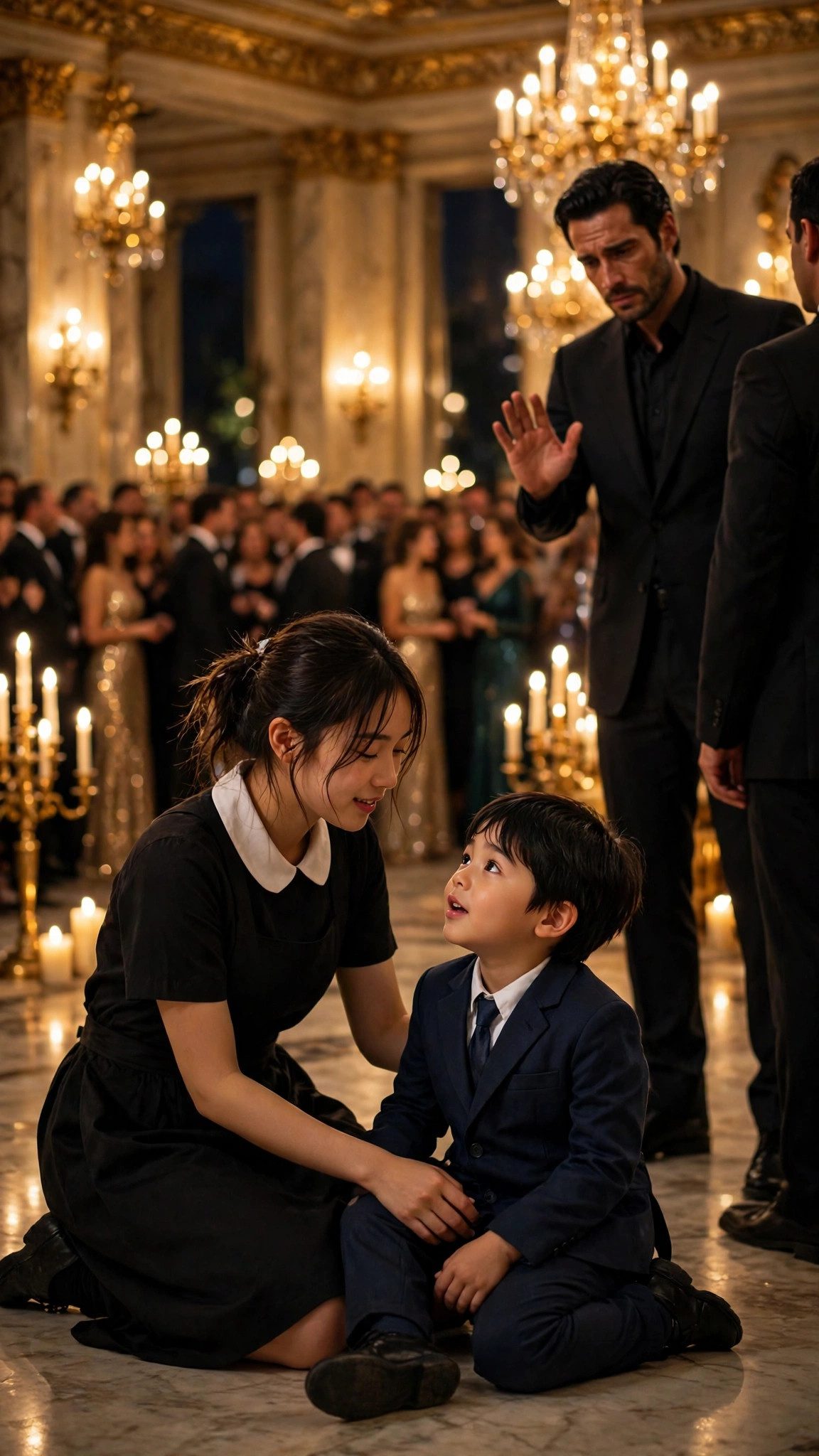
The morning after the gala, the Lake Forest estate woke up to a storm that had nothing to do with the weather.
By seven o'clock, three newspapers had already called. By eight, the story was on the local television news, and by nine, a gossip website had posted a photograph of Emma kneeling beside Oliver beneath the chandeliers, with a headline that read: "MAFIA BOSS OFFERS MARRIAGE TO MAID WHO MADE HIS SILENT SON SPEAK." Mrs. Delaney found Emma in the kitchen before the staff meeting, her face pale, and pressed a cup of tea into her hands with fingers that trembled.
"Mr. Hale wants to see you in his study at ten," she said. "And child — whatever you do, do not lie to him. He will know. He always knows."
Emma spent the hours until ten o'clock cleaning the music room, because her hands needed something to do. She dusted the closed piano, and she thought about the night before, and about the way Oliver had leaned against her shoulder while the orchestra played, humming the lighthouse song under his breath, and about the way Preston Hale had looked at her when she told him the song came from her mother. He had not believed her. She could see it in his face. He believed in threats and bribes and leverage, and a maid who knew his dead wife's song did not fit into any of those categories. A thing that did not fit was a thing he could not control, and Preston Hale was a man who controlled everything.
At ten o'clock, she knocked on the study door, and his voice told her to enter, and she stepped into a room lined with books and smelling of leather and cigar smoke, and found Preston Hale standing by the window with his back to her, and Marcus Hale sitting in a leather chair by the fireplace, watching her the way a cat watches a bird that has flown into the wrong room.
"Close the door," Preston said, without turning around.
Emma closed it.
"My uncle tells me," Preston said, still facing the window, "that you are a plant. That Vincent Castellano sent you here to get close to my son. That the song is a trick, something his people learned from one of my own staff, and that you were coached to sing it at exactly the right moment, in front of exactly the right audience."
Emma's hands went cold. "That is not true."
"My uncle also tells me," Preston went on, "that you have been seen talking to a man in a gray car on the road outside the estate. Twice. And that the man matches the description of one of Castellano's drivers."
"I have never spoken to anyone in a gray car," Emma said, and her voice shook, but she did not look away. "I do not know anyone named Castellano. I came here because my mother told me to come. Because she said this house was kind once, and because I had nowhere else to go."
Preston turned around then, and his eyes were dark and tired, and Emma saw for the first time that the most feared man in Chicago looked like a man who had not slept properly in two years.
"Your mother," he said. "Tell me about your mother."
So Emma told him. She told him about Grace Carter, and the apartment on the South Side, and the sewing machine, and the song. She told him about St. Agnes Home for Girls, and the narrow bed, and the girl named Serena who had promised never to forget her friend. She told him about the Christmas cards with no return address, and the money folded inside them, and the words her mother had spoken on her deathbed. She told him everything, because Mrs. Delaney had told her not to lie, and because she had nothing else to offer a man who owned everything except the one thing he wanted.
When she finished, the study was silent for a long time. Marcus shifted in his chair, and the leather creaked, and Preston walked to his desk and opened a drawer, and took out a small silver frame, and held it out to Emma. Inside it was a photograph of two girls in matching gray dresses, standing in front of a brick building, their arms around each other's shoulders, laughing at something outside the frame. One of them was Serena. The other, Emma knew without being told, was her mother.
"Serena kept this in her dressing room," Preston said quietly. "I found it after she died. I asked her about it once, years ago, and she only said, 'She was my sister before I had a sister.' I never understood what she meant. I thought it was a figure of speech."
"It was not," Emma said. "They were foster sisters. They promised each other they would never forget."
Preston looked at the photograph for a long moment, and then he looked at Emma, and something in his face changed, the way a door changes when a key finally turns.
"My son spoke to you," he said. "He has not spoken to anyone in two years, and he spoke to you. I do not care what my uncle thinks. I do not care what Castellano thinks. I made an offer in front of four hundred witnesses, and I am a man who keeps his word. But I will not force a marriage on a woman who does not want it. So I am asking you, Emma Carter, and I am asking you plainly. Will you stay in this house? Will you help my son? And will you consider, in time, what I offered last night?"
Before Emma could answer, there was a knock at the study door, and a guard opened it without waiting, his face tight with urgency.
"Mr. Hale," he said. "Miss Vivian Castellano is here. She says she has an appointment. She says her father sent her."
Preston's jaw tightened. "Show her to the drawing room. I will be there in five minutes."
When the guard had gone, Marcus rose from his chair and walked to Preston's side, his voice dropping to a murmur that Emma was not meant to hear, though she heard every word.
"Vincent is moving fast," Marcus said. "Vivian will claim she can help the boy. She will offer tutors, doctors, anything. Do not let her near Oliver. And Preston — do not let the maid near him alone, either. Not until we know who she really is."
"She is the woman who made my son speak," Preston said. "That is who she is. That is all I need to know."
Marcus's mouth tightened, and for a moment something crossed his face that Emma could not read — not anger, exactly, but something colder. Fear. The look of a man who has just realized that a door he thought was locked has been standing open all along.
"I am only trying to protect this family," Marcus said.
"Then protect it," Preston said. "Starting with my son."
In the drawing room, Vivian Castellano waited beneath a portrait of Preston's grandfather, her blonde hair arranged in a perfect wave, her diamonds catching the morning light. She was beautiful in the way expensive things are beautiful, and she smiled when Preston entered as if they were old friends, and she did not look at Emma at all, which was its own kind of message.
"Preston," she said, "I was so moved last night. Truly. Your boy speaking again — it was the most beautiful thing I have ever seen. And I came because I want to help. My father has connections to a children's hospital in Geneva. The finest specialists in Europe. If you will let me, I can have Oliver seen within the week."
"My son has already been seen by the finest specialists in Europe," Preston said. "He spoke to a maid."
"Yes," Vivian said, and her smile did not waver, though something behind it went very still. "The maid. I have been asking about her. No one seems to know very much. A girl from the South Side, no family, no references before this house. It is strange, is it not? A girl like that, knowing a song like that. One wonders who taught it to her. One wonders what they wanted in return."
"She told me who taught it to her," Preston said. "Her mother. Her mother's friend was my wife."
"How convenient," Vivian said softly. "A dead mother. A dead wife. A story no one alive can confirm."
Emma felt the words like a slap, and she opened her mouth to answer, but Preston spoke first, and his voice was very quiet, the way it got when he was most dangerous.
"My wife is dead," he said. "My son was silent for two years. Last night he spoke. You will not stand in my house and call the woman who gave him his voice a liar. You will leave now, and you will tell your father that if he wants to discuss the Hale family, he can discuss it with me, in person, the way men do."
Vivian's smile finally broke, and for a moment Emma saw what was underneath it — not kindness, not concern, but calculation, and something else, something hungry.
"My father only wants what is best for this family," Vivian said, rising from her chair. "We have been allies for a long time, Preston. It would be a shame to throw that away over a maid."
"Then it is a shame," Preston said, and he opened the drawing room door himself, and Vivian walked out with her head high, and Emma watched her go, and felt, for the first time since she had come to this house, truly afraid.
That afternoon, Oliver spoke his second word.
Emma was sitting with him in the nursery, helping him build a tower of wooden blocks, when he looked up at her and said, very clearly, "Emma."
She froze, a block halfway to the top of the tower, and Oliver smiled at her, a real smile, the first she had ever seen on his face, and he said it again, as if he were trying the sound out, rolling it around in his mouth like a sweet.
"Emma."
She did not cry. She wanted to, but she did not, because she knew that if she cried he might close again, and so she only smiled back at him and said, "Yes, Oliver. I am Emma. And you are Oliver. And you are talking."
He nodded, solemn as a judge, and went back to his blocks, and Emma sat beside him with her heart pounding, and thought about the narrow bed at St. Agnes, and about two girls who had promised never to forget each other, and about how a promise made by children could reach across thirty years and two deaths and open the mouth of a silent little boy.
Upstairs, in his study, Preston Hale stood at the window and watched the gray car that had been parked on the road outside his estate all morning finally pull away, and he thought about the man his uncle had described, and about the photograph of two girls in gray dresses, and about the way Marcus had looked when Emma told her story — not surprised, but afraid. And Preston Hale, who had built his life on noticing the things other men missed, began, for the first time in two years, to pay attention to his own house.
The morning after Vivian's visit, Preston called his head of security, a broad, quiet man named Frank Doyle, into his study, and asked him about the gray car.
"Rented," Doyle said, consulting a small notebook. "Cash. False name. Returned to the agency yesterday afternoon, wiped clean. Whoever drove it knew what he was doing."
"And the man Emma was supposed to have spoken to?" Preston asked.
"There is no record of her speaking to anyone, Mr. Hale. The gate cameras show her leaving the estate twice in eleven months, both times to buy shoes at the village shop. She spoke to no one. My men watched the road for a week after your uncle raised it. Nothing."
Preston nodded slowly. "Keep watching the road. And keep watching the house. I want to know who comes and goes, and when, and I want to know it before they do it, not after."
Doyle left, and Preston sat alone in his study, thinking about the way his uncle had described the gray car with such confidence, such precise detail, as if he had rehearsed it. A man who invents a gray car is a man who needs you to look at the road outside your house, instead of looking inside it.
At breakfast that morning, Oliver spoke his first full sentence.
Emma was pouring orange juice when he looked up from his plate of pancakes and said, very clearly, "Emma, can I have more pancakes, please?"
The kitchen went silent. Mrs. Delaney dropped a spoon. A young maid by the stove put her hand over her mouth. Emma stood frozen with the juice jug in her hand, and Preston, who had been reading the newspaper at the head of the table, lowered it slowly, and stared at his son as if he had just performed a miracle in front of him.
"Of course you can," Emma said, and her voice was steady, though her hands were shaking as she put two more pancakes on his plate. "Of course you can have more pancakes, Oliver."
Oliver smiled at her, syrup on his chin, and went back to eating, as if he had not just done the most extraordinary thing in the world. And Preston Hale, the most feared man in Chicago, sat at his breakfast table with tears running down his face, and did not bother to wipe them away, because for the first time in two years, his son had asked for something, and the world had answered.
That same week, Preston's uncle Marcus came to the study with a folder of Foundation papers and a proposal he had clearly rehearsed. A new donor, he said. A man from New York, very wealthy, very discreet, who wanted to give a large sum to the Foundation in exchange for a seat on the board. Preston listened to the proposal without interrupting, and when Marcus had finished, he said, very quietly, "No."
Marcus blinked. "Preston, this man is offering two million dollars."
"Then he can offer it to someone else," Preston said. "The Foundation does not need new friends. It needs honest ones."
Marcus left the study with his folder under his arm, and Preston watched him go, and thought about the way his uncle had described the donor — wealthy, discreet, no name given — and about the way Marcus had not mentioned the donor's name even once. A man who will not name his friend is a man who is afraid of the name.