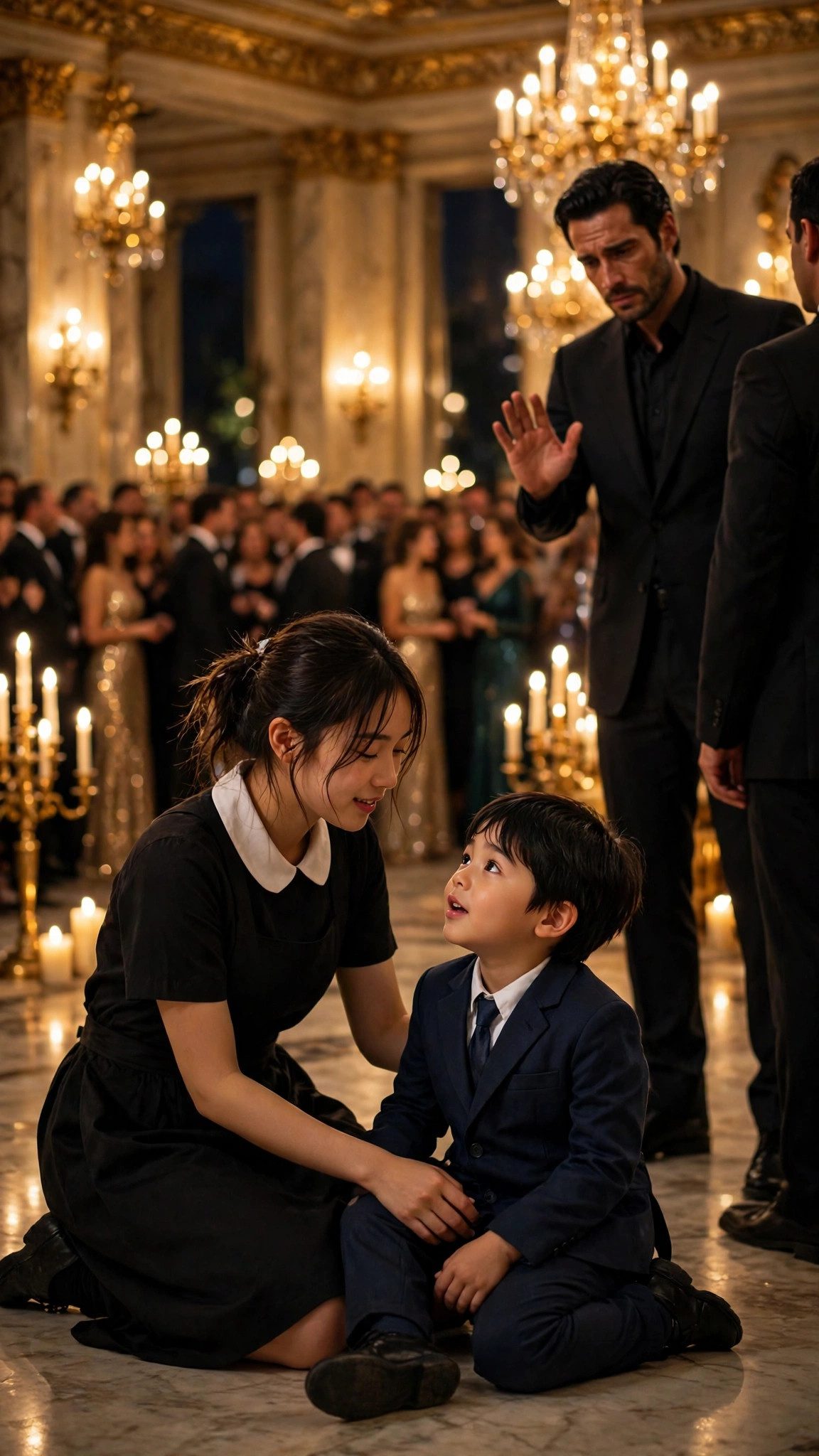
Oliver's words came back the way spring comes back after a hard winter — slowly, and then all at once.
In the days after the gala, he spoke in single words, carefully chosen, as if each one cost him something. "Emma." "Blocks." "Hungry." "Cold." Then two words together. "More juice." "Stay here." "Sing again." Then, on the fourth morning, a whole sentence, spoken to Emma while she was braiding his hair before breakfast, in a voice so small she had to lean close to hear it.
"The man in the dark coat hurt Mommy."
Emma went very still. Her hands stopped in his hair. "What did you say, Oliver?"
He looked up at her with those wide dark eyes, and his small face was serious in a way no six-year-old's face should ever be serious. "The man in the dark coat," he said again, slowly, as if he were reading the words off a wall inside his head. "He came when the rain was loud. He touched Mommy's tube. Mommy cried. Then Mommy went quiet. Then I screamed. Then I could not talk anymore."
Emma's heart was beating so hard she was certain he could hear it. She kept her voice steady, the way her mother had taught her to speak to frightened things.
"Oliver," she said gently, "did the man in the dark coat hurt your mommy on purpose?"
Oliver nodded, once, and then he climbed into her lap and buried his face against her shoulder, and he did not speak again for the rest of the morning.
Emma did not tell Preston right away. She sat with the words all afternoon, turning them over in her mind, trying to decide whether a six-year-old boy who had not spoken in two years could be trusted to remember what he had seen on the worst night of his life. But she knew, in the way she had known the song, that he was telling the truth. Children do not invent men in dark coats. They do not invent tubes being touched. And the fear in Oliver's eyes when he said it was not the fear of a bad dream. It was the fear of a memory.
That evening, after Oliver was asleep, she went to Preston's study and knocked, and when he told her to enter, she stood in the doorway with her hands folded and told him exactly what Oliver had said, word for word, without adding anything and without leaving anything out.
Preston listened without moving. His face did not change. His hands, resting on the desk, did not clench. Only his eyes changed, going very dark and very still, the way the sky goes dark before a storm.
"Say it again," he said quietly. "Every word."
She said it again.
"When did he tell you this?" Preston asked.
"This morning. While I was braiding his hair."
"And you are certain he said 'touched Mommy's tube'? Not 'held Mommy's hand'? Not 'gave Mommy medicine'?"
"I am certain," Emma said. "He said 'touched Mommy's tube.' And he said she cried. And then she went quiet."
Preston stood up slowly and walked to the window, and stood there for a long time with his back to her, looking out at the dark gardens, and Emma waited, because she had learned that when Preston Hale went quiet, it was better to wait than to speak.
"Serena died of heart failure," he said at last, his voice flat. "That is what the death certificate says. That is what the doctors told me. Her heart stopped in the night, and the machines sounded the alarm, and by the time the nurses reached her, she was gone. I was holding her hand. Oliver was standing beside the bed. That is what I remember. That is what I have believed for two years."
"Oliver remembers something else," Emma said.
"Oliver remembers a man in a dark coat," Preston said. "A man I did not see. A man no nurse reported. A man who may not exist."
"Or a man who was supposed to be invisible," Emma said, and immediately wished she had not spoken, because Preston turned around, and his eyes were on her face, and she could see him weighing her words the way he weighed everything, looking for the threat inside them.
"Do you know what you are saying?" he asked.
"I know what Oliver said," Emma answered. "That is all I know."
Preston nodded slowly. "Then we will find out what Oliver saw. Quietly. No one in this house is to know. Not Marcus. Not the staff. Not Vivian Castellano, and especially not her father. Do you understand?"
"I understand."
"Good," Preston said. "Because if someone killed my wife, and my son has been carrying that knowledge inside him for two years, unable to speak it, then the man who did it has been walking free while my boy suffered in silence. And I intend to find him. Whatever it takes."
The next morning, Preston drove alone to St. Catherine's Hospital, where Serena had died, and asked to see the records from that night. The administrator, a nervous man with a thin mustache, brought him a file and a cup of coffee he did not drink, and Preston sat in a small windowless office and read every page, twice.
The records were clean. Too clean, he thought, though he could not have said why. Serena's vital signs, recorded every fifteen minutes through the night. Her medication schedule, signed and initialed. The IV drip, a standard saline and pain medication mix, checked at midnight and again at two in the morning. The alarm at 2:47 a.m., when her heart stopped. The resuscitation attempt, forty-one minutes, unsuccessful. The time of death, 3:28 a.m.
But there was a gap. Between 2:00 a.m. and 2:47 a.m., no one had recorded anything at all. No nurse's note. No vital signs. No check of the IV. Forty-seven minutes of nothing, in a hospital where everything was supposed to be recorded.
"Who was on duty that night?" Preston asked the administrator.
The administrator flipped through the file, his fingers damp. "Nurse Alvarez," he said. "Maria Alvarez. She worked the night shift on the oncology floor for six years. She left the hospital about a year ago. Moved to Florida, I believe."
"And who else was in the room?" Preston asked. "Visitors? Family? Anyone?"
"Only you and the boy, Mr. Hale. That is what the visitor log says."
Preston thanked the administrator and drove home through the rain, and all the way home he thought about the gap. Forty-seven minutes. Long enough for a man in a dark coat to walk into a hospital room, touch an IV line, and walk out again. Long enough for a little boy to see it happen and scream, and then never speak again.
That afternoon, he called a man he had not called in years. Daniel Reyes, an FBI agent he had known since they were both young men on opposite sides of a line that had blurred a long time ago. Reyes had investigated the Hale family twice and found nothing he could prove, and Preston had respected him for it, the way you respect an honest enemy.
"I need a favor," Preston said, when Reyes answered. "And I need it quiet."
"Preston Hale needs a favor from the FBI," Reyes said. "This should be interesting."
"My wife died two years ago," Preston said. "I believed it was her illness. My son has just started speaking again, after two years of silence, and the first thing he told me is that a man in a dark coat touched his mother's IV line the night she died. I need to know if someone killed her. And if they did, I need to know who."
There was a long silence on the other end of the line. Then Reyes said, "Give me forty-eight hours. And Preston — do not do anything stupid. If someone in your house killed your wife, the worst thing you can do is let them know you are looking."
"I understand," Preston said.
But he did not entirely understand, because that evening, when he went to check on Oliver, he found Marcus Hale sitting in the nursery, reading to the boy from a picture book, and Oliver was sitting stiffly in his chair, his hands folded in his lap, his eyes fixed on the page, and the moment Marcus saw Preston in the doorway, he closed the book and smiled.
"He is doing so well," Marcus said. "Speaking more every day. It is a miracle, Preston. Truly."
"Yes," Preston said. "It is."
He watched his uncle leave the nursery, and he watched the way Oliver relaxed the moment the door closed behind him, his small shoulders dropping, his breath coming out in a long sigh, and Preston thought about the photograph of two girls in gray dresses, and about the gray car on the road outside his estate, and about the way Marcus had looked when Emma told her story — not surprised, but afraid.
And he thought about something else, too. Something he had not allowed himself to think about for two years. Serena had been getting better in the last month before she died. The doctors had said so. Her numbers were improving. She had talked about coming home for Christmas. She had asked Preston to bring Oliver to the hospital so she could read him a story. And then, on a rainy night in November, her heart had simply stopped, and no one had recorded anything at all for forty-seven minutes.
Preston Hale had built his life on noticing the things other men missed. And now, for the first time in two years, he was paying attention to his own house. And what he saw there frightened him more than anything Vincent Castellano had ever done.
Reyes called again the next evening, with more.
"Alvarez told me something else," he said. "After she left the hospital, a man called her home. He knew her daughter's name. He knew the school her daughter attended. He told her that if she ever spoke about that night, her daughter would pay for it. She packed a bag that same night and drove to Arizona, and she has been looking over her shoulder ever since. She is willing to testify now, Preston, because her daughter is grown and safe, and because she says she has carried this for two years and she cannot carry it any longer. But I want you to understand what kind of men we are dealing with. These are not men who make mistakes. These are men who plan."
Preston thanked him and put the phone down, and then he called Frank Doyle into his study, and asked him a question he had never asked before.
"Frank," he said, "has my uncle been leaving the estate at night?"
Doyle hesitated, and Preston saw the hesitation, and his stomach went cold.
"Twice a week, Mr. Hale," Doyle said quietly. "For the last three years. He leaves after midnight, through the boathouse gate, and he comes back before dawn. I reported it to you twice, in writing, in my monthly reports. I assumed you had read them."
Preston had not read them. He had signed them without reading them, the way he signed a hundred papers a week, trusting the men around him to tell him what mattered. He thought about that for a long time after Doyle left — about how a man can be blind in his own house, about how trust, given to the wrong person, becomes a weapon.
The next afternoon, Emma sat with Oliver at the nursery table while he drew. He was working on a lighthouse, as always, but this time there was something new in the picture: a tall figure standing beside the lighthouse, wearing a dark coat, with a small yellow circle on one finger.
"Who is that, Oliver?" Emma asked, keeping her voice light.
Oliver did not look up from his crayons. "The man," he said. "The man in the dark coat. He had a shiny ring. Like Uncle Marcus's ring."
Emma's hand went still on the table. She looked at the drawing, at the small yellow circle, and she thought about the heavy gold ring Marcus always wore, the one with the dark stone, and she felt a chill run down her spine that had nothing to do with the weather.
"Did the man say anything to you, Oliver?" she asked softly.
Oliver shook his head. "He did not see me. I was behind the curtain. Mommy saw him. Mommy tried to push the button, the red button, but he held her hand down. Then Mommy cried. Then the machines went quiet."
Emma gathered him into her lap and held him while he drew, and she did not cry, though she wanted to, because she knew that every word he spoke was a piece of evidence, and that the man with the shiny ring had no idea his victim's six-year-old son had been watching from behind a curtain all along.
The following morning, Preston drove to the hospital a second time, and this time he asked to see the visitor log from the night Serena died. The administrator brought it reluctantly, a thick leather book with pages full of names and times, and Preston ran his finger down the entries for that November night, looking for anything out of place. Most of the names were nurses and doctors. A few were family members. And then, at 1:52 a.m., there was an entry in a different handwriting, hurried and slanted, that read simply: "M. Hale. Family." No first name. No badge number. No checkout time.
Preston stared at the entry for a long time. His uncle had been at the hospital that night. Marcus had never told him. In two years, through all the grief and all the questions, Marcus had never once mentioned that he had visited Serena on the night she died. And the visitor log said he had arrived at 1:52 a.m., eight minutes before the gap in the records began.
He closed the log gently, and thanked the administrator, and drove home through the rain, and all the way home he thought about his uncle's handwriting, hurried and slanted, and about the eight minutes between 1:52 and 2:00, and about how a man can hide in plain sight for two years, in his own nephew's house, wearing a ring with a dark stone.