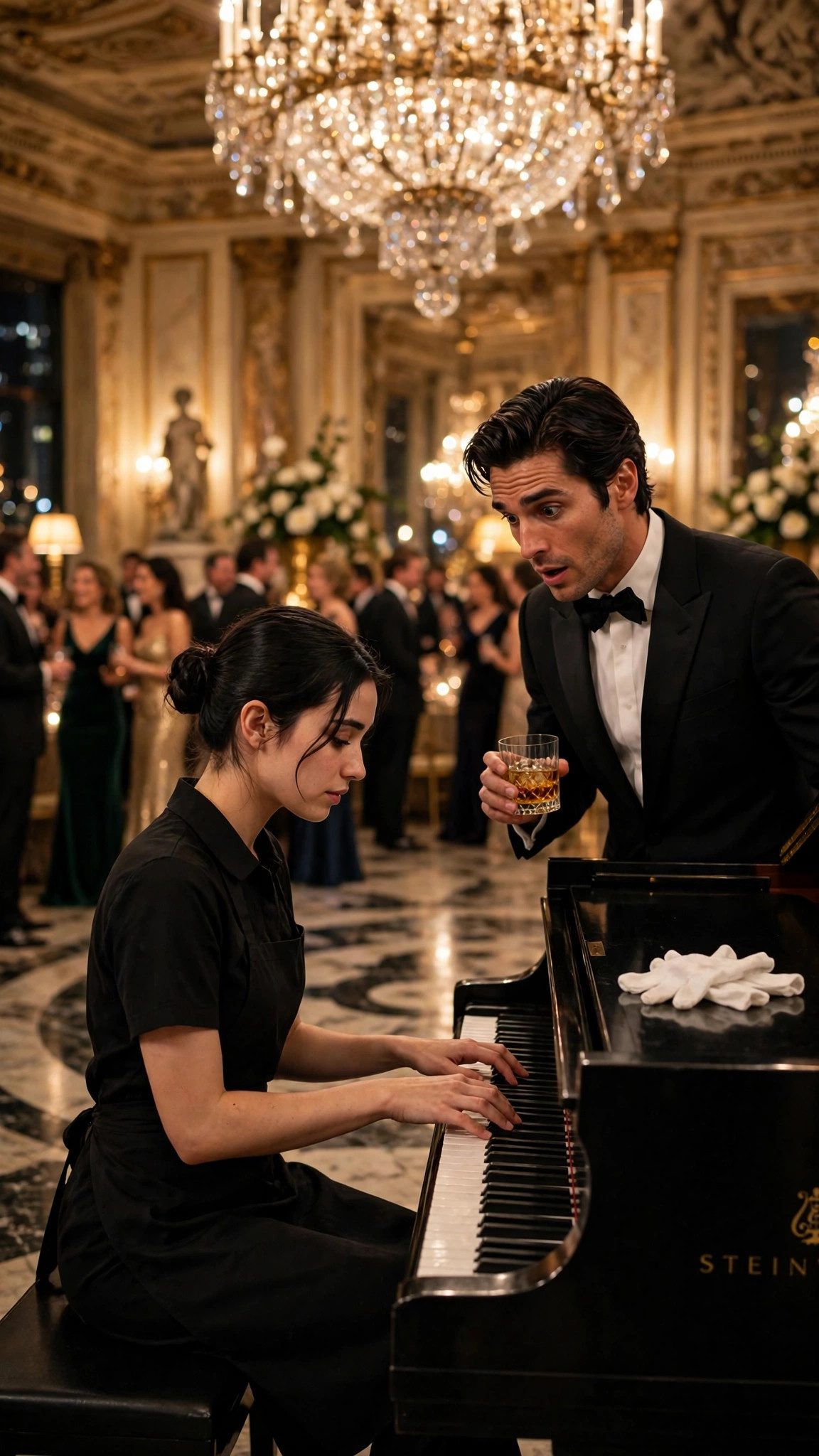
Dinner at Dominic Vale's house was not what I expected.
I had expected a mansion — marble and chandeliers, like Hawthorne Estate, but colder, more fortress than home. Instead, the car pulled up to a brownstone on a quiet street lined with old trees, and the house inside was warm and lived-in, with books stacked on tables and a fire burning in the living room and a kitchen that smelled of garlic and rosemary.
"I cook," Dominic said, when he saw my surprise. He was standing in the kitchen in a black sweater and jeans, sleeves rolled up, holding a wooden spoon like a weapon. "Badly, most of the time. But I cook. My mother taught me before she died, and I have never trusted a chef to make her sauce."
He made pasta. He burned the garlic slightly and pretended not to notice. He poured red wine into two glasses and set them on a small wooden table by the fire, and for the first hour, we did not talk about the promise, or the gala, or Caroline, or Marcus Hale. We talked about music. He asked me about my father. He asked me how I had learned the Rachmaninoff. He listened the way my father used to listen — completely, without checking his phone or looking past me, as if what I was saying were the only thing in the room.
And then, halfway through the meal, I told him everything.
I told him about Caroline and the recording lie. I told him about Marcus Hale and the card with no name on it. I told him about the threat to Nora. I laid it all out on the table between us, the way you lay out evidence, and I watched his face change as I spoke — the warmth draining out of it, replaced by something cold and still and very, very dangerous.
When I finished, Dominic was quiet for a long moment. Then he stood up, walked to the window, and looked out at the dark street for a while without speaking.
"Marcus Hale," he said finally, "does not work for me. He works for Vincent Castellano."
"Who is Vincent Castellano?" I asked.
"The man who has been trying to kill me for ten years," Dominic said, turning back to me. "The head of the Castellano family. The man who ordered the hit on my father, and who has been waiting ever since for a weakness he could use against me." He paused. "Last night, I gave him one. You."
I felt the blood drain from my face. "Me?"
"You are the most famous woman in Chicago today," Dominic said, sitting back down across from me. "Eleven million people have watched you play my piano. Every newspaper in the city has your photograph. And last night, in front of four hundred witnesses, I promised to marry you. Do you understand what that makes you, Elena? It makes you the most valuable hostage in this city. Castellano doesn't need to hurt me. He only needs to hurt you, and I will do whatever he asks."
"Then unpromise it," I said, and my voice came out sharper than I intended. "Take it back. Tell everyone it was a joke. I don't want to be a hostage, Dominic. I don't want to be a promise, either."
"I can't take it back," he said quietly. "Not because of my pride. Because of my uncle Anthony, and the council, and the four hundred people who heard me say it. If I break my word publicly, I lose the families. If I keep it, I put you in danger. Either way, someone pays." He looked at me, and his dark eyes were full of something I had not seen in them before — not anger, not amusement, but guilt. "I am sorry, Elena. I made a joke at a party, and it has put your life in danger. That is not a thing I can fix with an apology."
"Then fix it another way," I said.
He almost smiled. "You sound like my mother. She used to say that too. 'Fix it another way, Dominic. Apologies are just words with nowhere to go.'"
We sat in silence for a moment, the fire crackling, the pasta going cold on our plates. Then Dominic's phone buzzed, and he glanced at it, and his whole body went rigid.
"What is it?" I asked.
"My security team," he said, standing up fast. "Two men were seen near the staff entrance at Hawthorne. They asked for you by name. They were turned away, but —" He stopped, listening to something on the phone, his jaw tightening. "Nora," he said. "They asked about Nora too."
My heart stopped. "Nora is at the estate. She was going to stay late to finish the linen inventory—"
"She's safe," Dominic said quickly, but his voice was tight. "My men are with her now. But Elena —" He looked at me, and I saw the fear in his eyes, real and unguarded. "They know where you live. They know where Nora lives. Castellano is not going to wait for you to decide anything. We need to move you. Tonight. Now."
I did not argue. I had seen enough in the last twenty-four hours to know that when Dominic Vale tells you to move, you move.
He drove me himself — no driver, no security car, just his black sedan moving fast through the dark streets, his eyes flicking constantly to the mirrors. He took me to a small apartment above a bakery on the west side, a safe house, he said, that only three people knew about. He gave me a phone with a single number programmed into it — his — and he told me to lock the door and not to open it for anyone, not even him, unless he called first.
"I'll be back in the morning," he said, standing in the doorway, his hand on the frame. "My uncle and I are meeting with the FBI tonight. There is an agent — Daniel Reyes — who has been building a case against Castellano for two years. Your friend Marcus Hale is one of his targets. If we give Reyes what he needs, this ends. Not with a war. With the law."
"The law," I repeated. "You believe in the law?"
Dominic smiled, tired and honest. "I believe in whatever keeps you alive, Elena. Tonight, that happens to be the law."
He stood up then, and walked to the small bookshelf beside the fireplace, and ran his fingers along the spines of the books — old books, worn books, the kind of books that have been read more than once. He pulled one out, a thin volume with a cracked leather cover, and held it out to me.
"My mother's," he said. "A book of poetry. She used to read it to me when I was a boy, before bed, even after I was too old for bedtime stories. She said that a man who cannot sit still for a poem will never sit still for anything that matters." He smiled, a little sadly. "I was a terrible student. I fidgeted. I asked when it would be over. But I remember every word of this one."
He opened the book to a page marked with a ribbon, and he read aloud, in his deep, steady voice: "'I will arise and go now, and go to Innisfree, and a small cabin build there, of clay and wattles made.' Yeats. My mother loved Yeats. She said he understood that peace is not something you find. It is something you build, with your own hands, in a small place, one stone at a time."
He closed the book and set it gently back on the shelf. "I have spent ten years building a fortress, Elena. Walls. Guards. Men with guns at every door. And tonight, sitting here with you, I realized that I have never built a single thing that was meant to be peaceful. Not one. I don't know how. But I would like to learn."
I looked at him — at the feared man in the black sweater, standing in his mother's living room with a book of poetry in his hands — and I understood, suddenly, that Dominic Vale was not one man but two: the man the city feared, and the man his mother had raised. And I wondered which one would survive the night.
"I'll learn with you," I said quietly. "If you'll let me."
He looked at me for a long moment, and then he nodded, once, the way a man nods when he has just made a decision he cannot take back.
"Then let's start," he said. "Tomorrow. With the law. With Reyes. With all of it."
He left, and I locked the door, and I sat on the bed in the dark apartment above the bakery, listening to the city hum below me, and I thought about how strange my life had become. Three days ago, I was a maid who carried champagne and watered flowers by the east staircase. Now I was hiding in a safe house because a mafia boss had promised to marry me as a joke, and a rival family wanted to use me as leverage, and the FBI wanted my testimony.
I did not sleep. I sat by the window and watched the street, and I thought about my father, and about the piano, and about the fact that I had spent two years hiding from music because it hurt too much to remember him — and now music was the reason I was hiding in the dark, afraid for my life.
At three in the morning, my phone buzzed. Not Dominic's phone — my own phone, the one I had owned for four years. The screen showed a number I did not recognize.
I almost didn't answer. Then it buzzed again. And again.
"Elena Carter," a voice said when I finally picked up. It was a woman's voice — smooth, educated, and very calm. "This is Caroline Whitmore. I know where you are. Not exactly — but I know you're not at Hawthorne, and I know Dominic moved you tonight, and I know why. So listen carefully, because I am only going to say this once."
"What do you want, Caroline?" I asked, my voice shaking.
"I want you to understand something," she said. "My father owes Vincent Castellano four million dollars. Four million. If I don't marry Dominic Vale, Castellano takes everything — the house, the business, my father's life. Maybe mine too. So when I tell you that I will do anything to fix this, I mean anything. I hired the pianist in that video. I invented the recording story. And if that doesn't work, I will invent something worse."
"Why are you telling me this?" I asked.
"Because Marcus Hale works for Castellano, and Castellano works for no one, and if he takes you tonight, he will not give you back," Caroline said, and for the first time, her voice cracked — not with anger, but with something that sounded almost like fear. "I hate you, Elena. I hate that you sat down at that piano and played better than anyone I have ever heard. But I do not want you dead. So here is my advice, and it is the only honest thing I will ever say to you: do not open that door tonight. Not for anyone. Not even for Dominic. Castellano's men are already on your street."
The line went dead.
I stood frozen in the dark apartment, my heart hammering so hard I could feel it in my throat. Outside, the street was quiet. Too quiet. The bakery below was dark. A car I had not noticed before was parked across the street, its headlights off, its engine running.
And then I heard footsteps on the stairs.
Slow. Deliberate. Coming up toward my door.
I grabbed Dominic's phone and pressed the single number, my fingers shaking so badly I almost dropped it.
"Dominic," I whispered, when he answered on the first ring. "They're here. On the stairs. Right now."
"Don't open the door," he said, and his voice was calm, but I could hear the engine of his car in the background, and I knew he was already driving. "Don't make a sound. I'm four minutes away. Four minutes, Elena. Just hold on."
The footsteps stopped outside my door. A hand knocked — three slow knocks, polite as a dinner guest.
"Miss Carter," a man's voice said through the door. "My name is Marcus Hale. I believe we have an appointment. Open the door, please. I would hate to have to open it for you."
I pressed myself against the wall beside the door, holding the phone to my ear, listening to Dominic's breathing on the other end of the line, and to the sound of a lock being picked on the other side of the door.
"Elena," Dominic said quietly. "Whatever happens, do not let them take you out of that building. Scream. Fight. Break something. Make noise. The neighbors will hear. Four minutes."
The lock clicked. The door began to open.
And then, from the street below, came the sound of sirens — not one, but many, converging from every direction — and the sound of Dominic's car screeching to a stop, and his voice shouting my name from the stairwell, and Marcus Hale's voice cursing, and running footsteps going down, away, fast.
The door slammed shut again. I slid down the wall to the floor, shaking, and I stayed there until Dominic burst into the room a minute later, his face white, his hands reaching for me, pulling me up, holding me so tightly I could barely breathe.
"You're safe," he said, over and over, into my hair. "You're safe. You're safe. Reyes's men were already on the street — I called him the moment you told me about Marcus. They've got him. They've got all of them."
I clung to him, shaking, and I thought about Caroline Whitmore — the woman who hated me, who had lied about me, who had threatened me — calling me at three in the morning to warn me. And I thought about my father, and about the piano, and about the fact that I had spent two years hiding from the world because it hurt too much to be seen.
I was done hiding.
"Dominic," I said, pulling back just enough to look at him. "Tomorrow, I'm going to play the concerto again. In public. In front of everyone. And this time, nobody is going to decide for me what happens next."