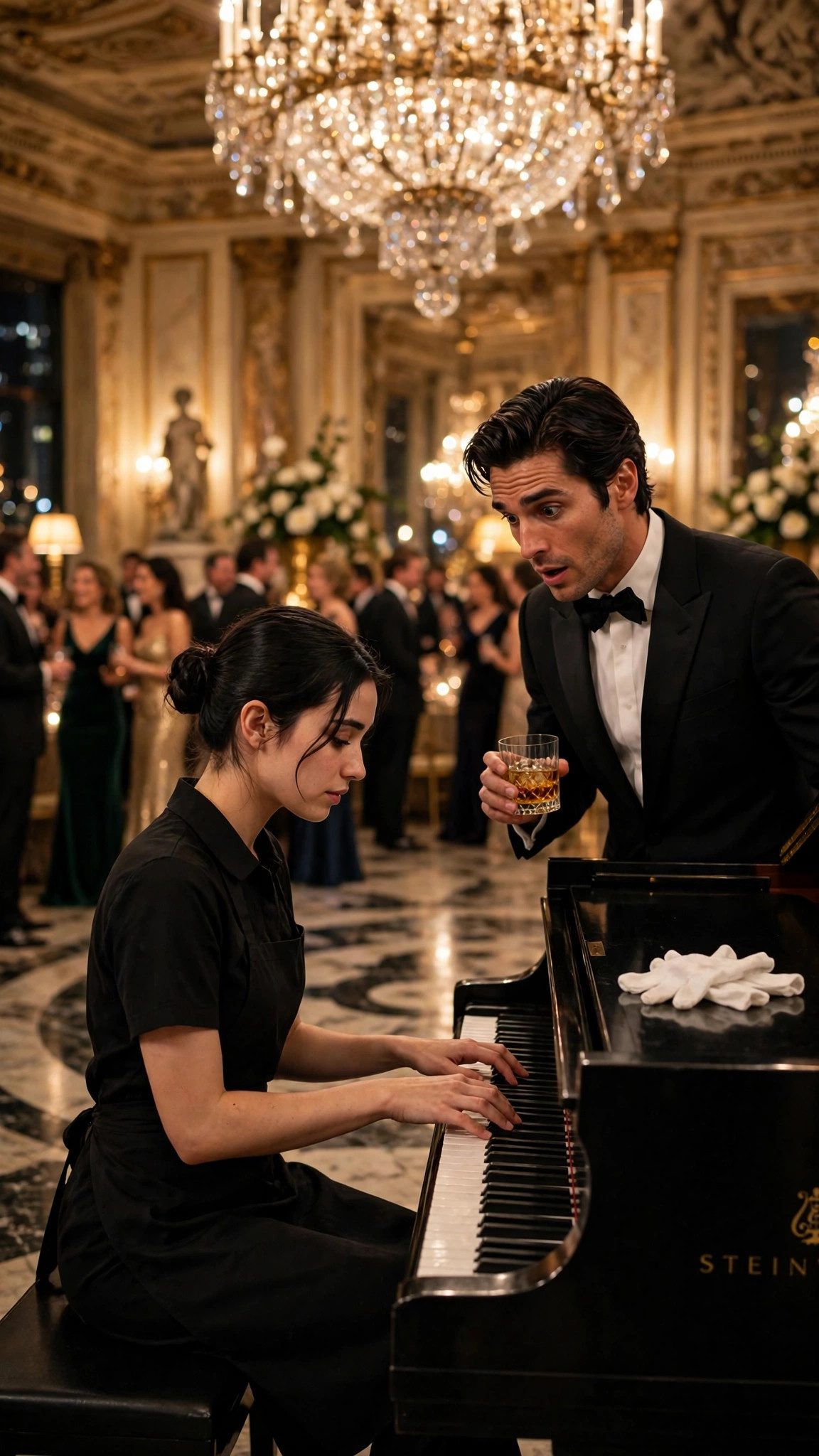
The morning after the gala, Hawthorne Estate woke up to find itself famous.
By nine o'clock, the video of me playing the Rachmaninoff had been viewed two million times. By noon, it was eleven million. A society reporter had filmed the whole performance on her phone from the third row, and by the time I woke up in my small third-floor room, my face was on every news site in Chicago, and my phone — which I had owned for four years and which had never once rung before noon — would not stop ringing.
Nora burst into my room without knocking, waving her own phone at me like a flag. "Eleven million views!" she shouted. "Elena, you are famous! People are calling you the Maid Pianist! There is a hashtag! Someone has already made a fan page!"
"I don't want a fan page," I said, pulling the blanket over my head.
"Too late," Nora said, yanking the blanket back. "Also, Dominic Vale's office called. Twice. Dinner is at seven tonight, at his house, not the estate. A car will come for you at six-thirty. Also, Caroline Whitmore's father called the estate manager and demanded to know why a maid was allowed to touch a piano worth a quarter of a million dollars. Also — and this is my favorite part — three different concert halls have called asking if you will perform for them."
I sat up slowly. "I don't perform. I played one concerto at a party. That was an accident."
"An accident that eleven million people watched," Nora said. "Get up. You have a dinner to get ready for, and I am going to help you pick something to wear, because if you show up in your uniform, I will personally disown you."
But before dinner, before the car, before any of it, there was the morning — and the morning began in the kitchen, where the staff had gathered around Nora's phone to watch the video for the tenth time.
"Look at Dominic's face," said Tomas, the waiter, pointing at the screen. "Right there. When she hits the high part. He looks like someone just told him the building is on fire."
"Eleven million views," said Mrs. Delaney, the head housekeeper, shaking her head in wonder. "I have worked at Hawthorne for thirty-one years, and I have never seen anything like this. The phone has not stopped ringing since seven this morning. The estate manager says we may need to hire extra staff just to answer it."
I stood at the edge of the group, holding a tray I did not need, feeling like a stranger at my own party. These were my people — the kitchen staff, the cleaners, the gardeners, the men and women who made Hawthorne Estate run while the rich people upstairs pretended it ran itself — and they were looking at me differently now. Not with resentment. With pride. With something that felt uncomfortably like hope.
"My daughter watched it three times," said Rosa, one of the cleaners, a woman in her fifties with graying hair and hands rough from years of work. "She wants to learn the piano now. She asked me this morning if we could afford lessons." Rosa laughed, a little embarrassed. "I told her we would find a way. I don't know how, but we will find a way."
I felt my throat tighten. "Rosa," I said, "if she wants lessons, I will teach her. For free. On my days off. I don't have a piano anymore, but the estate has three, and I am sure —" I stopped, because I was not sure of anything, least of all what the estate manager would say about a maid giving piano lessons on the Steinway. But Rosa's face lit up like a sunrise, and she grabbed my hands across the kitchen counter, and she said, "You are a good girl, Elena Carter. Your father would be so proud of you."
That was when the estate manager appeared in the kitchen doorway, his face pale, his tie crooked, and said, "Elena. A word. In my office. Now."
His office was small and smelled of coffee and old paper. He closed the door behind us and sat down heavily behind his desk, and he looked at me for a long moment without speaking.
"Elena," he said finally, "I have worked at Hawthorne for twenty years, and I have never had a morning like this one. The board of directors has called. The owners have called. Three newspapers have called. A woman from a television station is sitting in the lobby right now, and she will not leave until she speaks to you." He rubbed his forehead. "I don't know what to do with you, Elena. You are the most famous maid in America, and I don't know whether to give you a raise or fire you for touching a piano worth a quarter of a million dollars."
"I'm sorry," I said, and I meant it. "I didn't plan any of this."
"I know you didn't," he said, sighing. "That's the problem. If you had planned it, at least I could be angry at you in an organized way." He stood up and walked to the window, looking out at the gardens. "Listen to me, Elena. Whatever happens next — whether you marry Dominic Vale or not, whether you become famous or not — you will always have a job here. That is a promise, and I don't make promises lightly. You have worked here for three years, and you have never once been late, and you have never once complained, and you watered the flowers by the east staircase even when nobody asked you to. That counts for something. That counts for a great deal."
I thanked him, and I meant that too, and I walked out of his office with my head a little higher than it had been when I walked in.
And then, in the ballroom, the morning belonged to Caroline Whitmore.
She came to Hawthorne at eleven, in a black dress and dark sunglasses, with her father's lawyer walking two steps behind her carrying a leather briefcase. She did not ask for me at the front desk. She went straight to the estate manager's office, and when she came out twenty minutes later, she found me in the ballroom, where I had gone — I do not know why, except that my feet had taken me there on their own — to look at the Steinway one more time.
The piano stood in the morning light, its lid closed now, the white rose from the night before still lying on top of it, wilting. I touched the lid gently, the way you touch a sleeping animal.
"Enjoying your moment?" Caroline said from the doorway.
I turned. She had taken off her sunglasses, and her eyes were red — not from crying, I thought, but from anger held too long without sleep. Her beautiful face looked drawn and sharp, like a photograph left out in the sun.
"I didn't plan it," I said.
"Of course you didn't," Caroline said, walking slowly toward me across the marble floor, her heels clicking. "Maids never plan anything. They just happen to be piano prodigies who sit down at the exact right moment in front of the exact right audience. How convenient for you."
"I played because you told me to try," I said quietly. "Those were your words. 'Why don't you try, Elena?'"
Her mouth tightened. "I was mocking you. Everyone knew I was mocking you. You were supposed to fail. You were supposed to sit down and stumble through a few bars and give everyone a good laugh, and then go back to your champagne glasses, and Dominic would forget about you by midnight."
"But I didn't fail," I said.
"No," Caroline said. "You didn't fail. You ruined everything."
She stopped a few feet from me, and for the first time, the polished mask slipped, and I saw what was underneath: not just anger, but fear. Real, desperate fear.
"Do you know what my father owes?" she said, her voice dropping low. "Do you know what happens to my family if I don't marry Dominic Vale? The Whitmore name is four generations old, Elena. Four generations of real estate, and my father borrowed against all of it, and the men he borrowed from do not send polite letters. They send men with hammers."
I stared at her. "That is not my problem."
"It is your problem now," Caroline said, and her voice turned cold and sharp as broken glass. "Because I am going to fix this. Dominic made a promise in front of four hundred people, and he is an honorable man, which is his weakness. But a promise made to a fraud is not binding, Elena. And by tonight, everyone in Chicago will know that you are a fraud."
"A fraud?" I said. "I played the concerto. Four hundred people heard me play it."
"Did they?" Caroline smiled, and it was the ugliest smile I had ever seen. "Or did they hear a recording?"
She opened her purse and took out her phone, and she held it up so I could see the screen. On it was a video — grainy, taken from a bad angle — of a woman in a black dress sitting at a piano in a dark room. The woman's face was hidden. Her hands moved across the keys. The music was the Rachmaninoff, note for note.
"My friend in New York found this yesterday," Caroline said. "A concert pianist — a real one, with a degree and a career — playing the same concerto in a practice room. The recording is forty minutes long. Long enough to cover your entire performance." She slipped the phone back into her purse. "All I have to do is suggest that a hidden speaker was placed under the piano, and that you were only pretending to play while the recording did the work. People will believe it. People always believe the worst explanation, Elena. It is easier than believing the best one."
"That's a lie," I said, and my voice shook — not with fear, but with anger. "You know it's a lie."
"Prove it," Caroline said. "Play it again. Right now. Here. In this empty ballroom, with no audience and no recording. Play the concerto again, and if you can do it twice, I will leave you alone."
I looked at the piano. I looked at Caroline. And I understood, suddenly and clearly, what she was doing. She was not asking me to prove myself. She was trying to make me perform on command, like a trick dog, so that she could decide whether I was allowed to exist.
"No," I said.
Caroline blinked. "What?"
"No," I repeated, and my voice was steady now. "I will not play for you. I played last night because the music was there and my hands remembered it. I will not play on command to prove to you that I am real. I am not your entertainment, Caroline. I am not your fraud, and I am not your problem to fix. If Dominic wants to hear me play again, he can ask me himself."
For a moment, neither of us spoke. Then Caroline laughed — a short, brittle sound, like ice cracking.
"You're braver than I thought," she said. "That won't save you. By tonight, the story will be everywhere. The maid who faked it. The recording under the piano. You will see."
She turned and walked out of the ballroom, her heels clicking across the marble, and I stood alone beside the Steinway, my hands shaking, my heart hammering, and I realized that I had just made my first enemy as a free woman — and that she was right about one thing.
By tonight, the story would be everywhere.
But Caroline Whitmore was not the only person who came looking for me that day.
At three in the afternoon, a black car pulled up to the staff entrance of Hawthorne Estate, and a man I had never seen before asked for me by name. He was in his fifties, with graying hair and a suit that cost more than my father's old upright had cost when it was new, and he introduced himself as Marcus Hale, a business associate of Dominic Vale's. He had a soft voice and a patient smile, and he asked if we could talk somewhere private.
"I represent certain interests," he said, once we were sitting in the empty staff lounge, "that would like to make you an offer."
"What kind of offer?" I asked.
"A simple one," Marcus said, folding his hands on the table. "You walk away. You leave Chicago. You never play the piano in public again, and you never speak to Dominic Vale again. In exchange, you receive a sum of money — enough to live comfortably for the rest of your life — and a house, anywhere you like, and the gratitude of people who do not forget their friends."
"And if I refuse?" I asked.
Marcus smiled, and the smile did not reach his eyes. "Then you should understand something, Miss Carter. Dominic Vale is a dangerous man with dangerous enemies. The promise he made last night has made you important. Important people get hurt in this city. It would be a shame if something happened to you — or to your friend Nora, who seems very dear to you — before you had the chance to enjoy your new fame."
I felt cold then, the way you feel cold when you step into deep water and the bottom drops away beneath your feet. This was not Caroline's petty cruelty. This was something older and darker, and I understood, with a clarity that frightened me, that Marcus Hale did not work for Dominic Vale at all.
"Who do you work for?" I asked.
"That doesn't matter," Marcus said, standing up and straightening his jacket. "What matters is that you have until tomorrow morning to decide. I suggest you decide wisely."
He left a card on the table — no name, only a phone number — and walked out, and I sat alone in the staff lounge for a long time, looking at that card, and thinking about my father, and about the piano, and about the fact that I had played one concerto at a party and somehow, in a single night, I had become important enough to threaten.
At six-thirty, Dominic's car came for me, as promised. I got into the back seat in the only dress I owned that was not a uniform — a simple dark blue dress I had bought three years ago for a job interview — and I rode through the evening streets of Chicago toward Dominic Vale's house, and I decided, somewhere between the river and the lake, that I was done being afraid.
I would go to dinner. I would tell Dominic everything — about Caroline, about the recording lie, about Marcus Hale and his card. And then I would decide for myself what happened next.
Not Caroline. Not Marcus. Not four hundred guests, and not a promise made as a joke.
Me.