Three months later, I played the Rachmaninoff again.
This time, it was not at a charity gala. It was not in front of four hundred people who had come to drink champagne and pretend to care about a fundraiser. It was at Symphony Center in Chicago, on a stage lit like a sunrise, with a full orchestra behind me and two thousand people in the audience who had come for one reason only: to hear the music.
The concert had been Dominic's idea. Or rather, it had been my condition, and Dominic had made it happen the way he made everything happen — quickly, completely, and with an attention to detail that would have impressed my father.
"You said you would play in public, as often as you wanted," he had said, the morning after we left the hospital. "So play. Play for two thousand people. Play for the whole city. Let them hear what I heard that night."
I had laughed. "You want me to perform at Symphony Center? Dominic, I haven't played in public since I was seventeen, and that was in a church basement."
"And three nights ago," he said, "you played Rachmaninoff in front of four hundred people and eleven million more on the internet, and you did not miss a single note. You are ready, Elena. You have always been ready. You were just waiting for someone to open the lid."
So I practiced. Every day, for three months, in a practice room at the conservatory that Dominic had quietly rented for me — not bought, rented, because he knew I would not accept a gift that big, and because he was learning, slowly, how to love a woman who did not want to be owned. I practiced the Rachmaninoff until my fingers ached and my shoulders burned, and then I practiced it some more, because a gift is a responsibility, and I had two years of silence to make up for.
Nora came to every rehearsal. She sat in the back row with a bag of cookies and a notebook, and she wrote down everything the conductor said, and she told me afterward, in great detail, which parts had made her cry and which parts had made her want to stand up and cheer. "The second movement," she said after the final rehearsal, wiping her eyes. "The slow one. The one that sounds like remembering someone you loved. That one made me cry so hard I had to pretend I had something in my eye for twenty minutes."
The night of the concert, I stood in the wings of Symphony Center in a black dress — not a uniform, a dress, simple and elegant, the first beautiful thing I had ever owned that was truly mine — and I looked out at the audience, and I saw Dominic in the front row, in a black tuxedo with a bow tie that sat perfectly straight, and I saw Nora beside him, and I saw Caroline Whitmore three rows back, sitting alone, her hands folded in her lap, her face unreadable.
Caroline had come to see me the week before the concert. She had stood in the doorway of my practice room, awkward and stiff, holding a small wrapped box, and she had said, "I came to apologize. Properly. Not because my lawyer told me to, but because I owe you one."
I had stared at her, unsure what to say.
"I was cruel to you," Caroline said, setting the box down on the piano. "I lied about you. I tried to destroy you. And then you —" She stopped, and her voice cracked. "Then you warned me. No — then I warned you. At three in the morning. I called you because I didn't want you to die, and I have spent three months trying to understand why I did that, when I had every reason to let Castellano take you."
"Why did you?" I asked.
Caroline was quiet for a moment. Then she said, "Because when you played that concerto, I heard something I had never heard before. I heard a person who was not afraid. And I realized that I had spent my whole life being afraid — afraid of my father's debts, afraid of losing my place, afraid of being nobody — and I had let that fear turn me into someone I didn't like. You weren't afraid, Elena. And for three minutes in the middle of the night, I wanted to be like you."
She opened the box. Inside was a pair of white gloves — new ones, soft leather, beautiful.
"I bought them for you," she said. "For the concert. Not as an apology. As a thank you. For reminding me that I get to choose who I am."
I had hugged her then — awkwardly, stiffly, two women who had been enemies and were not quite friends yet, but who were no longer strangers either. And now, on the night of the concert, she sat in the third row, and when I walked onto the stage, she was the first person to applaud.
The orchestra began. The eight quiet chords rose like waves gathering far out at sea. And I played.
I played for my father, who had taught me that a gift is a responsibility. I played for the seven-year-old girl in the church basement who had heard morning in a single note. I played for the seventeen-year-old girl who had taught herself Rachmaninoff in the dark with headphones on. I played for the woman who had stopped playing for two years because it hurt too much to remember, and who had found her way back through a ballroom full of strangers and a promise made as a joke.
And when the final chords came down, enormous and certain, and the hall erupted — two thousand people on their feet, shouting, crying, throwing roses onto the stage — I stood up from the piano, and I looked out at all of them, and I was not invisible anymore.
I never would be again.
The wedding was a month later, at Hawthorne Estate, in the same ballroom where it had all begun.
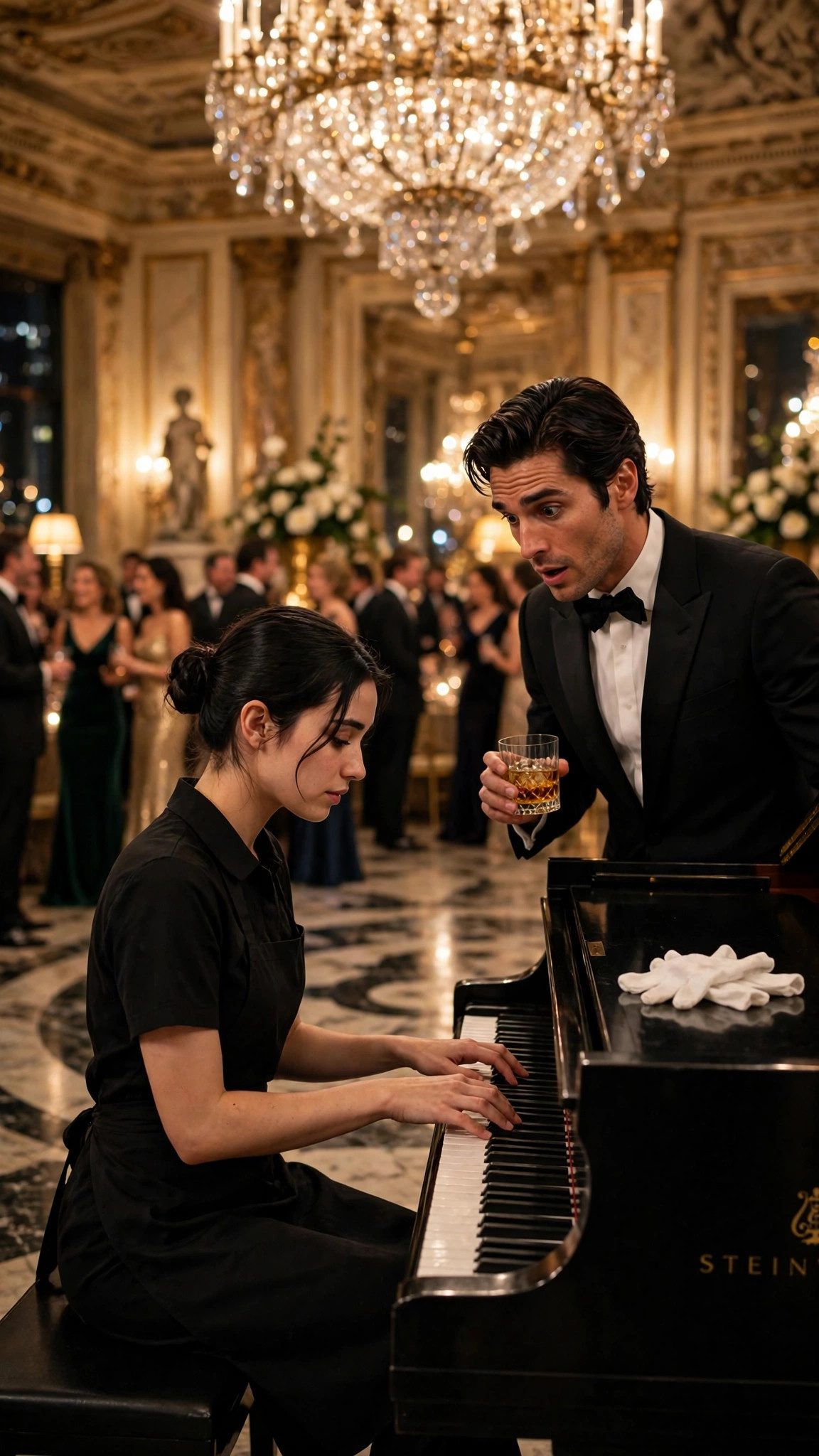
It was a small wedding, by Vale family standards — only two hundred guests, which Dominic's uncle Anthony called "intimate" and Nora called "still completely insane." The chandelier was lit. The marble floor gleamed. The Steinway stood at the far end of the ballroom, its lid raised, waiting.
I walked down the aisle in a white dress, and Dominic waited for me at the piano, and when the ceremony was over, and the guests were cheering, and the champagne was flowing, I sat down at the Steinway one more time.
"Play something for us," Dominic said, standing beside me, his hand resting lightly on my shoulder.
I looked out at the ballroom — at Nora, crying happily in the front row; at Anthony, smiling for the first time I had ever seen; at Caroline, raising her glass in a toast; at the two hundred guests who had come to celebrate a maid and a mafia boss — and I thought about my father, and about the morning in the church basement, and about the night I had sat down at this piano and changed my life with ten notes.
I played the Chopin nocturne my father had loved best. The slow one. The one that sounds like remembering someone you loved.
And as I played, Dominic stood beside me, and the ballroom went quiet, and the music rose toward the chandelier like light, and when the last note faded, the room erupted — not with the shocked silence of the gala, but with joy, pure and uncomplicated, the sound of two hundred people who were happy and did not care who knew it.
Then Anthony Vale stood up.
Dominic's uncle — the consigliere, the man who had called him three times on the night of the gala, the man who had warned him that marrying a maid would cost him the respect of every family in the city — stood up with his champagne glass in his hand, and he waited for the room to quiet, and when it did, he cleared his throat and said, "I have known Dominic Vale since he was born. I held him in this very house when he was three days old. And I have spent the last ten years watching him become the most feared man in Chicago, and I have spent the last ten years worrying that fear was all he would ever be."
He paused, and his old eyes found mine across the ballroom.
"Tonight," Anthony said, "I watched a maid sit down at a piano and remind my nephew that there are things in this world more powerful than fear. Music. Courage. Love. And I watched my nephew choose those things. So I will say this, in front of all of you, and I do not say it lightly: Elena Carter is not marrying into the Vale family tonight. The Vale family is marrying into hers."
The room erupted again, and Dominic — Dominic, who had faced down hitmen and rival families and federal agents without flinching — stood beside the piano with tears in his eyes, and he did not try to hide them.
Then Nora stood up, and the room laughed before she even opened her mouth, because Nora has that effect on people.
"I have known Elena for three years," Nora said, raising her glass. "I have known her as the woman who waters the flowers by the east staircase even when nobody asks her to. I have known her as the woman who cries in the linen closet on the anniversary of her father's death and then goes back to work with dry eyes and a steady smile. I have known her as the woman who hums Chopin while she polishes silverware and pretends she doesn't know she's doing it."
She paused, and her voice went soft.
"And now I know her as the woman who sat down at a piano in front of four hundred people and played like the whole world was listening — because it was. Elena, you taught me something. You taught me that being invisible is a choice, and that you can unchoose it any time you want. So here is my toast: to Elena Carter Vale — who was never invisible. We were just not looking hard enough."
I cried then. I cried in my white dress, in front of two hundred people, and Dominic handed me his handkerchief, and Nora cried too, and Anthony pretended he had something in his eye, and it was, without question, the happiest moment of my life.
But the night was not over.
After the toasts, after the dancing, after the cake had been cut and the champagne had been poured and the ballroom had settled into the warm, golden hum of a celebration winding down, Dominic took my hand and led me to the Steinway, and he said, "I have one more surprise for you. Or rather, you have one more surprise for them."
He nodded toward the back of the ballroom, and the doors opened, and a group of children walked in — twelve of them, ages seven to fourteen, dressed in their best clothes, nervous and excited and trying very hard not to stare at the chandelier. At the front of the group was a little girl with dark hair in braids, holding the hand of Rosa, the cleaner from the kitchen, who was beaming with pride.
"This is Rosa's daughter," Dominic said quietly. "And these are the children of the staff at Hawthorne Estate. The children of the people who make this place run."
I looked at him, confused. "Dominic, what is this?"
"This," he said, "is the first class of the Daniel Carter School of Music."
I stared at him. I could not speak.
"Free lessons," Dominic said. "For the children of the staff. For any child in Chicago whose family cannot afford a conservatory. Taught by you, Elena — when you want, as often as you want, in whatever way you want. The estate will fund it. I will fund it. It will be named after your father, because he was a man who tuned other people's pianos and taught his daughter that a gift is a responsibility, and because no child should have to learn music the way you did — through rehearsal doors and borrowed recordings and abandoned practice rooms."
The little girl with the braids stepped forward then, shyly, and held out a small bouquet of white lilies.
"Miss Elena," she said, in a voice barely above a whisper, "my mom says you're going to teach me to play the piano. Is that true?"
I knelt down beside her, in my white dress, on the marble floor of the ballroom, and I took the lilies, and I looked into her dark, hopeful eyes, and I thought about a seven-year-old girl in a church basement in Milwaukee, sitting on a wooden folding chair with her legs dangling, listening to her father tune an old upright piano.
"Yes," I said. "It's true. And the first thing I'm going to teach you is what my father taught me. A gift isn't a crown. It's a responsibility. And you, my dear, are going to learn to carry it very, very well."
The little girl beamed. The ballroom applauded. And Dominic knelt down beside me, in his tuxedo, on the marble floor, and he kissed my forehead, and he whispered, "Your father would be so proud of you."
I knew he was right.
And as I played, Dominic stood beside me, and the ballroom went quiet, and the music rose toward the chandelier like light, and I understood, finally, what my father had meant all those years ago.
A gift isn't a crown. It's a responsibility.
And for the first time in my life, I was carrying it the way it was meant to be carried — not hidden, not buried, not packed away in the dark, but out in the open, in the light, where everyone could hear it.
Where everyone could hear me.
The End.
THE END