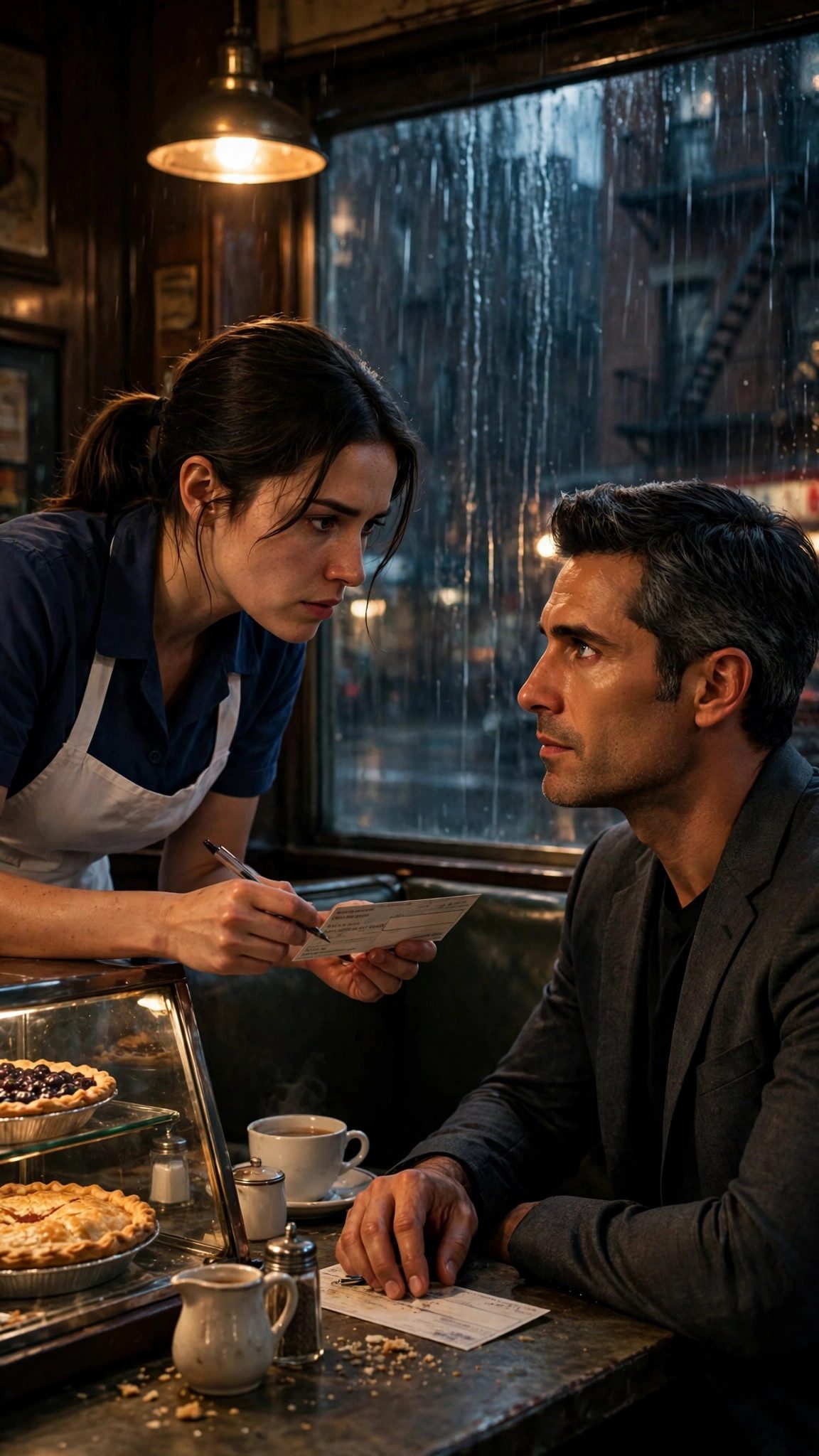
The next day, everything changed, and nothing changed. I still poured coffee. I still carried plates. I still counted tips. But now Marco's Lincoln sat across the street from the diner every night, and now I knew the name of the man who had ordered my brother's death, and now I knew that the most feared man in Brooklyn was sleeping no better than I was.
Adrian called me at noon. Not on the card's number — he called the diner's phone, during the lunch rush, and asked for me by name, and Joe Barone handed me the receiver with his eyebrows raised so high they nearly touched his hairline.
"Don't come to the diner tonight," Adrian said. "Take the night off. Tell Joe you're sick. I'll send a car at eight."
"I can't just not show up," I said. "Joe needs me on nights."
"Joe will survive one night," Adrian said. "And Emily — bring the notebook."
I hung up and told Joe I had a fever coming on. He looked at my face, which must have shown exactly how little sleep I had gotten, and said, "Go home, kid. Rest. Marcus can cover."
At eight o'clock, a black Lincoln pulled up in front of my building, and Luca — the youngest of Adrian's men, the one who checked his phone every thirty seconds — opened the back door for me like I was someone important. He was twenty-six, with dark curls and a nervous energy that made him seem younger, and he kept glancing at the mirrors the whole drive, the way Danny used to when he thought someone might be following us.
"Does Mr. Moretti always send a car for waitresses?" I asked.
Luca almost smiled. "He doesn't send cars for anyone, miss. He sends cars for people he owes. And he says he owes you his life, so —" He shrugged. "Here we are."
The car took me to a house in Bay Ridge I had never seen before, a brownstone with a garden in front and warm light in the windows, nothing like the fortress I had imagined a Mafia boss would live in. Inside, the house smelled of coffee and old books. A woman in her sixties with silver hair and Adrian's gray eyes opened the door and looked me up and down with the frank assessment of a woman who has raised a son in a dangerous world.
"So you're the girl with the numbers," she said. "I'm Rosa. Adrian's mother. Come in, child. You look like you haven't eaten in days."
Rosa Moretti fed me before Adrian would talk business. She put a plate of pasta in front of me and a glass of red wine beside it and sat across the table and asked me about my life with the directness of a woman who has no patience for evasion. I told her about Philadelphia. I told her about Danny. I told her about the diner and the three years of not getting involved. She listened without interrupting, and when I finished, she reached across the table and took my hand.
"My son has carried your brother for three years," she said. "He doesn't sleep. He doesn't eat properly. He works until he drops, and then he works more. I have prayed for the day someone would come along who understood what he was carrying. I didn't think it would be a waitress from a diner, but God has a sense of humor, so here you are."
Adrian came downstairs then, in a sweater instead of a suit, looking younger and more tired than I had ever seen him. He sat beside his mother, and the three of us ate in silence for a while, the way families do when the food is good and the conversation is waiting.
After dinner, Rosa went to the kitchen, and Adrian and I sat in the living room with Danny's notebook open on the coffee table between us. I had brought it, wrapped in the same plastic bag, and Adrian handled it the way you handle something sacred — carefully, with both hands.
"He kept records of everything," Adrian said, turning the pages slowly. "Look. Here. The warehouse schedule. The delivery routes. The names of Castellano's men. Danny was building a case, Emily. He wasn't just driving. He was watching, and writing it all down, because he knew that one day someone would need it."
He stopped at the page with the circled initials. "E.F.," he read aloud. "With a phone number. Do you know what this is?"
"No," I said. "I never understood that page."
Adrian was quiet for a long moment. Then he said, very carefully, "E.F. is Enzo Falcone. That phone number is a burner phone. I gave it to Enzo two years ago for emergencies only. Danny wrote it down because he saw Enzo using it — in Philadelphia, the week before he died, outside a bar where Castellano's men drink. Danny wrote a note beside it. Read it."
I leaned over the notebook. In Danny's handwriting, small and tight: "E.F. talks to V.C.'s men. Don't trust him. Tell A.M. —" The sentence ended there, mid-thought, as if Danny had been interrupted. He never got to finish it. He never got to tell Adrian.
"The mole is Enzo," Adrian said, and his voice was so flat it scared me more than shouting would have. "Twelve years. He was at my father's funeral. He held my mother's hand at the cemetery. And he has been feeding Castellano my movements for at least three years. He told them about the warehouse in Philadelphia. He told them about the diner. He told them four total, corner booth, twelve minutes."
"How can you be sure?" I asked. "Maybe E.F. is someone else."
"There is no one else," Adrian said. "And the burner phone — I can check the records. If Enzo has been calling Castellano's people from that phone, the records will show it. But I already know what they'll show, Emily. I know because Danny knew, and Danny was never wrong about people. He could spot a liar the way other men spot a storm coming. He wrote it down because he was going to warn me, and he died before he could."
He stood up and walked to the window, and for a long time he just stood there, looking out at the garden his mother kept, with his hands in his pockets and his shoulders tight.
"My father taught me that the family is everything," he said finally. "That you protect your own, no matter what. Enzo was my own. I trusted him with my life, and he sold it to Castellano. And now I have to decide what to do with that, and the decision is going to cost me something either way."
"What will you do?" I asked.
"Not what my father would have done," Adrian said. "My father would have had Enzo killed in an alley and called it justice. I am not my father. Danny's notebook is going to the FBI, Emily. All of it. The names, the numbers, the routes, everything. There is an agent — Daniel Reyes — who has been building a case against Castellano for two years, and he has been waiting for exactly this. Evidence from inside. A witness who can testify."
"A witness?" I said. "You mean Enzo?"
"I mean Enzo will have a choice," Adrian said. "He can testify against Castellano and go to prison for eight years, or he can refuse and go to prison for life. That is the choice I am going to give him, because Danny's death deserves the law, not another body in an alley. And because if I kill Enzo, I become the man Castellano says I am. And I am tired of being that man."
Rosa came back into the room then with a tray of coffee, and the conversation stopped, the way conversations stop when a mother walks in. She poured for all three of us, and we drank it in silence, and I thought about how strange it was that the most dangerous family in Brooklyn had a living room with a crocheted blanket on the couch and a photograph of a boy in a graduation gown on the mantel.
Later, when Luca drove me home, Adrian walked me to the car himself, and at the door he stopped and said, "Emily. I need you to do one more thing for me. I need you to listen. Tomorrow night, at the diner, Enzo will be there. He comes every Thursday — he has for years. I want you to serve his table. I want you to listen to his voice. And I want you to tell me if he is the man you heard in the hallway that night."
My stomach turned over. "You want me to serve the man who got my brother killed."
"I want you to help me prove it," Adrian said. "And I will be in the back room the whole time, with Marco, and nothing will happen to you. I swear it on Danny's name."
I looked at him for a long moment. Then I said, "Okay."
"Okay," he repeated, like he hadn't expected me to agree. "Okay."
That night, I lay awake in my apartment and thought about the notebook, and the circled initials, and the unfinished sentence. "Tell A.M. —" Danny had been interrupted. Or he had run out of time. Or he had decided to wait until the right moment, and the right moment had never come.
I was going to finish that sentence for him. Tomorrow night, at the diner, I was going to listen to Enzo Falcone's voice, and I was going to know the truth, and whatever happened after that, I was going to face it standing up.
For the first time in three years, I wasn't running. I was walking toward something. And for the first time in three years, I wasn't alone when I did it.
The next morning, I woke up to the sound of the laundromat machines and the smell of rain coming through my open window, and for a moment, I forgot everything — the notebook, the phone call, the meeting at two in the morning — and I was just a waitress on her day off, in a small apartment above a laundromat, with nowhere to be until six o'clock. Then I remembered, and the weight settled back onto my chest, the way it always did, and I got up and made coffee and sat at the kitchen table with Danny's photograph in my hands.
I had not slept well. Every time I closed my eyes, I saw Adrian's face in the diner, and I heard him say, "Danny's notebook is going to the FBI," and I heard Rosa's voice saying, "Trust, in this family, is worth more than money." I thought about the notebook, wrapped in its plastic bag under my bed, and about all the names in it, and about how a small black book had become the most important thing in my life — more important than my job, more important than my apartment, more important than the rule I had lived by for three years.
At noon, I walked to the diner to pick up my schedule for the next week, and Joe Barone took one look at me and said, "You look better, kid. Whatever that fever was, it seems to have broken."
"Thanks, Joe," I said. "Sorry about last night."
"Don't worry about it. Marcus covered. He always covers." Joe leaned on the counter. "You know, Em, I've been meaning to tell you something. You've worked here three years, and you've never once asked for a raise, or a day off, or anything. That's not normal. Most people ask. You don't. I just want you to know — if you ever need something, you ask. Okay?"
"Okay, Joe," I said, and I meant it, and I felt something loosen in my chest, because Joe Barone, who had hired me with no references and asked no questions, had just told me, in his own gruff way, that I belonged here.
That afternoon, Luca drove me to Bay Ridge again, and this time he talked the whole way — about the city, about the traffic, about a girl he liked who worked at a bakery in Queens and didn't know he existed. He was twenty-six and nervous and sweet, and he reminded me of Danny at that age, before the world had taught him to be careful, and I found myself liking him in spite of everything.
"Mr. Moretti doesn't trust many people," Luca said, as we pulled up to the brownstone. "He trusts his mother. He trusts Marco. He trusts me, I think, because I'm too dumb to betray anyone." He grinned. "And now he trusts you. That's — that's a big deal, Miss Rivers. I just wanted you to know that."
Inside, Rosa was in the kitchen, making sauce, and the whole house smelled of tomatoes and basil, and she waved me in and put me to work stirring the pot while she told me stories about Adrian as a boy. About the stray dog. About the black eye. About the day he came home from school and told her he wanted to be a builder, not a boss, and the way his father had laughed and said, "In this family, son, building is the job. The rest is just noise."
"He wanted to be normal," Rosa said, tasting the sauce. "All boys want to be normal. But normal was never going to be his life. His father saw to that. And then his father died, and Adrian became the man the family needed, and he stopped wanting to be normal, because wanting something you can't have is the fastest way to go crazy."
She looked at me then, with those gray eyes that were so like her son's, and she said, "But you — you make him want things again. I can see it. He talks about you at dinner. He asks what you said, and what you think, and whether you're safe. He hasn't asked about anyone like that since —" She stopped. "Since a long time. So whatever happens next, child, know that you matter to him. Not because of the numbers. Not because of Danny. Because of you."
I stirred the sauce, and I didn't say anything, because I didn't know what to say to a woman who had just told me that her son — the most feared man in Brooklyn — cared about me. I just kept stirring, and the sauce thickened, and the house smelled like home, and for the first time in three years, I felt like I was somewhere I belonged.