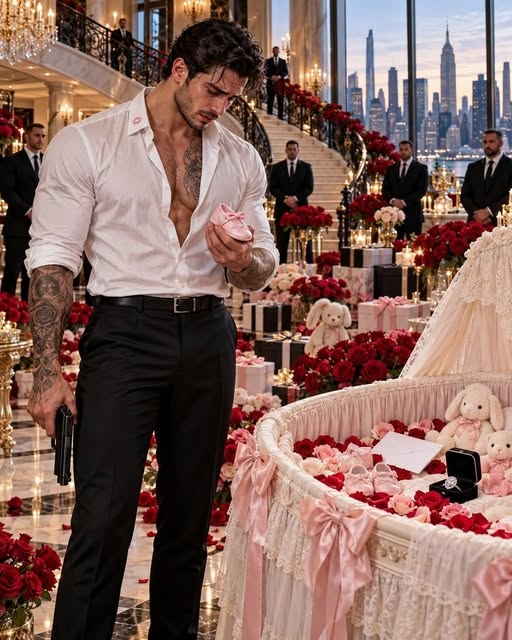
I did not sleep the night Evelyn Hart told me what my wife had done.
I sat in the nursery until the candles in the hall had burned themselves out and the roses in the crib had begun, very faintly, to smell of their own dying. Staff came and went at the edges of my vision like figures in a house of mourning, which I suppose is what it was. We had prepared that penthouse for a homecoming and it had become, instead, a place where a child was conspicuously, legally, deliberately not.
Marco stayed. At some point past three in the morning — I remember noting the hour, and hating myself for noting it, because 3:12 had become a wound I would check for the rest of my life — he set a glass of water on the nursery floor beside me and said nothing at all. Twenty years of loyalty had taught him that there are vigils where counsel is an intrusion.
"Evelyn Hart's office," I said at last. "At nine. Tell her I'll be there. Tell her—" I stopped. Every addition I could imagine was a manipulation dressed as devotion. Tell her I'm sorry. Tell her I'll do anything. Tell her about the crib, the roses, my knees. Grace had heard my words for twelve years, and my words, weighed at 10:17 p.m. against a mistress's hand on my wrist, had come up weightless. "Just tell her I'll be there at nine."
"You'll be there at nine," Marco repeated, and went to make the call.
I arrived at Evelyn Hart's office in Midtown at 8:47 with two men in the car downstairs and Marco beside me in the elevator, and I would like to record, for accuracy, that I went up in that elevator the way I imagine condemned men take stairs: composing my face for an audience I no longer controlled.
Evelyn Hart received us in a conference room of pale wood and floor-to-ceiling glass, the city laid out below her windows like something she might use as an exhibit. She was in her fifties, silver at the temples, with reading glasses on a chain and the unhurried manner of a surgeon. A single file lay on the table in front of the chair opposite hers. She did not offer coffee. She did not stand when I entered, and it took me a moment — a shaming moment, in which I felt outrage stir out of pure habit — to understand that her not standing was the first honest dealing I had received in days. Everyone stood for Vincent Romano. Evelyn Hart's client had nearly died giving birth while I posed for a photographer, and her attorney did not stand.
"Mr. Romano," she said. "Sit down."
I sat.
She opened the file. "This is the undertaking. I will explain it once, plainly, and then you may take as long as you require to read it, and your own counsel may review it. I advise you to have your own counsel review it. Nothing in this room needs your haste, and I would rather this document survive your regret than benefit from your shock."
"Read me the substance," I said.
"You undertake to the court," she said, "and to Mrs. Romano, as follows. One: you will make no attempt to discover the location of Lily Grace Sullivan or of Mrs. Romano, directly or through employees, associates, private investigators, or intermediaries of any kind. Two: you will conduct no surveillance of either of them, electronic, physical, or financial. Three: you will apply no pressure, and permit none to be applied on your behalf, through family, clergy, mutual acquaintances, or any third party, intended to induce Mrs. Romano to return, to withdraw her filings, or to grant you access. Four: all communication concerning your daughter will pass through my office. Five: you will not attend, approach, or seek admission to any medical facility for the purpose of locating your daughter."
She folded her hands.
"In exchange, and conditional upon your compliance, Mrs. Romano will cause you to receive, through me, regular updates on Lily's medical condition. And if — if — Mrs. Romano at any point chooses to invite you to see your daughter, that invitation will be conveyed to you. She has given me no indication of when, or whether, that will occur. I am not empowered to negotiate it. I am instructed to tell you, Mr. Romano, that begging me is a waste of the breath you will want for other things."
"And if I don't sign?" I asked. It was not defiance. It was a man taking inventory of his own exits, the way I had been trained by thirty years of rooms to take inventory of exits. I needed to hear the doors close out loud.
"Then nothing changes except the record," Evelyn Hart said. "The custody filings proceed. The protection order stands. You remain free to spend your considerable resources attempting to do what this document asks you to promise not to do, and my office will document each attempt, and a judge will read that documentation at every subsequent hearing concerning your fitness as a parent, for as many years as you choose to keep writing it." She tilted her head slightly. "Mrs. Romano's position — and I find it, professionally, unassailable — is that the first evidence of whether you can be trusted near a medically fragile child is whether you can be trusted to leave her alone when leaving her alone is what her mother and her doctors require."
Marco, beside me, did not breathe audibly. He knew what I knew: she was right, and she had phrased my whole life as the opposing argument. Every instinct I owned — find, reach, seize, secure — was standing up inside me like men rising from a table. And Grace, from a hospital bed I was forbidden to find, had foreseen every one of those instincts and built her daughter's safety directly out of restraining them.
"Before I sign," I said, "one question. Through you, then. Not pressure. One question." I waited until Evelyn Hart inclined her head the fraction that meant continue. "Is she — is Grace — recovering? Not the baby. Grace. The delivery was early. There was surgery; Marco said there was—" My voice failed me in a Midtown conference room, in front of a woman who had not stood up for me, and I found I did not have the equipment to finish the sentence with dignity, so I finished it without dignity. "Is my wife all right?"
Something in Evelyn Hart's expression altered. Not softened — she was not a woman who softened on the clock — but a ledger somewhere behind her eyes recorded the question and marked it, perhaps, as the first entry in a new column.
"Mrs. Romano is recovering," she said. "She is weak, and she is grieving, and she is, in my observation, the most resolute client I have represented in thirty-one years of practice. She has been discharged to a location I will not describe, with nursing support, near enough to her daughter to be present for her care. She holds a photograph of Lily when she cannot be in the room with her." A pause. "She asked me yesterday whether you would sign. I told her I did not know. It is the only question she has asked about you."
I picked up the pen.
I have signed documents that moved millions, documents that ended companies, documents — God forgive me — that ended other things, and my hand never shook for any of them. It shook for this one: three pages that gave me nothing, promised me nothing, and stripped me of every tool I had ever used to protect what I loved, in exchange for the bare possibility that protecting what I loved might one day mean something other than holding it in my fist.
I signed all three copies. Vincent Romano, in full, the signature that had closed a thousand rooms, now consenting to be closed out of the only room that mattered.
Evelyn Hart gathered the pages, aligned them once against the table with a small, definitive tap, and slid one copy into an envelope for me as if handling something already historical.
"Then we begin," she said. "Your first update will come through my office this afternoon. I suggest, Mr. Romano, that you spend the interval becoming a man whose signature continues to mean what it meant in this room. My client will be watching for exactly one thing: not what you feel. What you do."
I ended the affair that afternoon.
Not by telephone. I owed even Vanessa Cole the honesty of a face, and I owed Grace a termination with no ambiguity left in it anywhere for anyone to later exploit — no open door, no maybe, no Chicago-shaped ambiguity in the record. Marco drove me. The red sports car was parked outside her building under a cover, the way you cover something you are pretending is precious while you decide what it is worth.
She opened the door already performing hurt, in a robe, at two in the afternoon, with the necklace — my necklace, four hundred and fifty thousand dollars of my guilt — at her throat as if it were evidence in her favor.
"Vincent." Her eyes went past me to Marco and calculated, correctly, that this was not a reconciliation. "You didn't call. After everything in Chicago, you get on a plane and you don't even—"
"It's over, Vanessa."
She laughed, one note of it. "Because she had the baby? Darling, babies were always the plan — hers. Ours was—"
"There is no ours," I said. "There never was. I want you to hear that from me and not invent a kinder version later. I did not love you. I used the fact of you to avoid going home to my own life, and you used the fact of me to build yours, and one of those arrangements has now cost my daughter the first hours of her life and her father his name on her birth certificate. It ends today. Not after a conversation. Not after Chicago cools down. Today."
The performance left her face by degrees, and underneath it was the woman I had actually been involved with for eleven months, whom I had never once bothered to look at directly: intelligent, furious, and already doing arithmetic.
"The car," she said. "The necklace. The apartment in—"
"Keep the car. Keep the necklace." I watched her register the insult inside the generosity, which was fair, because there was one. "They were never gifts, Vanessa. They were fees. We're both clearer about that now than we were at the jeweler's."
She stepped closer, close enough that I could smell the perfume I had paid for, and lowered her voice into the register that had once been able to stop me in doorways.
"You don't get to do this to me," she said. "Eleven months, Vincent. I know things. I know where I've been with you, and who saw us, and when. I know things about your life that certain people — journalists, for instance. Or other families, for instance — would pay very well to hear at exactly the moment your wife is telling a court you're unfit." Her hand rose, not quite touching my chest. "That photograph got out somehow, didn't it? Imagine what else could get out. Imagine what I could say about the great Vincent Romano, begging me to lock a door against his own—"
Marco moved. Not far. Just enough that the light in the doorway changed.
"Stop," I said to him, without looking away from her. Then, to Vanessa: "Listen to me carefully, because I'm going to say this the new way, and the new way is the only way I have left. I am not going to threaten you. I'm not going to send anyone to frighten you, or buy you off beyond what's already in your hands, or touch any part of your life. Threatening people is how I arrived at an empty crib." Her eyebrows rose; of all the responses she had rehearsed for, mercy disguised as principle was not among them. "But understand the shape of your position. Whatever you sell, you sell once, and everyone who buys it will know precisely what you are and price you accordingly, forever. And I will answer anything you say with documents. Signed ones. Dated ones. In court, where your eleven months will be read aloud by people in robes who will not find them romantic." I let that settle. "You held my wrist in Chicago and told me to let my wife's call ring. Say that part too, when you sell it. Say it exactly."
She stared at me for a long moment, and I saw the threat die unfinished in her — not because she feared me, but because she could suddenly see, with the clarity of a woman who priced everything, that the man in front of her had stopped being a negotiable asset. You cannot blackmail a man who has already confessed the worst of it himself and signed the confession in a lawyer's office.
"This isn't finished," she said, because she needed the last line.
"It is," I said. "That's the tragedy you're going to have to live with, Vanessa. It was finished at 3:12 in the morning, and neither of us was looking at the clock."
I walked out. In the car I sat with my hands open on my knees — a posture Marco had never seen me take — and I said, "If she talks, she talks. Nobody moves on her. Nobody calls her. That instruction stands even if it costs me. Write it down somewhere, Marco, so that on a bad night I have to argue with my own handwriting."
"It stands," Marco said.
That afternoon, at 4:20, Evelyn Hart's office sent the first court-supervised update on my daughter.
Marco brought the envelope into my study himself, dismissed the two men outside the door with a look, and set it in front of me without a word. It was a single page, typed, on Hart's letterhead. There was no photograph. There was no hospital name, no room number, no physician's surname I could chase — I learned later her neonatologist was a Dr. Sarah Kim, but in that first update she was only "the attending neonatologist," faceless by design. Just facts, typed in a row like beads:
Lily Grace Sullivan. Day three of life. Weight: 1.86 kilograms, down from a birth weight of 1.9, within the expected range. Breathing: supported, on CPAP, with episodes of apnea being monitored. Feeding: via tube, tolerating small volumes. Temperature: stable in the incubator. A line, near the end, that I read so many times the words stopped behaving like language: "The attending physician describes her condition as serious but stable, and her progress over the past twenty-four hours as encouraging for an infant of her gestational age."
Serious but stable. Encouraging.
I sat at my desk, in a penthouse that employed a chef and two drivers and a man whose only job was to keep fresh flowers in rooms no one was using, and I wept over a typed page that did not contain my name — because it was the first true thing anyone had given me about my daughter, and Grace had arranged for me to have it. On her terms. Through her attorney. Because I had signed. The machinery of her mercy was as precise as the machinery of her leaving, and both were teaching me the same lesson: everything I would ever receive from now on would come through a door I did not control, at an hour I did not choose, in an amount I did not set — or it would not come at all.
I read the update eleven times. Then I did the only thing left in the building that was mine to do.
I found paper. Not penthouse stationery, nothing embossed — a plain pad from a drawer, and a pen. And I wrote my wife a letter.
"Grace," I wrote. "I signed. I want that to be the first sentence you ever read from the man I am trying to become, because it is the first promise I have kept to you in longer than I can bear to count. I signed without conditions and I will live inside what I signed…"
I wrote for an hour. I wrote about the crib and did not ask her to forgive it. I wrote about 10:17 and did not permit myself a single explanation, because explanations are just excuses wearing better tailoring. I wrote Lily's weight — 1.86 kilograms — and said that I had memorized it, and that a typed page through a lawyer's office had taught me more about fatherhood than forty-three years of being feared: that a father could be a man who receives news like weather and builds his day around a number he cannot influence. I did not ask where she was. Evelyn Hart had been clear, and the letter itself was an examination I could not afford to fail: not pressure, not a performance, just a man reporting, honestly, to the mother of his child.
I sealed it and gave it to Marco to deliver to Evelyn Hart's office, as the undertaking required — all communication through her office.
"She may not read it," Marco said, gently, at the door.
"I know."
"She may never read any of them."
"Them?" I said.
Marco looked at me with the flat affection of twenty years. "You're going to write more than one, Vincent."
He was right, of course. I wrote the second letter the next day, and the third the day after that. I wrote to Grace about the updates as they came — each one typed, each one short, each one opened at my desk with hands I had to consciously steady. Day four: Lily's weight holding; the CPAP continuing; a blood test described as reassuring. Day five: she had tolerated a slightly larger feed, and I caught myself standing in the kitchen at midnight telling a silent room, out loud, "She ate," like a madman, like a father. I wrote about ending it with Vanessa, in facts only, without triumph. I wrote about the red car going past me on an avenue, some stranger's, and how I had understood standing on that curb that I could not have described, even then, what Vanessa's laugh sounded like — but that I could describe the sound of Grace reading in bed, turning pages, twelve years of it, down to the small pause she took at the top of each one.
No answer came.
Not to the first letter, and not to the fifth, and not to the ninth. No acknowledgment arrived through Hart's office beyond the updates themselves, which came on their schedule and stopped at their facts. Each envelope I sent out went into the same silence Grace had once lived inside — the silence of a person calling someone who has decided, for reasons that feel excellent in the moment, not to pick up. I understood, writing the eleventh letter at 3 a.m. with the skyline cold and blue beyond the glass, that I was finally standing where my wife had stood for six months of knowing, and eleven months of hoping, and one night of calling.
She had waited, and waited, and then she had stopped waiting and acted.
I was only at the waiting. I did not know if there would ever be anything after it — an invitation, a courtroom, a door. Evelyn Hart's voice stayed with me, the last thing she had said in that conference room, more accurate than any threat ever made against me:
Not what you feel, Mr. Romano. What you do.
So I signed, and I stayed signed. I ended the affair and let its ashes lie where anyone could see them. I wrote letters into a silence I had authored, and on the fifth day I set the typed update beside the plain pad on my desk — serious but stable, encouraging, 1.86 kilograms of my whole remaining world — and I wrote the first line of the next letter, to a wife who might never read a word of it, in a hand that had finally stopped shaking.
"Grace. Day six. I am still here, and I am asking nothing. I wanted you to have one letter in the pile that asks for nothing at all…"