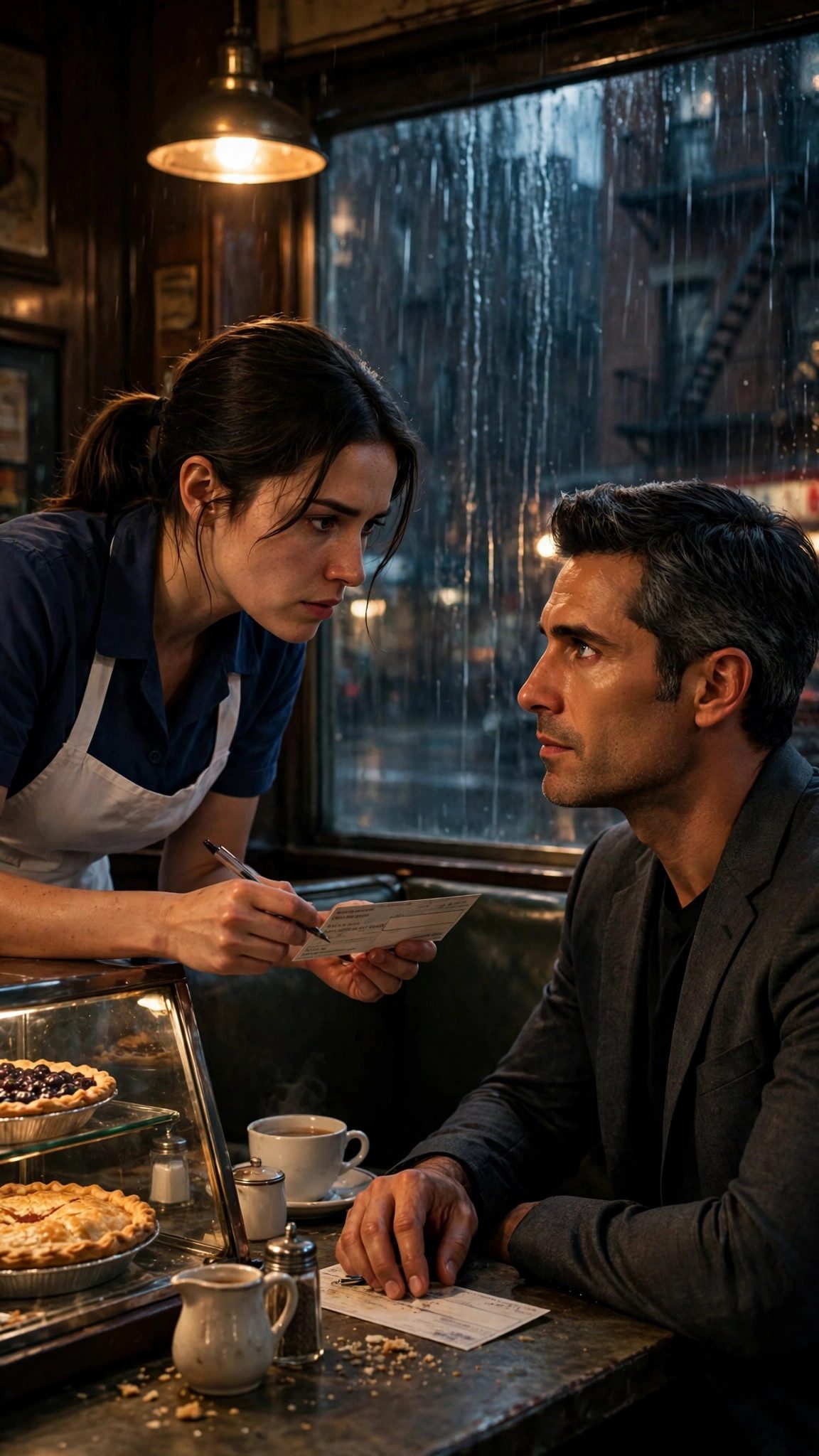
Thursday night came too fast and too slowly, the way nights do when you are waiting for something you are afraid of. I worked my shift with my hands steady and my face calm, and nobody in the diner would have guessed that the most feared man in Brooklyn was sitting in the back room behind the kitchen with his bodyguard, listening to every word I said.
Enzo Falcone came in at 9:30, the way Adrian said he always did on Thursdays. He sat at the counter, not the corner booth, and ordered coffee and a slice of apple pie, and he smiled at me the way a regular customer smiles at a waitress he has known for years.
"Evening, Emily," he said. "Busy night?"
"Slow, actually," I said, pouring his coffee. "Rain keeps people home."
He nodded and picked up his fork, and then his phone buzzed, and he turned slightly away from me and answered it in a low voice.
"He's here," he said. "One woman. Counter. Give it ten minutes."
My blood turned to ice. It was the same voice. The same low, rough whisper, like a man who smokes too much. The same words, almost — the same shape of a sentence, the same pause before the numbers. It was him. Enzo Falcone was the man in the hallway that night, and he was doing it again, right now, sitting at my counter with a slice of apple pie in front of him.
I did not react. Three years of practice kept my face still. I picked up the coffee pot and refilled his cup, and I said, "More pie, Mr. Falcone?"
"No, thank you, dear," he said, and he smiled, and the smile was the smile of a man who has just signed someone's death warrant and is enjoying his dessert.
I walked back to the kitchen, and my hands were shaking so hard I had to set the coffee pot down before I dropped it. Marcus saw my face and started toward me, but I shook my head, just once, and he stopped. Then I went to the back room door and knocked twice, the way Adrian had told me to.
Adrian came out into the hallway, and I said the words I had rehearsed all day. "It's him. The voice in the hallway. It's Enzo."
Adrian closed his eyes for a moment. When he opened them, they were gray and cold and absolutely still. "Thank you," he said. "Go back to the counter. Serve him his pie. Act like nothing happened. Marco and I will handle the rest."
I went back to the counter. Enzo was still eating his pie. Outside, the rain had stopped, and the street was quiet in the way streets get quiet just before something happens.
Ten minutes passed. Enzo paid his check and left a tip, and he smiled at me on his way out and said, "Good night, Emily. See you next Thursday."
He did not see next Thursday. He did not even see the end of that night.
The moment Enzo's car pulled away from the curb, two men came through the diner door — the same two men from across the street that first night, the ones who had pretended to wait for a bus. One of them locked the door behind him. The other one looked at me and said, "Emily Rivers. You're coming with us."
The diner went silent. The truck driver at the far booth froze with his fork halfway to his mouth. The nurse coming off her double shift stood up slowly, her chair scraping the floor. Marcus came out of the kitchen with a meat cleaver in his hand, and the man by the door laughed.
"Put that down, old man," he said. "This isn't your business."
"It became my business three years ago," Marcus said, "when that girl walked in here with one suitcase and no family. You want her, you go through me."
Then Adrian Moretti walked out of the back room.
He did not shout. He did not run. He walked across the diner floor the way a man walks across a room he owns, and he stopped three feet from the man by the door, and he said, "Cole. Step away from my waitress."
The man — Cole Brandt, I would learn later, one of Castellano's best hitters — looked at Adrian, and then at Marco, who had come out of the back room behind him, and then at the door, and I saw the calculation happen in his eyes. Two against two, in a diner full of witnesses, with a meat cleaver in the mix. The odds were not good.
"Walk away, Cole," Adrian said. "Castellano sent you here to take a girl who did nothing but write a number on a bill. You walk out that door right now, and I will forget your face. You stay, and I won't have to remember it."
Cole hesitated. His partner shifted his weight. And then the front window of the diner filled with light — headlights, half a dozen cars, pulling up to the curb in a line — and the door opened again, and a man in a dark suit with a badge on his belt walked in with six armed agents behind him.
"FBI," the man said. "Daniel Reyes. Everybody stay exactly where you are."
It was over in ninety seconds. Cole and his partner were on the floor in handcuffs. Enzo Falcone was being pulled out of his car half a block away by two more agents. The truck driver sat back down. The nurse sat back down. Marcus put the meat cleaver down on the counter, very carefully, like a man putting down something he never wants to pick up again.
Agent Reyes walked over to me, and he was younger than I expected, maybe forty, with tired eyes and a notebook in his hand, and he said, "Miss Rivers. I'm sorry about the scare. Mr. Moretti told us this might happen tonight, and we were ready. Are you hurt?"
"No," I said. My voice sounded very far away. "I'm not hurt."
"Good," he said. "Because I need you to tell me everything you saw tonight, and everything you heard the first night, and everything you know about your brother's notebook. And then I'm going to need you to testify. Can you do that?"
I looked at Adrian. He was standing by the counter, watching me, and for the first time since I had met him, he looked unsure — like a man who has asked a woman to do something dangerous and is waiting to find out if she will hate him for it.
I thought about Danny. I thought about the warehouse. I thought about the note under my door, and the men across the street, and the three years of running, and the three numbers on a bill.
"Yes," I said. "I can do that."
Reyes nodded and wrote something in his notebook. "Then let's start at the beginning," he said. "Tell me about 317."
And so, in a diner full of witnesses, with the neon sign buzzing and the coffee going cold, I told a federal agent everything. I told him about the bill, and the voice in the hallway, and the sedan idling half a block away. I told him about the card, and the five hundred dollars, and the note under my door. I told him about Danny's notebook, and the circled initials, and the unfinished sentence. And when I was done, Agent Reyes closed his notebook and said, "Miss Rivers, your brother was building a case against Vincent Castellano for three years, and he died before he could finish it. With your testimony and that notebook, we can finish it for him."
Outside, the rain started again. Enzo Falcone sat in the back of an FBI car with his head in his hands. Cole Brandt and his partner were already gone. And Adrian Moretti stood in the doorway of the Blue Anchor Diner, watching the street, the way a man watches a street he has just taken back.
I walked over to him, and I said, "You knew they were coming tonight."
"I suspected," he said. "Enzo called Castellano from my own counter. I heard him through the kitchen door. I let him make the call, because I wanted Reyes to catch them in the act. I wanted it clean. No shooting. No bodies. Just handcuffs and a courtroom."
"You used me as bait," I said.
"I protected you," he said. "There's a difference, and the difference is that I was in the next room the whole time, and Marco was beside me, and Reyes was outside with six agents. You were never in real danger, Emily. I would not have allowed it. Not after Danny."
I wanted to be angry. I had every right to be angry. But when I looked at his face — tired, gray-eyed, carrying three years of guilt like a weight he would never set down — I couldn't find the anger. All I could find was the truth: that this man had lost my brother, and he had spent three years trying to make it right, and tonight he had.
"Okay," I said. "Okay. But next time you use me as bait, you tell me first."
A ghost of a smile crossed his face. "Next time," he said, "there won't be a next time. Castellano's men are in custody. Enzo is in custody. Tomorrow, Reyes takes the notebook to a judge. By the end of the week, Castellano will be in a cell. And then, Emily — then it will finally be over."
I wanted to believe him. I stood in the doorway of the diner with the rain falling outside and the smell of coffee and pie in the air, and I wanted to believe that three years of running could end in one night of handcuffs and testimony.
But I had spent three years learning how men like Castellano work, and I knew that men like him do not go quietly. I knew that somewhere in the city, Vincent Castellano was hearing that his men had been arrested, and his mole had been exposed, and a waitress from a diner had written three numbers on a bill and brought his whole plan down.
And I knew that he would not forgive that. Not ever.
The night was not over. It was only the beginning of the end.
The hours before Thursday were the longest hours of my life. I worked my regular shifts, and I poured coffee, and I carried plates, and I counted tips, and every time the door opened, my heart jumped, because I thought it might be Enzo, coming early, or Cole Brandt, coming back, or a man I didn't know, coming for me. But the door only ever opened for regulars — the truck driver, the nurse, a pair of college students studying for exams — and by Wednesday night, I was so tired from watching the door that I fell asleep on my couch with my shoes still on, and I dreamed about Danny.
In the dream, we were kids again, in Philadelphia, and Danny was teaching me the code at our kitchen table. He wrote 317 on a napkin, very slowly, so I could see each number, and he said, "If you ever see something wrong and can't say it out loud, write this. Anyone who needs to understand will understand." And in the dream, I asked him, "Who needs to understand?" And he smiled, the way he always smiled when he knew something I didn't, and he said, "The right person, Em. You'll know him when you see him."
I woke up with the sun in my eyes and tears on my face, and I lay there for a long time, thinking about the dream, and about the right person, and about how strange it was that Danny had known, even then, that one day I would need the code, and that one day the right person would see it.
On Thursday morning, I stood in front of my bathroom mirror and practiced my face. Neutral. Calm. The face of a waitress who has seen nothing and knows nothing. I practiced it for twenty minutes, until it felt natural, until I could hold it without thinking. Then I put on my uniform, and I did my hair the way I always did, and I walked to the diner the way I always did, and I told myself, over and over, that I was just going to work. Just a normal shift. Just coffee and pie and tips.
Marcus knew. I don't know how he knew — maybe it was the way I held the coffee pot, or the way I kept checking the clock, or the way I jumped when the back room door creaked — but he knew, and during a slow stretch, he came over to me and said, very quietly, "Whatever happens tonight, kid, I'm right here. I have a cleaver, and I'm not afraid to use it. My wife used to say I was too stubborn to die, and she was right about most things."
"Thank you, Marcus," I said, and I meant it, because in that moment, Marcus the night cook felt more like family than anyone I had left in the world.
At 9:15, Adrian texted me from the back room — a single message, on the card's number, the first time he had ever texted me. "We're here. Marco and I. Nothing will happen to you. I promise." I read it twice, and I put my phone away, and I felt something settle in my chest — not calm, exactly, but something close to it. The steadiness of knowing that someone was watching over me, for once, instead of me watching over myself.
When Enzo came in at 9:30, I was ready. I poured his coffee. I served his pie. I listened to his voice. And when he left, and Cole Brandt came through the door, and the whole night exploded into handcuffs and FBI agents and shouting, I did the thing Danny had taught me to do a long time ago. I stayed still. I stayed calm. I watched everything. And I remembered every word.
After the arrests, after Reyes took my statement, after the diner emptied out and Marcus went home and the neon sign buzzed alone in the dark, Adrian drove me home himself. He didn't send Luca. He didn't send Marco. He drove, and I sat in the passenger seat, and for the first ten minutes, neither of us said anything.
Then he said, "You were very brave tonight."
"I was terrified," I said.
"Bravery isn't the absence of fear," he said. "It's doing the thing anyway. Danny used to say that. He said it to me once, in the car, on the way to a meeting he didn't want to go to. He said, 'I'm terrified, boss. But I'm going anyway.' And he went. And that's why I trusted him with my life."
I looked out the window at the Brooklyn streets going by, and I thought about Danny in the car, terrified and going anyway, and I thought about myself in the diner, terrified and serving pie anyway, and I thought about how alike we were, my brother and I, in ways I had never understood before.
When we got to my building, Adrian walked me to the door, and he waited while I unlocked it, and he said, "Get some sleep, Emily. Tomorrow, Reyes will call. The week after that, the trial will start. It's going to be long, and it's going to be hard, and there will be days when you wish you had never written those numbers on that bill. But I want you to remember something. You didn't just save my life that night. You finished what Danny started. And that is worth everything."
I went upstairs, and I pushed the chair under the door handle, and I lay down on my bed, and I slept — really slept, deeply, without dreams — for the first time in three years.