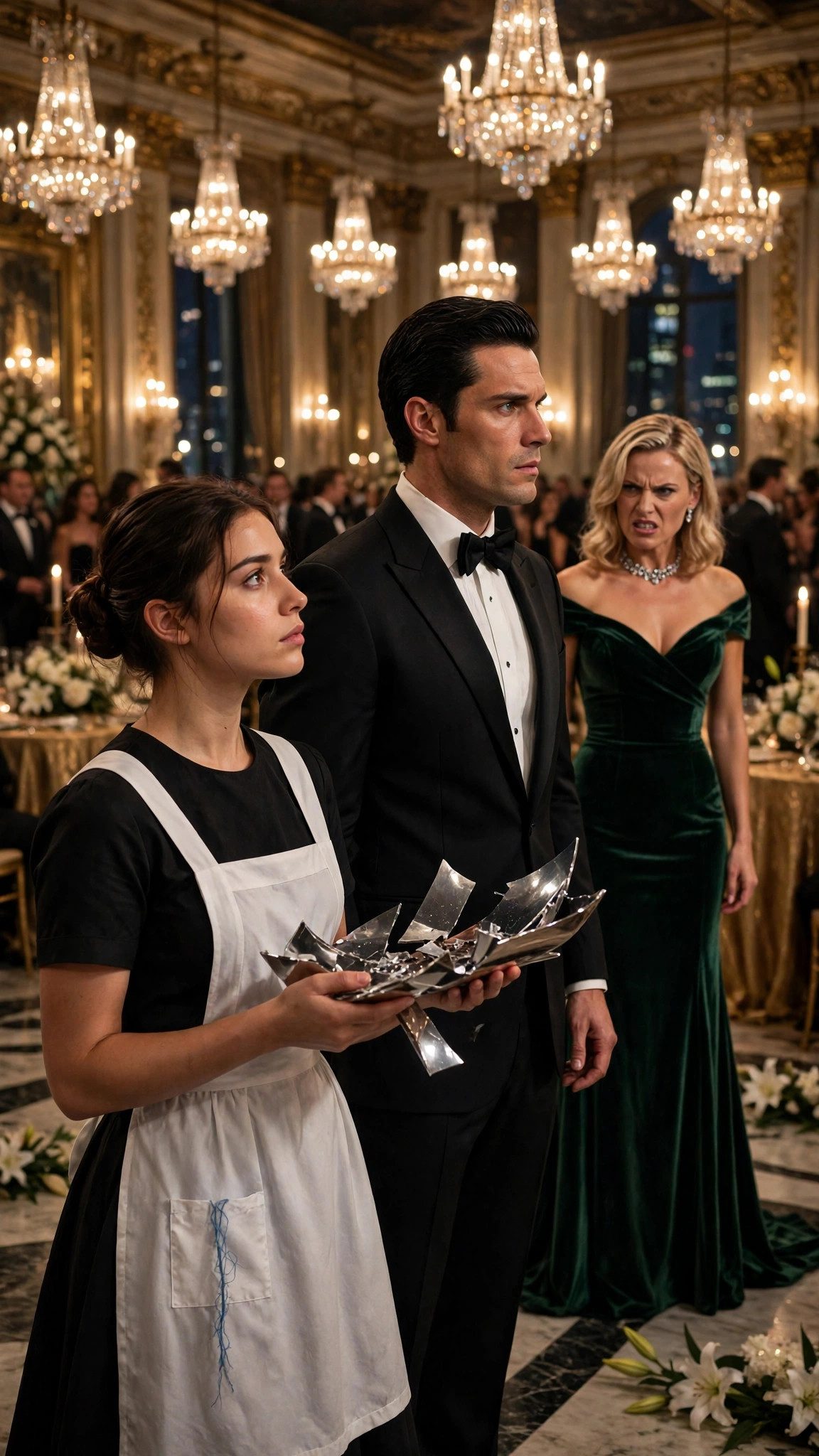
Three hundred guests watched the fiancée of New York's most feared mafia boss swing her jeweled heel at the maid nobody dared to defend.
I was the maid.
The ballroom of the Plaza Grand glittered above us like a second sky. Chandeliers hung in rows down the ceiling, each one dripping crystal, each one throwing light across marble floors and white tablecloths and three hundred faces turned toward the head table. The air smelled of white lilies and expensive perfume and the roast duck the kitchen had been plating since four in the afternoon. A string quartet played something soft near the far windows. And in the middle of all that beauty, Bianca Romano lifted her foot, aimed the pointed heel of her silver shoe at the serving tray I was holding, and smiled at me the way a cat smiles at a bird it has already caught.
"Oops," she said.
Her crystal glass slipped from her hand. It did not fall. She let it fall, tipping it with two fingers as deliberately as a woman signing her name. Red wine splashed across the golden rim of the glass serving dish on my tray and ran down in thin red lines over the white porcelain, over my wrist, over the cuff of my black uniform.
A woman nearby shrieked. A fork clattered. The quartet played on for two more bars and then stopped, the violin dying in the middle of a note.
"This is why hired help should never serve while Diamond Malhotra is at the table," Bianca said, loud enough for the whole head table to hear. Her voice was sweet and cold at the same time, the way only a woman who has never been told no can make her voice sound. "Diamonds don't tolerate clumsiness."
I did not know who Diamond Malhotra was. I knew only that Bianca Romano, twenty-nine years old, blonde hair swept into an elegant updo, cold blue eyes, a floor-length emerald-green gown that probably cost more than I made in a year, and a diamond choker around her neck that caught the chandelier light every time she moved, was looking at me like I was something she had found on the bottom of her shoe.
"I'm sorry," I said quickly. "I'm so sorry, I'll—"
Before I could finish, the tray slipped from my hand. I still don't know, even now, whether my hands were shaking so hard that I lost my grip, or whether Bianca's friend at her elbow — a thin woman in a red dress whose name I never learned — knocked my wrist as she pulled away. Bianca and her friend pulled back so quickly, all at once, that the tray dropped and shattered on the table. Glass everywhere. Porcelain in pieces. Wine spreading across the white tablecloth like blood.
The room went still. Three hundred people, and nobody breathed.
"Leave no stone unturned," Bianca shouted, and her eyes didn't leave mine. She placed her foot on the tray — on the broken pieces of it, on the shattered glass, grinding her heel down as if she were crushing a cigarette. "Pick it up."
My hands were shaking. I could feel my face burning. I bent down, slowly, because my knees felt like they might give out, and I reached for the largest piece of the broken tray.
"Bianca Romano," a voice called from the far end of the ballroom. "Don't kick the maid."
The voice was deep and quiet and it cut through the silence like a knife through silk. Every head in the room turned.
Dante Moretti stood at the far end of the head table. New York's most feared mafia boss. Thirty-four years old, slicked-back black hair, a sharp jaw, intense grey eyes, a black tuxedo with a white shirt and a black bow tie, standing perfectly still with one hand resting on the back of his chair. I had seen photographs of him in the newspapers, always from a distance, always looking like a man carved out of marble. Up close, under the chandeliers, he looked even less like a man and more like a storm deciding whether to break.
"What did you say, Anatole?" Bianca shouted. She called him Anatole sometimes — a pet name from some old joke I didn't understand, a name that sounded wrong in her mouth now, sharp and mocking.
"I said don't kick the maid," Dante said, and he started walking around his table toward us. He didn't hurry. He didn't raise his voice. He walked the way a man walks when he knows the whole room is watching and he doesn't care.
"Why?" Bianca shouted. "She's just a maid."
Dante stopped between Bianca and me. He didn't look at her. He looked at me first — one long look, grey eyes taking in my face, my shaking hands, the wine on my cuff — and then he turned to Bianca.
"Because where I come from," he said, "a man who stays silent while a woman is humiliated is worse than the man doing it."
Other men stepped back. I saw it from the corner of my eye: two men in dark suits at the next table, men I recognized as Dante's people, moving back half a step, giving him room. Nobody spoke. The chandeliers hummed faintly above us, the way they do when a room goes completely quiet.
Bianca's face went white, then red. She reached up with one hand and tore the diamond earring from her left ear and threw it at me. It struck my shoulder and fell to the floor with a tiny, bright sound.
"That maid — she just wrecked my party. Can't you see it?" she said, her voice rising. "My party. My engagement party. And she ruined it."
Dante didn't move. "No," he said. "I can't see it. Because it never happened."
Bianca's voice fell off a cliff. For a second she had nothing to say at all, and in that second the whole ballroom seemed to lean forward, waiting.
"Don't kick the maid," Dante said again, quietly.
The room hushed. I could hear my own breathing. I could hear the blood in my ears.
"I won't let you make my wife feel insecure," Bianca said then, her voice shaking, and I didn't understand what she meant — I wasn't her wife, I wasn't anyone's wife, I was a waitress holding a broken tray — but she went on, her hand dropping to her side. "Hiring you was the mistake."
"She was never meant for me," Bianca said, looking at me now, her eyes full of fury and something else underneath it, something frightened. "She was always plain."
Dante looked at me. Really looked at me, the way nobody had looked at me in years — not as a uniform, not as a pair of hands carrying a tray, but as a person.
"What's your name?" he asked.
"Elena," I said. My voice came out smaller than I wanted it to. "Elena."
I was about to say something else — I don't remember what, something about being sorry, something about leaving — when Dante spoke to Bianca, and his voice had changed. It was colder now. Final.
"Bianca, the answer is no."
Bianca's smile twisted. "What did you say?"
"You heard me."
"You're not the one to decide," Bianca said, but her voice was thinner now, and I could see her hands trembling at her sides.
Dante cut her off. "I just freed myself from a prison where I wasn't allowed to defend anything but a man's ego." He pointed at her, one finger, steady as a gun barrel. "The wedding is off."
"You can't be serious," Bianca gasped.
I looked at Bianca as she stepped back, her expression full of fury, and I looked at Dante, and I thought about how strange it was that a man I had never met was standing between me and the most powerful woman in the room, and that he was doing it over a broken tray and a spilled glass of wine.
"Who is Elena?" Dante asked then, and for a moment I thought he was asking Bianca, but his eyes were on me. "Are you trying to protect your family?"
"She's just a maid," Bianca said.
"Why are you acting like she matters?" Bianca snapped. "Did you not understand? You don't get to call me a liar!"
Dante spoke over her, calm and flat. "Bianca, the wedding is off."
All ears turned toward Bianca. Three hundred guests, and you could have heard a pin drop on the marble floor.
"It makes me an accomplice," Dante said. "It makes the wedding a business transaction. Only one with a much higher price tag."
Then he looked back at me. "That's not your problem," he said.
"You're not my problem," I said, and I don't know why I said it — maybe because I was terrified, maybe because nobody had ever defended me before and I didn't know what to do with it. "I'm nobody's problem."
Bianca's eyes met his. "How did this happen?" she said, and her voice had gone quiet now, almost a whisper. "How did you end up being a witness to such a thing?"
Dante drew a breath. His brow furrowed. "I don't know you," he said to me, "but I know a woman who doesn't lie when it's easier. You're the same one who found Bianca in the hallway, aren't you?"
My chest tightened. My heart was beating so hard I was sure everyone in the ballroom could hear it.
"You were there," he said. "You know how this began."
I did know. God help me, I knew exactly how it began, and I had been carrying it in silence for three weeks because I needed this job and because women like me don't accuse women like Bianca Romano of anything, ever, unless they want to lose everything.
He hesitated then, and his eyes searched my face, and something in his expression felt familiar, like I had seen him before, like I had known him in some other life. But I decided to ignore it. I had bigger problems. I had a broken tray at my feet and three hundred people staring at me and a diamond earring on the floor beside my shoe.
"What's your name?" he asked again.
"Elena," I said. I didn't hesitate. I liked this man. I didn't know why, but I did — something in the way he had stepped between me and Bianca without a second thought, the way he hadn't asked permission from anyone in the room to do it.
He hesitated. "Was your father," he said slowly, "the man who saved a stranger outside the Astoria subway station six years ago?"
The ballroom tilted. The chandeliers swung, or maybe it was just me. The wine on my cuff. The broken glass. The blue thread sewn into the inside pocket of my apron, the thread I had carried with me every single day for two years, the thread from my father's old navy uniform — and suddenly Dante Moretti was looking at me like he was seeing a ghost.
I didn't answer him. I couldn't. Because the last thing I had expected, standing in the middle of the most humiliating night of my life, was for the most feared man in New York to ask me about my father.
But that was later. That was after the heel and the glass and the wedding being called off in front of three hundred people. Before any of that, there was the morning, and the agency, and the bus, and the ordinary day that turned into the night that changed everything.
It started the way all my days started: at five in the morning, in a small apartment in Queens, with my mother asleep in the next room and the smell of coffee I couldn't afford to waste.
My name is Elena. I am twenty-six years old. I am plain, with dark brown hair I wear in a low bun because it keeps it out of the food, warm brown eyes, no makeup because makeup costs money and smears under a hot kitchen light anyway. I wear a simple black maid uniform with a white apron. I work for an agency called Sterling Events that sends girls like me to galas and weddings and charity balls all over New York, and I take every shift they offer, because rent in Queens does not wait and my mother Rosa's medicine does not pay for itself.
My father was Thomas. He was a subway maintenance man for thirty-one years, and he was the kindest man I ever knew, and he died two years ago, and I have missed him every day since. He used to come home with grease under his fingernails and a thermos that smelled of coffee, and he would sit at our kitchen table and tell me about the people he saw on the platforms — the musicians, the tired nurses, the kids going to school — and he always said the same thing: "Elena, the city is full of people nobody sees. You see them. That's your job in this world."
The morning of the gala, I woke at five and stood in the kitchen in the dark, and I did what I always did before a big job. I took my apron off its hook. I checked the hem. I checked the pocket. And inside the pocket, sewn into the lining where nobody could see it, was a short length of frayed blue thread — the exact navy blue of my father's old subway uniform. When the uniform was finally thrown away after he died, my mother had cut one thread from the cuff and given it to me, and I had sewn it into every apron I owned since, because it was the only piece of him I could carry into rooms where I was nobody.
"For luck," my mother used to say. "Your father is with you."
I didn't believe in luck. But I believed in my father. So I put the apron on, and I tied it, and I went to catch the bus to Manhattan, and I told myself it was just another gala, just another night of carrying trays and smiling at people who would never remember my name.
I was wrong. It was the night Dante Moretti looked at me, under the chandeliers, and asked me who I was.
And it was the night Bianca Romano decided to destroy me.
The bus ride to Manhattan that morning took almost an hour, and I spent most of it watching the city slide past the window — the brick buildings of Queens giving way to the bridges, the bridges giving way to the towers of glass and steel that rose over the river like something out of a dream. The other agency girls sat around me, chatting about their boyfriends and their rent and the shoes they wanted to buy, and I listened with half an ear, because my mind was somewhere else entirely.
I was thinking about the thread. I always thought about the thread on the way to a big job. I would press my hand against my apron pocket, just for a second, just to feel it there, and I would think about my father coming home from the night shift with grease under his fingernails and a thermos in his pocket, and I would tell myself what he always told me: "Elena, the city is full of people nobody sees. You see them. That's your job in this world."
The bus stopped at the corner of Fifth Avenue, and we all got off, twelve girls in black uniforms with white aprons, and we walked the last two blocks to the Plaza Grand together, our shoes clicking on the pavement, our breath making little clouds in the cold air. The hotel rose above us, gold and white and impossibly grand, and the doorman held the door open for us, and we went in through the service entrance, the way girls like us always go in — not through the front, never through the front — and Mrs. Delaney was waiting for us in the corridor with her clipboard and her sharp eyes.
"Remember," she said, looking at each of us in turn. "You are invisible tonight. The guests are celebrating an engagement. The most important engagement this city has seen in years. Nothing goes wrong. Nothing spills. Nothing breaks. Do you understand?"
We all nodded. We understood.
I understood, too. I just didn't know yet that by the end of the night, everything would be broken — the tray, the glass, the engagement, and the whole careful order of the world I thought I lived in.