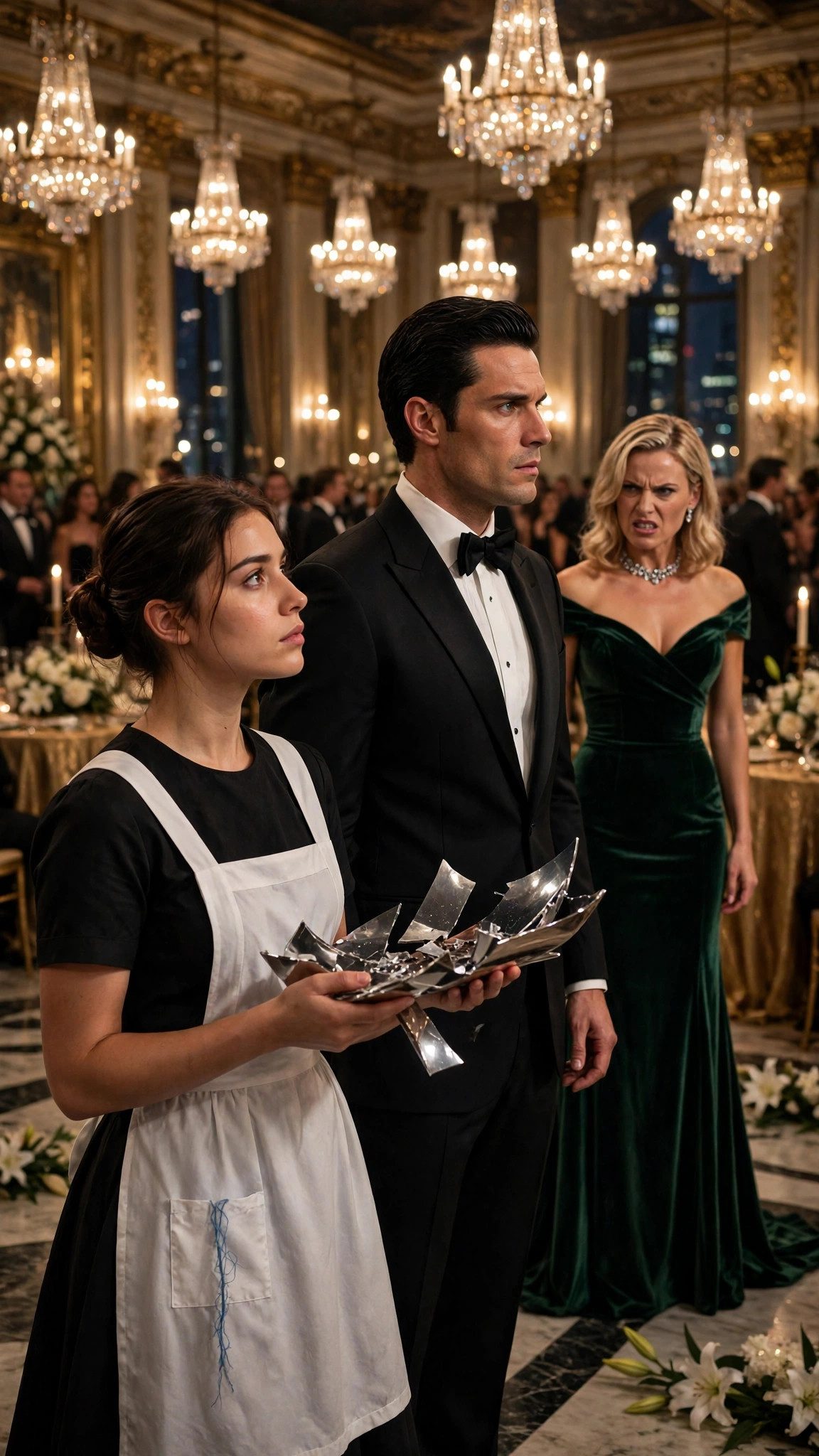
There was something I hadn't told Dante in the café. Something I hadn't told anyone, because I hadn't been sure what I had seen, and because it had seemed too strange, too small, to matter next to everything else that had happened that night.
When I lifted the tray at the head table — just before Bianca's glass slipped, just before the wine splashed, just before everything went wrong — I saw something under the rim of the serving platter. Something small and dark and wrong. A tiny black lens, no bigger than the head of a pin, set into the gold rim of the dish, pointing up at the guests, pointing straight at the head table, pointing straight at me.
A hidden camera.
I didn't understand it at the time. I thought I had imagined it. A camera, hidden in a serving dish, at an engagement party? It made no sense. But I had seen it — I was sure I had seen it — a tiny black eye in the gold, watching.
I told Dante about it three days after the café, when he called me and asked me to meet him again. Not at the café this time. At his office, high above the city, in a building with marble floors and a view of the whole of Manhattan spread out below us like a map.
"Tell me again," he said, leaning forward across his desk, his grey eyes fixed on mine. "Exactly what you saw. Slowly."
So I told him. I told him about the platter, and the gold rim, and the tiny black lens, and the way it had been angled — not at the room, not at the guests in general, but up, at the head table, at Bianca's chair, at the exact spot where she had been standing when she tipped her glass.
Dante was quiet for a long time. Then he picked up his phone and said three words: "Sal. My office. Now."
Sal Greco arrived ten minutes later, carrying a small black case. He set it on Dante's desk and opened it, and inside, nestled in foam, was a serving platter — a glass dish with a gold rim, identical to the one I had carried that night.
"The Plaza Grand's security people found it in the service pantry," Sal said. "It was supposed to go back to the rental company with the rest of the dishes. One of the kitchen boys noticed the rim felt warm — warm, like something inside it had been running. He brought it to the manager. The manager called us."
Sal turned the platter over in his hands, and there it was — a tiny black lens set into the gold rim, and behind it, no bigger than a thumbnail, a battery pack and a memory card, all of it hidden inside the hollow rim of the dish.
"It was recording," Sal said. "The whole night. From the moment the platter was set on the head table until the moment it shattered on the floor."
Dante looked at me. "Elena," he said. "You just found the most important piece of evidence in this whole mess, and you didn't even know it."
They played the footage for me on a laptop, right there in Dante's office, and I watched the night of the gala unfold from the point of view of a serving dish.
I saw myself approaching the head table, my face calm, my hands steady. I saw Bianca reach out — not to take a glass, not to take a plate, but to the platter itself, her fingers brushing the rim, right where the lens was hidden. She knew it was there. She was checking it. She was making sure it was on.
And then I saw her tip her own glass. Deliberately. Carefully. Two fingers, the way I had described it, the way I had seen it with my own eyes — and now there it was, on camera, in perfect clarity, for anyone to see: Bianca Romano, spilling her own wine, on purpose, so that she could blame me.
I saw her friend in the red dress knock my wrist as she pulled away. I saw Bianca grind her heel into the broken glass. I saw myself bend down, shaking, reaching for the pieces. And I saw Dante, walking around the table, stepping between us, his face like stone.
"She staged it," I whispered. "She staged the whole thing."
"She staged it," Dante agreed, his voice flat and cold. "And now I want to know why."
The answer came two hours later, when Sal's men found the fake waiter — the man from the hallway, the man in the uniform that didn't fit him quite right. His name was Eddie Krol. He wasn't a waiter at all. He was a small-time fixer who did jobs for the Romano family, and he had been paid five thousand dollars to plant the camera in the platter and to stand in the hallway with an envelope full of cash for Bianca, and he had been paid to disappear after the gala and never come back.
He didn't disappear. Sal's men found him in a bar in Brooklyn, drinking away his five thousand dollars, and they brought him to a room with no windows, and they asked him questions, and Eddie Krol — who was not a brave man, and who had never been loyal to anyone in his life — told them everything.
The camera had been Vittorio Romano's idea. The plan was simple: film Dante defending a maid. Film him losing his temper, film him humiliating his fiancée in front of three hundred guests, film him choosing a nobody over the Romano family. Then leak the footage to the papers, to the council, to every family in New York, and use it to force Dante's hand — to make him marry Bianca anyway, to apologize, to hand over the docks as the price of the insult, to prove to the whole city that the Moretti family was weak and ruled by its feelings instead of its interests.
"It was supposed to make you look weak, boss," Eddie said, his voice shaking. "That was the whole point. Mr. Romano said — he said a boss who defends a maid is a boss who can't be trusted with an empire."
But the plan had failed, because Bianca had been too cruel, too theatrical, too sure of herself — and because Dante hadn't lost his temper at all. He had been calm. He had been controlled. He had been right. And the footage, instead of showing a weak boss, showed a cruel fiancée staging a humiliation and a boss who refused to stand by and watch it happen.
And there was more. Eddie told them about the envelope in the hallway. It hadn't been cash for Bianca. It had been the other way around — Bianca had given Eddie the envelope, and inside it had been a list. A list of names. The names of every Moretti captain who had been approached by the Romano family, every man who had been offered money to betray Dante, every man who had said yes.
"She was building an army inside your family, boss," Eddie said. "While you were planning a wedding, she was buying your men."
Dante sat in his office long after Eddie was taken away, staring out the window at the city, at the lights coming on all over Manhattan as the sun went down. Sal stood by the door, silent, waiting.
"Call Bianca," Dante said finally. "Tell her to come here. Tonight. Alone."
"Boss—" Sal began.
"Alone," Dante said. "She owes me a conversation. And I owe her one, too."
Bianca arrived at nine o'clock, in a black dress this time, no diamonds, her blonde hair loose around her shoulders, looking smaller than I had ever seen her — not the queen of the ballroom, not the fiancée in the emerald gown, just a woman walking into a room where she knew she was going to lose everything.
Dante didn't offer her a seat. He didn't offer her a drink. He played the footage on the laptop, without a word, and he let her watch herself tip the glass, and grind her heel into the broken tray, and throw her earring at a girl who had done nothing wrong.
When it was over, she stood there, very still, her hands clasped in front of her, and she said, "It was my father's idea. All of it. The camera. The hallway. The list. I just did what he told me."
"Did you?" Dante said. "Or did you enjoy it?"
Bianca's face crumpled then, just for a second, and I saw something I had never expected to see in her — not cruelty, not arrogance, but fear. Real, raw fear, the fear of a woman who had spent her whole life doing what her father told her and had never once asked herself what she wanted.
"He was going to kill you, Dante," she whispered. "Six years ago. At Astoria. My father paid a man to push you onto the tracks. And when that failed, he spent six years planning the wedding, because the wedding was the only way to get what he wanted without killing you. The docks. The routes. Everything. I knew. I knew the whole time, and I said nothing, because he is my father, and because I was afraid of him, and because I thought — I thought if I married you, if I became your wife, he would stop. He would have what he wanted, and he would stop."
The office went silent. Sal didn't move. I stood in the corner where Dante had asked me to wait, holding my breath, holding the arms of my chair, feeling like the whole world had just tilted on its side.
"Thank you for telling me the truth," Dante said to Bianca, and his voice was quiet and terrible. "Now get out of my office. And tell your father that the wedding is off, the alliance is off, and the next time he sends a man to kill me, he should come himself."
Bianca left. The door closed behind her. And Dante turned to me, and he looked at me the way he had looked at me in the ballroom — like I was the only honest thing in a world full of lies — and he said, "Elena. I need your help. I need you to tell the FBI what you saw in that hallway, and what you saw on that platter, and I need you to be brave one more time. Can you do that?"
I thought about my father, standing on a platform in Astoria, stepping between a killer and a stranger. I thought about the blue thread in my apron pocket. I thought about my mother, sitting at our kitchen table in Queens, telling me that carrying yourself is harder than carrying a tray.
"Yes," I said. "I can do that."
And I did.
That night, after the footage, after Bianca, after Eddie Krol, I went home to Queens, and I sat at the kitchen table with my mother, and I told her everything — the camera, the hallway, the list, the notebook, all of it — and she listened without interrupting, the way she always listened, with her hands folded in her lap and her eyes on my face.
When I finished, she was quiet for a long time. Then she said, "Your father didn't pull a man back from the edge so his daughter could be afraid to speak."
"I know, Mama," I said. "But I'm scared. Vittorio Romano is a dangerous man. His people know where we live. They know my name now. What if they come here?"
"Then let them come," my mother said, and her voice was steady, and her hands were steady, and I realized, sitting there at the kitchen table, that my mother was braver than I had ever given her credit for. "We have lived in this apartment for twenty years, Elena. We have paid our rent. We have hurt no one. We have nothing to be ashamed of. And if a man like Vittorio Romano wants to frighten us, he will have to do better than a phone call in the middle of the night."
The phone call had come the night before. No voice. Just breathing, slow and heavy, for thirty seconds, and then the click, and the dial tone. I hadn't told anyone about it — not Dante, not Sal, not even my mother, until now — because I had told myself it was a wrong number, a prank, nothing. But sitting at the kitchen table, telling my mother everything, I finally said it out loud, and the moment I did, I knew it hadn't been a wrong number at all.
Dante knew, too. I don't know how — maybe Sal's men had seen something, or heard something, or maybe Dante simply understood the world he lived in better than I did — but the next morning, a young man named Joey was standing outside our building, leaning against a lamppost, reading a newspaper, drinking coffee from a paper cup. He was twenty-five years old, with a quiet face and a calm way about him, and when I came out to catch the bus, he nodded at me and said, "Morning, Miss Elena. Mr. Moretti asked me to keep an eye on the building. Just for a few days. You won't even know I'm here."
I knew he was there. Every day, I knew he was there — at the lamppost in the morning, at the corner deli at lunch, on the bench across the street in the evening — and knowing he was there made me feel safe in a way I hadn't felt safe since the night of the gala. Not because Joey was frightening — he wasn't, not at all — but because his presence meant that Dante Moretti had meant what he said in the ballroom: a man who stays silent while a woman is humiliated is worse than the man doing it. And Dante Moretti was not a man who stayed silent.
Two days later, Sal's technical man — a thin, nervous young man named Paulie, who spoke in a rush and never looked anyone in the eye — brought the camera to Dante's office and took it apart on the desk, piece by piece, explaining as he went.
"The lens is military grade," Paulie said, holding up a tiny black circle between his thumb and forefinger. "Not something you buy at a store. This is custom work. Somebody paid a lot of money for this. And the battery — see this? It runs for twelve hours. Twelve hours, boss. Whoever planted this wanted the whole night. Every minute. Every word."
"Can you tell who made it?" Dante asked.
Paulie nodded. "There's a serial number, etched on the inside of the housing. I ran it. It traces back to a security company in New Jersey — a company that does work for the Romano family. Exclusively. For six years."
Dante looked at Sal. Sal looked at Dante. And neither of them said anything, because there was nothing left to say. The camera had been Vittorio's. The hallway had been Vittorio's. The list had been Vittorio's. The man on the platform, six years ago, had been Vittorio's. Everything led back to the same man, the same name, the same hand reaching out of the dark, year after year, trying to take what wasn't his.
And now, finally, they had the proof to stop him.