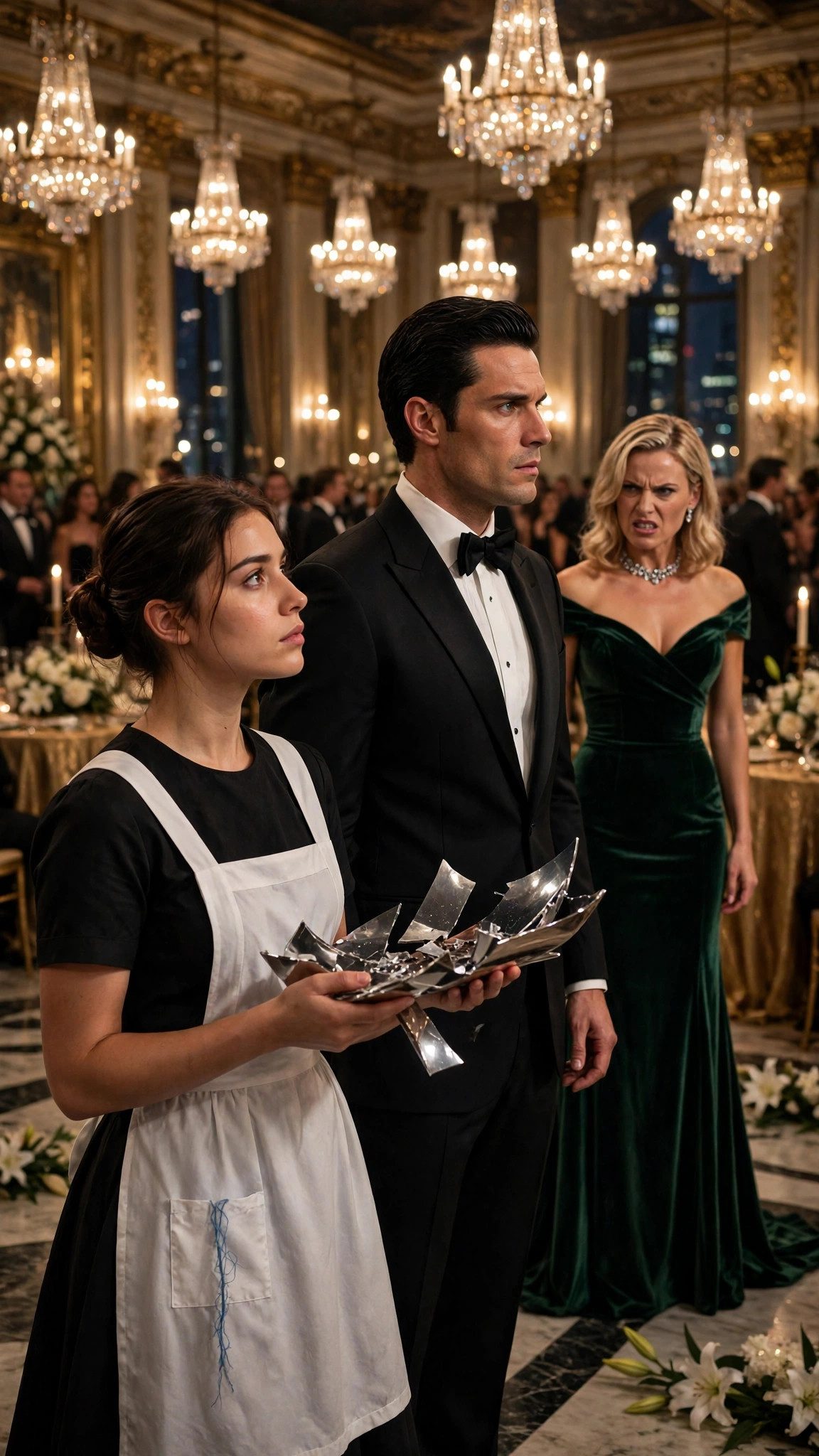
The morning after the gala, I woke up in my little apartment in Queens and for one blessed second I thought it had all been a dream — the chandeliers, the heel, the wine, the wedding being called off in front of three hundred people. Then I looked at my uniform hanging on the back of the door, and I saw the wine stain on the cuff, and I knew it had been real.
My mother was already up, standing at the stove in her housecoat, making coffee.
"You're on the front page of the papers," she said, without turning around.
My stomach dropped. "What?"
She set the newspaper down on the table, folded open to the society page. There was a photograph of the ballroom — blurry, taken from across the room — and a headline in big black letters: MORETTI CALLS OFF WEDDING AT ENGAGEMENT GALA. And underneath it, in smaller print: "In a dramatic scene witnessed by three hundred guests, Dante Moretti ended his engagement to Bianca Romano after a confrontation involving a catering waitress."
They didn't print my name. Thank God, they didn't print my name. But they printed the word "waitress," and they printed the word "confrontation," and I knew that by noon every agency in the city would know exactly who I was.
The phone rang at eight. It was Mrs. Delaney from Sterling Events.
"Elena," she said, and her voice was colder than I had ever heard it. "Don't come in today. Don't come in tomorrow. Don't come in at all, until I call you. Do you understand?"
"Mrs. Delaney, I—"
"Bianca Romano's father called the agency this morning," she said. "He said that if we ever send you to another event in this city, he will personally make sure Sterling Events never works again. I have forty girls depending on this agency for their rent, Elena. I can't lose the agency for one girl. I'm sorry."
The line went dead.
I stood in the kitchen holding the phone, and my mother stood at the stove holding the coffee pot, and neither of us said anything for a long time.
Then my mother set the pot down, and she came over to me, and she put her arms around me, and she said, "Your father would be proud of you. Whatever happened last night, whatever that woman did to you, your father would be proud."
"I lost my job, Mama," I said. My voice was shaking. "I lost my job, and I don't know how we're going to pay the rent."
"We'll manage," she said. "We always manage."
But I could see the worry in her eyes, and I could see her hands shaking, just slightly, and I knew that we wouldn't manage, not really, not for long — not on her sewing money alone, not with the rent and the medicine and the bills that never stopped coming.
At noon, there was a knock on the door.
I opened it, and a man in a dark suit stood in the hallway — not a threatening man, not a frightening man, just a quiet man with tired eyes and a calm face, holding his hat in his hands.
"Miss Elena?" he said. "My name is Sal Greco. I work for Mr. Moretti. He'd like to speak with you, if you're willing. No pressure. No obligation. Just a conversation, at a place and time of your choosing."
My mother appeared behind me in the doorway, wiping her hands on her apron.
"Is this about last night?" she asked.
"Yes, ma'am," Sal said. "Mr. Moretti would like to thank your daughter. And to ask her a few questions. That's all."
I looked at my mother. She looked at me. And I thought about my father, and about the blue thread in my apron pocket, and about the man who had stepped between me and Bianca Romano without a second thought, and I said, "All right. I'll come."
We met at a small café on a quiet street in the Village, two hours later — not a restaurant, not an office, just a café with chipped cups and a waitress who didn't look at us twice. Dante Moretti was already there when I arrived, sitting at a table in the back, wearing a dark sweater instead of a tuxedo, looking less like a mafia boss and more like a man who hadn't slept.
He stood up when I came in. He pulled out my chair. He ordered me coffee and didn't ask if I wanted it.
"I'm sorry about your job," he said. "I heard what Vittorio did. It will be fixed. I promise you that."
"I don't need your promises, Mr. Moretti," I said. My hands were wrapped around the coffee cup because they wouldn't stop shaking otherwise. "I just need to know what you want from me."
He looked at me for a long moment, and then he said, "I want to know about your father."
The café went quiet around us, or maybe it was just me. The smell of coffee. The sound of a spoon against a saucer. My heart beating in my ears.
"My father is dead," I said.
"I know," Dante said. "I'm sorry. When did he die?"
"Two years ago. In March. His heart."
Dante nodded slowly. "And before that — did he work for the transit authority? The subway?"
"Thirty-one years," I said. "He was a maintenance man. Night shift, mostly. Astoria station, at the end."
Dante closed his eyes for a second. Just a second. And when he opened them again, they were shining — not with tears, exactly, but with something close to it, something I had never expected to see in the eyes of New York's most feared mafia boss.
"Six years ago," he said, "on a cold night in November, a man pulled me back from the edge of the platform at Astoria station. A stranger tried to push me onto the tracks. Your father stepped between us and said, 'Not here. Not on my platform.' He saved my life, Elena. And I spent six years looking for him, and I never found him, because he never told me his last name."
I stared at him. I couldn't speak. My mother had told me the story — "A man fell, Rosa. I pulled him back. That's all" — but she had never told me who the man was, because my father had never told her, because he had said it didn't matter.
"It mattered," Dante said, as if he could hear my thoughts. "It mattered to me. It mattered every day for six years."
He reached across the table then, and he touched my hand — just the tips of my fingers, gently, the way you would touch something fragile — and he said, "I saw the blue thread on your apron last night, under the chandeliers. It was the same blue as his uniform. I knew the moment I saw it."
I looked down at my hands. I thought about my father, standing on that platform in his navy uniform, stepping between a killer and a stranger without a second thought. I thought about the thread in my apron pocket, the thread my mother had cut from his cuff, the thread I had carried into every room I had ever worked in.
"My father would have done the same for anyone," I said. "That's just who he was."
"I know," Dante said. "That's why I'm here. And that's why I need to ask you something else, Elena. Something important. Something I should have asked you last night, in the ballroom, but I didn't, because I was too busy calling off a wedding."
"What?" I said.
"Three weeks ago," he said, "did you see Bianca in the hallway at the Plaza Grand?"
My blood went cold. My hands started shaking again, and I pulled them back from the table and wrapped them around my coffee cup, and I stared down into the dark surface of the coffee like it might tell me what to do.
"I don't know what you're talking about," I said.
"Yes, you do," Dante said, and his voice was gentle, not threatening, not angry — just certain. "I know a woman who doesn't lie when it's easier, Elena. That's what I said about you last night, in front of three hundred people. Don't make me a liar now."
I looked up at him. His grey eyes were steady on mine. And I thought about Bianca's voice in the hallway — "You didn't see anything, and if you ever breathe a word about this hallway to anyone, I will make sure you never work in this city again" — and I thought about Mrs. Delaney's voice on the phone that morning, and about Vittorio Romano calling the agency, and about the fact that I had already lost my job, and that Bianca had already taken everything she could take from me, and that there was nothing left for her to threaten me with.
So I told him. I told him about the hallway. I told him about the man in the waiter's uniform that didn't fit him quite right. I told him about the envelope, and about Bianca's shaking hands, and about the way she had looked at me — not angry, not cruel, but frightened, like a woman who had just realized she had been seen doing something she could never take back.
Dante listened without interrupting. When I finished, he was quiet for a long time, staring out the café window at the street, at the people walking past with their shopping bags and their dogs and their ordinary lives.
"Thank you," he said finally. "You have no idea what you've just given me, Elena. No idea at all."
"What did I give you?" I asked.
"The truth," he said. "And the truth is the one thing nobody in my world ever gives me."
He paid for the coffee. He walked me to the door. And as I stepped out onto the street, into the cold November air, he said, "Elena — the wedding was never about love. It was about the docks. Vittorio Romano wants my shipping routes, and he was going to get them through his daughter. The envelope you saw in the hallway — I think I know what was in it. And I think your father's killer and my would-be killer are the same man."
I turned around. "What do you mean?"
"I mean," Dante said, "that six years ago, someone paid a man to push me onto the tracks at Astoria station. And I have spent six years wondering who. And now I think I finally know."
He didn't say the name. He didn't have to. We both knew it.
Vittorio Romano.
The week after I lost my job was the longest week of my life.
I woke up every morning at five, the way I always did, and I would sit at the kitchen table with a cup of coffee, and I would look at the classified ads in the paper, and I would circle the jobs that might take me — a diner in Astoria, a catering company in Brooklyn, a hotel in Midtown that needed banquet servers — and I would call them, one by one, and I would hear the same thing, over and over again, in different voices, with different words, but always the same meaning.
"We're not hiring right now." "We'll keep your number on file." "Have you worked at any of the big hotels?" "I'm sorry, but —" And then the click, and the dial tone, and the silence.
On the third day, the landlord knocked on our door. Mr. Kowalski was a big man with a kind face and a hard job, and he stood in our hallway holding his hat in his hands, and he said, "Elena, Rosa, I know times are hard. But the rent is due on the first, and I can't wait past the fifth. Not this time. I'm sorry."
"We'll have it, Mr. Kowalski," my mother said, and her voice was steady, but I could see her hands shaking behind her back. "We'll have it by the first. I promise."
After he left, my mother went into her sewing room, and she worked until midnight — hems and buttons and a wedding dress for a neighbor's daughter, her needle moving in the lamplight, her shoulders bent, her eyes tired — and I sat at the kitchen table, and I did the math, over and over again, on the back of an envelope: rent, medicine, electricity, food. Rent, medicine, electricity, food. No matter how many times I added it up, the numbers didn't work. Not without my job. Not without Sterling Events.
On the fourth day, I went to the diner in Astoria, the one from the classified ad, and I filled out an application, and the manager — a tired woman named Dot, with flour on her apron and a pencil behind her ear — looked at it and said, "You've worked galas, honey. The Plaza Grand. That's good experience. But I can only pay twelve an hour, and the shifts are nights and weekends, and there's no tips to speak of. Can you live on that?"
"I can live on anything," I said. "I just need to work."
She hired me on the spot. I was supposed to start the following Monday.
I never started. Because on Sunday, Sal Greco came to our door, and everything changed.
While I was counting pennies in Queens, Dante was counting something else entirely, high above the city, in an office with a view of the whole of Manhattan.
Sal had brought him a report — a thick folder, full of papers, full of numbers, full of names — and Dante read it twice, slowly, the way a man reads a letter that tells him his house is on fire.
The Romano family had been buying Moretti captains for six years. Not all of them. Not most of them. But enough — seven men, in key positions, at the docks, at the warehouses, on the shipping routes — seven men who had taken Vittorio Romano's money and promised, when the time came, to stand with the Romanos instead of the Morettis.
"They were waiting for the wedding," Sal said, standing by the window, his arms crossed. "That was the plan. After the wedding, after you were family, Vittorio would move. He'd take the docks first — he'd say it was a merger, a partnership, a natural step now that the families were joined. Then the warehouses. Then the routes. And by the time anyone realized what was happening, the Moretti family would be a Romano family with a Moretti name on the door."
Dante closed the folder. He stood up. He walked to the window and looked out at the city, at the river, at the docks far below, where his father's ships had come and gone for forty years.
"My father built those docks with his hands," he said quietly. "He unloaded crates when he was sixteen years old. He bled on those docks. And Vittorio Romano thinks he can buy them with a wedding and a list of names in an envelope."
"He thinks he already has," Sal said.
Dante turned around. His face was calm. His voice was steady. And Sal, who had known him for thirty years, who had seen him angry and afraid and grieving, had never seen him look quite like this — like a man who had finally, completely, run out of patience.
"Then he's wrong," Dante said. "And we're going to prove it."