The call came at 5:47 in the morning, and for once in my life, I answered on the first ring.
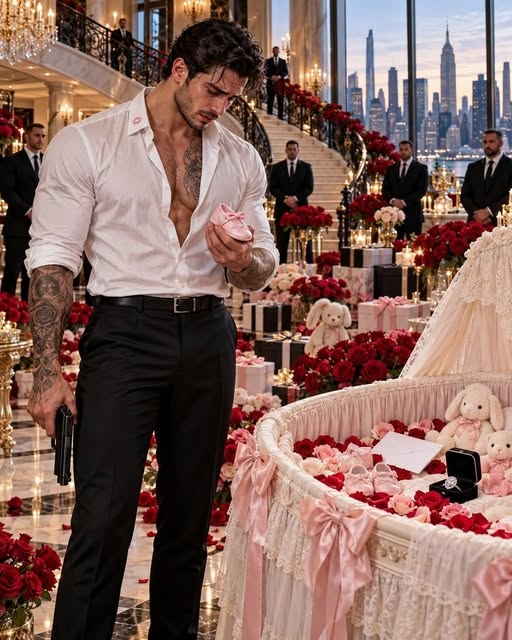
I had been sleeping — if you could call it sleeping — on the narrow couch in the small apartment Marco had found for me two blocks from the hospital. Not the penthouse. I had not slept in the penthouse since the night I came home to an empty nursery and a pink ribbon in a crib full of roses. That place belonged to the man I had been in Chicago. This apartment had a kettle Grace would have laughed at, a secondhand table, and a phone that I kept face-up on my chest all night in case the hospital, or Evelyn Hart, or — God forgive me for still hoping — Grace herself, ever needed me.
Dr. Sarah Kim did not waste time on softening anything. She never had.
“Mr. Romano, Lily had a difficult night. Her oxygen needs have gone up again, and the echocardiogram this morning shows what we were afraid of. The ductus — the vessel that should have closed after birth — is still wide open. It is flooding her lungs and making her heart work too hard. We have tried the medication course twice. It has not closed.”
I was already standing, already pulling on a shirt with one hand. “What are you saying?”
“I am saying we cannot wait any longer. She needs surgery today. A ligation. We will go in through a small incision under her left arm and close the vessel with a tiny clip. It is a procedure we do in this unit, and she is stronger than she was three weeks ago, but she is still a baby who was born at one point nine kilograms, Mr. Romano. There are risks. Bleeding. Infection. Injury to the nerve that helps her breathe and cry. I need her mother’s consent, and Grace has given it. I thought you should know before we take her down. Grace said you should know.”
Grace said you should know.
Four words. In the months of letters I had written and she had not answered, of supervised updates passed through lawyers and a pane of glass I had not been allowed to touch until she nodded, those four words were not forgiveness. I knew better than to call them that. They were information. They were a mother deciding that a father, even a father like me, should not learn about his daughter’s surgery after it was already over.
“Thank you,” I said. My voice sounded scraped raw. “What time?”
“We are aiming for two o’clock, if her labs stay stable. She will be in the operating room for perhaps two hours, maybe longer. You may wait where you waited last time. You may not come past the doors. That has not changed.”
“I understand.”
“And Mr. Romano — she will need quiet afterward. No disturbances on this floor today. None.”
She could not have known, when she said it, how much I would have to do to keep that promise.
I was at the hospital by six-thirty with no driver, no guard, and no gun. That last part had become a rule I did not break anymore, not since I signed Evelyn Hart’s undertaking in an office where my name had meant nothing at all. No force. No searching. No surveillance. I had given up the search before Grace ever gave me the address, and when she finally allowed me to know where Lily was being cared for — through Evelyn, on paper, with conditions printed in black and white — I treated that address like something holy. I told no one except Marco. I wrote it nowhere. I never sent a man to watch the building, not even to protect it, because protection I imposed without permission was only control wearing a kinder coat, and Grace had named that difference more clearly than any judge: she had hidden our daughter not to punish me, but because the only thing I had never done was ask permission.
The NICU waiting area was a small, too-bright room that smelled of antiseptic and old coffee. Grace was already there.
She looked thinner than she had at the glass three weeks before. Her hair was pulled back simply. There were shadows under her eyes that no sleep in snatches on a hospital chair could have prevented. She held a paper cup with both hands, though she was not drinking from it, and when I came in, her shoulders went tight in a way that still, after twelve years of marriage, I could read like a language I had once been fluent in and had forfeited the right to speak.
I stopped well inside the door. I did not cross the room.
“Dr. Kim called me,” I said. “Thank you for letting her.”
“She is your daughter too.” Grace’s voice was quiet, exhausted, and completely without warmth, but it was not cruel. That was almost harder. Cruelty I would have deserved and known how to carry. This careful fairness undid me. “If something happens today and you were not told, that would be wrong. I am not trying to be wrong. I am only trying to keep her safe.”
“I know.”
“Do you?” She looked down at the cup. “Sit wherever you like, Vincent. Just — please do not try to make today about us.”
“Today is about Lily,” I said. “Only Lily.”
I sat in the chair farthest from hers, the one by the wall where I had sat during the breathing crisis, with three empty seats between us like a border we had both agreed not to cross.
For an hour, we did not speak. Nurses came and went through the double doors. A monitor somewhere beyond them beeped, steadied, beeped again. Grace prayed once, silently, her lips moving over words I could not hear, her mother’s rosary I had not seen in years wrapped around her fingers. I wanted to tell her that I had started, clumsily and in private, to pray again myself — not the bargaining prayers of a man who thinks God can be treated like a creditor, but the small, ashamed prayers of a man asking only to be allowed to stay in the room where his daughter was fighting. I did not tell her. My new rule, learned too late and at too high a price, was that Grace did not owe me a hearing for every change I claimed to be making. If my change was real, it would still be real without applause.
At eight-fifteen, Marco Leone came through the waiting room door, and I knew from his face, before he said a word, that the other world — the one I had spent forty-three years building and the last months trying, piece by piece, to walk out of — had followed me to my daughter’s hospital.
Marco had been loyal to me for twenty years. He had stood beside me at funerals I had caused and funerals I had grieved. He was the man who, on the night I came home from Chicago, had asked the question that stopped me colder than any threat: Boss, if she refuses to return, will you force her? He had held me to my answer — no — on the days when holding me to it could not have been easy, and he had never once treated that no as weakness.
He glanced at Grace and lowered his voice. “Vincent. I need you. Outside. Now.”
Grace heard it anyway. Her head came up.
I stood, but I did not move toward the door. “Is it something that can be said here?”
Marco hesitated. In twenty years I had seen him hesitate perhaps three times.
“No,” he said. “But it cannot wait.”
I looked at Grace. “I will be just outside. I am not leaving the floor.”
She did not nod. She did not tell me not to go. She only tightened her hands around the cup until her knuckles whitened, and I understood that she was already bracing to be left again — not dramatically, not with shouting. Just quietly, in a hospital corridor, the way she had been left at 10:17 on the night she first called, and at 11:42 when she was already in labor, and at 3:12 in the morning when our daughter was born while a photographer photographed me leaving a hotel with another woman.
In the corridor, Marco closed the waiting room door with care and put a sealed envelope and his phone into my hands.
“The Salvatores have Lily’s photograph,” he said.
The corridor seemed to tilt.
“Not a photograph of Lily,” he said quickly. “Calm yourself and listen, because we have very little time to be stupid. The 3:12 photograph. You and Vanessa, outside the hotel in Chicago. They have an original file, Vincent, not the copy that was sent to Grace. And this morning, about forty minutes ago, two of their people tried to get onto this floor.”
“What?”
“They did not get past the elevators. One had a courier’s uniform and a delivery that did not exist. The other was dressed as an orderly. Hospital security turned the first away. The second ran when they asked for his badge a second time. Our contact in security — a man we pay legally, through the foundation account, for the anonymous donation work, nothing more — recognized the tattoo on the orderly’s wrist. Salvatore. He called me because my name is on the donor paperwork as the contact, and because I told him after Lily’s crisis that if anyone ever asked about this floor, he was to call me and call the police, in that order, and tell neither caller anything about any baby.”
My hands had begun to shake. Not with fear. With something older and far more dangerous. The rage I knew. The rage I had lived on. It rose in me clean and familiar as a hand finding a grip it had held ten thousand times, and with it came the whole vocabulary of my old life, fluent and immediate: names, addresses, which Salvatore cousin ran which crew, which warehouse would hurt them most to lose, how quickly I could have men in this hospital, in their homes, in the streets around their social club, how a message was sent so that it was understood the first time.
“What do they want?” I asked, and my voice was not my new voice at all.
Marco showed me his phone. A single message, from a number I recognized as belonging to a Salvatore intermediary I had not spoken to in six years.
Tell Romano the East Harlem territory and the Hunts Point contracts transfer to us by 3 p.m. today, signed, or his wife learns how unsafe a hospital can be. A baby that small needs so much care. It would be a shame if the power, or the staff, or the mother, had an accident. 3 p.m. No police. He knows what happens to people who bring police.
Three o’clock.
One hour into Lily’s surgery.
I read it twice. The second time, the letters seemed to arrange themselves into the only sentence my old self knew how to answer.
“Where are they?” I said.
“Vincent —”
“Where are they, Marco?”
“Two cars have been seen circling. One is parked in the garage, level three, black Escalade, plates we are running. The men who tried the floor are gone. But that is not all I came to tell you, and you need to hear the rest before you decide who you are today.”
He opened the sealed envelope. Inside were printed pages: bank records, screenshots, a chain of messages Marco’s investigator — a licensed man, hired through my lawyers for the divorce proceedings after Vanessa had threatened to sell her story, and I had refused, even then, to have her followed by anyone but a lawyer’s investigator — had assembled legally and handed to Evelyn’s firm that morning.
Vanessa Cole had tipped off the photographer herself.
Not directly. She was too careful for direct. Through a friend from her modeling years, a woman who ran a gossip page’s tip inbox, Vanessa had arranged for a photographer to be outside that Chicago hotel from midnight onward. She had sent the friend the hotel name, the time she expected us to leave the party, and a message that Marco read aloud in the corridor while the fluorescent lights hummed and my daughter lay beyond two sets of doors learning how to breathe.
Make sure you get him leaving with me. Not arriving. Leaving. Send the best one to his wife first — she needs to finally get it — and keep the originals. If he chooses me in public, the wife is finished. If he doesn’t, somebody will pay for pictures of Vincent Romano looking like exactly what he is.
The last message was timestamped 3:04 a.m. Eight minutes before Lily was born.
And below it, worse, a second chain, dated two days after I ended the affair. The same friend, asking Vanessa whether a man who had contacted her — a man whose number belonged, Marco’s investigator believed, to someone in the Salvatore orbit — should get the original file, with its metadata, its time stamp, its proof. Vanessa’s reply was one line.
He didn’t choose me. Why should I protect him?
She had not loved me. I had known that, in the way a man knows weather is coming and still stands in the field pretending he is surprised by rain. She had loved the life: the necklace that cost four hundred and fifty thousand dollars, the car, the table everyone looked at, the dangerous thrill of being held by a man other men feared. But knowing it and seeing it, printed, timed at eight minutes before my daughter’s first breath — that a woman I had chosen over my wife and child had sold the moment itself, first to Grace to wound her, then to my enemies to wound me — something in my chest went very quiet and very cold.
“How many men can we have here in twenty minutes?” I asked.
“Vincent.”
“How many in the garage? How many at the Salvatore club? If we move on the cousin first —”
“Stop.” Marco did not raise his voice. He never had to. “Look at me. Look where you are standing.”
“I know where I am standing!” The words came out too loud. A nurse at the far end of the corridor looked up, and I forced my volume down with an effort that hurt. “They threatened my daughter on the day of her surgery, Marco. They sent men onto her floor disguised as staff. And Vanessa — Vanessa arranged the whole ruin of my family for a photograph, and then handed my enemies —”
“Yes,” he said. “All of that is true. And Lily goes into surgery at two. The Salvatore deadline is at three. That is not a coincidence, and you know it. They do not only want Harlem and Hunts Point. They want you to do exactly what you are doing now. They want you to leave this corridor, fill this hospital with your men, start a war from a children’s floor, break your undertaking, break the protection order, terrify Grace, and give a judge every reason in the world to decide you will never be allowed near that baby again. And if you do not do it for them —” he held up the phone — “they want you gone from here when Grace is alone, so that even if their men never touch Lily, Grace spends her daughter’s surgery knowing you chose revenge over both of them. Again.”
Again.
He let the word sit.
“Vanessa held your wrist at 10:17 and you stayed at a party,” Marco said, not cruelly, but with the pitiless accuracy of a man who had decided his loyalty meant telling me the truth when no one else would. “She stood in a doorway at 11:42 and you stayed again. Today she is not even in the room, and she and the Salvatores together are holding a door open for you. Walk through it, and you will have chosen her a third time. And them. Over Lily. On the day they cut open Lily’s chest.”
I stared at the waiting room door. Behind it, Grace sat with a cold paper cup and a rosary, believing — because I had taught her to believe it at the cost of almost everything she had — that when the moment became hard enough, I would leave.
“What would you have me do?” I said at last. “Nothing? Sit in a plastic chair while men circle my daughter’s hospital?”
“No,” Marco said. “I would have you let me do what we have spent four months building the machinery to do — lawfully. And I would have you do the one thing only you can do, which is stay.”
He laid it out with the speed of a man who had already begun before he came upstairs, and as he talked, I could hear, under the rage, something else: the plan was good. It was better than mine. Mine ended in blood and headlines and a custody hearing I would lose before I entered the room. His ended, if it worked, with the Salvatores in handcuffs of their own making.
Hospital security already had the elevator footage and the fake orderly’s abandoned badge. Marco had called Evelyn Hart before he called me; Evelyn had called the judge who signed the protection order, at home, on an emergency number reserved for exactly this, and the judge had not been pleased to learn that men were impersonating hospital staff on a sealed floor. The NYPD had been notified — not by me, which mattered, but by the hospital’s own security director, reporting attempted unauthorized access to a neonatal unit, which was a crime that had nothing to do with my name and everything to do with a building full of other people’s babies. Two detectives were already on their way. Marco’s licensed security firm — the legitimate company we had begun shifting the Romano protection work into, with contracts and uniforms and a paper trail — could provide uniformed, unarmed liaison officers at the hospital’s public entrances at the hospital’s request, which its director was about to make in writing. And the message itself, the threat, with its number and its intermediary, was already in the hands of a federal prosecutor Marco’s lawyer knew from the legitimate-business filings, because threatening the infant daughter of a cooperating — no, I was not cooperating, I was not an informant, and Marco was careful about that line — because threatening any child to extort a business transfer was extortion, and the Salvatores had been careless enough to write it down.
“They chose a hospital,” Marco said. “A sealed floor. In writing. With cameras everywhere. They were counting on you making it a street matter before anyone could make it a legal one. If you sit down in that waiting room and do not move, Vincent, they have nothing. No war. No photograph of Romano men flooding a children’s hospital. Just their own men, their own fake badges, their own message, and a judge and two detectives and a federal office who have all seen the file before three o’clock ever arrives.”
“And if a man gets past all of that while I am sitting down?”
“Then the police and security who are actually permitted to stop him will stop him, and you will be where Grace and Lily need you — which is not in a parking garage doing a thing that would follow Lily in court papers for the rest of her childhood.” He stepped closer. “You asked me once, in the penthouse, what you should do, and I asked you if you would force Grace to return. Do you remember what you finally said?”
“I said no.”
“You said no when it cost you your pride. Say it now when it costs you your revenge. It is the same word.”
The double doors at the end of the corridor opened, and Dr. Kim came out with a clipboard and a nurse, heading for the waiting room. For Grace. The surgical team was early. They were going to take Lily down within the hour, not at two. My whole body understood, before my mind did, that the next minutes were the hinge of the day: the Salvatores’ cars were in the garage now. Marco’s phone was in my hand. Twenty men waited on the other end of one call from me, men who would have been at this hospital before Lily reached the operating room, and whose arrival would be the real emergency of the day.
Grace opened the waiting room door. She had heard Dr. Kim’s step. Her eyes went from the doctor to Marco to me, standing in a corridor with a phone in my hand and an envelope of ruin in the other, and I watched her face do a terrible, quiet thing. She did not look surprised. She looked like a woman seeing a thing she had seen before.
“Vincent,” she said, very softly. “What is happening?”
Dr. Kim, professional to her core, said, “Grace, we are ready to prepare Lily. You can come and hold her hand while we —”
“One moment, Doctor.” Grace did not look away from me. “What is happening?”
I could have lied. There were a hundred lies ready, some of them even kind: nothing, a business call, Marco was just leaving. I could have protected her from knowing men had tried to reach this floor on her daughter’s surgery day, and in my old life I would have called that protection and been proud of it.
I handed Marco back his phone.
“Tell them no police from me, because the hospital has already called them,” I said to him. “Tell Evelyn everything goes through her and the judge. The security company answers to the hospital director, in writing, unarmed, at the public doors only. No Romano man comes to this floor. No one goes to the garage to handle anything. No one goes anywhere near a Salvatore address today, tomorrow, or any day, on my order. If a man of mine lifts a hand today, he answers to me for disobeying a direct order to stand down. Do you understand me?”
“Vincent, the garage car —”
“Photograph the plates. Give them to the detectives. That is all. That is the whole of it.” I turned the envelope over in my hands — Vanessa’s messages, times, prices, the unsparing print of my own choices — and handed that to him too. “Give this to Evelyn and to the prosecutor. All of it. Even the parts that shame me. Especially those.”
Marco searched my face for a second, the way a man checks a knot he is about to trust his weight to. Then he nodded once, put the phone away, and walked down the corridor toward the elevators — not toward the garage with violence in his coat, but toward a security office with paperwork in his hand.
I faced Grace. Dr. Kim, with a tact I will be grateful for until I die, stepped a few paces away and studied her clipboard as though it were the most absorbing document in New York.
“There is a threat,” I told Grace. “From the Salvatore family. They have the photograph from Chicago — the original of it, which Vanessa arranged to be taken and later allowed to reach them — and two of their men tried to get onto this floor this morning, disguised. They were turned away. They sent a message demanding business from me by three o’clock, using you and Lily as pressure. I have just told Marco that everything will be handled by the hospital, the judge, Evelyn, and the police, and that I am not leaving. That is all of it. I will not lie to you about a day like today.”
She stared at me. Her mouth parted slightly. For a long moment she said nothing, and I bore it, because a man does not get to tell the truth only when it is comfortable to hear.
“You are not leaving,” she said at last. It was not quite a question.
“No.”
“Your men —”
“Have been ordered to stand down. By me. Just now.”
“The people who threatened our daughter are downstairs, and you are —” Her voice broke on the word. “You are staying here?”
“Lily goes into surgery within the hour,” I said. “I missed her birth because a woman held my wrist at a party and I let her. No one — not Vanessa from wherever she is watching this burn, not the Salvatores, not my own rage, which God knows is the loudest voice in that corridor right now — is taking me out of this building while our daughter is operated on. If I leave this floor, Grace, it will be because you tell me to leave it. Not them. Never them.”
She covered her mouth with one hand. Her eyes filled, but she did not turn away, and she did not ask Dr. Kim to make me go. Instead, after a moment, she lowered her hand and said, in the voice of a woman making a decision she would examine later, at night, alone: “Then come and see her before they take her down. You may — you may stand where I can see you. And Vincent —”
“Yes?”
“If your phone rings in there, do not answer it.”
“I have given my phone to Marco,” I said. “It is already gone.”
We went in together — not together as husband and wife, for we were not that, not anymore, whatever the law still said. Together as the two people in the world who had made a small girl with a heart that needed help and lungs that had fought for every hour of her life. Lily lay in her incubator in a cap too small for any doll I had ever seen in a shop window, wires and lines arranged around her with a care that humbled me every time I saw it. She was awake. Her eyes, dark and unfocused and entirely uninterested in the empires men built and burned outside her walls, moved slowly toward the sound of her mother’s voice.
Grace leaned close to the glass and sang something under her breath, one verse only, her finger resting where Lily’s hand, in sleep, had found the edge of the blanket. I stood where Grace could see me, with my hands at my sides, and I did not touch the glass until, without looking up, she said, “You can put your hand here. She is about to go down. She should — she should know we are both here.”
I laid my palm against the warm surface, an inch from her finger, not touching it, and I stayed exactly there while the surgical team came, while they checked and re-checked, while they wheeled my daughter — my whole world reduced to a clear box and a brave, beeping line on a monitor — toward doors I was not permitted to pass.
The surgery lasted two hours and forty-one minutes. I know because I counted them the way a man counts who has been forbidden every other useful thing: by the clock above the waiting room door, by cups of water I did not drink, by prayers I did not finish because each one turned, halfway through, into Lily’s name said over and over like a rope. Grace sat across from me. Twice, Marco came to the door — not in, never in, he understood the room better than I did — and gave me, in a murmur meant also for Grace, the news of the world I had refused to go and rule.
At 1:20, the two detectives took statements from hospital security and left with copies of the footage. At 1:55, the black Escalade left the garage too quickly and was stopped two blocks away for the expired plates Marco’s photograph had flagged; the men inside were arrested on outstanding warrants and an unregistered weapon in the vehicle, a stupid, ordinary crime that would hold them while the larger file was built. At 2:30 — half an hour before the Salvatores’ deadline — officers executing the judge’s emergency order arrested the fake orderly and the courier at a diner on Second Avenue, identified from the elevator footage, with a second set of hospital lanyards in a bag under their table. And at 2:48, Marco received a call, through lawyers, from a Salvatore elder I had known since I was twenty: the family disavowed the message, the men had acted — the fiction was transparent and everyone involved knew it — without authority, there would be no approach to any hospital, any wife, any child, and to prove it they were withdrawing, formally and in writing through counsel, from the East Harlem question altogether.
“They are retreating because they are exposed, boss,” Marco said, and the old word slipped out of him before he could stop it. “Not because they are beaten in the street. Because there is a file, and a judge, and cameras, and because you did not give them the war photograph they needed to call it a war. Evelyn says the prosecutor used the word ‘textbook’ about the message. Their own words did it.”
Grace had heard all of it. She had not asked him to stop. When Marco left the last time — to go, at Evelyn’s direction, and sign yet more paper, paper being the weapon of the entire day — Grace looked at me across those three empty chairs, and her expression was one I had never seen on her in twelve years of marriage. Not love. I did not insult it by naming it love. Astonishment, perhaps. The astonishment of a woman revising, by one hard degree, a conclusion she had believed was final.
“You could have gone,” she said quietly.
“Yes.”
“And killed them. Or had it done.”
“Yes,” I said. “I wanted to. I want to still. Do not mistake sitting in this chair for being a different species of man, Grace. I am sitting in it because the man who leaves this chair loses his daughter twice.”
At 3:36, Dr. Kim came through the doors with her surgical cap in her hands and an expression that, even before she spoke, made Grace stand so fast her chair scraped the floor.
“The ligation is complete,” she said. “The vessel is closed. Her oxygen is already better than it was this morning, and her heart is not working nearly as hard. She did beautifully. She is in recovery, she is stable, and in about an hour, if she continues like this, you can both —” she glanced at Grace, taking her instruction, as everyone now did, from the mother — “Grace can come in. And we will see.”
Grace sat down again, all at once, as though her legs had simply completed their duty for the day, and she wept — openly, with her face in her hands, the rosary wound so tight around her fingers it left marks. I did not go to her. I wanted to with an ache that reached back through twelve years of holding this woman while she grieved babies we had lost and nights she had feared I would not come home. But she had not invited me to hold her, and I had learned — on a day when learning it had saved, perhaps, everything — that staying is not the same as seizing. Staying is a chair kept. A phone surrendered. A hand laid on glass an inch from hers, and no closer, until she says.
So I stayed in my chair, three seats away, and I wept too, without covering my face, while my daughter breathed on the other side of the wall with a closed vessel and an easier heart — alive, on the day men had threatened her, because for the first time in my life I had protected her by refusing to leave her.