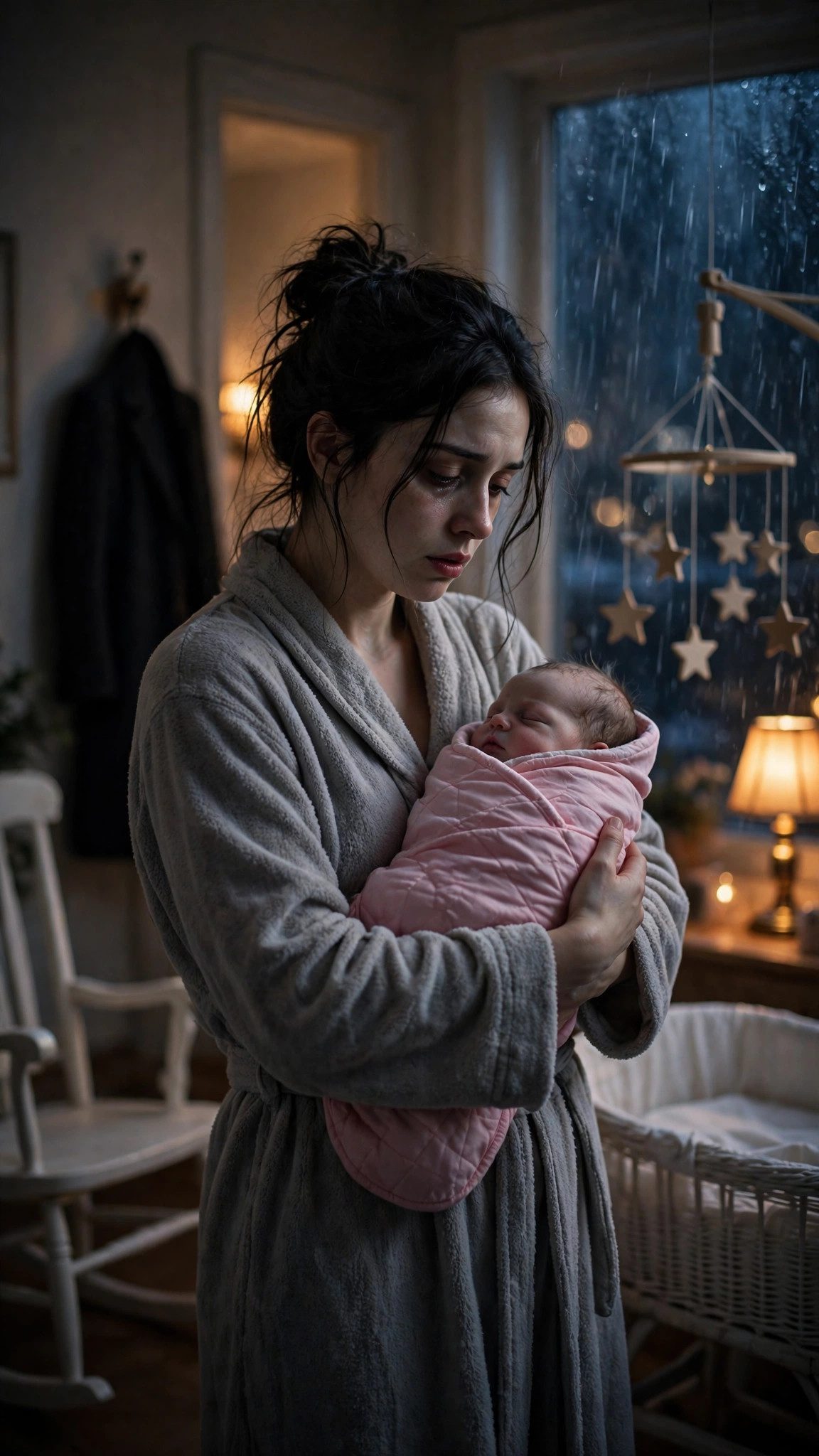
Tuesday came in gray and cold, the way Tuesdays in Milwaukee always came in November, with a low sky and a wind off the lake that cut through coats and found the skin underneath.
Roman did not go to the south dock. He stayed home, in the house on Lake Drive, in the study with the curtains drawn, and he waited, and at 2:00 in the morning his phone rang, and it was Agent Reyes, and Reyes said three words that changed everything.
"We got them."
Castellano's men had come to the south dock at 2:00 in the morning, just as the message had said — four men in a black van, with rifles and rope and a plan to make Roman Moretti's death look like an accident at the warehouse. They had walked straight into an FBI tactical team, and within ninety seconds, all four of them were on the ground in handcuffs, and within an hour, two of them were talking, and by dawn, the FBI had enough to arrest Vincent Castellano himself at his home in the suburbs, in his bathrobe, in front of his wife, while the morning news cameras filmed from the street.
Laya Crane was arrested the same morning, at her apartment, while she was packing a suitcase. The burner phone was in the locked drawer, exactly where Salvatore's people had said it would be. The money was in her bank account, seventy-five thousand dollars, paid in small amounts, always in cash, always on the first of the month. Her father, Charles Crane, was arrested at his office an hour later, and he confessed within the day, because Charles Crane had never been a brave man, and when the FBI showed him the evidence, he told them everything — about Castellano, about the routes, about the plan to kill Roman, about the eighteen months his daughter had spent beside a man she had been paid to destroy.
Roman watched it all on the news, sitting in his study with the television turned low, and he felt nothing. Not triumph. Not relief. Not even anger. Just a hollow, echoing emptiness, the way a house feels after everyone has moved out.
He had won. Castellano was in custody. Laya was in custody. The men who had come to kill him were in custody. The FBI had what they needed. And none of it mattered, because the house on Lake Drive was still empty, and the nursery was still empty, and the only two people he loved in the world were forty miles north, in a cabin he had never seen, and he did not know if they would ever come home.
That afternoon, he drove north.
He did not bring his men. He did not bring Salvatore. He did not bring a gun, or money, or threats, or any of the things he had always brought to solve his problems. He brought himself, in the black SUV, driving north on Highway 41 through the rain, past West Bend and Fond du Lac and Oshkosh, following the same road Aaron had driven a week earlier, in the dark, with their daughter in the back seat.
He found the cabin the way he found everything — by asking the right people the right questions, quietly, until someone remembered a blue Honda with a Milwaukee plate, heading north in the rain, and a woman with a baby, and a man named Ethan Sullivan who had a cabin on Lake Mendota that his father had bought under a different name.
When he turned down the gravel road, the headlights caught Ethan standing on the porch, and Ethan was holding a shotgun, and he did not look surprised to see Roman Moretti. He looked like a man who had been expecting this visit, and dreading it, and preparing for it, all at once.
"Turn around, Roman," Ethan said. His voice was steady. "She doesn't want to see you."
"I know," Roman said. He got out of the car slowly, with his hands where Ethan could see them. "I know she doesn't. But I need to ask her something, and I need to ask it in person. And then, whatever she says, I'll go."
"She's not coming back with you," Ethan said. "You understand that, right? She's not a shipment. You can't just collect her."
"I understand," Roman said. "I'm not here to collect her. I'm here to apologize. And then I'm here to leave."
Ethan studied him for a long moment. Then he lowered the shotgun, very slowly, and he stepped aside, and he said, "She's inside. Sophie's asleep. Don't wake the baby. And Roman — if you hurt her again, I don't care who you are. I'll kill you myself."
Roman nodded. He walked up the porch steps, and he opened the cabin door, and he stepped inside, into the warmth and the smell of wood smoke, and there she was.
Aaron was sitting on the couch beside the fireplace, with a book open in her lap, and she looked up when the door opened, and for a moment — just a moment — he saw something flicker across her face. Not love. Not hate. Something older than both of those things. Recognition. The look of a woman seeing a man she used to know, a man she used to love, standing in her doorway like a stranger.
"Roman," she said.
"Aaron," he said. "I'm sorry."
She closed the book. She set it down on the couch beside her, very carefully, the way a woman handles something fragile. "You're sorry," she said. "For what, exactly? For Laya? For the birthday dinner? For the toast? For the papers? Or for the eighteen months you spent lying to me while another woman sold your life to a man who wanted you dead?"
"For all of it," he said. "For every piece of it. I know about Laya. I know about Castellano. I know about the routes and the money and the burner phone and the south dock. I know she was going to have me killed on Tuesday, and I know the FBI arrested them all this morning because I gave them the evidence. And I know none of that matters, because none of it brings back the six days I threw away, or the night you sat at home with our daughter waiting for a man who promised to be home before nine."
She stared at him. The fire crackled in the fireplace. Somewhere in the back of the cabin, Sophie made a small sound in her sleep, and Aaron's head turned toward it, instinctively, the way a mother's head always turns toward her child.
"Why did you come here, Roman?" she asked.
"To tell you the truth," he said. "All of it. Finally. Laya was Castellano's plant. She was using me to get to my routes, and I was too blind to see it, because I wanted to believe that a beautiful woman wanted me for myself. I betrayed you, Aaron. Not once. Every day, for eighteen months, in a hundred small ways, until there was nothing left of the man you married. And then, on the sixth night of our daughter's life, I walked out the door to celebrate another woman's birthday, and you did the bravest thing anyone has ever done for me. You left. You protected our daughter. You did what I couldn't do. You chose us, even when I wouldn't."
He knelt down then, in front of the couch, in the cabin on Lake Mendota, with the firelight on his face, and he looked up at her, and he said, "I'm not here to ask you to come home. I don't deserve that. I'm here to tell you that I've ended it. All of it. Laya is in custody. Castellano is in custody. I've given the FBI everything. I'm testifying. I'm dismantling the family businesses — the docks, the warehouses, all of it — and I'm making them legitimate, or I'm closing them. I'm done being the man who made grown men tremble. I want to be the man who comes home before nine. I want to be Sophie's father. But I understand if you never want to see me again. And if that's what you decide, I'll respect it. I'll send money. I'll stay away. I'll do whatever you ask. I just needed you to hear it from me, in person. I needed you to know that I know what I did. And I'm sorry."
Aaron looked at him for a long time. She looked at his face — at the gray eyes, at the dark hair, at the lines around his mouth that had not been there a year ago — and she thought about the gala, and the chocolate fountain, and the plastic dinosaurs, and the rocking chair on the first night, and the empty nursery, and the voicemail, and the drive north in the rain, and she felt two things at once, both of them true.
She still loved him. And she did not trust him.
"Here's what I need," she said, finally, and her voice was steady, the way a woman's voice is steady when she has decided what she deserves. "I need time. I need you to prove it, not with words, but with your life. I need you to dismantle the family, like you said. I need you to testify. I need you to be a man Sophie can be proud of, not a man she has to be protected from. And I need you to understand that if you ever — ever — choose another woman over us again, I will leave, and this time I won't tell you where I'm going, and you won't find me. Do you understand?"
"I understand," Roman said.
"Then go home, Roman," she said. "Go home and do what you said you'd do. And when you've done it — when it's real, not just words — come back. And we'll see."
He stood up. He looked at her for one more moment, and then he turned and walked to the door, and he opened it, and the cold November air came in, and he stepped out onto the porch, and Ethan was still standing there, watching him, and Roman nodded at him, and he got into the black SUV, and he drove away, south, toward Milwaukee, toward the empty house and the empty nursery and the long, hard work of becoming a man worth coming home to.
Aaron watched the headlights disappear down the gravel road. Then she went to the back of the cabin, and she picked up Sophie from the wicker bassinet, and she held her daughter against her chest, and she whispered, "I'm here, sweetheart. I'm here. And your daddy is going to try. That's all we can ask. That's all anyone can ask."
The weeks that followed were the hardest of Aaron's life, and also, in a strange way, the simplest.
At the cabin, there were no parties. There were no phone calls from women with soft, wounded voices. There were no men watching the roads. There was only the lake, gray and cold in the November light, and the fire in the stone fireplace, and Claire's bread baking in the oven, and Ethan's terrible jokes, and Sophie, growing bigger every day, in the wicker bassinet beside the wood stove.
Sophie smiled for the first time on a Tuesday, three weeks after they left Milwaukee. Not a gas smile, the nurse had told Aaron — a real smile, a social smile, the kind that means a baby recognizes you and is glad you're there. Aaron was changing her diaper on the couch when it happened, and she looked up at her mother and her whole face lit up, and Aaron laughed out loud, and then she cried, because it was the first time in weeks that something had felt purely, uncomplicatedly good.
Claire found her there, laughing and crying at the same time, and she sat down beside her and put her arm around her, and she said, "That's your daughter, Aaron. That's what you saved. Remember that, when it gets hard."
It got hard. On the nights when Sophie would not stop crying, and Aaron was so tired she could barely see, and she thought about the house on Lake Drive, with its marble floors and its chandeliers and its nursery kept at exactly seventy-two degrees, and she wondered if she had made a terrible mistake. On the mornings when she woke up and reached for her phone, and there was no phone, because she had left it on the changing table, and she realized she did not know what day it was, or what was happening in the world, or whether Roman was alive or dead.
And then, in the fourth week, the first letter arrived.
It came in a plain white envelope, with no return address, delivered by a courier Ethan did not recognize, and Aaron held it in her hands for a long time before she opened it. She was afraid of what it would say. She was afraid it would be a lie. She was afraid it would be the truth.
It was neither. It was a list.
"Things I have done this week," Roman had written, in his precise, slanted handwriting. "1. I testified before a federal grand jury about Vincent Castellano. 2. I gave the FBI the names of every man in my organization who took money from Castellano. 3. I closed the south dock warehouse. 4. I met with a lawyer about making the trucking company legitimate. 5. I went to the nursery every night at nine o'clock and sat in the rocking chair for one hour, because I promised I would be home before nine, and I am keeping that promise now, even though there is no one here to keep it for."
There was no "I love you." There was no "Come home." There was only the list, and at the bottom, in smaller handwriting: "I am doing the work. I will keep doing the work. — R."
Another letter came the next week. And another the week after that. Each one was a list. Each one was shorter than the last, and more specific. The trucking company was now fully legitimate, with audited books. The docks had been sold to a shipping firm from Chicago. The men who had taken Castellano's money were cooperating with the FBI. Salvatore Voss had retired to Florida. The house on Lake Drive was being sold, and Roman was buying a smaller house, in a quiet neighborhood, with a nursery that faced the morning sun.
Aaron read every letter twice. She did not answer any of them. She was not ready. But she kept them, folded neatly, in the drawer of the nightstand beside her bed, and some nights, after Sophie was asleep, she took them out and read them again, and she thought about the man who had written them, and she wondered if he was really changing, or if he was just a very good actor, playing the part of a reformed man until she came home.
Ethan watched her read the letters, and one evening, while they were sitting on the porch watching the sun go down over the lake, he said, "You don't have to decide today, Aaron. Or tomorrow. Or next month. But at some point, you're going to have to decide what you believe. Do you believe people can change? Because if you don't, then it doesn't matter what he does. And if you do — then you have to give him a chance to prove it."
Aaron looked out at the lake, gray and still in the evening light, and she thought about her father, who had bought this cabin under a different name so that his family would always have somewhere safe to go. And she thought about Sophie, asleep in the wicker bassinet, who deserved a father. And she thought about Roman, sitting in an empty nursery every night at nine o'clock, keeping a promise to no one, because he had finally understood that a promise is not something you make to another person. It's something you make to yourself.
"I believe people can change," she said, finally. "But I believe it slowly. And I believe it with proof."
Ethan nodded. "Then let him prove it," he said. "And when you're ready, you'll know."