The wedding was in June, in the garden of the Moretti estate, under the old oak tree where Isabella was buried, and the whole world seemed to have come out to see it.
It was not a big wedding. After everything that had happened, neither of us wanted a big wedding. There were no two hundred people in black tie. There were no chandeliers and no champagne fountains. There were fifty chairs set out on the lawn, and white roses on every table, and a string quartet playing softly in the shade, and the late afternoon sun coming down through the leaves like gold.
Gabriel was the ring bearer. He wore a little black suit with a white shirt, and he carried the rings on a velvet cushion, and he walked down the aisle so slowly and so carefully, with his tongue sticking out of the corner of his mouth in concentration, that half the guests were crying before the ceremony even began. His stuffed rabbit, worn and gray and missing one ear, sat in a place of honor on the front row, dressed in a tiny bow tie.
I wore a simple white dress, nothing fancy, nothing borrowed, just a dress I had chosen myself, and my mother's old score of The Magic Flute, pressed flat and framed, sat on a table by the altar, so that she could be there too.
Alessandro waited for me at the end of the aisle, in a black suit with a white shirt and no tie, the collar open at his throat, the way he had looked the first night I saw him at Lumière, and when he saw me, he smiled, and it was not the smile of the King of New York. It was the smile of a man who had finally, after thirty-eight years, found his way home.
The priest was an old man from the church in the village, with white hair and kind eyes, and he spoke simply, about love and forgiveness and second chances, and when he asked if anyone objected, the garden was silent, because everyone there knew what we had survived to reach this day.
"Do you, Alessandro Moretti, take this woman to be your wife?" the priest asked.
"I do," Alessandro said, and his voice was steady and sure.
"Do you, Elena Marchetti, take this man to be your husband?"
"I do," I said, and my voice did not shake.
And then Gabriel stepped forward, and he tugged on Alessandro's sleeve, and he said, in a voice loud enough for the whole garden to hear, "Mr. Alessandro, can I ask you something?"
The guests laughed, softly, and Alessandro knelt down so that he was eye to eye with my son, and he said, "You can ask me anything, Gabriel."
"Will you be my papa?" Gabriel asked. "Not just my mamma's husband. My papa. The one who comes to my school plays and teaches me to ride a bike and is there when I wake up in the night because I had a bad dream?"
The garden went silent. Fifty people held their breath. And Alessandro Moretti, the King of New York, the man who had once sworn he would never love anyone again, looked at my five-year-old son with tears in his eyes, and he said, "Gabriel, I would be honored to be your papa. If you will have me."
Gabriel threw his arms around Alessandro's neck, and the whole garden erupted into applause and tears, and I stood there in my white dress with the sun coming down through the oak leaves, and I thought about my mother, and about Isabella, and about five years of running, and I knew that I was finally, finally home.
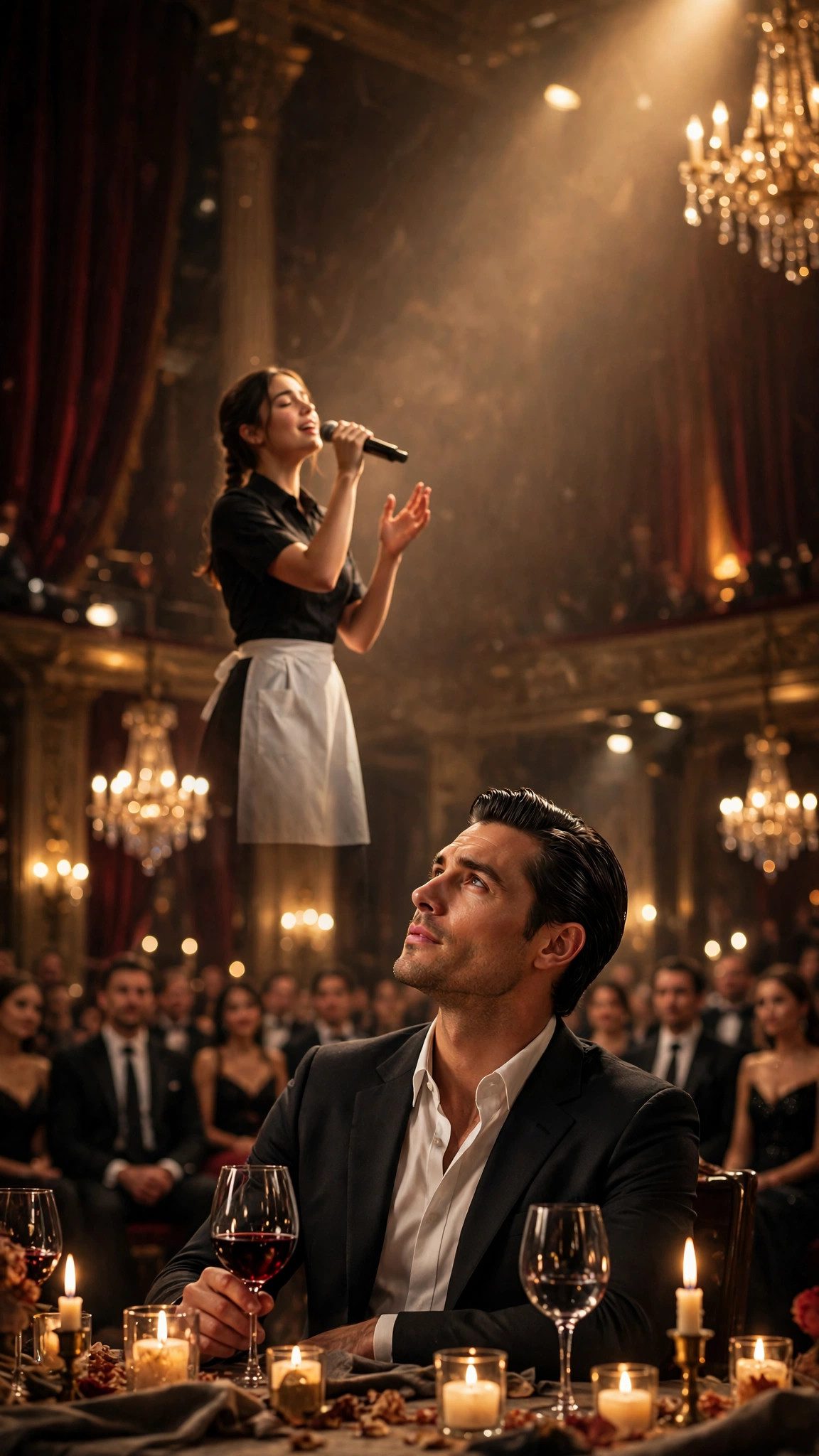
After the ceremony, there was dinner under the lights, and dancing, and toasts, and Rosa, Alessandro's sister, stood up and told the story of the night I sang at the gala, and how her brother had laughed in front of two hundred people and made a dare he never expected anyone to answer, and how a waitress in a black uniform had answered him with Mozart and changed his life forever.
And then, as the sun went down and the stars came out, Alessandro took my hand and led me to the small stage they had set up at the edge of the garden, and he handed me a microphone, and he said, "Sing for us, Elena. Sing for your mother. Sing for mine. Sing for everyone who is here, and everyone who is watching from above."
So I sang. I sang the Queen of the Night, one more time, under the stars, in a garden full of white roses, with my husband beside me and my son asleep in his arms, and my voice rose up into the night sky, clear and true and bright, and when the last note died, the garden was silent, and then the applause came, soft and warm, like rain on a rooftop.
Later, when the guests had gone and the lights were dimmed and Gabriel was asleep in the big bedroom upstairs with his stuffed rabbit, Alessandro and I walked through the garden together, hand in hand, and we stopped beneath the old oak tree, where Isabella was buried, and we stood there for a long time in the moonlight.
"Your mother would have loved tonight," Alessandro said quietly.
"So would yours," I said.
He squeezed my hand. "Do you know what my mother said to me, the night you sang for her in her room? She said, 'Alessandro, God has a sense of humor. He took your voice away, and then He sent you a woman whose voice could bring it back.' I did not understand her then. I understand her now."
We stood there under the oak tree, and the night was warm, and the stars were out, and for the first time in my life, I was not afraid. Not of the dark. Not of the future. Not of anything.
A week after the wedding, a letter arrived from Naples. It was from Matteo. He wrote that he was well, that his shoulder had healed, that he was working to change the family business from the inside, slowly, the way he had promised. He wrote that he thought of Gabriel every day, and that he kept a photograph of him on his desk, the one from the hospital, where Gabriel was sitting on his bed with his stuffed rabbit. And he wrote, in a careful, formal hand, "Tell Gabriel that his father loves him, and that he is proud of him, and that he will always be proud of him, no matter how far away he is."
I read the letter to Gabriel that night, sitting on the edge of his bed, and he listened quietly, and then he said, "Mamma, can I have two papas? Papa Matteo in Italy, and Papa Alessandro here?"
"Yes, tesoro," I said, and I kissed the top of his head. "You can have two papas. You are a very lucky boy."
"I know," he said, and he yawned, and he closed his eyes, and he was asleep before I finished tucking the blanket around him.
One year later, on the first anniversary of our wedding, I sang at a charity concert in the same hall where I had sung at the gala, and this time the hall was full, and the audience knew my name, and the newspapers called me "the voice the King of New York could not forget," and I laughed when I read it, because they had it backwards.
Alessandro had not forgotten my voice. My voice had found him. My mother's voice, carried across forty years and an ocean, through a daughter who had run away and a son who had searched for five years, had brought us together, and it would never let us go.
That night, after the concert, Alessandro and I went home to the estate, and Gabriel was waiting up for us, in his pajamas, with his spelling book, and he made us sit down and listen while he read us a story he had written at school. It was about a queen who sang, and a king who listened, and a little boy who had two papas and a rabbit with a bow tie, and when he finished, he looked up at us with his mother's green eyes and his father's dark hair, and he said, "The end."
And Alessandro put his arm around me, and he kissed the top of my head, and he said, "No, Gabriel. Not the end. The beginning."
He was right. It was the beginning. Of a family. Of a life. Of a voice that would never be forgotten, and never be silenced, and never, ever run away again.
Our honeymoon was a week at a lake house upstate, just the three of us, with no telephones and no visitors and no one who needed anything from us. Gabriel learned to fish, standing on the dock in his bare feet with a rod almost as tall as he was, and Alessandro taught him to cast, patiently, over and over, until on the third day Gabriel caught a fish, a small silver perch, and he shouted so loudly that the birds rose up out of the trees in a cloud, and Alessandro laughed, and I laughed, and we cooked the fish for dinner that night, and Gabriel declared it the best fish in the whole world.
In the evenings, we sat on the porch and watched the sun go down over the lake, and Alessandro told Gabriel stories about his own childhood, about the summers he had spent at the lake house with his father, and about the time he had caught a fish so big it had pulled him halfway into the water. And Gabriel told Alessandro stories about school, and about Mrs. Deluca, and about Barnaby the rabbit, and I sat between them, listening, and I thought about how strange and wonderful it was that my son had a father now, a real father, who listened to his stories and taught him to fish and was there when he woke up in the night because he had a bad dream.
When we came home, I began to sing again in earnest. Not just at charity concerts, but in a small recital series downtown, once a month, in a hall that held two hundred people, and every month the hall was full. I sang Mozart, and Verdi, and Puccini, and sometimes, at the end, I sang the Queen of the Night, and the audience rose to their feet, and I thought of my mother, and of Isabella, and of all the women whose voices had brought me to this place.
Gabriel started school that autumn, a good school, with a music program, and on the first day, Alessandro walked him to the gate, holding his hand, and Gabriel turned and waved to me, and he shouted, "Bye, Mamma! Bye, Papa!" and the other parents turned to look, and I did not care, because my son had a papa, and his papa was walking him to school, and that was the most ordinary, most miraculous thing in the world.
We kept the little apartment in Queens, even after we moved to the estate. I would not let Alessandro sell it. "It is where we survived," I told him. "It is where Gabriel learned to walk, and where I learned to be brave. I want to keep it, so that we never forget."
And I recorded the aria, one quiet afternoon in the music room at the estate, with the grand piano and the tall windows and the photograph of my mother and Isabella on the wall. I sang the Queen of the Night, and Alessandro recorded it on his telephone, and we sent the recording to the church in Naples where my mother used to sing, and they played it at the memorial service for Isabella, one year after her death, and the whole congregation wept.
That is the story of how I stopped running. Not with a single moment, but with a hundred small ones: a fish on a dock, a song in a garden, a little boy walking to school holding his papa's hand. That is how a life is built. Not all at once, but one day at a time, one song at a time, until one day you wake up and you realize you are home, and you have been home for a long time, and you are never going to run again.
Gabriel began violin lessons that autumn, on a small violin that had belonged to his grandfather Antonio, the one my father had played in the Naples orchestra, which I had kept wrapped in cloth in the bottom of a drawer for five years, too precious and too painful to look at. Alessandro found it when we were unpacking at the estate, and he held it up, and he said, "Elena, this is your father's violin. Gabriel should learn to play it."
So Gabriel learned. He practiced every day after school, screeching at first, the way all beginners do, and then, slowly, the notes began to come clean, and one evening, six months later, he played the opening of The Magic Flute for us in the music room, standing very straight with the little violin under his chin, and his grandfather's music filled the room, and I wept, and Alessandro held my hand, and neither of us said a word, because there was nothing to say.
On the second anniversary of our wedding, we went back to the lake house, and Gabriel caught another fish, bigger than the first, and Alessandro taught him to clean it, and I cooked it for dinner, and afterwards we sat on the porch and watched the stars come out over the lake, and Gabriel fell asleep with his head in my lap, and Alessandro looked at me across the porch, and he said, "Elena, do you remember the night you spilled wine on my shirt?"
"How could I forget?" I said. "I thought you were going to have me thrown out of the restaurant."
"I thought you were going to be the most interesting thing that had ever happened to me," he said. "And I was right."
We sat there in the dark, listening to the water on the shore and the crickets in the grass, and I thought about my mother, and about Isabella, and about all the voices that had led me here, and I knew that the story was not over. It would never be over. It would go on, in Gabriel's violin, and in my songs, and in the children we might one day have, and in every note of every aria I would ever sing. A voice, once found, is never lost again.
The End.
THE END