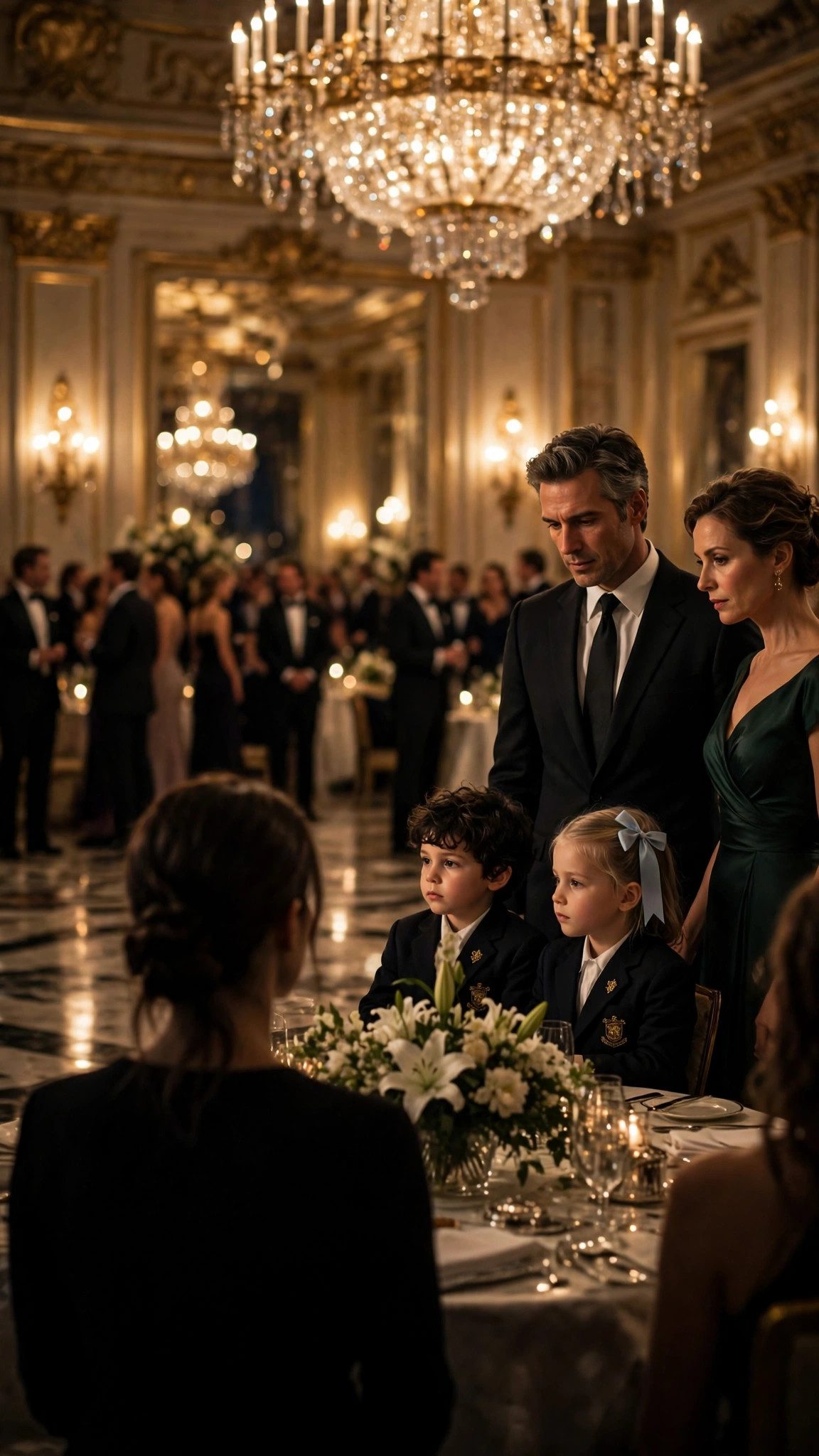
The first time I saw my children in six years, they were standing under a chandelier the size of a small car, wearing the Mercer crest on their school blazers, and they did not know my name.
I had slipped into the back of the Mercer Foundation gala the way I used to slip into hospital rooms at three in the morning — quietly, on soft shoes, with my hands folded so no one would ask me what I was doing there. The ballroom of the Drake Hotel smelled of white lilies and old money. Two hundred people in black tie turned their faces toward the stage, where a string quartet was playing something expensive and forgettable. And there, in the front row, sat a little boy with dark curls and a little girl with a ribbon in her hair, both of them straight-backed and still, both of them wearing the small gold crest of the Mercer family pinned above their hearts.
Leo and Lily. My son and my daughter. Six years old. Born six days — no. Born days before I left.
My little son had been born on a Tuesday, in a room that smelled of antiseptic and rain. His sister had followed him eleven minutes later, screaming like she had somewhere better to be. I had held them both for exactly one night. Then my husband had walked into the hospital room with a folder in his hand, and everything I thought I knew about my life had ended in a single sentence.
"Sign these," Adrian Mercer had said. "I still love Evelyn Carter. I always have. You were a mistake I am correcting."
Six years. I had carried those words across state lines and through six years of night shifts, and I had believed them every single day, because believing them was easier than believing the alternative — that I had abandoned my babies for nothing.
Now here they were. Alive. Beautiful. Wearing his name on their chests like armor.
"There she is," a woman said behind me, too loudly. "The ghost finally came home."
I turned. An older woman in a silver gown was staring at me with the particular expression of a woman who has just recognized someone she buried years ago. Margaret Mercer. Adrian's mother. She had aged a decade in six years. Her hair was white now, and her hands shook around her champagne glass.
"Mother," Adrian said.
He was standing three feet from her, and I had not even seen him come up beside us. He was taller than I remembered, or maybe I had just forgotten how a room changes shape when Adrian Mercer walks into it. His suit was black. His hair was black, going gray at the temples. His face was the same face I had married in a ceremony that resembled a state funeral — beautiful, cold, and closed to me like a door I had never been given the key to.
He did not look at me. He looked at his mother, and his voice was very quiet, and very tired.
"Mother," he said. "I told you they had no mother."
Something in my chest cracked open. Six years of night shifts. Six years of covering for everyone else, of taking the shifts nobody wanted, of holding strangers' hands while they died because their own families could not be bothered to come. Six years of telling myself that it was better to let my babies live a life without me so they would not be hurt. And here was the man who had thrown me away, telling his mother — telling the whole glittering room, if anyone was listening — that my children had no mother.
I had not planned to speak. I had come to look. One look, I had told myself on the drive down from Milwaukee. One look at them, alive and well, and then I would go back to my night shifts and my small apartment and my life of covering up for everyone else.
But my mouth opened anyway.
"You can tell stories to strangers, Mr. Mercer," I said. My voice sounded calm. I was proud of how calm it sounded, because nothing else about me was calm. My hands were shaking. My knees were shaking. The whole shining ballroom seemed to be shaking, or maybe that was just me. "But I'm not a stranger."
Adrian turned his head then. Slowly. The way a man turns when he hears a voice from a room he thought was empty.
His eyes found mine. And for one terrible, endless second, I saw it — the flicker. The recognition. The shock. The thing he had buried under six years of ice, surfacing all at once, raw and unguarded, before he killed it.
"Clara," he said.
It was not a question. It was not a greeting. It was my name, said the way a man says the name of someone he has already mourned.
Margaret Mercer's champagne glass slipped from her hand and shattered on the marble floor. The string quartet faltered. Two hundred heads turned. Somewhere in the front row, a little boy with dark curls turned around in his seat, and a little girl with a ribbon in her hair turned with him, and two pairs of dark eyes — his eyes, my eyes, the same eyes — found me standing in the back row in a cheap black dress that did not belong in that room.
"Mother?" the little boy said. Not to me. To Margaret. But his eyes were on me.
I should have run. Every instinct I had built over six years of hiding told me to run. But my feet would not move, because my children were looking at me, and for the first time in six years, I was not going to be the one who walked away.
"I walked over to Adrian," I would tell the police later, when they asked me to describe that night. "I unlocked the door, and I opened it."
That is not quite what happened. What happened was this: I walked across the ballroom floor while two hundred people whispered behind me, and my children — my son and my daughter — had already moved away from me, walking toward the door where their father was standing next to a woman I had expected to see.
Evelyn Carter. Standing next to Adrian in a dark green gown, beautiful and composed, her hand resting lightly on his arm the way a wife's hand rests. The woman he had chosen over me. The woman he still loved. The woman whose name had been the last thing he said to me before I signed the papers and walked out of the hospital with empty arms.
A man stopped me before I could reach my children. He moved out of the crowd like a wall sliding into place — tall, broad, gray at the temples, a hand raised, palm out. Marcus Hale. Adrian's head of security. I had seen him a hundred times in the old days, standing behind Adrian's shoulder, saying nothing.
"Not here," Marcus said quietly. "Not tonight. Please."
I tried to turn around, but he moved faster than I did. His hand closed around my upper arm — not hard, not cruel, just firm, the way you hold someone who is about to walk into traffic.
And that was when I understood, little by little, in the slow and terrible way that understanding comes when you have been wrong about everything for six years: the most feared mafia boss in Chicago was not fighting to get his children back.
He was racing to reach them before his enemies did.
But I did not know that yet. Not in that moment. In that moment, all I knew was that my son and my daughter were walking away from me toward a door, toward their father and the woman he had chosen, and a stranger's hand was on my arm, and six years of silence was about to end whether I was ready or not.
Six years earlier, I had been Clara Mercer, twenty-three years old, and I had married Adrian Mercer in a cathedral full of white flowers and armed men, in a ceremony that resembled a state funeral more than a wedding. There had been no music I recognized. There had been no laughter. My father had cried. Adrian's father had not. The priest had spoken about duty and family and forever, and I had stood there in a dress that cost more than my father's house and thought: this is a mistake. I knew it in my bones. I knew it the way you know a storm is coming when the air goes still.
I married him anyway. Because his father had asked, and my father had owed, and because when Adrian Mercer looked at me across the aisle, for one single second, he had looked at me like I was the only living thing in that cold cathedral.
I had been wrong about that too. Or so I believed for six years.
The twins were born on a Tuesday in October, in a room at St. Margaret's Hospital, while rain hammered the windows and a nurse with kind eyes held my hand and told me to push. Leo came first, dark-haired and furious. Lily came eleven minutes later, smaller, quieter, her tiny fist curled around my finger as if she already knew she would have to hold on tight.
I held them both that night. I counted their fingers. I memorized the weight of them. I whispered their names into the dark, over and over, like a prayer: Leo. Lily. Leo. Lily. Mine. Mine.
In the morning, Adrian walked in with a folder, and he did not look at the babies, and he did not look at me, and he said the words that ended my life as I knew it.
"Sign these. I still love Evelyn Carter. I always have. You were a mistake I am correcting."
I signed. I do not remember deciding to sign. I remember the pen. I remember the way the paper sounded when he turned the page. I remember the nurse with the kind eyes standing in the doorway, and the way she looked at me, and the way I understood, in that moment, that no one in that room was going to save me.
I left the hospital the next day with a bag that held two changes of clothes and four thousand seven hundred dollars in cash and a nursing license with my maiden name on it. I left my babies in a nursery full of machines that beeped and hummed, under the care of women who were paid to love them for a few hours at a time.
I told myself it was better this way. I told myself that a mother who stayed would only bring the danger with her, that the Mercer name was a target painted on a child's back, that Adrian could protect them in ways I never could. I told myself that they would be safer without me, richer without me, happier without me.
I told myself that for six years. I told myself that on every night shift in Milwaukee, while I covered for nurses who had families to go home to, while I held the hands of dying strangers, while I learned to live with the particular silence of a woman who has given away the only two people she has ever loved.
That was what I did for money. That was why I had worked nights, covering up for everyone else. And now I was the one covering up — hiding my name, hiding my face, hiding in the back row of a ballroom in a dress I had bought on sale, watching my children wear a crest I had never agreed to, listening to their father tell the world they had no mother.
I was done covering up. I was done hiding. I was done being the ghost in my own children's lives.
Marcus Hale's hand was still on my arm. The string quartet had stopped playing entirely now. Two hundred people were watching us. Evelyn Carter was watching us, her face pale and unreadable. And Adrian Mercer was standing three feet away, looking at me like I was a door he had locked six years ago and someone had just kicked open.
"Let go of me," I said to Marcus.
"Clara," Adrian said again. And this time his voice broke, just slightly, on the second syllable. "Don't."
"Don't what?" I asked. "Don't look at my children? Don't speak to my children? Don't exist? I've been doing all three for six years, Adrian. I'm done."
The little boy — Leo, my Leo, six years old and brave in a way that broke my heart — took a step toward me. His sister's hand was in his. They moved together, the way twins do, like two halves of a single thought.
And then the lights went out.
Not all of them. Just the chandeliers. The ballroom plunged into a darkness so sudden and complete that for a moment, nobody moved, nobody breathed. Someone screamed. Glass shattered somewhere to my left. Marcus Hale's hand tightened on my arm, and then it was gone, and a voice I did not recognize shouted, "Now! Take them now!"
In the dark, I heard my daughter cry out. "Leo!"
And I heard Adrian Mercer roar my son's name like a man watching his whole world burn.
"LEO!"
I ran toward the sound. I did not think. I did not plan. I ran, in the dark, in my cheap black dress, toward the small voice calling for her brother, toward the man who had thrown me away six years ago and was now shouting for his son like his heart was being torn out of his chest.
I am only now, little by little, starting to realize what I should have understood that night: the most feared mafia boss in Chicago was never fighting to get his children back.
He was racing to reach them before his enemies did.
And his enemies were already in the room.