I met Adrian Mercer on a Tuesday night in March, in a trauma room that smelled of blood and bleach, and I saved his life with my hands and a prayer I did not believe in.
I was twenty-two years old, a night-shift nurse at St. Margaret's Hospital on the South Side, three months out of nursing school, and still young enough to think that the night shift was romantic — the quiet halls, the humming machines, the feeling that the whole sleeping city belonged to the handful of us who stayed awake to watch over it.
It was 2:14 in the morning when they brought him in. Four men in black suits carried him through the emergency doors on a backboard, and the charge nurse took one look at the blood and said, "Trauma One, now," and I ran.
He had been shot twice. Once in the shoulder, once in the side, just below the ribs. The blood was everywhere — on his white shirt, on the backboard, on my hands before I even realized I was touching him. His eyes were open. That was the thing I remembered most clearly afterward. Most people who come in like that have their eyes closed, or rolled back, or fixed on nothing. His eyes were open, and they were locked on mine, and they were furious.
"Don't you dare let me die in this room," he said to me. His voice was low and steady, which frightened me more than the blood did, because a man who can speak that clearly with two bullets in him is a man who is used to giving orders and having them obeyed. "Do you understand me? I don't die tonight."
"Then stop bleeding on my floor," I said. I don't know where the words came from. I was twenty-two and terrified and my hands were shaking, but my mouth had always been braver than the rest of me. "And hold still. You're making it worse."
Something flickered in his eyes then. Not warmth. Not gratitude. Something closer to surprise — as if no one had spoken to him that way in a very long time.
I worked on him for four hours. I held pressure on the wound in his side while the surgeon worked. I counted his breaths. I watched the monitor. I talked to him the whole time, because that was what the older nurses had taught me — you talk to them, you keep them here, you don't let them drift. I told him about my shift. I told him about the vending machine on the third floor that ate quarters. I told him about my father, who ran a small diner on Halsted Street and made the best meatloaf in Chicago and had taught me that a person is only as good as their word.
He listened. He didn't say much. But his eyes stayed on my face, and when the surgeon finally stepped back and said, "He's stable," Adrian Mercer reached out with his good hand and caught my wrist.
"What is your name?" he asked.
"Clara Whitfield," I said.
"Clara Whitfield," he repeated, like he was memorizing it. "You kept me alive tonight. I don't forget a debt."
Three days later, his father came to the hospital.
Salvatore Mercer was seventy years old, white-haired, soft-spoken, and terrifying in the particular way that only very old, very powerful men can be terrifying — not because they raise their voices, but because they never have to. He came to my floor with two men in suits, and he asked to speak with me alone, and the charge nurse looked at me with wide eyes and mouthed, "Be careful."
"My son tells me you saved his life," Salvatore said. He had a cup of coffee in his hand, from the machine in the waiting room, and he held it the way a man holds something he has no intention of drinking. "He also tells me you saw the men who brought him in. You saw their faces. You heard what they said."
I had. I had seen four men in black suits, and I had heard one of them say the name Castellano, and I had heard another one say, "The docks. Thursday." I had not understood what any of it meant. I understood now, standing in front of this old man with his waiting-room coffee, that I had seen something I was not supposed to see.
"I don't know anything," I said. "I just did my job."
"Of course," Salvatore said. "And that is why I am here. A girl who does her job and keeps her mouth shut is a rare thing, Miss Whitfield. My family values rare things." He set the coffee down on the nurses' station, untouched. "My son needs a wife. A respectable wife. A wife with clean hands and a clean name, who understands discretion. You will marry Adrian. The wedding will be in six weeks. Your father will be taken care of. You will be taken care of. And you will never speak of what you saw in that trauma room, to anyone, for the rest of your life."
It was not a proposal. It was not a request. It was a sentence, delivered in the same soft voice he might have used to order lunch.
"I don't want to marry him," I said. My voice sounded very small. "I don't even know him."
"You know him well enough," Salvatore said. "You held his life in your hands for four hours. That is more than most wives ever know of their husbands." He smiled then, a thin, practiced smile. "Besides, Miss Whitfield. Refusing the Mercer family is not a thing people do twice."
I went home that night and I told my father. My father was fifty-eight years old, and he had run his diner for thirty years, and he had never owed anyone anything until the winter his wife — my mother — got sick, and the medical bills piled up, and a man from a lending company with a kind face and a hard handshake had offered him a loan with terms he did not understand until it was too late.
"How much?" I asked my father.
"Forty thousand," he said. His voice was hollow. "Clara, I didn't know. I thought I could pay it back."
The loan had been sold. And sold again. And the last man holding it was a man named Castellano, who had told my father, very politely, that the debt could be settled in one of two ways: with money my father did not have, or with a daughter.
I understood then. I understood that my meeting Adrian Mercer in that trauma room had not been an accident of fate. I understood that the old man with the waiting-room coffee had not come to thank me. He had come to collect.
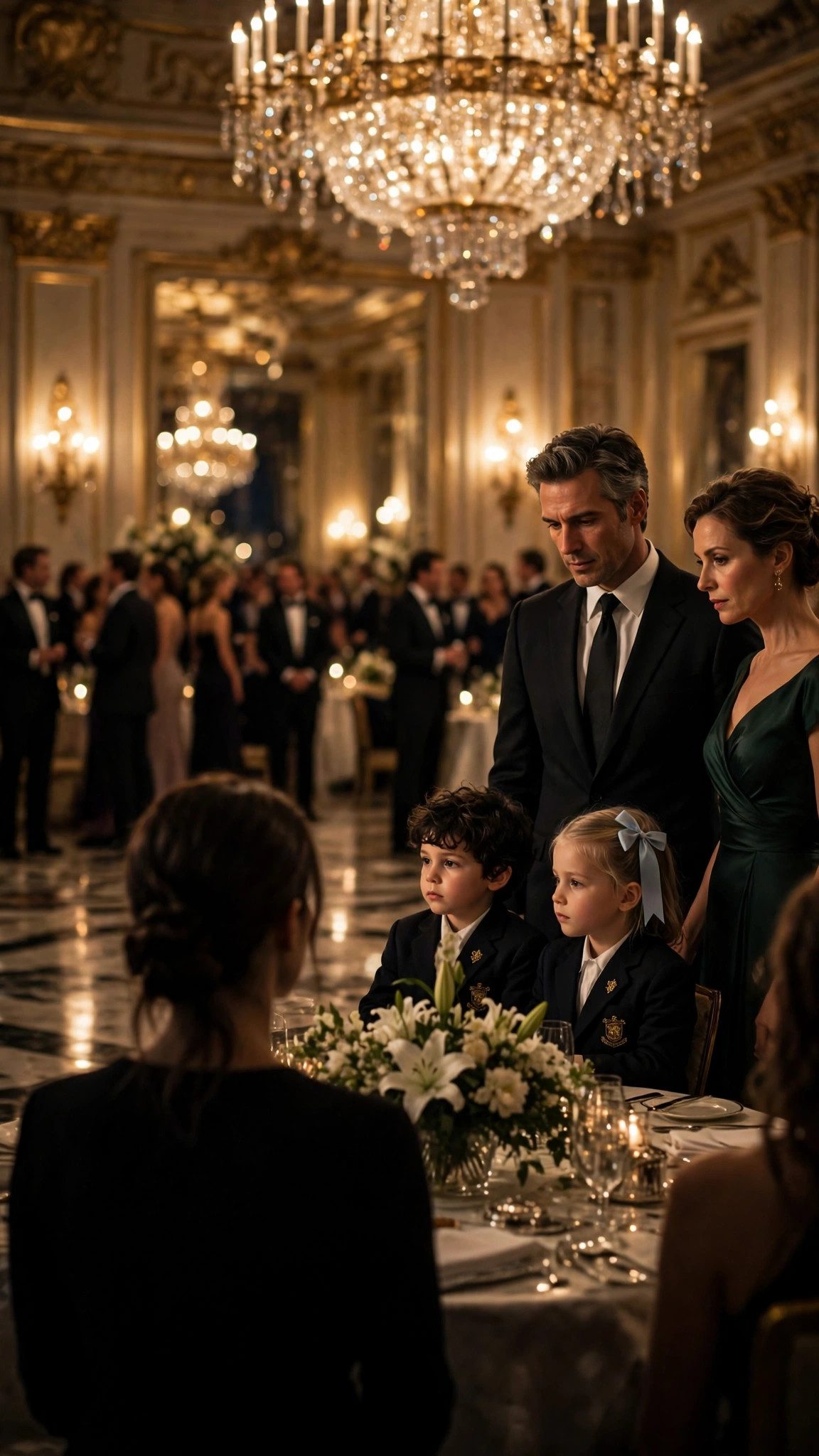
I married Adrian Mercer six weeks later, in a cathedral full of white flowers and armed men, in a ceremony that resembled a state funeral more than a wedding.
There was no music I recognized. The organ played something slow and stately, and the guests — two hundred of them, in black, in diamonds, in suits that cost more than my father's diner made in a year — sat in silence, like mourners. My father cried through the whole ceremony. He sat in the front pew with his hands folded, and his shoulders shook, and I knew he was crying because he had sold his daughter to save his diner, and because he loved me, and because there was nothing else he could do.
Adrian's father did not cry. He sat beside Margaret Mercer — Adrian's mother, silver-haired even then, her face carved from the same cold marble as the cathedral walls — and he watched the ceremony the way a man watches a business transaction conclude.
Adrian himself stood at the altar in a black suit, and he looked at me as I walked down the aisle, and for one single second — one heartbeat — he looked at me like I was the only living thing in that cold cathedral. Like I was a person, and not a debt, and not a solution to a problem.
Then the second passed, and his face closed, and he was Adrian Mercer again: beautiful, cold, and unreachable.
The priest spoke about duty. About family. About forever. I said the words I was supposed to say. Adrian said the words he was supposed to say. A ring — heavy, gold, set with a single diamond the size of a tear — was pushed onto my finger. It felt like it was strangling me.
Afterward, at the reception, I met Evelyn Carter.
She was standing by the champagne table, in a dark green gown, beautiful in the way that women who have always been beautiful are beautiful — effortlessly, carelessly, like it costs them nothing. She was thirty years old, and she had known Adrian since childhood, and when she looked at me, her eyes were not unkind. They were worse than unkind. They were pitying.
"So you're the nurse," she said. She held a glass of champagne she was not drinking. "He told me about you. He said you were brave."
"Did he?" I said. "He never told me about you."
"Of course not," Evelyn said. She smiled, and the smile did not reach her eyes. "Adrian doesn't talk about the things that matter. He never has." She looked across the room, to where Adrian was standing with his father, his back to us, his shoulders rigid under his black suit. "We were supposed to be married, you know. Years ago. Before his father decided the family needed a different kind of wife. A clean one." Her eyes came back to mine. "I hope you're happy, Clara. I truly do. But you should know — a man like Adrian doesn't stop loving someone just because his father tells him to."
I did not answer her. I did not know what to say. I stood there in my wedding dress, in a room full of strangers, holding a glass of champagne I had no intention of drinking, and I understood, with a clarity that felt like falling: I had married a man who loved another woman. I had married into a family that had bought me to settle a debt. And I had done it wearing a dress that cost more than my father's house.
That night, in the penthouse at the top of the Mercer building, Adrian came into the bedroom where I was standing by the window in my wedding dress, looking out at the city lights.
"Clara," he said.
I turned. He was loosening his tie with one slow pull, the way a man does when he is finished with a long day. He did not look at the dress. He did not look at the flowers dying in their vase on the dresser. He looked at me the way he had looked at me in the trauma room — like I was a problem he had already decided how to solve.
"This marriage," he said, "is an arrangement. You know that. I know that. My father knows that. You will live here. You will be safe here. You will want for nothing. But do not mistake this for something it is not."
"I know what it is," I said. My voice sounded steady, which surprised me, because nothing else about me was steady. "It's a debt. I'm the payment."
Something moved in his face then. Something I could not read. It was gone before I could name it.
"Get some sleep," he said. And he left the room, and he did not come back that night, or the night after, or the night after that.
I lived in that penthouse for two years. I learned the shape of Adrian Mercer's life the way you learn the shape of a house you do not own — from the outside, through windows, never quite inside. He left before dawn and came home after midnight. He took his meals in his study. He spoke to me at breakfast, briefly, politely, about nothing: the weather, the staff, the charity gala his mother was planning. He never asked me about my work at the hospital — I had kept my nursing job, three nights a week, because it was the only part of my life that was still mine. He never asked me about my father. He never asked me what I wanted.
And I never asked him about Evelyn Carter. I saw her name in the paper, at charity events, at the opera, always photographed at a careful distance from Adrian, always beautiful, always composed. I saw the way his face changed when her name came up in conversation — a tightening, a closing, a door shutting. I told myself I did not care. I told myself that a marriage that meant nothing could not hurt me.
I was wrong about that too. It hurt every single day, in small, quiet ways that added up to something enormous: the empty chair across from me at breakfast. The wedding ring that felt like a shackle. The knowledge that the man I had married — the man whose life I had held in my hands for four hours in a trauma room — loved a woman who was not me, and always would.
I told myself I never truly loved him. I told myself that a hundred times, in a hundred different ways, because if I had never loved him, then none of it mattered. If I had never loved him, then the cold penthouse and the empty chair and the ring that strangled me were just the terms of a contract, and contracts end, and people walk away, and nobody gets hurt.
I was very good at lying to myself. I had six years of practice ahead of me, and I did not even know it yet. That was the last night I believed the lie that a contract could ever protect a heart.