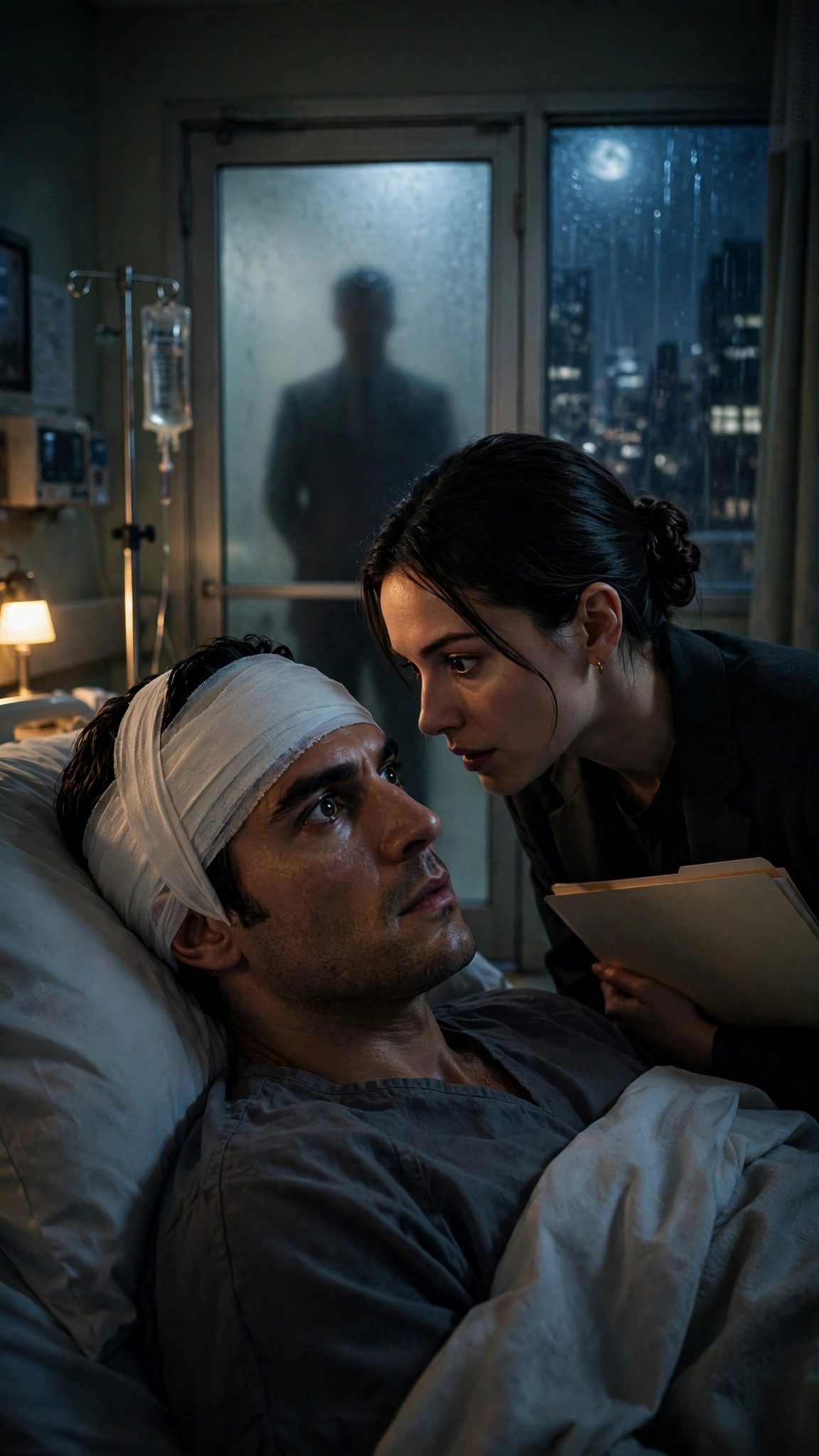
Waking up with a bullet wound was not what frightened me most. Realizing that one of the five people closest to me had betrayed me was worse — so before anyone could ask what I remembered, I made the most dangerous decision of my life and pretended the bullet had stolen everything.
My name is Vincent Moretti.
In Manhattan, people knew my name for reasons polite newspapers preferred not to print. I had survived raids, family wars, betrayals, and men who smiled across dinner tables while arranging funerals before dessert. I had buried friends and enemies in the same cold ground and learned to tell the difference between a man who feared me and a man who loved me, which is a harder lesson than it sounds, because in my world the two often wore the same face.
But that hospital room made me feel vulnerable in a way I hated.
Rain tapped the glass. My skull throbbed beneath heavy bandages. The light in the room was too white, too clean, and every sound seemed too loud — the IV dripping, the monitor counting my heartbeats, the soft shoes of a nurse moving somewhere beyond the door. I lay still and did what I had done a hundred times in rooms full of dangerous men: I watched, and I waited, and I gave nothing away.
"Mr. Moretti?" the doctor asked. "Can you hear me?"
"I can hear you."
He explained that the bullet had grazed my temple and fractured my skull. Another inch, and I would have died. He used words like "trauma" and "swelling" and "observation," and I nodded at the right places while my mind ran through the night before, frame by frame, the way a man replays a film he has already seen a dozen times, looking for the one detail he missed.
I remembered everything.
The private restaurant room in Midtown. The long table, the white cloth, the candles burning low. The meeting I had called myself, to settle a dispute over the docks before it became a war. Marco Benedetti near the door, as always, watching the room the way he had watched every room for eight years. The lights going out all at once, not a flicker, not a failure — a switch thrown by someone who knew where the panel was. Gunfire. Glass exploding. The smell of blood and wine. The taste of copper in my mouth when the bullet took a piece of my temple and kept going.
Most importantly, I remembered that only five people had known where I would be that night.
One of them was standing outside my hospital door. I could see his shadow through the frosted glass, tall and still, the way a man stands when he is waiting for news that will change his life.
Marco entered a moment later.
He had been my right hand for eight years. He had stood beside me through funerals, negotiations, and nights when one wrong decision could wipe out an entire family. He had carried my father's coffin beside me when I was twenty-nine years old and the whole weight of the Moretti name came down on my shoulders in a single afternoon. I trusted Marco Benedetti the way a man trusts his own hands.
That was the problem. I trusted all five of them.
"Boss," he said. "Thank God."
I studied him. Red eyes. Trembling hands. Exhaustion. Maybe grief. Maybe guilt. He looked like a man who had not slept since the shooting, and I could not tell whether he had stayed awake because he was afraid I would die or because he was afraid I would live and remember.
Then the doctor asked the question I had been waiting for.
"Do you remember what happened before you lost consciousness?"
I glanced toward the glass beside the door. Marco's shadow was visible outside, and through it I could see the hallway, the nurses moving past, the two men in dark suits standing guard at either end. My men. Or his men. That was the question, wasn't it?
And the plan formed instantly, whole and clean, the way the best plans always do.
If the traitor knew I remembered, he would become careful. He would cover his tracks, silence witnesses, disappear into the walls of the city I thought I owned. If he believed I remembered nothing, he would relax. He would make a mistake. Men made mistakes when they felt safe, and the man who had sold me to a gunman in a dark restaurant was about to feel very safe indeed.
So I let confusion enter my face. I let my eyes lose their focus. I became, in a single breath, a man who had woken up in a hospital bed with a hole in his head and a hole in his memory.
"I'm not sure," I murmured. "There was a room. People talking. Then loud noises."
The doctor nodded, the way doctors do when a patient says exactly what they expect him to say.
"Temporary memory loss after trauma is possible," he said, writing something on his clipboard. "We will monitor it. Sometimes the memories return on their own. Sometimes they do not. For now, rest is the best medicine."
By the time Marco returned, my lie had become a diagnosis. That was the beauty of it. I had not simply told a lie; I had handed the hospital a story it already believed, and the hospital would now protect that story for me, with charts and clipboards and kind, professional voices.
He sat beside me, pulling the chair close, the way he had done a hundred times in offices and restaurants and the backs of cars.
"You scared us," he said.
I stared at him as though recognition came slowly, the way a man stares at a face he thinks he should know but cannot quite place.
"Marco?"
His face changed. Just for a second. Relief. Pure, unguarded relief, the kind a man cannot fake, flooding across his features before he could stop it. That tiny reaction told me more than his words ever could — and it told me something I had not expected. It told me that Marco Benedetti had been terrified I would die, and that he was relieved I was alive, and that relief was the one thing a guilty man would never feel.
Unless he was a very good actor. And Marco, for all his loyalty, had never been a good actor. That was one of the reasons I trusted him.
"Yeah," he said. "It's me. You're safe."
"Am I?"
"I have men guarding every entrance."
"Your men?" I asked, and I let the question sound like the confusion of a man who could not remember whose men were whose.
He hesitated. Just a fraction of a second. "Our men."
Interesting. He had corrected himself, and the correction mattered. A guilty man would have said "my men" without thinking, because a guilty man is already counting what belongs to him. Marco had said "our men" because that was how he had always thought of them — ours, not his, not mine. Ours.
I pretended not to notice. I let my gaze drift toward the window, toward the rain running down the glass in thin silver lines.
"What do I do?" I asked.
Marco frowned. "What?"
"My work."
He leaned closer, watching me carefully, the way a man watches a wounded animal to see if it is still dangerous.
"You're a businessman," he said. "Restaurants. Real estate. Imports. People respect you."
Respect. That was one way of describing fear.
"And the shooting?"
His jaw tightened. "We're still investigating."
I nodded slowly, acting confused while memorizing every movement: the way his hands shook when he said "investigating," the way his eyes went to the door, the way he kept his voice low even though there was no one else in the room. He was afraid. But afraid of what? Afraid for me, or afraid of me?
Then the hospital door opened again, and a woman stepped inside carrying a folder against her chest.
My secretary. Emily Carter.
Quiet. Precise. Invisible when she wanted to be. For three years, she had managed my schedules, hidden my meetings, taken emergency calls in the middle of the night, and carried information in her head that even my captains did not know. She knew where I was every hour of every day, and she had never once let that knowledge slip. She was twenty-nine years old, with dark hair pulled back into a knot, and eyes that missed nothing, and a way of standing so still in a room that people forgot she was there.
She stopped when she saw me. She looked at the bandages, at the IV, at the monitor, and her face did not change. But her hands tightened on the folder, just slightly, and I knew she was doing the arithmetic every good secretary does in a crisis: who knows, who needs to know, who must never know.
Marco immediately stood.
"He doesn't remember," he told her, and there was something in his voice I could not name. Relief again. Or warning. "The doctor says it's the trauma."
Emily looked at him. Then at me. Her face barely moved. But her eyes did. They moved across my face the way they always did when she was reading a schedule and finding the mistake in it, and I knew, with a certainty that settled cold in my chest, that Emily Carter had already seen through me.
She walked to the side of my bed and placed the folder down on the table beside it, carefully, precisely, the way she did everything.
"Mr. Moretti?"
I forced myself to look at her like a stranger. Like a man seeing his secretary for the first time and finding her unfamiliar.
She swallowed. Then she leaned close enough that only I could hear, close enough that her breath warmed my ear, and she said three words that changed everything.
"I know everything."
My entire body went cold.
Because Emily was not looking at me with fear. She was looking at Marco. And for the first time since waking up, I almost forgot to pretend.
She straightened up, her face calm again, and picked up the folder, and said, in her normal voice, the voice she used for appointments and phone calls, "I brought the files you asked for, Mr. Moretti. From the office. In case you need them."
Marco frowned. "What files?"
"His schedule," she said. "His contacts. Everything he might need to remember who he is."
And she looked at me, just once, and in that look there was a whole conversation: I know you are lying. I know why. And I know who did this.
Then she left the room, and Marco followed her to the door, and I lay in the hospital bed listening to the rain and the monitor, and I thought about the five names on the list in my head.
Marco Benedetti. Emily Carter. Sal DeLuca. Frankie Gallo. Leo Santoro.
Five people had known where I would be. One of them had sold me to a gunman. One of them, I was now almost certain, knew exactly who it was.
And I had just told the whole world that I remembered nothing at all.
My father used to say that trust is a ledger. Every man you trust is a line in the book, and every line has two columns: what he has done for you, and what he has cost you. A wise man checks the ledger often, my father said, because a ledger that is never checked is a ledger that will ruin you. I had checked my ledger a hundred times over nine years, and every line had balanced. Marco had taken a knife for me. Sal had stood beside my father's coffin. Frankie had driven through a gunfight to get me home. Leo had hidden me in his kitchen when the Castellanos were searching the streets. Emily had never once let a secret slip.
Now one of those lines was false. One of those men had written a lie in my ledger in red ink, and I did not know which one. But a ledger can be checked, line by line, and that was what I was going to do. I was going to check every line, and I was going to do it with lies of my own, because the only way to catch a man who lies to you is to give him a lie to carry, and watch where he carries it.
That night, I lay awake while the hospital slept around me, and I planned. I would test them, one by one, the way a man tests a wall for the loose brick: gently, patiently, and without ever letting the wall know it is being tested. I would give each of them a different piece of false information, a different lie dressed up as a returning memory, and I would watch to see which lie traveled. The truth would stay where it was, locked inside my own head. The lies would do the walking.
It was a dangerous plan. A man pretending to have no memory is a man with no power, and power was the only thing that had ever kept me alive. Every captain in the family would be watching to see whether the boss was finished. Every enemy in the city would be sharpening his knives. The man who had shot me would be listening for news, waiting to learn whether he needed to finish the job.
But it was the only plan I had. And I had one advantage nobody else in that hospital knew about.
I remembered everything. And the traitor did not know that.
Outside the window, the rain kept falling on Manhattan, washing the streets clean for a little while, the way it always did, as if the city could pretend, for one night, that nothing had happened at all.
I closed my eyes and pretended to sleep. And behind my closed eyes, I began to count the five names, over and over, like beads on a rosary, like the steps of a man walking toward the truth.
Marco. Emily. Sal. Frankie. Leo.
One of them had tried to kill me. And I was going to find out which one — by pretending I had already forgotten.