The first time I laughed that hard in six weeks, my husband decided to kill the man who made me laugh.
It was a Tuesday afternoon in October, and the mall was full of the ordinary noise of ordinary people — teenagers arguing over sneakers, a mother pushing a stroller past the fountain, a man in a security uniform telling a boy to stop riding the escalator handrail. I had come to buy a birthday present for my housekeeper's granddaughter, a small thing, an excuse to leave the house for an hour without anyone in my husband's organization writing it down in a notebook. Six months into my marriage, I still needed excuses to leave my own home.
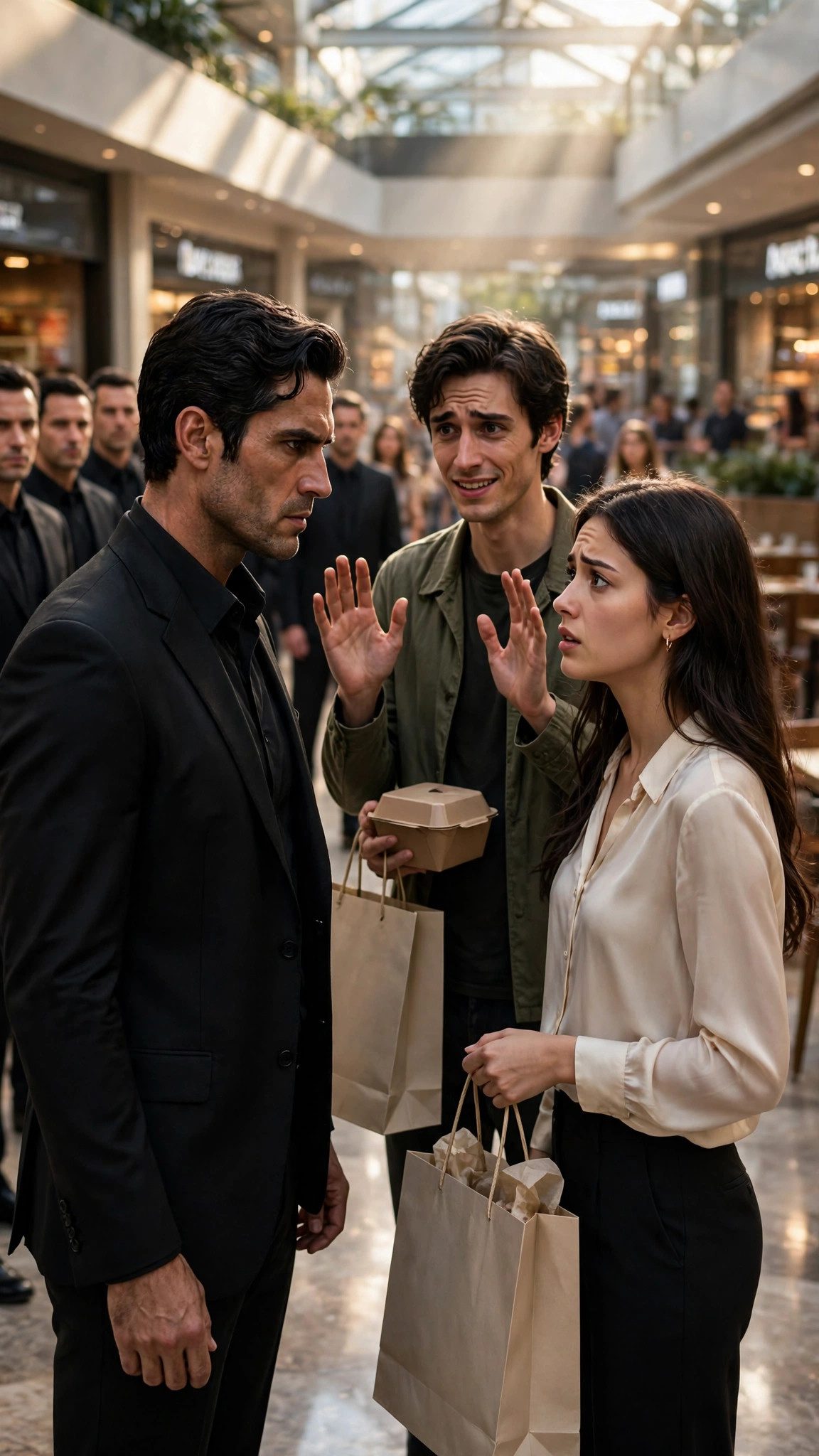
I was standing near the food court, holding a shopping bag in one hand and a takeout container in the other, when a man leaned against the polished rail beside me and said my name the way only one person in the world ever said it.
"Audrey."
I turned, and the whole mall tilted sideways.
It was Daniel. My brother. Daniel Bennett, twenty-nine years old, six feet of lanky, grinning trouble, the boy who had taught me to ride a bicycle by running behind me and letting go without telling me, the boy who had hidden my diary under the floorboards and then pretended for three years that he had no idea where it was. He had been in London for two years on a surgical fellowship, and he had missed my wedding, and I had not seen his face in person since the day he left, and now here he was, leaning on a mall railing in Chicago with a shopping bag in one hand and a takeout container in the other, wearing a jacket that did not fit him and a smile I had forgotten I missed.
"Daniel," I said, and then I laughed. I laughed the way I used to laugh when we were children, loud and helpless and completely without dignity, the kind of laugh that comes out of your chest before your brain has time to approve it. People turned to look. I did not care. Six weeks. It had been six weeks since I had laughed like that, six weeks of careful smiles and measured words and dinners eaten in silence across a table the size of a small country, and here was my brother, and the laugh just came out of me like water through a broken dam.
That was when the rumor started. I did not know it yet. That is how the worst misunderstandings always work — you are the last person to hear them.
A man leaned against the polished rail, holding a shopping bag in one hand and a takeout container in the other. His face was familiar. His smile was the one I remembered from family dinners, the smile that used to appear across the table whenever our father said something pompous and Daniel caught my eye. I could not help but laugh. And because the world can be extremely cruel and perfectly timed, everyone else seemed ahead of me.
I looked at the man again. And I understood. He was my brother.
I never even got a chance to speak before a pair of dark eyes landed on me.
We had a tradition. Every year, the first man to look at me that way gets a punch. And Julian Sterling has thrown plenty. At the gala last spring, he once threw a man across the room for staring too long. The second time, he knocked out two millionaires who would not stop looking at my dress. Even then, I had never seen a look this dangerous. Whoever the man I had been laughing with was, he was in serious trouble.
The six associates behind Julian stepped forward silently, forming a line that blocked half the food court. One of them raised his phone, checking Julian's expression for instructions.
"Boss, the property inspection—"
"Later."
Julian did not even look at me when he spoke, but the warning in his voice was unmistakable.
"Boss, Mr. Huntington's mall chain agreement is waiting for your signature."
"Later."
"Boss…"
"Shut up."
And so began the real problem. It became clear that I was not going to avoid this situation. A hand grabbed mine; I began to make my way quietly toward the exit. A man beside me did not move for a moment, but when he did, he led me to one of the most expensive stores in the mall. It was a much nicer way to ensure people watching knew he had lost control. He never even smiled. He simply pulled me toward the escalator. He stopped walking. I did not see him move, but suddenly he was in front of me — right in front of everyone — his cologne and anger colliding like a thunderstorm.
"Stop. You're coming with me."
And there was no room for argument in that one. I glanced back toward my brother, not Julian. I was heading toward something dangerous, but the escalator had already closed.
"You're very… persuasive."
He pulled me into his arms. And for a moment, the room stopped. It was not sound. It was not the music. It was an intense, shameful urge to prove that I could be the one thing that controlled a man who ruled the city. His hands rested lightly on my waist, but he was already aware of everything else. He was strangely calm, and if he had retreated, I would have followed him. He stared at me directly. His expression was intense. He was clearly frustrated.
"She's my wife."
The mall fell silent.
"Do you understand me? I don't care who you are, you don't touch what's mine."
He turned to my brother, whose face had turned pale with shock.
"My brother-in-law, I can't lose my wife to a man I don't even know."
By the time Julian's words reached my ears, my voice was gone. It was the announcement that solved everything. And it was utterly ridiculous.
"Brother-in-law?"
For the first time, I realized how stupid I was not to understand. The man's cold expression dissolved into embarrassment. My brother held his hands up in surrender. And then, unexpectedly, a wave of warmth spread through me. By the time I realized Julian had stopped being angry, it was too late. He was also my brother-in-law.
Because you see, I'm not Audrey Bennett. I'm Audrey Sterling. I'm the wife of Julian Sterling, head of one of Chicago's most powerful mafia organizations. Did you really think I would let a stranger hug me in public when I'm married to a mafia boss?
That was the moment everything should have ended. The misunderstanding, the fury, the crowd staring at us like we were the afternoon's entertainment. My brother, alive and unpunched. My husband, embarrassed instead of murderous. The mall, slowly returning to its ordinary noise.
But that was not the end. That was the beginning, because Julian Sterling had just announced to half of Chicago that he did not know his own wife's brother — and by the time we reached the food court, the rumor had already started. And someone in that crowd had already filmed the whole thing, and someone had already sent that film to a man who had been waiting six months for exactly this kind of gift.
Six months earlier, I had been Audrey Bennett, twenty-six years old, the daughter of Robert Bennett, who owned a shipping company with forty-two vessels and a reputation for never breaking a contract. My mother had died when I was nineteen, and my father had raised Daniel and me the way he ran his ships — on schedules, on discipline, on the belief that a promise made was a promise kept even when it hurt. Daniel had gone to medical school and then to London. I had gone to art school, and then I had come home, and then one evening my father had sat me down in his study and told me that the Sterling family wanted an alliance, and that the alliance required a marriage, and that the marriage required me.
I had not cried. I had asked one question.
"Does he know who I am?"
My father had looked at the decanter on his desk instead of at me.
"He knows your name," he said. "He knows your family. That is enough for an alliance."
It was not enough for a marriage. But nobody had asked me what a marriage needed.
Julian Sterling was thirty-three years old, tall, sharp jaw, dark eyes and hair, and he wore a black tailored suit over a black shirt the way other men wore armor. At our first meeting, in a private dining room at the Drake, he had looked at me for exactly four seconds, nodded once, and said, "She will do."
She will do. Not "she is beautiful" or "I am pleased to meet you." She will do, the way a man might speak about a car, or a house, or a shipment of steel.
I married him six weeks later. Daniel was in London. He sent a letter, and a silver bracelet, and a promise to come home soon. He did not come to the wedding because the fellowship would not release him, and because, as he wrote in the letter, "someone has to stay alive to tell you if you married a monster." I read that letter three times on my wedding night, and then I put it in the bottom drawer of my dresser, under the sweaters I never wore.
My wedding night, Julian came into the bedroom, loosened his tie, and said, "This is an arrangement. I expect loyalty. I expect discretion. I do not expect conversation."
I said, "I expect the same."
He looked at me for a moment longer than four seconds that time. Then he went to sleep on his side of a bed the size of a small boat, and I lay awake listening to a stranger breathe, and I thought about the fact that I had married a man who did not know my favorite color, my favorite food, the name of my best friend, or the fact that I had a brother who was currently saving lives in a hospital in London.
He did not know. And I did not tell him. Because he had made it very clear that he did not want to know.
Six months passed. Six months of breakfasts eaten in silence. Six months of galas where I stood beside him like a vase. Six months of his associates nodding at me in hallways and never once asking me a question. Six months of a house with eleven bedrooms and not one room that felt like mine.
And then one Tuesday afternoon in October, I went to the mall to buy a birthday present for my housekeeper's granddaughter, and my brother leaned against a polished rail, and I laughed for the first time in six weeks, and my husband decided to kill the man who made me laugh.
And that was the day Julian Sterling discovered that he did not know his own wife.
I thought about my wedding day again that night, lying in the dark beside a man who breathed like a stranger. The cathedral had been full of flowers — white roses, hundreds of them — and my father's friends had filled the pews, and Julian's associates had filled the back rows, standing like a wall of black suits. I had walked down the aisle on my father's arm, and my father had whispered, "You are doing the right thing, Audrey. You are saving the family." And I had believed him, because my father had never lied to me, and because I had never learned that a thing could be right for a family and wrong for the woman inside it at the same time.
The reception had been held in a hotel ballroom, and I had danced once with Julian — a slow, careful dance, his hand on my waist the way it had been on my waist in the mall, light and certain and completely without tenderness — and then I had danced with my father's oldest friend, and then I had sat at the head table and watched three hundred people eat and drink and congratulate a marriage that none of them understood, including the two people in it.
Daniel's letter had arrived that morning, before the ceremony. Mrs. Okafor had slipped it into my hand while the hairdresser was pinning my veil, and I had read it standing in a bathroom with the door locked, my wedding dress pooled around my feet like spilled milk. "My dearest Audrey," he had written. "By the time you read this, you will be a married woman, and I will be in London, and I will be thinking of you every minute. Remember what Mother used to say — that a marriage is not a contract, it is a conversation, and a conversation only works if both people are speaking. If he will not speak to you, then you must speak louder, until he hears you. And if he will not hear you, write the word 'seagull' in your next letter, and I will come home. I promise. I love you. Your brother, Daniel."
I had not written the word "seagull." Not once, in six months of letters. Not because there was nothing to say. Because I did not know what Daniel could do against a man who owned half of Chicago, and because I was afraid that if Daniel came home, Julian would look at him the way he had looked at the man in the mall — the way he looked at any man who stood too close to what was his — and I was afraid of what would happen next.
So I had kept writing ordinary letters. The weather. The house. The garden I was not allowed to plant. The books I was reading. I had never once written about the silence, or the loneliness, or the way Julian's associates looked through me as if I were a piece of furniture that had come with the house. I had never once written about the night I heard two of his men in the hallway, talking about "the wife" as if I were a shipment, a contract, a signature on a page.
That night, after the mall, I lay awake and thought about Daniel's letter, and about the word "seagull," and about the fact that my brother had come home anyway — without the word, without being asked, because he had noticed that I had stopped writing, and he had understood what that meant. He had come home because he loved me. And Julian, my husband, had nearly killed him for it.
It was the strangest thought I had ever had in my life: that the two men I loved most in the world had met each other for the first time in a food court, over a shopping bag and a takeout container, and that one of them had wanted to kill the other, and that both of them were now sitting in my house, eating my housekeeper's roast chicken, pretending that everything was normal.
Nothing was normal. Nothing would ever be normal again. But for the first time in six months, the strangeness felt like it belonged to me — like it was my story, and not just something that had happened to a woman named Audrey Sterling, who had once been Audrey Bennett, and who was still, underneath all of it, just a girl who liked to laugh, and who had forgotten how.