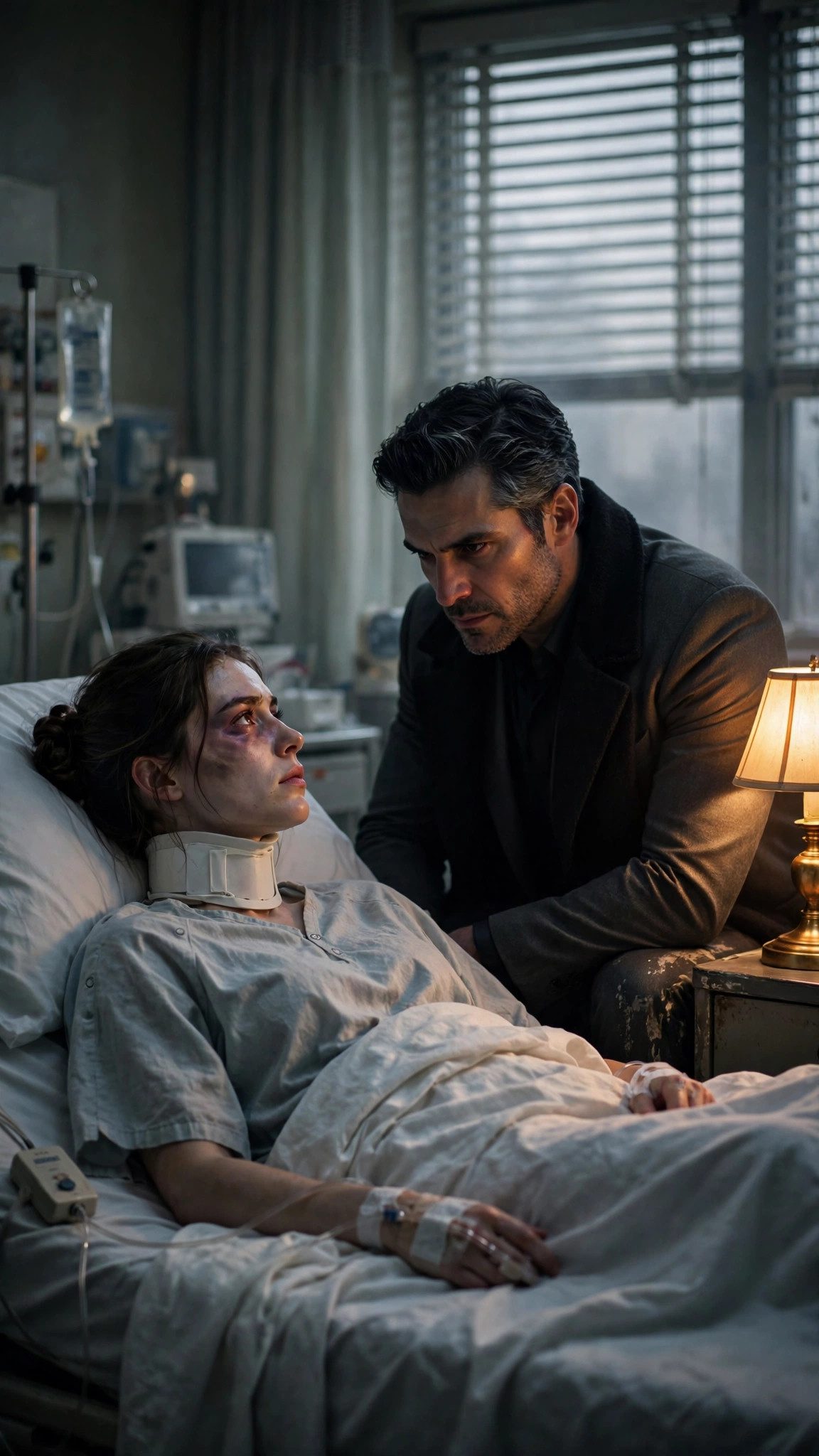
Harper Bennett had not planned to work for Dante Moretti.
Three years earlier, she had been twenty-six years old, fresh out of a master's degree in public administration, working as a junior clerk in the city planning office, and quietly drowning in student loans and her mother's medical bills. Her mother, Ruth Bennett, had been a schoolteacher for thirty-one years, and her knees had given out, and the surgery she needed cost more than a schoolteacher's pension could cover. Harper had taken the city job because it was steady. She had hated it because it was slow. She had applied for the Moretti position on a dare from her best friend, a woman named Priya who worked in the mayor's office and who had said, "You are the only person I know who is not afraid of powerful men, so go work for the most powerful one and see what happens."
She had gone to the interview expecting to be eaten alive.
Instead, she had found a man in a charcoal suit sitting behind a desk the size of a small car, reading her resume with the focused attention of a man defusing a bomb, and when he looked up, his eyes were gray and direct and entirely without warmth.
"You worked in city planning," he had said.
"For eleven months," she said.
"Why did you leave?"
"Because my supervisor wanted me to lose a file," she said. "A traffic study. A developer paid him to make it disappear. I refused, and he made my life difficult, and I decided I would rather be unemployed than be someone's eraser."
Dante had studied her for a long moment. Then he had said, "The job is sixty hours a week. The pay is three times what the city pays you. You will manage my schedule, my companies, my meetings, and my legitimate paperwork. You will see things you do not repeat. You will hear things you do not repeat. If you repeat them, I will know, and you will be finished in this city. Do you understand?"
"I understand," she said.
"One more thing," he said. "I have rules. Civilians are untouched. Secretaries especially. No one in my organization harms a civilian, ever, for any reason. If anyone threatens you, you tell me. If anyone follows you, you tell me. If anyone so much as raises their voice to you in my building, you tell me. Is that clear?"
"It is clear," she said, and she had believed him, because the thing about Dante Moretti was that he never lied. He was many things, and most of them were frightening, but he was not a liar.
She had taken the job. She had learned his world the way she learned everything: by reading every file, memorizing every name, and refusing to be intimidated. Within six months, she knew which politicians preferred envelopes and which businessmen required threats disguised as dinner invitations. She knew the difference between a legitimate meeting and a meeting that was only legitimate on paper. She knew the names of every council member, every port authority official, every union leader, and every lawyer in the city who mattered.
In her first week, human resources had handed her an emergency contact form. She had stared at it for a long time. Her mother was in Ohio, three hundred miles away, with bad knees and a pension that barely covered her medicine. Her father was gone. Her friends were scattered across the country. In the end, she had written down the only name in Chicago she trusted to answer a phone at two in the morning: Dante Moretti, her employer. She had felt strange about it. She had almost erased it. But she had left it there, and then she had forgotten about it completely, the way people forget the small decisions that later turn out to matter most.
Six months into the job, her mother had needed surgery, and the hospital in Ohio had wanted eight thousand dollars before they would schedule it, and Harper had not had eight thousand dollars. She had sat in Dante's office after hours, crying quietly into her hands, because she did not know what else to do. Dante had come in, and he had stood in the doorway, and he had asked her what was wrong, and she had told him, because she was too tired to lie. He had listened without interrupting. Then he had said, "It will be handled," and he had walked out. The next morning, the hospital had called to say the bill was paid in full, and Harper had never asked him if he did it, and he had never told her, but she knew. She had known then, and she knew now, that Dante Moretti was a man who took care of his own, quietly, without speeches, without expecting thanks.
That was the thing about him that no one outside his office understood. The city feared him. The newspapers called him ruthless. The councilmen whispered about him in hallways. But the people who worked for him knew a different man: a man who remembered birthdays, who paid hospital bills, who called his mother every Sunday, and who had once spent an entire afternoon helping the security guard's daughter with her college application, because the girl wanted to study law and had no one else to ask.
Harper had learned, over three years, that Dante Moretti was two men at once: the monster the city feared, and the man who sat beside her hospital bed at six in the morning without being asked. She had spent three years pretending she only knew the first one. The beating had stripped that pretense away, and now she knew the second one, and she could not unknow him.
And she knew Dante.
She knew that he drank his coffee black and never before seven in the morning. She knew that he read the financial pages first and the obituaries second. She knew that he called his mother every Sunday evening and that his voice changed when he did, becoming softer in a way that would have shocked anyone who only knew him from a boardroom. She knew that he had built the legitimate side of his empire himself, piece by piece, and that he was prouder of the shipping company and the construction firm than of anything else he owned. She knew that he had a scar on his left hand from a fishing accident when he was twelve, and that he never talked about his father, and that he kept a photograph in his desk drawer of a young woman with dark hair who had died before Harper was born.
She did not know the woman's name. She had never asked.
She also knew, without ever being told, that she was safe. That was the unspoken contract of the job. Dante Moretti's people did not get hurt. His secretary did not get hurt. His reputation was a wall, and she lived behind it, and for three years the wall had held.
Until Tuesday night.
On the morning after the attack, Harper lay in her hospital bed at West End General and tried to put the pieces of her life back together in the right order. The doctor, a kind-eyed woman named Dr. Alvarez, came in at eight and told her what Dante had already told her: two cracked ribs, a concussion, a fracture near her left eye. She would be in the hospital for at least three days. She was not to work. She was not to drive. She was not to lift anything heavier than a book.
"I need my laptop," Harper said.
"Your laptop was stolen," Dr. Alvarez said gently. "The police have a report. I am sorry."
Harper closed her good eye. The laptop was not just a laptop. It held the zoning board packet, the traffic study, the environmental addendum, the bid numbers for the waterfront parcel, and three years of notes on every meeting Dante had ever held. The drive was encrypted, and she was the only person who knew the password, but the loss of it still felt like losing a limb.
"The police," she said. "Did they find anything?"
Dr. Alvarez hesitated. "A detective came by while you were asleep. He left a card. He said the car was stolen from a lot in Cicero three days ago. The plates were fake. There were no fingerprints."
"Of course there weren't," Harper said.
A nurse came in with breakfast she could not eat. A different nurse came in to check her blood pressure. A police officer came in with a form, and Harper signed it with her right hand because her left was bruised, and she answered his questions in a flat, steady voice.
Three men. Black Lincoln. Cheap suits. Street muscle. No, she did not recognize them. No, they did not rob her. Yes, her bag was gone. Yes, her laptop was inside it.
The officer wrote it all down and left, and Harper was alone again, and she stared at the ceiling and thought about the one thing she had not told the police.
She had not told them the message.
She had told Dante. Only Dante. And she had seen his face when she said the words, and she knew that the message was not a threat. It was a declaration of war.
The docks were the reason. She understood that now, in a way she had not understood it before the beating. The waterfront parcel was the last piece of the Chicago docks that had not yet been claimed, and Dante's bid was the strongest, and the zoning vote on Tuesday would decide who controlled the river for the next fifty years. Vincent Castellano had wanted the docks for two years. He had lost the council vote. He had lost the port authority vote. He had lost the union vote. And now he was losing the zoning vote, and he had decided to stop losing.
He had sent three men to beat Dante Moretti's secretary in an alley and steal her laptop, because if Harper could not present the traffic study on Tuesday, the vote would be delayed, and a delayed vote was a vote Castellano could still steal.
It was a good plan. It was a cruel plan. And it had almost worked.
Except for one thing.
The men had not known that Harper Bennett kept a second copy of everything. Not on the laptop. In her head. She had memorized the traffic study. She had memorized the bid numbers. She had memorized the environmental addendum, page by page, because that was what she did: she read things until she knew them by heart, and then she carried them with her, and no one could steal them out of her head.
She was still thinking about this when the door opened and Dante came back in.
He looked different. Not softer. Dante Moretti never looked softer. But the stillness was gone, replaced by something coiled and alert, like a man who had spent the last two hours making phone calls and now knew exactly what he was going to do.
"The police found nothing," he said. "The car was stolen. The plates were fake. The men wore gloves."
"I know," she said.
"But I found something," he said, and he sat down in the chair beside her bed, and his elbows rested on his knees, and his voice was low and precise. "Five people knew your Tuesday routine. Five people knew you walked from the Drake to your car at nine forty, alone, every week. You, me, Tony, Chairwoman Voss, and Marcus Hale."
Harper's stomach tightened. "Marcus Hale is your head of security."
"Yes," Dante said. "He has been with me for nine years. He is the man who checks my cars, my offices, my routes. He is the man I trust with my life."
"And?"
"And someone sold your schedule," Dante said. "Someone told Castellano's men where to find you, and when. Someone who knew you would be alone, and that you would be carrying the zoning packet, and that no one would be watching."
He did not say the name again. He did not have to.
Harper thought about Marcus Hale. She had known him for three years. He was a broad-shouldered man in his forties with a graying buzz cut and a habit of standing too close to doors. He had always been polite to her. He had once carried her laptop bag up three flights of stairs when the elevator broke. He had brought her coffee on the morning her mother had surgery. He had seemed, in every way that mattered, like a loyal man.
But she had also noticed something, once, a long time ago, and she had filed it away and forgotten it. She had seen Marcus Hale in the parking garage one evening, talking on his phone, and when he saw her, he had ended the call quickly and smiled too wide. She had thought nothing of it at the time. She thought about it now.
"Dante," she said slowly, "what are you going to do?"
"I am going to find the men who touched you," he said. "I am going to find the man who paid them. And I am going to make sure that no one in this city ever again believes that my secretary is a message they can deliver."
He stood up, and he looked down at her, and for a moment the coldness in his eyes was replaced by something else. Something she had never seen there before. Something that looked almost like fear.
"Rest," he said. "Do not worry about Tuesday. I have already called Chairwoman Voss. The vote is still on. And you will present the traffic study, Harper. Not from a hospital bed. From the podium. Because the day Castellano's men decide who speaks at a zoning meeting is the day I stop being who I am."
"You want me to present on Tuesday?" she said. "With two cracked ribs and a fracture near my eye?"
"I want you to be there," he said. "I want Castellano to see you walk into that room on your own two feet, holding the numbers he tried to steal, and I want him to understand that he did not delay anything. He only made you angry."
Harper looked at him for a long moment. Then, despite the pain in her ribs, despite the collar around her neck, despite the bruise swelling shut her left eye, she smiled.
"Then I had better start memorizing the addendum," she said. "I want every number perfect."
Dante almost smiled back. It was the thirteenth time in three years.
"Good," he said. "Because on Tuesday, we are going to take the docks. And after that, we are going to take Castellano."
Then he walked out of the room, and Harper was alone again, and she closed her eyes, and for the first time since the black Lincoln had pulled up beside her, she was not afraid.
She was angry. And anger, she was beginning to understand, was a much more useful thing than fear.