At 2:04 in the morning, the personal phone of the most feared man in Chicago rang with the one kind of call even he could not control.
Dante Moretti had been awake. He was almost always awake at that hour. The penthouse was dark except for the low lamp on his desk, and the city spread out below his windows in a grid of cold light, and he had been reading the same page of the zoning board's traffic study for twenty minutes without absorbing a word of it. When the phone rang, he looked at the screen and saw a number he did not recognize, and something in his chest went still in a way it had not gone still in years.
He answered on the second ring.
"This is West End General Hospital," a woman said. "We are calling about Harper Bennett. You are listed as her emergency contact."
Dante did not speak for a moment. He could hear the hospital behind her voice, the soft beeping of machines and the rubber soles of nurses on polished floors, and he could hear his own breathing, slow and even, the way it sounded when he was deciding whether a man lived or died.
"Is she alive?" he asked.
"She is alive," the nurse said. "She was brought in just after ten o'clock. She has two cracked ribs, a concussion, and a fracture near her left eye. She is stable. She asked for no one, Mr. Moretti, but your name is the only one on her form."
Dante was already standing. He did not remember standing. His coat was on the hook by the door, and his keys were in his hand, and Tony was on the phone before the elevator doors had finished closing, and the city slid past the windows of the car in wet black ribbons while Dante sat in the back seat with his hands folded and his face like stone.
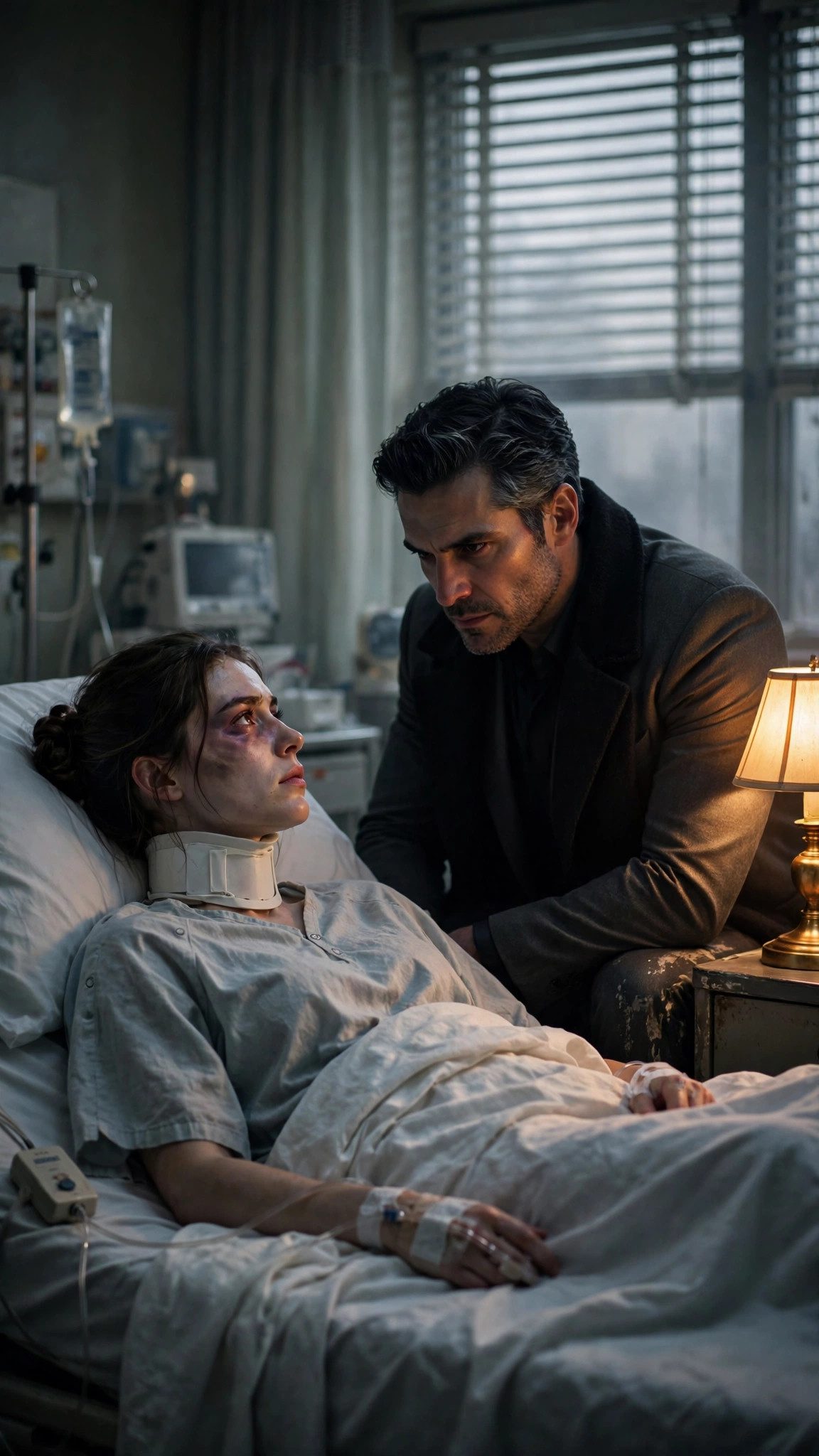
Twenty minutes later, he was sitting beside her bed in absolute silence, looking at her as if someone had just signed their own death warrant.
The last thing Harper clearly remembered was leaving dinner and walking toward her car.
Then a black Lincoln pulled up. Three men got out. After that, everything came in pieces. Hands grabbing her arms. Pavement against her knees. A fist connecting with her face. Someone telling her to stop fighting.
She didn't.
By the time she woke, gray morning light was leaking through the blinds. Her entire body hurt. One eye would barely open, her ribs felt as though someone had driven nails between them, and a stiff cervical collar held her neck in place.
Then she saw him.
Dante sat beside the bed in a charcoal suit and black overcoat, elbows resting on his knees. He looked exactly the way he did before destroying someone in a boardroom. Still. Quiet. Terrifying.
"You're here," she whispered.
"I'm here."
"What time is it?"
"After six."
Her brain immediately reached for routine. "I have a nine o'clock meeting with the zoning board."
For half a second, his mouth almost moved. "The meeting is canceled."
She tried to sit up. Pain exploded through her side.
"Don't move," Dante said sharply. "Two cracked ribs. Concussion. Fracture near your left eye."
She sank back against the pillow, breathing carefully.
"My bag."
"Gone."
"My laptop was inside."
"The police didn't find it."
She closed her good eye. "At least the drive is encrypted."
Dante leaned closer.
"Harper."
Something in his voice made her look at him.
"Who did this?"
There was no anger in his tone. That frightened her more.
"Three men," she said slowly. "Black Lincoln. Cheap suits. Street muscle."
"Names?"
"I didn't recognize them."
"Did they rob you?"
She almost laughed, but her ribs stopped her. "No."
His expression changed by less than an inch. That was enough.
For three years, she had managed Dante's schedule, companies, meetings, and legitimate paperwork. She knew which politicians preferred envelopes and which businessmen required threats disguised as dinner invitations. She also knew his rules.
Civilians were untouched. Secretaries especially. His reputation was supposed to protect her.
Instead, it had apparently made her useful.
"They didn't want my money," she said.
Dante became perfectly still.
"What did they want?"
She remembered one of them gripping her hair while another crouched in front of her. The smell of cigarettes. Cheap cologne. Rainwater dripping from his jaw. Then the sentence he had whispered before the next blow landed.
Her stomach tightened.
"Harper."
She looked directly at Dante.
"They wanted me to give you a message."
His eyes went cold.
"What message?"
For the first time since waking, she hesitated. Because now that Dante Moretti was sitting three feet away from her, she understood something she had not understood in that alley.
The beating had never really been about her.
She swallowed. Then she told him the exact words the man had said.
"Tell Moretti the docks are Castellano's. He pulls his bid before the zoning vote on Tuesday, or next time we don't stop at his secretary."
And Dante stopped breathing.
Twelve hours earlier, Harper Bennett had been having an ordinary Tuesday.
She had woken at six in her small apartment on Maple Street, made coffee in the chipped blue mug her mother had mailed her from Ohio, and stood at the window while the city woke up below her. The apartment was small and plain and entirely hers: a secondhand couch, a bookshelf full of paperbacks, a framed photograph of her father on the mantel. Daniel Bennett had been a high school history teacher. He had died of a heart attack when Harper was sixteen, and his daughter had inherited his stubbornness, his terrible handwriting, and his absolute refusal to be intimidated by men who thought volume was the same thing as strength.
She had dressed the way she always dressed for work: a navy blazer, a white blouse, a pencil skirt, low heels she could run in if she had to. Her dark brown hair went up in a low bun. She put on no jewelry except the small silver watch her mother had given her when she graduated from college. Then she had walked the six blocks to the Moretti Building in the rain, carrying her laptop bag and her umbrella, and she had taken the elevator to the forty-first floor, and the day had begun the way every day began.
"Good morning, Miss Bennett," the security guard said.
"Good morning, Ray," she said, and she meant it, because Ray was one of the few people in the building who smiled at her like she was a person and not a piece of furniture that happened to answer phones.
Dante's office was already lit. He was standing at the window with his back to the room, a cup of black coffee in his hand, and he did not turn around when she came in.
"The zoning board packet," he said.
"On your desk," she said. "The traffic study is flagged on page twelve. Chairwoman Voss wants the environmental addendum by Thursday, and the Port Authority counsel called twice yesterday."
"And?"
"And I told him what you told me to tell him, which is that the Moretti bid is the only bid that keeps the longshoremen employed, and that he can read the numbers himself."
Dante turned then, and for a moment the morning light caught the gray at his temples, and he looked almost human. "You enjoy that part too much."
"I enjoy watching powerful men realize a secretary has read the file better than they have," she said. "It is the only real entertainment this job offers."
He almost smiled. She had worked for him for three years, and she had seen him almost smile perhaps a dozen times, and each one felt like a small victory she kept in a private place no one else could touch.
The day moved the way days in Dante Moretti's office always moved: fast, precise, and full of people who wanted something. There was a call with the lawyers about the waterfront parcel. There was a meeting with the architects about the new terminal design. There was a stack of contracts to be checked, a charity gala to be scheduled, a councilman's assistant to be politely but firmly refused. Harper kept it all moving the way she always did, with a calm voice and a color-coded calendar and a memory that had never once failed her.
At five o'clock, she stood in his doorway with her bag over her shoulder.
"Dinner with Chairwoman Voss is at seven," she said. "The Drake. She wants to go over the traffic study one more time before Tuesday."
"Go," Dante said. "And Harper."
"Yes?"
"Take the car."
"I walk home from the Drake every week," she said. "It is four blocks. I am not made of glass."
He looked at her for a long moment, and something crossed his face that she did not know how to read. Then he nodded once, and she went home to change, and the evening began.
Dinner was pleasant. Elaine Voss was a sharp-eyed woman in her sixties who had run the zoning board for eleven years and had never once been bribed, threatened, or fooled, and she liked Harper because Harper never tried any of the three. They talked about the traffic study. They talked about the longshoremen's union. They talked about the waterfront, and the old warehouses, and what the docks could become if the right hands held them.
"You know what Castellano wants, don't you?" Voss said over dessert.
"The docks," Harper said.
"The docks," Voss agreed. "He has wanted them for two years, and he has lost every vote so far, and men like Vincent Castellano do not lose gracefully. Be careful, Harper. You are the one who carries the numbers. That makes you visible."
Harper laughed. "I am a secretary, Mrs. Voss. Nobody notices secretaries."
Voss looked at her for a long moment. "That is exactly why they notice you."
At nine forty, Harper said goodnight, and stepped out into the rain, and started walking toward her car.
The street was quiet. The rain was coming down in thin silver threads, and the streetlights made halos on the wet pavement, and her heels clicked softly against the sidewalk. She was thinking about the traffic study, and about Tuesday's vote, and about whether she should stop for milk on the way home, when the black Lincoln pulled up beside her.
Three men got out.
She did not have time to run. She did not have time to scream. Hands grabbed her arms. Pavement hit her knees. A fist connected with her face, and the world went white, and then red, and then it broke into pieces.
She fought. She fought the way her father had taught her to fight, which was to say she fought dirty and without rules, and she kicked and scratched and bit, and she heard one of them curse, and she felt someone grip her hair and drag her head back, and then a man crouched in front of her, close enough that she could smell the cigarettes on his breath and the cheap cologne on his skin, close enough to see the rainwater dripping from his jaw.
He leaned in, and his voice was soft, and that was the worst part of it, because a man who whispers while he hurts you is a man who has done this before.
"Tell Moretti the docks are Castellano's," he said. "He pulls his bid before the zoning vote on Tuesday, or next time we don't stop at his secretary."
Then the next blow landed, and the world went dark, and the last thing she heard before the dark took her completely was the sound of the Lincoln's doors closing, one after another, like the closing of a book.
When she woke, Dante Moretti was sitting beside her bed in absolute silence.
And she understood, finally, what the beating had been.
It had never been about her at all.
She was the envelope. The message was inside her. And the man who had sent it was Vincent Castellano, who had spent two years losing the waterfront vote by vote, and who had finally decided that if he could not win the docks in a boardroom, he would win them in an alley, using the one person Dante Moretti had always believed was untouchable.
Her own secretary.
Dante stood up slowly. He walked to the window and looked out at the gray morning light leaking through the blinds, and his hands were at his sides, and his shoulders were perfectly still, and Harper, who had watched this man destroy entire companies with a single phone call, felt something cold settle in her stomach.
Because she knew that look. She had seen it once before, three years ago, on the day a councilman named Peter Walsh had tried to blackmail him. Walsh had come to the office with a smile and a folder full of photographs, and he had asked for two million dollars, and Dante had listened to the whole thing without moving, without blinking, without changing expression. Then he had made one phone call. By Friday, Walsh had resigned from the council, and the photographs had been returned, and the two million dollars had never been mentioned again. Harper had watched it happen from the doorway, and she had understood, in that moment, that Dante Moretti did not threaten people. He simply removed them, the way other men removed stains.
Now he was standing at her hospital window with that same stillness, and she knew that somewhere in the city, three men in cheap suits had no idea what was coming for them.
"Stay here," Dante said, without turning around. "Do not move. Do not call anyone. Do not speak to the police again until I tell you to."
"Dante—"
He turned, and his eyes were the coldest she had ever seen them.
"They touched you," he said. "They used you like a piece of paper. And they think that frightens me."
He walked back to the bed, and he leaned down, and his voice dropped to something low and quiet and absolutely final.
"It doesn't frighten me, Harper," he said. "It signs their names."
Then he straightened his coat, and he walked out of the room, and the door closed behind him with a soft click, and Harper was alone with the beeping machines and the gray morning light and the knowledge that the most feared man in Chicago had just gone to war for her.