Tuesday came, as Tuesday always did, with Victor Rourke.
Martha was dusting the library when she heard the front door open and Miss Delaney's voice go thin and polite in the hall. "Mr. Victor. Mr. Rourke is in the study."
Victor Rourke was sixty-one years old, tall and thin, with silver hair combed straight back and a suit that cost more than Martha's car. He moved through the house like a man who had already decided it belonged to him. He did not look at Martha. Men like Victor never looked at the help unless they wanted something from them.
She waited until he had gone into the study and closed the door. Then she went to the kitchen, where Rosa was peeling potatoes, and she asked the question she had been holding for three days.
"Tell me about the night Mr. Rourke was shot."
Rosa's knife stopped moving. "Why do you want to know?"
"Because I am the one drawing his bath now, and I want to know who in this house I should be afraid of."
Rosa looked at the door. She looked at the window. Then she leaned across the table and spoke in a voice so low Martha had to lean in to hear her.
"Fourteen months ago, Mr. Rourke came home from a council meeting and told Victor, to his face, in front of four men, that the illegal side was finished. The uninspected containers. The protection money. The loans. All of it, done in thirty days. Victor laughed. He said the family would starve without it. Mr. Rourke said the family would survive, and that he would rather be poor than be owned by Vincent Castellano." Rosa crossed herself. "Two nights later, Mr. Rourke went down to Pier Nine at midnight to check a shipment himself. He always checked the shipments himself when he did not trust the paperwork. Someone was waiting in the dark between two containers. One shot, low in the back. The shooter walked away. He did not take Mr. Rourke's wallet. He did not take his watch. He did not take his phone. Tony found him twenty minutes later, lying on the concrete, awake, telling Tony not to call an ambulance yet, telling him to lock the warehouse first."
"And the police?"
"Robbery, they said. A robbery gone wrong." Rosa snorted. "A robber who shoots a man in the back and steals nothing. The detectives came twice. They asked questions. They left. Nothing happened. Nothing ever happens when the Rourke name is involved, unless the Rourke name wants it to happen."
"And Victor?"
"Victor was in Boston that night. He had a dinner. Twelve people saw him." Rosa's eyes were hard. "Twelve people who all work for him."
Martha filed it away. An alibi bought and paid for.
The next morning, Martha found Tony Ferraro in the garage, polishing the black car with the slow, methodical care of a man who has done the same job for twenty years and sees no reason to hurry it.
"Tony," she said. "I need you to tell me about Pier Nine."
Tony's hands stopped moving on the car. He did not look up. "Miss Delaney told you not to ask questions."
"Miss Delaney told me not to ask questions about the family," Martha said. "I am asking about a shooting. There is a difference."
Tony was quiet for a long time. Then he put the polishing cloth down, and he looked at her, and his face was the face of a man who has carried a memory for fourteen months and is tired of carrying it alone.
"I was twenty minutes late," he said. "That is the first thing you need to know. Mr. Rourke told me to wait at the gate, and I stopped for coffee, and I was twenty minutes late. If I had been on time, I would have been standing next to him, and the shooter would have had to go through me first. I have thought about those twenty minutes every day for fourteen months."
He leaned against the car. "It was midnight. Pier Nine. Fog coming off the water. Mr. Rourke was checking a shipment himself — containers from overseas, paperwork that did not match the manifest. He always checked the paperwork himself when he did not trust it, and that night he did not trust it. I came around the corner between two containers, and I saw him on the ground, on his back, awake, holding his side. He looked at me and said, 'Lock the warehouse first, Tony. Then call the ambulance.' He said it the way he always said things. Calm. Like he was giving an order in a meeting."
"Did you see the shooter?" Martha asked.
"I saw a man walking away, between the containers, toward the far gate. Tall. Dark coat. I shouted, and he ran. I did not chase him, because Mr. Rourke was bleeding on the concrete, and I was not going to leave him there to chase a shadow." Tony's voice thickened. "The police asked me if I could identify the man. I told them I saw a dark coat and a shaved head. They wrote it down. They never came back."
"A shaved head," Martha repeated. "And a tattoo on the neck?"
Tony looked at her sharply. "How do you know about the tattoo?"
"I don't," Martha said. "Not yet. But I know the kind of man who does this work, and I know that Victor Rourke has a man with a shaved head and a tattoo who does his jobs. His name is Eddie Krol."
Tony stared at her. Then he nodded slowly. "Eddie Krol. Yes. He was on the docks that night. I saw him there, earlier, leaning against a container, smoking. I told the police. They wrote it down. They never came back." He picked up the polishing cloth again, but his hands were shaking. "Mr. Rourke told everyone he would never walk again. He told the newspapers. He told the council. He told Victor. I believed him. I have believed him for fourteen months. Are you telling me he was lying?"
"I am telling you he was surviving," Martha said. "There is a difference. And Tony — if anyone asks, you did not talk to me. You polished the car. That is all."
Tony nodded. He went back to polishing. But as Martha turned to leave the garage, he said, very quietly, without looking up, "If you are helping him, Miss Kovak — if you are really helping him — then I am with you. Whatever you need. He is a good man. He was going to make this family honest. That is why they shot him. And I have waited fourteen months for someone to help him finish what he started."
That afternoon, while Victor was still in the study with Maxwell, Martha took the trash out to the bins behind the house — a chore no one had asked her to do, but one that gave her a reason to be near the study window. The window was open a crack, and voices carried out into the garden.
"…the docks are fine," Victor was saying. "The trucking is fine. The warehouses are fine. You do not need to worry about any of it, Maxwell. That is what I am here for."
"I am not worried," Maxwell said. His voice sounded tired. Weaker than it had sounded that morning. Martha recognized the performance, and her chest tightened with something like pride. He was good at this. He had been good at it for fourteen months.
"Good," Victor said. "Because there is something I need you to sign. A transfer. The Meridian Terminal lease. It is routine. The lawyers have already looked at it."
A pause. Paper rustling.
"I will look at it myself," Maxwell said.
"There is nothing to look at. It is routine."
"I said I will look at it myself."
Another pause, longer this time. When Victor spoke again, his voice had gone cold.
"You have changed, Maxwell. You used to trust me."
"I used to trust a lot of people," Maxwell said. "Then someone shot me in the back."
Silence. Then the sound of a chair scraping, and footsteps, and the study door opening. Martha turned back to the bins, her hands full of trash, her face arranged into nothing at all. Victor walked past her without a glance, got into the black car waiting at the curb, and was gone.
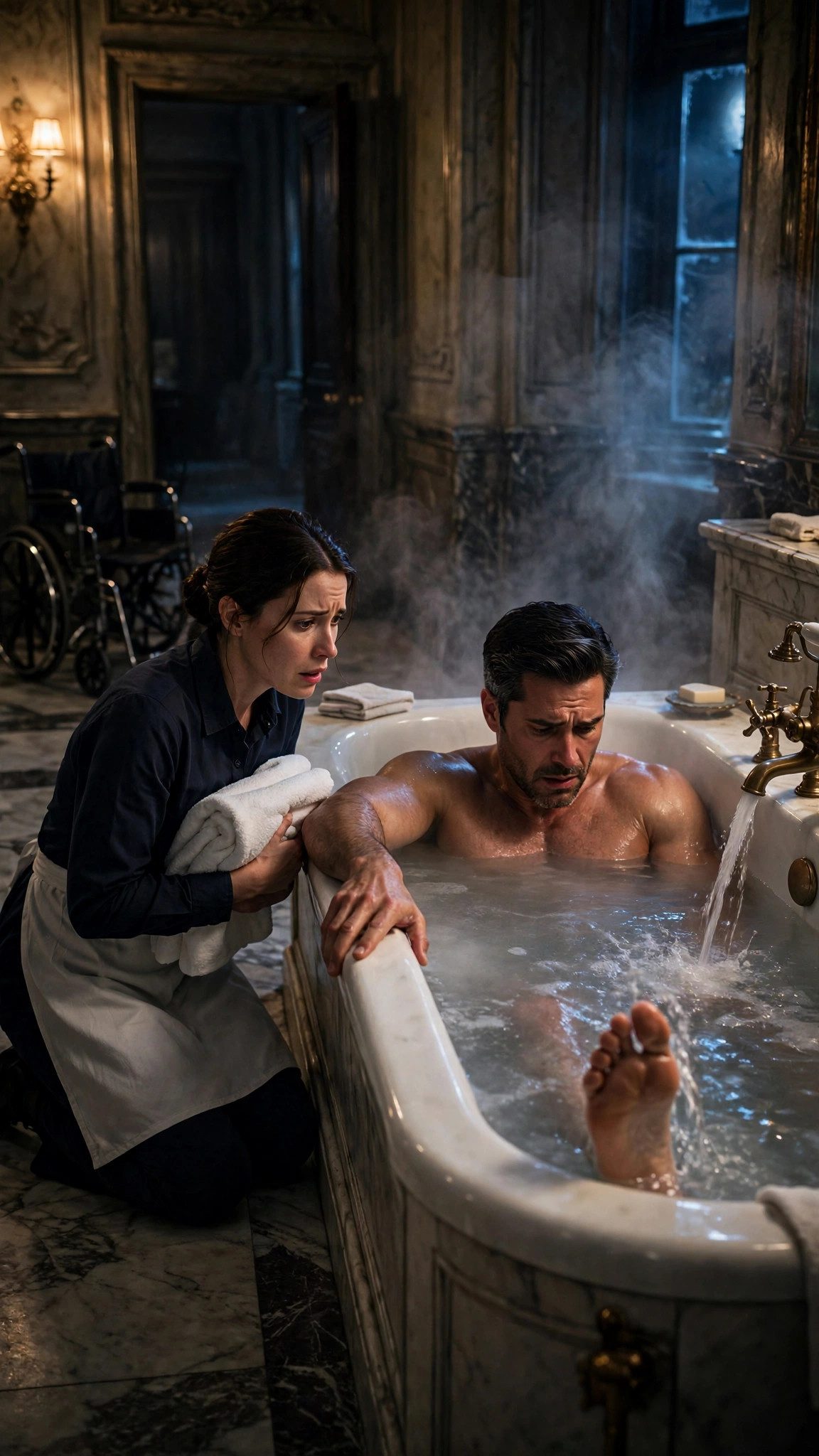
That evening, after the bath — one hundred and two degrees, documented, safe — Martha sat on the stool beside the tub and told Maxwell what she had heard.
"He wants the Meridian Terminal lease," she said. "He wants your signature on a transfer."
Maxwell nodded slowly. "The Meridian Terminal is the most valuable piece of waterfront property the family owns. If I sign it over to a holding company, Victor controls it. If I die, he inherits it anyway. If I live, and if I walk again, I can take it back." He looked at her. "He is getting impatient. Fourteen months is a long time to wait for a man to die."
"Then we need more than a notebook," Martha said. "We need proof. Proof that he ordered the shooting. Proof that he is paying Cole. Proof that he is working with Castellano."
"Proof like that gets people killed," Maxwell said.
"Proof like that is also the only thing that keeps people alive," Martha said. "I learned that at the hearing. I had no proof. Denise Fallon had a story, and the board believed the story, because a story is easier than a fact. I am not going to watch that happen to you."
The next morning, Martha did something she had not done in two years. She called in a favor.
Her name was still known at Harborview, even if her license was not. The head of physical therapy, a woman named Grace Okafor who had trained beside Martha for six years, answered on the second ring.
"Martha Kovak," Grace said. "Lord. It has been a while."
"I need a favor," Martha said. "Not a big one. I need to know if a spinal cord bruise at the T-eight level, fourteen months old, with returning sensation in the right leg and pressure in the left, is consistent with a man who might walk again."
A pause. "You are treating someone."
"I am helping someone."
"Martha. Your license—"
"My license is gone. I know. I am not treating him. I am watching him. I am writing things down. I am the only person in his house who knows how to test a bath." She swallowed. "Grace, I need to know if I am seeing what I think I am seeing."
Grace was quiet for a moment. Then she said, "T-eight, fourteen months, returning sensation distal to proximal, right before left — yes. That is consistent with a cord bruise healing. It is slow. It is incomplete. But it is real. And Martha — if he can feel a pinprick on his right calf, he is further along than most of the patients we ever had. Tell him to keep doing the exercises. Tell him not to rush it. And tell him to be careful who knows."
"I will," Martha said. "Grace — one more thing. The Abernathy chart. Do you remember it?"
Another pause, longer this time. "I remember that Denise Fallon cried at the hearing and said she could not remember who wrote the dose. I remember that the system showed the order was corrected at two in the morning, four hours after Mr. Abernathy died, from a terminal on the night shift."
Martha's hand tightened on the phone. "You never told me that."
"You were already gone by the time anyone looked," Grace said softly. "I am sorry, Martha. I should have called you."
Martha stood in the kitchen of Rourke House with the phone against her ear and felt something shift inside her chest — not anger, exactly, and not relief. Something closer to a door opening after two years of being locked.
"Thank you, Grace," she said. "I have to go."
She hung up and stood there for a long time, looking out the kitchen window at the garden where Victor Rourke had walked past her without a glance.
Two lies had shaped her life. The first was the lie on a hospital chart, told by a frightened night nurse, that had taken Martha's career. The second was the lie Maxwell Rourke had told the whole world — that he would never walk again — told to keep himself alive.
One lie had been told against her. The other had been told to protect him. And now, somehow, the two lies had brought them to the same house, the same bathroom, the same notebook full of temperatures and toe movements and facts that no one else would write down.
That night, after the bath, Martha showed Maxwell the page in her notebook where she had drawn the map of his legs — the sharp pinprick on the right calf, the dull pressure on the left thigh, the toe that moved on command.
"This is your proof," she said. "Not of who shot you. Of who you are. A man who is healing. A man who is coming back. And when the time comes, a man who will stand up in front of the people who tried to bury him and tell them the truth."
Maxwell looked at the map for a long time. Then he looked at her, and his dark gray eyes were clear and steady.
"Then we keep going," he said. "Quietly. Carefully. And when Victor comes back on Tuesday, I will be exactly what he expects. A man in a chair, getting weaker, no trouble to anyone."
Martha closed the notebook. "And I will be exactly what he expects, too. A woman who cleans rooms and asks no questions."
They smiled at each other then — a small, tired, conspiratorial smile, the kind two people share when they are the only ones in the room who know the truth.
Outside, the night darkened over the water. Inside Rourke House, a man who was supposed to be paralyzed practiced curling the toes of his right foot, and a woman who was supposed to have no career anymore wrote down every movement in a blue notebook, in handwriting so clear and careful that no one would ever be able to call it a lie.