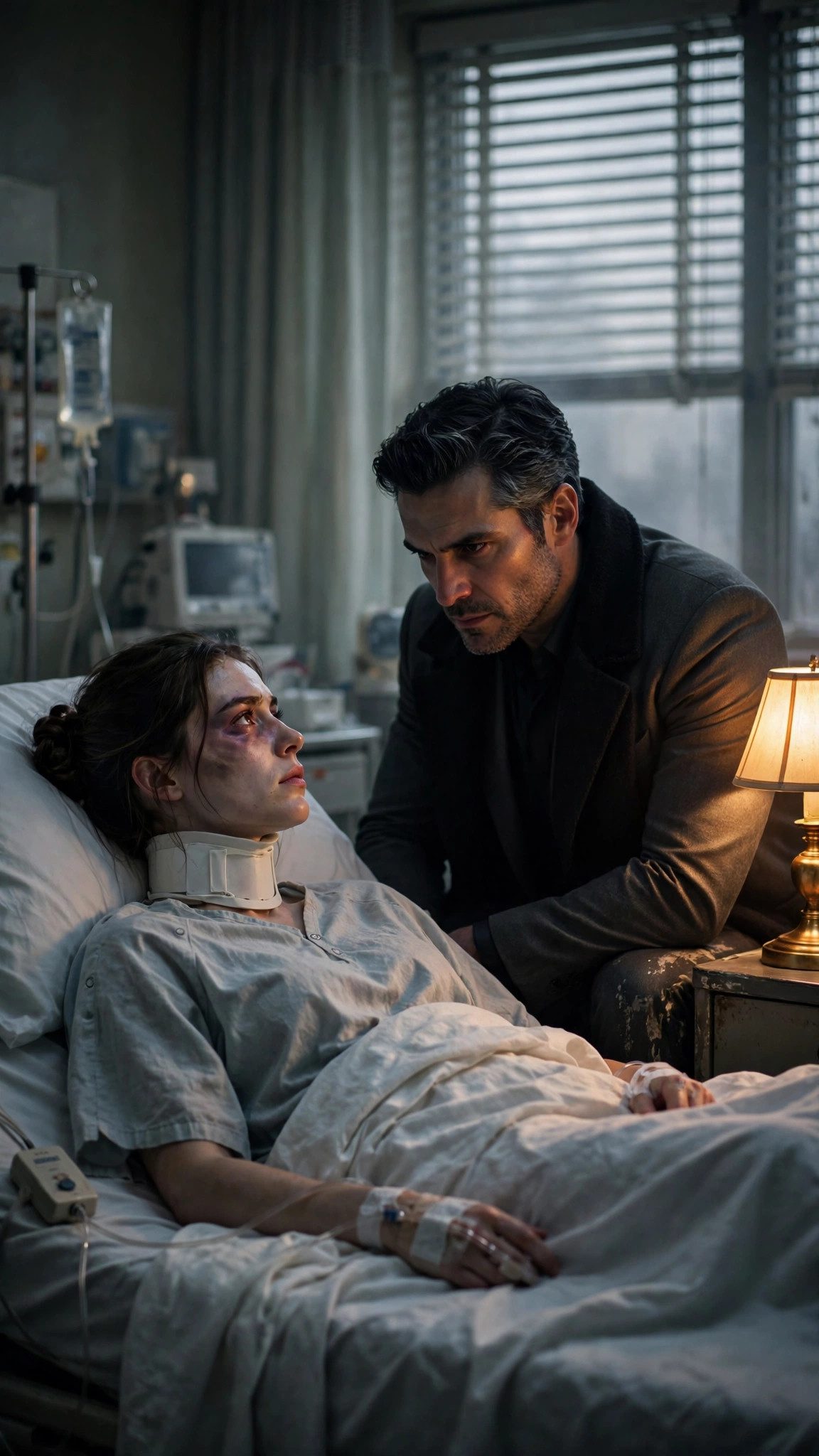
Eddie Krol talked within four hours.
He talked because Agent Daniel Reyes put him in a small white room with a tape recorder and a cup of coffee, and told him that he was facing twenty-five years for assault, conspiracy, and attempted murder, and that the only way to make that number smaller was to give Reyes the name of the man who had paid him.
Krol gave him two names. Vincent Castellano, who had paid him fifty thousand dollars. And Marcus Hale, who had given him Harper's schedule, her Tuesday routine, and the knowledge that she would be walking alone to her car at nine forty with the zoning packet in her bag.
Danny Cole talked within six hours. He was twenty years old, and he was frightened, and he told Reyes everything: the diner on Cicero, the stolen Lincoln, the plan to take Harper's bag and scare her badly enough that she would not present the traffic study on Tuesday. He cried when he talked about his mother, and Reyes, who had a daughter of his own, listened without interrupting.
Tommy Falco talked within eight hours. He told Reyes about the rose. He told Reyes that Castellano left a red rose for the people he was about to destroy, and that Marcus Hale had left the rose outside Harper's hospital door because Castellano had told him to, because Castellano wanted Harper frightened, and wanted Dante frightened, and wanted them both to understand that no hospital, no locked door, no bodyguard could keep Castellano away.
Marcus Hale talked last, and he talked the longest. He sat in the same small white room, and he told Reyes about two years of payments. Fifty thousand dollars a year, in cash, delivered in an envelope at a diner on the South Side. He told Reyes about the traffic study number he had changed, four hundred and twenty-one to four hundred and twelve. He told Reyes about the rose. He told Reyes about the phone call he had made from Harper's apartment, the message he had sent to Krol, the plan to take her a second time.
And then he told Reyes the one thing that made the whole case unbreakable.
He told him about the ledger.
Vincent Castellano kept a ledger. It was a black leather book, and it held the names of every politician he had bribed, every union official he had paid, every judge he had threatened, and every crime he had ordered for the last fifteen years. Marcus Hale had seen it once, in Castellano's office, and he knew where it was kept: in a safe behind a painting in Castellano's house on Astor Street.
Reyes got a warrant within the hour. The FBI searched the house at dawn. They found the safe. They found the ledger. And they found Vincent Castellano sitting in his study in a silk robe, drinking coffee, looking at them the way a man looks at the rain: as if it were an inconvenience, and nothing more.
"Mr. Castellano," Reyes said, "you are under arrest for conspiracy, assault, attempted murder, bribery, racketeering, and fifteen years of crimes I have not finished listing yet."
Castellano set his coffee cup down carefully. "You have no proof," he said.
"We have Krol," Reyes said. "We have Cole. We have Falco. We have Hale. We have the ledger. We have the traffic study. We have the security footage from the hospital, and the security footage from Wabash, and the phone records, and the bank records, and the fifty thousand dollars in cash that Hale kept in a shoebox in his closet because he was too stupid to spend it all."
Castellano was quiet for a long moment. Then he said, "I want a lawyer."
"You will have one," Reyes said. "You will need a very good one."
The trial took four months.
Harper testified on the third day. She walked into the courtroom in a navy suit, with her hair in a low bun, and her ribs healed, and her left eye clear, and she sat in the witness box, and she told the jury everything: the dinner, the walk, the black Lincoln, the three men, the beating, the message. She told them the exact words Krol had whispered in her ear. She told them about the rose outside her hospital door. She told them about Marcus Hale standing in her apartment with his hand moving toward his gun.
When the defense lawyer asked her if she was certain, if she was sure, if she might be mistaken, she looked at him, and she said, "I am certain. I remember every word. A woman does not forget the words a man whispers to her while he is hurting her."
The jury believed her. The jury believed Krol. The jury believed Hale. And when Reyes held up the black leather ledger, and read the names aloud, one by one, the courtroom went so quiet that Harper could hear her own breathing.
The verdict came on a Friday afternoon. Vincent Castellano was found guilty on every count. He was sentenced to life in prison, without the possibility of parole. Marcus Hale was sentenced to eight years, in exchange for his testimony. Eddie Krol was sentenced to fifteen years. Danny Cole was sentenced to six years. Tommy Falco was sentenced to six years.
Harper sat in the back of the courtroom with Dante beside her, and when the judge read the sentence, she felt something loosen in her chest, something that had been tight since the night of the attack, and she took a deep breath, and it did not hurt.
That was when she knew she was healed.
The weeks after the trial were quiet, and Harper learned to love the quiet. She went to physical therapy twice a week, in a small bright room with a therapist named Ana who had kind hands and no patience for self-pity. "Again," Ana would say, and Harper would lift her arm, and it would hurt, and Ana would say, "Good. Pain means it is working." By the end of the first month, Harper could lift both arms above her head. By the end of the second, she could carry a bag of groceries. By the end of the third, she could run, slowly, for one whole block, and she came home breathless and laughing, and Dante, who had been waiting on the porch, looked at her the way he had looked at her in the courtroom: like she was the most remarkable thing he had ever seen.
Rosa came to the apartment twice a week with soup. She made chicken soup, and vegetable soup, and a thick bean soup that Harper's mother had once made, and she would sit at the kitchen table and tell Harper stories about Dante when he was a boy: how he had once tried to cook and set fire to a dish towel, how he had hidden a stray dog in his bedroom for a week, how he had cried when his mother told him his father was not coming home. Harper listened to every story, and she stored them away, the way she stored everything, because these were the pieces of the man she loved that no one else knew.
Dante visited every day. Not in the mornings, when he had meetings, but in the evenings, after the office closed, and he would sit on the couch with a cup of coffee, and they would talk. They talked about the docks. They talked about the trial. They talked about the press conference Dante was planning, and about what it would mean to take the family businesses legitimate, and about the men who would fight him on it, and the men who would support him. And slowly, without either of them quite noticing it happening, they stopped talking about business, and they started talking about other things: about books, and about music, and about the house on the lake, and about the future, and about what it would be like to build a life that was not defined by fear.
One evening, Dante brought a folder, and he set it on the coffee table, and he said, "I want you to look at this."
Harper opened it. Inside were the plans for the waterfront project: the terminal, the warehouses, the rail spur, the community center, the library, the clinic. And on the cover page, under the title, was a line she had not expected to see.
"Project Director: Harper Bennett."
She looked up at him. "Dante, I am a secretary."
"You were a secretary," he said. "You are not a secretary anymore. You are the woman who took the docks from Vincent Castellano with a traffic study and two cracked ribs. If anyone in this city can run a waterfront, it is you."
Harper looked at the plans for a long time. Then she said, "All right. But I have conditions."
"Name them," he said.
"First," she said, "the community center stays. The library, the clinic, the job training program. All of it. Second, the longshoremen keep their jobs. Every one of them. Third, I hire my own assistant, and I pay her what she is worth, and no one ever calls her 'just a secretary.'"
Dante smiled. It was the first real smile she had ever seen on his face, wide and unguarded and young, and it changed him completely.
"Agreed," he said. "All three."
Her first day back at the office was a Monday. She walked into the Moretti Building in a navy suit, with her hair in a low bun, and Ray the security guard stood up when he saw her, and he said, "Welcome back, Miss Bennett," and the whole lobby seemed to go quiet, and then someone started clapping, and then everyone was clapping, and Harper stood in the middle of it with tears in her eyes, because she had not expected to be missed, and she had been missed, by everyone.
Her first meeting as project director was that same afternoon. The architects spread the terminal designs across the conference table, and Harper studied every line, and she asked questions no one had thought to ask: about the width of the loading bays, about the drainage on the north side, about the bus stop for the night-shift workers. The lead architect, a woman named Sarah Kim, stared at her for a moment, and then she smiled, and she said, "You read the whole file, didn't you?" And Harper said, "I always read the whole file." And from that day on, the architects never came to a meeting unprepared.
After the trial, Dante did something no one in Chicago had ever expected him to do.
He called a press conference.
He stood in front of the cameras in the lobby of the Moretti Building, in a charcoal suit, with Harper standing beside him, and he announced that the Moretti family businesses were going legitimate. All of them. The shipping company. The construction firm. The warehouses. The docks. Every contract, every deal, every dollar, from that day forward, would be clean, and legal, and open to inspection.
A reporter asked him why.
"Because," Dante said, "a man came after my secretary to stop a zoning vote, and he failed, and I have decided that I would rather build something that cannot be taken away in an alley than something that has to be defended with fear. The docks are ours now. The vote is won. And from today, the Moretti name will stand for something else."
Another reporter asked him about Harper.
"Miss Bennett," Dante said, "is the woman who walked into a zoning boardroom with two cracked ribs and took the docks from Vincent Castellano. She is not my secretary anymore. She is my partner. And the waterfront project will carry her name on every document, because she earned it."
Harper stood beside him, and she felt the cameras flashing, and she felt Dante's hand brush against hers, very lightly, and she understood that everything had changed, and that nothing would ever be the same again.
That evening, they went to dinner. Not a business dinner. Not a meeting. Just dinner, at a small restaurant on the river, with candles on the table and the water moving dark and slow outside the windows.
"I have something to ask you," Dante said, after the plates had been cleared. "And I have been waiting to ask it until Castellano was finished, and the trial was over, and you were healed, because I did not want you to think it was gratitude, or guilt, or anything except what it is."
Harper's heart was beating very fast. "What is it?"
He reached across the table and took her hand. His hand was warm, and rough, and steady, the same hand that had held hers in the hospital, and he looked at her, and his gray eyes were direct and entirely without warmth, except that now, for the first time, they were warm.
"Harper Bennett," he said, "will you marry me? Not because I need a wife. Not because the family needs an alliance. Because for three years, you have been the person who keeps my world standing, and for three months, you have been the person I think about when I wake up, and I am tired of pretending that you are only my secretary."
Harper looked at him for a long moment. Then she smiled, and her eyes filled with tears, and she said, "Yes. Yes, Dante. Yes."
He stood up, and he came around the table, and he knelt beside her chair, and he took a small box out of his pocket, and inside it was a ring: a simple band of white gold, with a single diamond, and Harper, who had never wanted jewelry in her life, looked at it and thought it was the most beautiful thing she had ever seen.
"My mother wore this," Dante said quietly. "She died when I was nineteen. I have kept it in my desk for twenty years, waiting for the right woman. I did not know, until the morning I sat beside your hospital bed, that I had already found her."
Harper held out her hand, and he slid the ring onto her finger, and it fit perfectly, as if it had been waiting for her all along.