Daniel Reyes arrived at Rourke House on a Friday morning, in a gray suit that did not fit him quite right and with a leather folder that had seen better days. He was forty-two, with tired eyes and the patient manner of a man who had spent years waiting for people to tell him the truth.
He did not start with Maxwell. He started with Martha.
They sat in the library, at the long table where no one had sat for months, and he put a small recorder on the table between them and said, "Miss Kovak, I need you to tell me everything. From the beginning. Slowly. Leave nothing out."
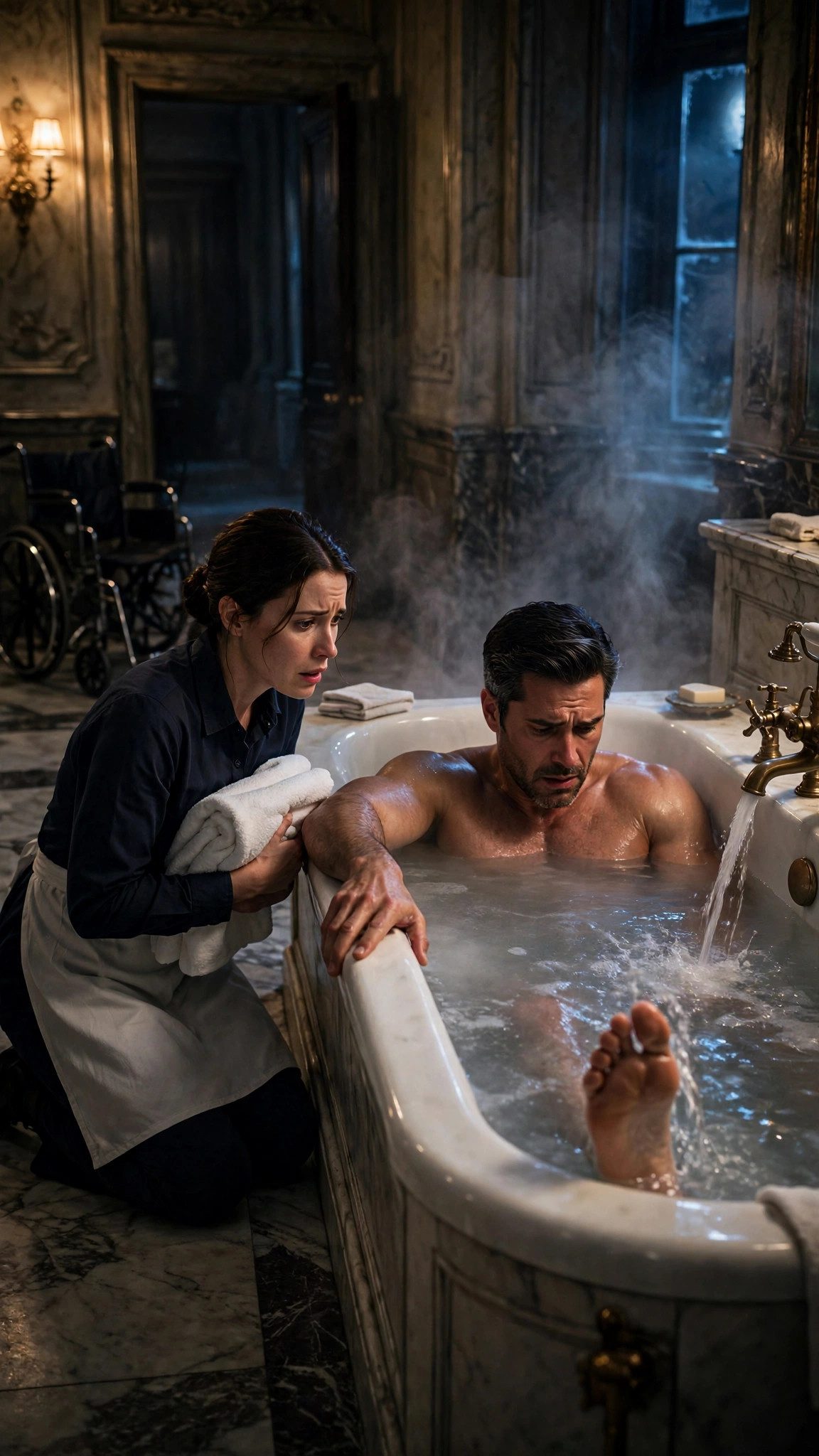
So Martha told him. She told him about the towels, and the steam, and the water that was too hot. She told him about the cold tap, and the foot that pulled away, and the fear on Maxwell's face. She told him about the thermometer, and the notebook, and the map of his legs she had drawn in blue ink. She told him about Cole Bennett's log, and the line that said "Extra hot. V. says it helps the circulation." She told him about the man with the pillow, and the bite on his hand, and the phone in the jacket pocket with Victor's number in it.
Reyes listened without interrupting. When she finished, he was quiet for a long moment. Then he opened his folder and took out a photograph.
"Do you know this man?" he asked.
It was Eddie Krol. Shaved head. Tattoo on the neck. The same face Martha had seen in the doorway of Maxwell's bedroom.
"That is the man who tried to smother Mr. Rourke," she said.
Reyes nodded. "Eddie Krol. We have been watching him for eighteen months. He works for your Mr. Victor Rourke, and Victor Rourke works for Vincent Castellano. Krol was on Pier Nine the night Maxwell was shot. We could never place him there — until last night, when he left his jacket in your house with his phone in the pocket."
He put the photograph away and took out another piece of paper. A bank statement, with lines highlighted in yellow.
"Victor Rourke has been moving money through a holding company called Bellini Holdings for three years. The money goes to Castellano. Some of it comes back as payments to men like Krol, and to men like Cole Bennett." He looked at Martha. "Cole Bennett has been receiving two thousand dollars a month, in cash, in envelopes, for six months. We found the envelopes in his room this morning. He is downstairs right now, telling my partner everything, because he is more afraid of prison than he is of Victor Rourke."
"Will he testify?" Martha asked.
"He already is," Reyes said. "He told us Victor ordered the hot baths. He told us Victor said, and I quote, 'A man who cannot feel his legs will not notice when the water is too hot, and a man who dies of an infection does not get a murder investigation.' Cole drew the baths because he was afraid, and because he was paid, and because he told himself it was not really killing anyone. He is wrong about that last part, and he knows it now."
Reyes closed the folder. "Miss Kovak, I need to ask you something, and I need you to answer honestly. Why did you check the water? You were hired to clean downstairs rooms. You were told not to go to the third floor. Why did you kneel beside that tub and put your wrist in the water?"
Martha thought about it. She thought about Walter Abernathy, seventy-one years old, a retired schoolteacher who liked crossword puzzles. She thought about the chart with her name on it. She thought about two years of cleaning other people's rooms.
"Because I am a nurse," she said. "They took my license, but they did not take the training out of my hands. I walked into a bathroom that was too hot, and a man was sitting in water that could burn him, and my hands knew what to do before my head had finished deciding. That is all. That is the whole reason."
Reyes studied her for a long moment. Then he said, "Tell me about the medication error."
So Martha told him that, too. She told him about Walter Abernathy, and the dose that was ten times too strong, and the chart that had been corrected at two in the morning, four hours after the patient died, from a terminal on the night shift. She told him about Denise Fallon, crying at the hearing, saying she could not remember who had written what. She told him about the board, and the revocation, and the two years of cleaning rooms.
Reyes wrote it all down. When she finished, he put his pen down and looked at her.
"Miss Kovak, I am going to tell you something I do not usually tell witnesses. The FBI does not forget a name once it is in a file. Your name is in a file, because of the Abernathy case. But files can be reopened. And when we subpoena Harborview's records for the Rourke investigation — because we will need the hospital's records to establish your training and your credibility as a witness — we will also subpoena the audit logs for the night Mr. Abernathy died. If that chart was edited at two in the morning from a night-shift terminal, the log will show it. And if it shows it, your case gets reopened."
Martha stared at him. "You would do that?"
"I would do it because it is the truth," Reyes said. "And because a witness who has been wronged by a lie is the most dangerous witness in the world to a man like Victor Rourke. He needs you to be quiet. I need you to be loud."
That afternoon, Reyes took Maxwell's statement. Martha was not in the room, but she heard the raised voices through the study door — Maxwell's voice, flat and cold, laying out fourteen months of silence in careful, measured sentences — and she heard Reyes's quieter voice, asking questions, writing things down.
When it was over, Reyes came out of the study and shook Maxwell's hand.
"We will move on Tuesday," he said. "Victor comes every Tuesday. We will be waiting."
Tuesday came, as Tuesday always did, with Victor Rourke.
He walked through the front door at eleven o'clock, silver hair combed straight back, suit immaculate, and he went into the study where Maxwell sat in his wheelchair by the window, exactly where he had sat every Tuesday for fourteen months. Miss Delaney brought coffee. Rosa stayed in the kitchen. Martha dusted the library, her hands steady, her heart beating hard against her ribs.
At eleven-twenty, the front door opened again. Daniel Reyes walked in with four agents behind him. He did not knock. He walked straight to the study, opened the door, and said, very calmly, "Victor Rourke, you are under arrest for the attempted murder of Maxwell Rourke, conspiracy to commit murder, racketeering, and money laundering."
Martha heard the cup hit the floor. She heard Victor's voice, high and furious, saying this was a mistake, saying his nephew was confused, saying a cleaning woman had filled his head with nonsense. She heard Maxwell's voice, quiet and steady, saying, "I can feel my right leg, Victor. I have been able to feel it for four months. You shot me because I was going to shut you down. You tried to scald me because I was healing. You sent a man with a pillow because I was still alive. It is over."
They took Victor away in handcuffs. Eddie Krol was arrested the same day, at a bar on the waterfront, with a gun in his waistband and Victor's money in his pocket. The money trail led from Bellini Holdings to Vincent Castellano, and Castellano was arrested two weeks later, in New York. The trial would take months. The waiting would take longer.
The trial began in late autumn, in a courtroom in Providence with high windows and hard wooden benches, and Martha testified on the third day.
She wore the only good dress she owned, a plain navy dress she had bought for her mother's funeral five years earlier, and she sat in the witness box with her hands folded in her lap, and she told the truth the way she had written it down: slowly, in order, leaving nothing out.
The prosecutor, a young woman named Alvarez with a calm voice and a sharp mind, walked her through it. The towels. The steam. The water that was too hot. The cold tap. The foot that pulled away. The thermometer. The notebook. The map of Maxwell's legs. Cole Bennett's log, and the line that said "Extra hot. V. says it helps the circulation." The man with the pillow. The bite on his hand. The phone in the jacket pocket.
Then Victor's lawyer stood up. He was a tall man in an expensive suit, with a voice like oil, and he smiled at Martha the way men like him smile at women they intend to destroy.
"Miss Kovak," he said. "You were fired from your last job, were you not?"
"I lost my license," Martha said. "I was not fired. I resigned while the hearing was pending."
"You lost your license because a patient died, did you not? A patient in your care?"
"A patient died," Martha said evenly. "The dose on the chart was ten times what the doctor ordered. The chart was corrected four hours after he died, from a night-shift terminal. My name was on the chart. That is why I lost my license."
"So you are a woman who was found responsible for a man's death," the lawyer said, "and now you expect this jury to believe your testimony about bathwater and thermometers?"
Martha looked at him. She looked at the jury. She looked at the judge. And then she did the thing she had rehearsed in her head a hundred times on the bus to the courthouse: she opened her bag, and she took out the blue notebook, and she held it up.
"This is my record," she said. "Every bath. Every temperature. Every test. Every movement. Dates, times, numbers, in order. I wrote it down the night it happened, every night, for six weeks. You can check the dates against the house logs. You can check the temperatures against the thermometer I used. You can ask the doctors at Harborview whether a pinprick on a right calf means what I say it means." She set the notebook down on the rail of the witness box. "I lost my license because someone else lied on a chart. I am not going to lose this case because someone else is lying in this courtroom."
The courtroom was silent. The lawyer looked at the notebook. He looked at Martha. He asked three more questions, and each one was weaker than the last, and then he sat down.
Cole Bennett testified the next day, and he cried on the stand, and he told the jury that Victor had ordered the hot baths, and that he had drawn them because he was afraid and because he was paid, and that he had known, every night, that what he was doing could kill a man. Eddie Krol did not testify — he took a plea, twenty-five years, in exchange for naming Victor as the man who had ordered the shooting on Pier Nine.
The jury deliberated for six hours. When they came back, the foreman stood up, and the courtroom held its breath, and he said the word Martha had waited fourteen months to hear — not for herself, but for Maxwell, and for Walter Abernathy, and for every patient whose chart had ever been lied about.
"Guilty."
Victor Rourke was sentenced to life in prison, no parole. Vincent Castellano, tried separately in New York, received the same. Cole Bennett, for his cooperation, received eight years.
In the weeks after the trial, a letter arrived at Martha's apartment in Pawtucket. It was from the state nursing board. It was short, and formal, and it changed everything.
The audit logs from Harborview had been subpoenaed. The logs showed that the Abernathy chart had been edited at two-fourteen in the morning, four hours after the patient died, from a terminal on the night shift — a terminal logged in under the name Denise Fallon. The board had reopened Martha's case. The revocation was reversed. Her license was restored. Denise Fallon, the night nurse who had cried at Martha's hearing and said she could not remember who had written the dose, was charged with falsifying a medical record, and she pleaded guilty, and she told the board, in her own words, that she had swapped the charts to cover her own error, and that Martha Kovak had done nothing wrong.
Martha sat at her kitchen table and read the letter three times. Then she put her head down on the table and cried — not the quiet, controlled tears she had cried for two years, but great, shaking sobs, the kind that come when a weight you have carried for so long finally lifts and you realize how heavy it was.
That evening, she went to Rourke House, and she found Maxwell in the library, in his wheelchair, with her blue notebook open on his lap. He was looking at the map she had drawn of his legs — the sharp pinprick on the right calf, the dull pressure on the left thigh, the toe that moved on command.
"They gave it back," she said. "My license. They gave it back."
Maxwell looked up at her, and for the first time since she had met him, he smiled — a real smile, wide and unguarded, the smile of a man who had spent fourteen months pretending to be broken and was finally allowed to stop pretending.
"Then we both got something back," he said.
Martha sat down beside him. She took the notebook from his lap and turned to a fresh page. At the top, in her clear, careful handwriting, she wrote a new heading.
Rehabilitation plan, week eight. Right leg: sensation to the knee. Left leg: sensation to mid-thigh. Standing: with support, two minutes. Walking: with a walker, ten steps.
She looked at the page. She looked at Maxwell. And she thought about the foot that had pulled away from cold water six weeks ago, and the man who had been afraid, and the woman who had checked the water, and how the two of them had ended up here — in a library, in a house that was finally safe, writing down the facts in a blue notebook, in handwriting so clear and careful that no one would ever be able to call them a lie.