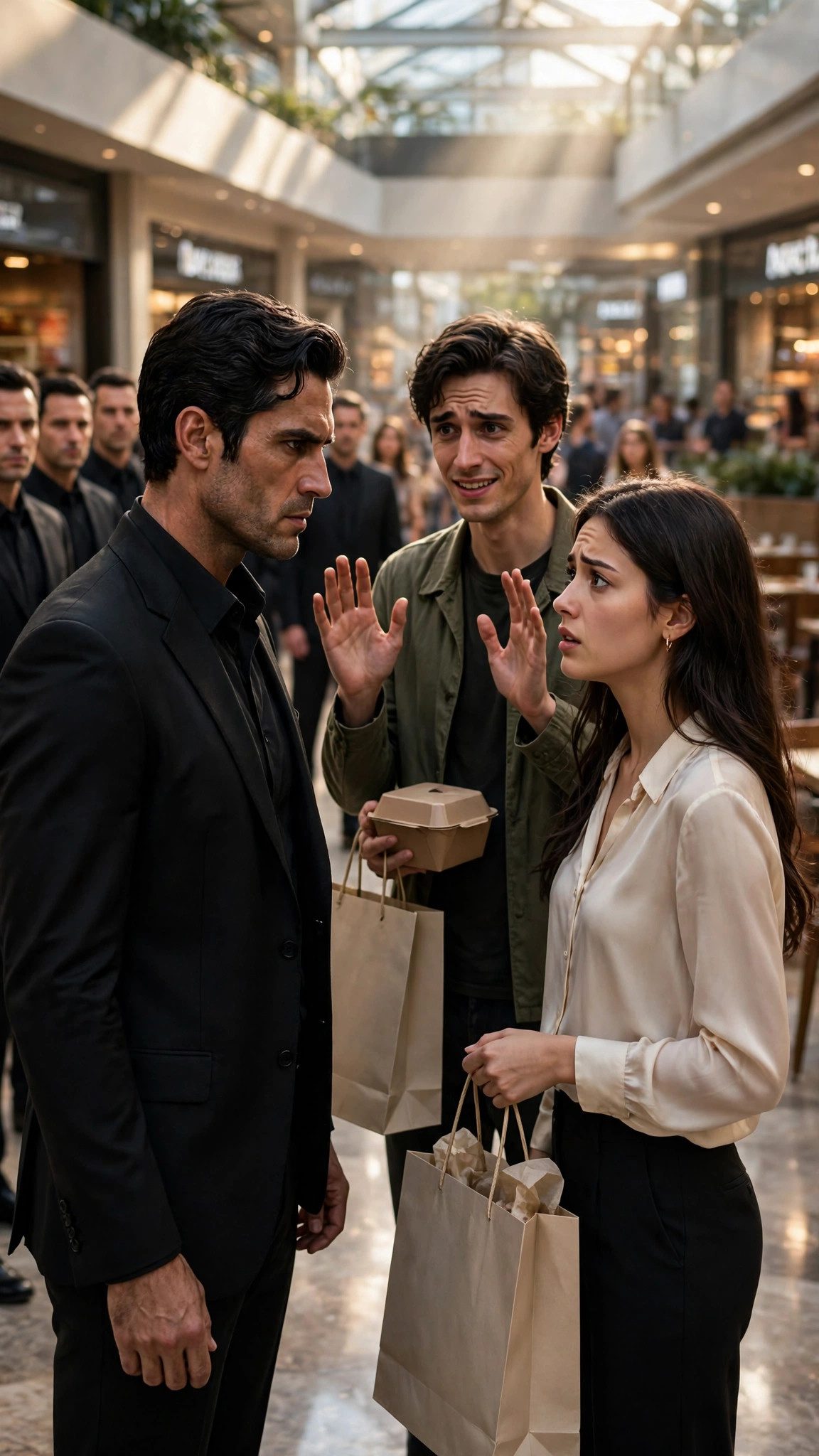
Monday morning arrived gray and cold, the lake wind rattling the windows of the house on Lake Shore Drive, and I woke up before the alarm, before Julian, before the house itself seemed fully awake, and I lay in the dark thinking about the day ahead.
Today, the Huntington agreement would be signed. Today, Vincent Castellano would learn that he had lost. Today, Agent Reyes would be waiting with a folder full of bank records, phone logs, Rosa Delgado's notebook, and the testimony of two frightened men who had been caught outside a farmers' market with a knife and a photograph of my brother.
And today, I would learn whether my husband — the man I had married six months ago and met, properly, only last week — was the kind of man who could finish a war without becoming the thing he was fighting.
Julian was already dressed when I came downstairs. He stood in the kitchen, drinking coffee, reading a newspaper, and when he saw me, he set the paper down and said, "Mrs. Okafor made pancakes. Daniel is already on his third."
Daniel was, indeed, on his third pancake, sitting at the kitchen table in a sweater that did not match his trousers, reading a medical journal and eating with the focused determination of a man who had spent two years eating hospital food.
"Your husband makes terrible toast," Daniel said, without looking up, "but your housekeeper makes excellent pancakes. I am staying for the pancakes."
"You are staying," Julian said, "because your sister needs you. The pancakes are a bonus."
We ate breakfast together — the three of us, like a family, like we had every morning for the past five days — and then Julian's phone rang, and it was Mr. Huntington's lawyer, and the signing was confirmed for eleven o'clock, and Julian stood up, and Daniel stood up, and I stood up, and we went to get ready.
The signing was held in a conference room on the top floor of the Huntington headquarters downtown, a room of glass and steel and a view of the whole city. Mr. Huntington was there, and his lawyers, and Julian's lawyers, and Agent Reyes, sitting quietly in the corner in a suit that did not quite fit him, drinking coffee from a paper cup, watching everything.
The documents were spread across the table. The pens were ready. Mr. Huntington picked up his pen, and he looked at Julian, and he said, "Before I sign this, I want to say something. I have done business in this city for forty years. I have seen men lie, and cheat, and steal, and call it business. Last week, I watched a man stand up in my dining room and tell the truth about his own wife, in front of twenty-seven people, when a lie would have been easier. That is the kind of man I do business with. So I am signing."
He signed. Julian signed. The lawyers witnessed. The agreement was done.
And then the door opened, and Vincent Castellano walked in.
He was a man in his sixties, with silver hair and a tailored suit and a smile that did not reach his eyes, and he walked into that conference room as if he owned it, with two men behind him, and he said, "Gentlemen. I believe there has been a misunderstanding."
Agent Reyes stood up. He set down his paper cup. He walked across the room, slowly, and he said, "Mr. Castellano. My name is Agent Daniel Reyes, Federal Bureau of Investigation. You are under arrest for racketeering, extortion, witness intimidation, and conspiracy to commit murder."
Castellano laughed. "You have nothing. You have the word of a florist and two men who will say anything to save themselves."
Reyes opened his own folder. "We have eleven months of bank records showing payments from your shell company to Marcus Hale. We have phone logs showing forty-seven calls between your number and Mr. Hale's number. We have Rosa Delgado's notebook, twenty years of records. We have the testimony of the two men we arrested outside the farmers' market on Friday, who have both agreed to cooperate. And we have Marcus Hale himself, who surrendered to us yesterday morning and has been talking for fourteen hours straight."
Castellano's smile faded. He looked at Julian. "You," he said. "You did this."
"No," Julian said. "My wife did this. She went to Rosa Delgado's apartment and asked her for the truth. My brother-in-law did this. He refused to hide when you threatened him. And an old woman with a notebook did this. I just signed a piece of paper."
Reyes took a pair of handcuffs from his pocket. "Mr. Castellano, you have the right to remain silent."
As the agents led Castellano out of the conference room, he turned back, and he looked at me — not at Julian, at me — and he said, "You are not what I expected, Mrs. Sterling."
"Neither is my husband," I said. "He makes terrible toast. But he is learning."
Castellano was taken away. The room was quiet. Mr. Huntington poured himself a glass of water with a hand that shook, just slightly. Daniel exhaled, long and slow, like a man who had been holding his breath for a week.
And Julian — Julian stood by the window, looking out at the city, and I walked over to him, and I stood beside him, and I said, "It is over."
"It is over," he agreed. "Castellano will go to prison. Marcus Hale will go to prison. The injunction is dead. The agreement is signed. It is over."
"Then why do you look like that?" I asked.
He was quiet for a moment. Then he said, "Because I spent six months being a man who did not know his own wife, and I spent one week learning who she was, and now I am afraid that I have already wasted the best part of our marriage on silence."
I took his hand. His hand was warm, and large, and calloused, and it held mine the way it had held mine in the car, gently, as if I were something breakable.
"You have not wasted it," I said. "You have just started it. Six months of silence, and then one week of truth. That is not a wasted marriage, Julian. That is a marriage that is finally beginning."
He looked at me. His dark eyes were tired, and serious, and full of something I had never seen in them before — not anger, not suspicion, not the flat unreadable stare of a mafia boss deciding something. It was something softer. Something that looked almost like hope.
"Then let us begin," he said.
That evening, we went home, the three of us, and Mrs. Okafor made roast chicken, and Daniel told a story about a patient in London who had woken up from surgery and asked for his dog, and Julian laughed — the rusty laugh, getting less rusty every day — and I sat at the table in a house with eleven bedrooms, and for the first time, every room in it felt like it belonged to someone I knew.
Later, after Daniel went to bed, Julian and I sat in the library, and he asked me about my sketchbook — the one I had kept since I was twelve — and I showed it to him, page after page, drawings of my mother, of Daniel, of the lake house, of the garden I had wanted to plant and never had. He turned the pages slowly, carefully, as if each one were something precious, and when he reached the last page — a drawing of a woman standing at a window, looking out at a lake, alone — he said, "Draw another one. Draw us. The three of us. At breakfast. Eating pancakes."
"I will," I said. "Tomorrow."
"Tomorrow," he agreed.
We went to bed, and I lay awake for a while, listening to a man breathe beside me — a man I had married six months ago, a man I had met properly only a week ago, a man who made terrible toast and asked me what I ate for breakfast and held my hand in the car — and I thought about the fact that the law had done what the law could do. It had arrested Castellano. It had arrested Marcus Hale. It had saved the agreement and the harbor and the family name.
But the law could not do the thing that mattered most. The law could not teach a man to know his wife. That was something Julian had to do himself. And he was doing it — one question at a time, one breakfast at a time, one page of a sketchbook at a time.
It was enough. It was more than enough. It was a beginning.
The trial of Vincent Castellano lasted eleven days. I did not attend every day — Julian said it was better if I stayed home, and for once, I agreed with him, because I had already told my part of the story to Agent Reyes, and because I did not need to sit in a courtroom and watch a man who had tried to destroy my family pretend that he was the victim. But I went on the last day, the day of the verdict, and I sat in the back of the courtroom beside Daniel, holding his hand, and when the foreman read the word "guilty," four times, for four separate charges, I felt something loosen in my chest that I had not known was tight.
Marcus Hale was sentenced two weeks later. He received eight years. He wrote Julian a letter from prison, apologizing, and Julian read it once, folded it, and put it in a drawer, and he said to me, "I do not forgive him yet. But I am no longer angry. Anger is a heavy thing to carry, Audrey. I carried it for a long time. I am putting it down now."
My father came to the house for the first time in two years, three days after the verdict. He sat in the library with Julian for three hours, and when they came out, my father's eyes were red, and he shook Julian's hand, and he said to me, "Your husband asked me about your mother. He asked me what she was like, and what she cooked, and what she sang when she thought no one was listening. No one has asked me about your mother in seven years, Audrey. Not one person. Your husband asked."
It was then that I understood what Julian had been doing all along, in his slow, careful, stubborn way. He had not just been learning about me. He had been learning about the people who made me — my mother, my father, my brother, my best friend — because he had finally understood that you cannot know a woman without knowing the people who loved her first.
The foundation came later, in the spring. Julian established it in my mother's name — the Elena Bennett Foundation, for children who had lost a parent — and he put Daniel on its board, and he put me on its board, and he funded it with money from the legitimized businesses, money that had once bought silence and fear and was now going to buy schoolbooks and grief counselors and summer camps by the lake. The first child the foundation helped was a girl named Sofia, nine years old, whose mother had died the year before, and who liked to draw, and who reminded me so much of myself at her age that I cried when I met her, and Julian held my hand, and he said, "This is what the money is for. This is what all of it was always supposed to be for."
Rosa Delgado came to the foundation's opening, wearing her best dress, carrying her notebook — the twenty-year notebook, the one that had helped put Castellano in prison — and she showed it to the children, and she said, "I kept this because I knew that one day, someone would come and ask me for the truth. And someone did. And the truth was enough."
It was enough. It had always been enough. It had just taken us a very long time to ask for it.
In the weeks after the verdict, Julian and I began a new routine. Every morning, after breakfast, we walked in the garden together — twenty minutes, no phones, no men, no business — and Julian asked me one question about my life, and I asked him one question about his. What was your father's favorite book? What did your mother cook on Sundays? What was the first thing you ever stole? What is the one thing you are afraid of? Some days the questions were easy. Some days they were hard. Some days Julian went quiet for a long time before he answered, and I waited, because I had learned that his silences were not walls anymore. They were doors, opening slowly.
One morning, he asked me what I had wanted to be when I was a little girl. "An artist," I said. "I wanted to paint big, wild pictures, the kind that take up a whole wall." And he said, "Then paint them. Paint the whole wall. I will buy you the wall." And I laughed, and he laughed, and the next week, a blank canvas arrived — six feet tall, four feet wide — and I stood in front of it for a whole day, terrified, and then I picked up a brush, and I painted the lake, and the beach, and two children laughing, and a woman standing at a window, looking out at the water. When it was finished, Julian hung it in the library, in the place of honor, above the fireplace, and he said, "That is the best thing in this house." And I believed him, because he had finally learned to see what was in front of him.