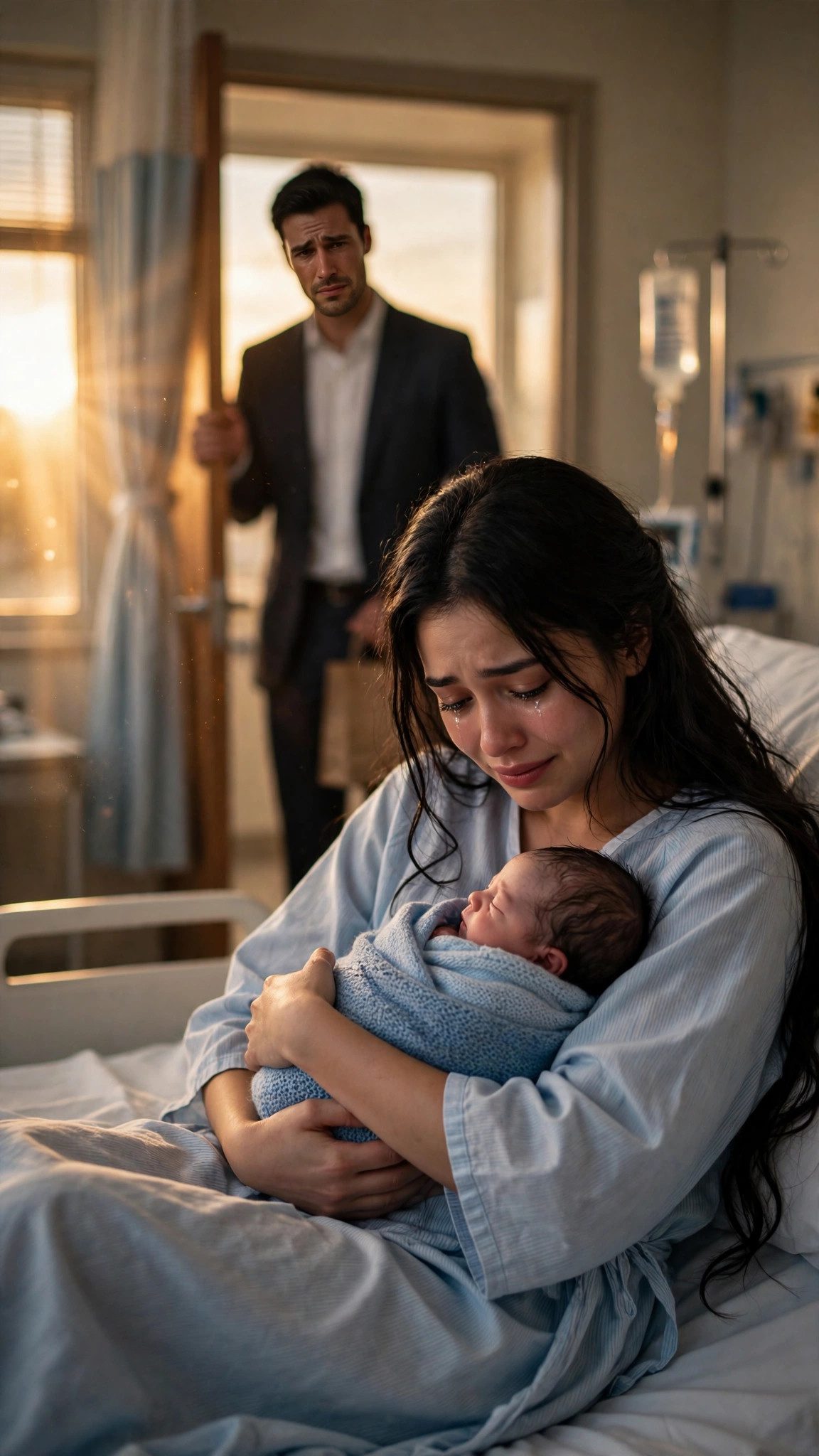
Damian sat in his car across the street from my mother's cottage for a long time before he found the courage to knock on the door.
I know this because my mother told me later. She had seen the car from the kitchen window. She had watched it sit there in the dark for almost an hour, and she had known who it was, because no one else would sit in a car on our quiet street for an hour in the dark, and no one else drove a car like that one. She did not tell me. She waited. She let him sit there, because she thought he deserved to sit there for a while, thinking about what he had done.
When he finally got out of the car, he was carrying the paper bag. He walked up the path slowly, the way a man walks when he is not sure he will be welcome. He knocked on the door, three soft knocks, and my mother opened it, and she looked at him, and she did not move aside.
"Mr. Moretti," she said.
"Mrs. Bennett," he said. "May I come in?"
"That depends," my mother said. "Why are you here?"
"To see my wife."
"My daughter is not your wife right now," my mother said, and her voice was calm, but there was steel underneath it, the kind of steel that comes from raising a child alone and burying a husband and keeping a garden alive through forty Wisconsin winters. "Right now, my daughter is a mother who buried her son four days ago. If you are here to give her orders, you can get back in your car. If you are here to apologize, you can start by telling me what you are sorry for, and I will decide whether it is enough."
Damian stood on the porch for a moment, and I think that was the first time in his life anyone had spoken to him that way. He was Chicago's most feared mafia boss. Men crossed the street to avoid him. Men lowered their voices when he entered a room. And here was a sixty-one-year-old woman in an apron, standing in the doorway of a small white cottage, telling him he could not come in until he said the right words.
"I am sorry," he said, "that I was in Capri when my son was born. I am sorry that I was in Capri when my son died. I am sorry that Claire called me eight times and I answered once. I am sorry that I told her I needed a little time, when what she needed was her husband. I am sorry that I warned her about nothing, and that she warned me about everything, and that I did not listen. I am sorry that our son lived twelve hours and six minutes and never felt his father's arms. I am sorry for all of it. I will be sorry for all of it for the rest of my life."
My mother looked at him for a long moment. Then she stepped aside.
"Come in," she said. "But you will not raise your voice in this house. You will not give orders in this house. And if my daughter tells you to leave, you will leave."
Damian nodded. He walked into the kitchen, and he saw me sitting at the table, and he stopped, as if the sight of me had knocked the air out of him. I was wearing one of my mother's old sweaters. My hair was pulled back. My eyes were swollen. I did not look like the woman he had married. I looked like a woman who had been through something terrible, and I was.
"Claire," he said.
I did not get up. I did not go to him. I sat at the table with my hands wrapped around a cup of tea gone cold, and I looked at him, and I said, "You found me."
"Elena told me about Lake Geneva," he said. "The nurse. She said you talked about your mother's cottage. She said your father planted a rosebush here."
"She shouldn't have told you."
"She said that part was up to you. She said she was telling me because I should know what I lost, not because I deserved to find you."
I nodded. That sounded like Elena. She was the kind of nurse who understood that the truth and forgiveness are not the same thing.
Damian set the paper bag on the table, very gently, between us. "I brought this," he said. "I didn't know what else to do. I watched the video, Claire. I watched it a hundred times. I read your letter. I read it until I had it memorized."
"What did the letter say that you didn't already know?" I asked. My voice was steady. I was surprised by how steady it was.
"It said I lost more than my child," he said. "And you were right. I lost my son. I lost my wife. I lost the man I wanted to be. I lost all of it in twelve hours and six minutes, and I did it to myself, one choice at a time."
He sat down across from me. My mother stood in the doorway, watching, her arms crossed. She did not leave. She did not trust him enough to leave us alone, and I was glad.
"I went to see Alessia," Damian said. "Before I came here. I went to her apartment, and I told her it was over. I told her I had chosen wrong, and that I was going to spend the rest of my life trying to make it right, and that she was not a part of that life anymore. She cried. She begged. She said she loved me. And I told her that love is not something you say. It is something you do. And what I did was leave my wife alone in a hospital while our son died."
"She sent me a photograph," I said. "Three weeks old. She tried to make me believe you went back to her."
Damian's face went dark. "She did that? After everything?"
"She is afraid," I said, echoing my mother's words. "A woman who is secure does not send photographs to another woman's phone."
"I will deal with her," Damian said. "She will never contact you again. I promise you that."
"Don't make promises, Damian," I said. "Your promises are what got us here."
He flinched. I saw it. The words landed the way I had intended them to land, and for a moment I felt a sharp, ugly satisfaction, and then I felt ashamed of it, because I did not want to be the kind of person who hurt people to feel better. I was not that person. Grief had made me into someone I did not recognize, and I did not like her.
"I didn't come here to make promises," Damian said quietly. "I came here to tell you what I have done. Not what I will do. What I have done."
He told me, then, and as he spoke, I began to understand that something in him had truly changed, not in the way a man changes when he is caught, but in the way a man changes when he has lost something he can never get back.
He had gone to FBI Agent Daniel Reyes. I knew that name. Everyone in Chicago who followed the news knew that name. Agent Reyes had been building a case against the Moretti family for two years, and against Vincent Castellano, the man whose men had grabbed my arm on Rush Street seven months ago. Damian had walked into the federal building in Chicago, alone, without a lawyer, without his men, and he had handed Agent Reyes everything: the ledgers, the shipping routes, the names, the accounts. He had given the FBI the entire criminal empire he had spent twenty years building, and he had told them he would testify against Castellano, against his own associates, against anyone they wanted, because the empire was what had taken him away from his family, and he was done with it.
"Castellano was arrested yesterday," Damian said. "He will spend the rest of his life in prison. Tony Russo testified. Sal Ferraro testified. The men who grabbed you on Rush Street testified. It is over, Claire. The empire is over. I am giving it all away. The warehouses, the shipping routes, the properties. I am selling everything that was built on blood, and I am keeping only the legitimate businesses, the restaurants, the hotels, the ones that were clean. I am going to be a businessman, Claire. A real one. Not a boss. Not a king. A man who comes home for dinner."
I stared at him. I had expected many things from this conversation. I had expected begging. I had expected anger. I had expected him to tell me I was his wife and I belonged in Chicago. I had not expected him to tell me he had dismantled his own empire.
"Why?" I asked. "Why would you do that?"
"Because I finally understood something," he said. "On the plane, when I was flying home, I kept thinking about the nursery. I kept thinking about the mobile with the wooden stars. And I realized that I had spent three years building an empire for a family, and I had forgotten to be part of the family. I built a kingdom, and I left my wife alone in it. I am not going to do that anymore. If you come back to me, I want you to come back to a man, not a kingdom. And if you don't come back to me, I want you to know that I became that man anyway, because our son deserved a father who would have been there, and I was not that father, and I will spend the rest of my life trying to be him for someone else, even if that someone else is only his memory."
My mother made a small sound in the doorway. I looked at her, and I saw tears in her eyes, and I realized she had not expected this either.
"I have one more thing to tell you," Damian said. "Alessia came here. Yesterday. She drove to Lake Geneva. She stood outside this house. My men saw her. Not my men, I mean, the men who used to be my men. Tony called me. He said she was asking people in town about you. I told Tony to make sure she never came near this house again, and he did. She is gone, Claire. She will not bother you again."
I thought about the photograph she had sent me. I thought about the lie dressed up as the truth. And I thought about how small Alessia seemed now, compared to everything else that had happened. She was not the reason my son had died. She was a symptom, not a cause. The cause was a man who had chosen his empire over his family, one trip at a time, until there was nothing left to choose.
"I am not coming back to Chicago," I said. "Not yet. I need time. I need to grieve my son. I need to figure out who I am without him, and without you, and without the life I thought I was going to have."
"I understand," Damian said.
"But I am not saying never," I said, and I saw his face change, the way a sky changes when the sun comes out after a storm. "I am saying: earn me back, Damian. Not with money. Not with promises. With time. With presence. With the man you say you want to be. Come here. Come to Lake Geneva. Help my mother in the garden. Sit with me while I grieve. Don't try to fix it. Don't try to buy it away. Just be here. And we will see."
Damian nodded. He reached across the table, slowly, giving me time to pull away, and he took my hand. His hand was warm. It was the hand that had held mine on our wedding day. It was the hand that had painted the nursery pale yellow. It was the hand that had never held our son.
"I will be here," he said. "Every day. As long as it takes."
And for the first time in four days, I believed him.
The next morning, I woke up to the sound of voices in the garden. I looked out my bedroom window, and I saw Damian standing beside the rosebush with my mother, holding a pair of pruning shears the way a man holds a weapon he does not know how to use. My mother was showing him, patiently, which branches to cut and which to leave, and Damian was listening the way he had once listened to me in the hospital cafeteria at three in the morning, with his whole body turned toward her, his phone nowhere in sight.
"Cut here," my mother said, pointing to a dead branch. "Not there. There is life in that one. You have to learn to tell the difference."
Damian cut where she told him to cut. He was careful. He was slow. He was not the kind of man who was used to being careful and slow, and it showed in the way his hands shook, just slightly, as he worked. My mother watched him for a while, and then she said, "You are good at this, Mr. Moretti. You have gentle hands. I did not expect that."
"I am learning," Damian said. "I am learning a great deal of things I should have learned a long time ago."
I stood at the window for a long time, watching them, and I felt something shift inside me, something I had thought was broken beyond repair. It was not forgiveness. Not yet. It was something smaller than forgiveness, and quieter. It was the beginning of believing that a man could change, not because he said he would, but because he showed up, day after day, in a garden, with pruning shears in his hands, learning how to tell a living branch from a dead one.
That afternoon, Damian cooked dinner. It was terrible. He burned the chicken and undercooked the potatoes, and my mother laughed so hard she had to sit down, and Damian laughed too, and for the first time in four days, I laughed as well. It was a small laugh, and it hurt a little, the way laughing hurts when you have been crying for days, but it was real. And as I sat at my mother's kitchen table, eating burned chicken with the two people I loved most in the world, I thought: this is what a family looks like. Not an empire. Not a kingdom. A kitchen table, and burned chicken, and a garden full of roses, and a man who is learning how to stay.