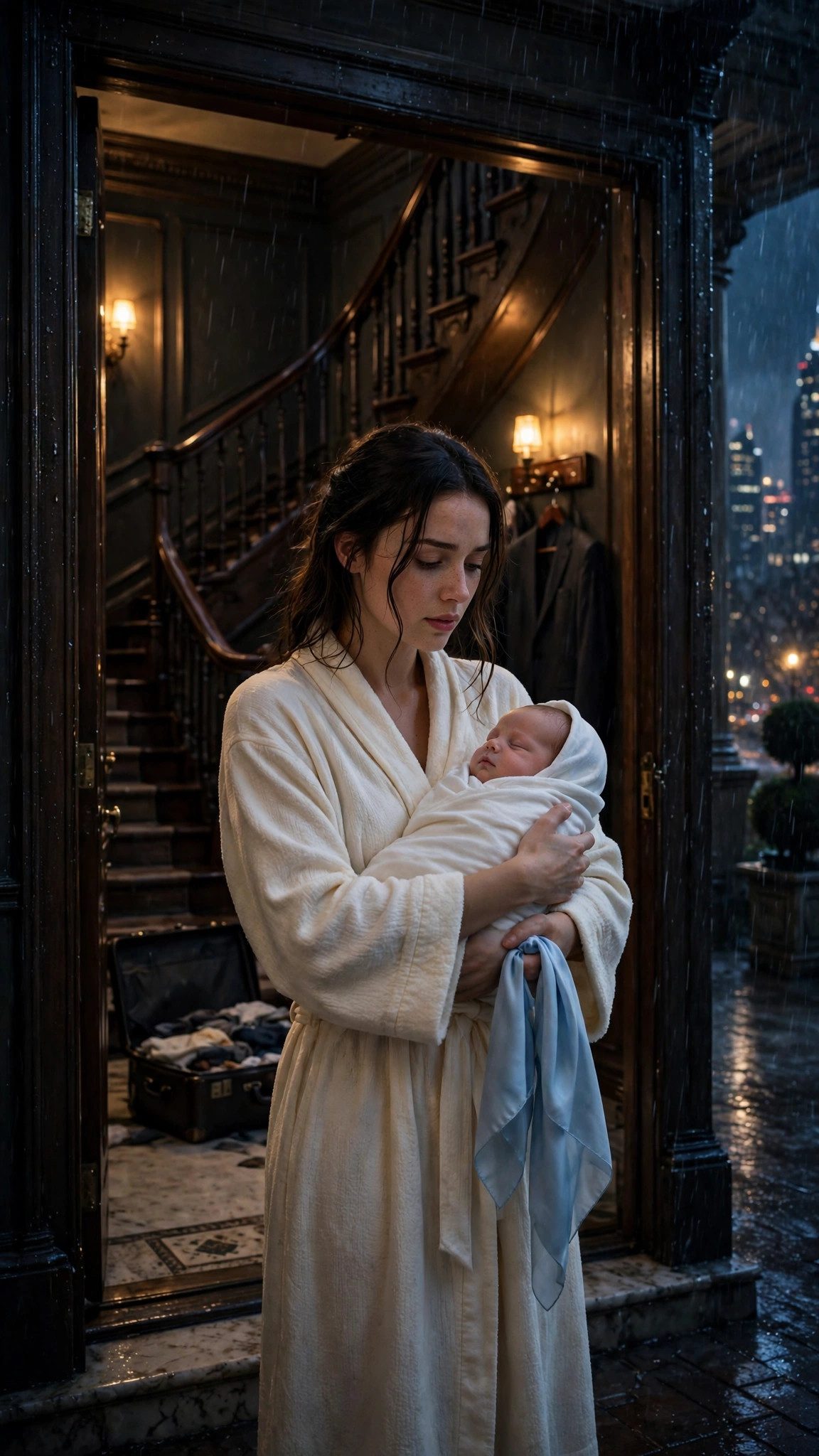
Seventeen days after giving birth to our daughter, I discovered my husband had booked a one-way flight to Lisbon with his mistress.
His name was Colton Beckett. He was not just a wealthy businessman. He was one of Atlanta's most feared mafia bosses, a man who could find almost anyone with a single phone call. He controlled shipping companies, commercial properties, and warehouses throughout Georgia. Behind those legitimate businesses stood a powerful criminal empire. Men twice his age lowered their voices around him. Even his enemies knew better than to threaten his family.
And yet, somehow, the man everyone feared had become the person who hurt me most.
Our daughter, Ren, was only seventeen days old. I had spent thirty-one hours in labor. My body still ached. During labor, he had sat beside me, holding my hand and whispering, "You're the strongest woman I know."
Then he was gone. Before I even knew he was leaving. He had arranged a flight to another country. He had arranged to leave the country with another woman before our daughter was even a month old.
It was the morning of the seventeenth day. Ren was asleep in her crib in the nursery, her tiny fists curled against her cheeks, her breathing soft and even. I was standing in the kitchen in my robe, one hand pressed to my still-tender stomach, the other holding a mug of tea that had gone cold, when I heard the front door open and close.
Colton came in carrying his suitcase in one hand and a small shopping bag in the other. He set the suitcase down by the stairs. He did not look at the nursery door. He did not look at me. He looked at his phone.
"You're home," I said.
"Just for an hour," he said. "I need to pack. The flight leaves at noon."
"What flight?"
He finally looked up. For a second, something crossed his face. Not guilt. Something closer to impatience, as if I had asked him a question he had already answered in his own head.
"Lisbon," he said. "It's business."
I stared at him. Lisbon. A city I had never been to. A city he had never mentioned. And the shopping bag on the counter, tissue paper spilling out of the top, and the corner of something pale blue showing through.
"What's in the bag?" I asked.
He picked it up and held it out to me, the way a man holds out a gift he bought at the airport because he remembered, too late, that he was supposed to bring something home.
"A scarf," he said. "Silk. I thought you'd like it."
I took the bag. I pulled the scarf out. It was baby blue, soft as water, with a fine silver thread running through the hem. It was beautiful. It was not my color. I had never worn baby blue in my life. I wore black and cream and deep green. Everyone who knew me knew that.
"Who is she?" I asked.
His face did not change. That was the worst part. His face did not change at all.
"She's just a client," he started.
"Stop lying to me!" The words came out louder than I meant them to, and I glanced toward the nursery, afraid I had woken Ren. But Ren slept on, and the silence that followed my voice was worse than the shouting would have been.
"I've never asked you for much, Colton," I said, quieter now. "I just wanted you here when our daughter was so small."
"No." He placed the suitcase on the bed. "Don't make this into a fight."
"Our daughter is seventeen days old," I said. "You're leaving to catch a plane to Lisbon with another woman."
"I need to work."
"No." I stood in the doorway so he would have to look at me to get past. "I am not going to pretend that it's okay that you would rather be anywhere else."
He folded a navy-blue suit into his suitcase. His hands were steady. That steadiness was what I had loved about him once, in the emergency room at Grady Memorial, when a man with a gunshot wound had been wheeled in and the whole trauma bay had been shouting, and Colton Beckett had lain there with a bullet in his shoulder and looked up at me, the nurse, and said, "You're calm. I like calm."
I had liked his steadiness too. I had mistaken it for safety.
"She's just a client," he said again, and this time his voice had an edge to it, the edge men use when they want a conversation to be over.
"I understand perfectly," I said. "I watched as you folded a navy-blue suit into your suitcase. I understand that you have already decided. I understand that our daughter is seventeen days old and you are leaving to catch a plane to Lisbon with another woman, and you want me to call it business so you don't have to call it what it is."
"You wouldn't understand."
"No, no, no, no, no." I heard my own voice shaking, and I hated it, because I had spent thirty-one hours in labor without making a sound like that, and I was not going to make it now for a man who had already left. "I am not going to pretend."
At that time, I didn't realize I was fighting for a family that had already disappeared.
He finished packing. He closed the suitcase. He kissed the top of my head the way you kiss a child you are leaving with a babysitter, and he walked out of the bedroom, down the stairs, and out the front door. I heard the car start. I heard it pull away.
I waited until he left the house. When I heard the sound of the door closing, the anger began to disappear.
Not anger. Something more direct. Something more decisive.
I realized I had been waiting for Colton to return home as a husband and father. For the first time, I saw that he had never intended to return at all.
It wasn't just about the suitcase, which continued to grow. It was that I'd seen a photograph of a woman in a scarf sitting next to Colton on a café patio in Greece. A woman I didn't know. She was wearing a baby-blue scarf. The same blue scarf he had brought home for her. And when she called on the phone, she said his name softly. In a voice that I had once thought was reserved for me.
The photograph had arrived three weeks ago, in a plain envelope with no return address, slipped under our front door while I was in the hospital giving birth. I had found it when I came home with Ren. I had told myself it was a mistake. A business dinner. A client. I had told myself that for seventeen days, because what else do you tell yourself when you have a newborn in your arms and your body is still healing and the man you married is the most dangerous man in Atlanta?
That was when I began to make plans for my own quiet departure. It wasn't revenge. It was self-preservation.
Each night, after he told me he needed to work late, Colton drove to an office he'd inherited from his father. And every night in that office, he spoke to a woman from the other side of the world. I remembered the words he'd once spoken to me. And for a moment, I felt a strange hope. What if he was simply still overwhelmed by fatherhood, feelings, and attachment? He was a mafia boss with armed men, powerful connections, and a reputation for never letting anything slip beyond his control. If Ren had been injured, Colton would have personally hunted down the culprit and handled him. But for his wife and child, he had left.
I remembered how his assistant, Hannah, had always made excuses for him. It's business. He's just overwhelmed. He'll come around. But he'd never once said it to our daughter. He didn't even look at her when she slept. I had waited for him to show up as a father and as a husband. I had waited long enough.
I packed the baby's bag. Diapers. A spare outfit. Her favorite blanket. I hesitated before putting it down. Then I wrapped our daughter in a soft blanket. I pushed the sandals off the door, leaned on the cradle, and before I left, I stopped. I could not leave her alone. I picked her up and held her against my chest.
I left a note on the envelope. I wrote her name across the front in my steadiest handwriting, because I wanted him to see it the moment he came home and found the crib empty and my clothes gone.
Jade Foresight.
Inside the envelope, on a single sheet of paper, I wrote four lines.
She can have the house. She can have the name. She can have the scarf. Ren is mine.
I left the envelope lying open on his desk, where he kept his keys and his phone charger and the small silver frame with our wedding photograph in it. In the photograph, I was laughing. He was looking at me the way men look at women they have just decided to spend their lives with. I did not take the photograph with me. I wanted him to see it when he came home to an empty house.
The night was calm and quiet. For the first time in months, I finally saw a few stars over the city. I walked to the red sedan parked in the driveway. I buckled Ren into her car seat. I drove away from the house without looking back once. I was afraid that if I looked back, I would change my mind.
I just kept driving. I ended up driving to the edge of the city. And as I walked away from Colton's home, a strange sense of security came over me. As if Colton would eventually come home from the airport, open the front door, and be relieved that I was gone.
But something unexpected happened. Half an hour later, I received a call from an unknown number. It was a woman's voice.
"Lauren," she whispered, "it's Colton."
I pulled the car over to the side of the road, my hands shaking so hard I could barely hold the phone. Ren was asleep in the back seat. The city lights were behind me. Ahead of me, the highway stretched dark and empty toward the county line.
"Who is this?" I said.
"Please," the woman whispered. "Please don't hang up. My name is Jade. Jade Foresight. And your husband is bleeding to death in a parking garage at the airport, and you are the only person in this world who can save him."
I met Colton Beckett three years ago, in the emergency room at Grady Memorial Hospital, on a Tuesday night in October. I was twenty-four years old, a second-year ER nurse, and I had been on my feet for eleven hours. The ambulance bay doors opened, and they wheeled in a man in a charcoal suit with a bullet in his left shoulder and blood soaking through his white shirt, and he looked up at me while the trauma team cut his jacket away and said, in a voice so calm it stopped the whole room for half a second, "You're calm. I like calm."
I did not know then that he was a mafia boss. I knew that he was handsome, and that he was bleeding, and that he had the steady hands of a man who had been shot before and expected to be shot again. I knew that when the surgeon asked him who had done it, he said, "I don't remember," in a voice that made it clear he remembered perfectly well and would deal with it himself.
I knew that he asked for me by name the next morning, when I came on shift, and that he asked again the morning after that. I knew that when he was discharged, he left a bouquet of white lilies at the nurses' station with a card that said only, "Thank you for the calm. — C.B."
I knew that he waited six weeks before he asked me to dinner, because he wanted me to be sure it was not gratitude. I knew that at dinner, in a small Italian restaurant in Buckhead with candles on the tables and a violinist in the corner, he told me the truth about what he did, because he said he would not build a marriage on a lie. He told me about the shipping companies and the warehouses and the men who worked for him, and he told me about the other part, the part that made men twice his age lower their voices, and he waited while I finished my wine and decided whether to stand up and walk out.
I did not walk out. I stayed. I told myself that a man who tells you the truth on the first date is a man who can be trusted. I told myself that the legitimate businesses were the real Colton, and the other part was something he had inherited from his father and was trying, slowly, to leave behind.
We married two years later, in a garden in Savannah, with a hundred guests and a string quartet and a cake with three tiers. My mother had died when I was sixteen, and my father had died two years after that, and I walked down the aisle alone, and Colton met me halfway and took my hand, and I thought, this is a man who comes to meet you. This is a man who does not leave you to walk alone.
I was wrong about so many things. But I was not wrong that he had once been the man who met me halfway. I had seen it. I had lived with it for two years. And then Ren was born, after thirty-one hours of labor, and Colton sat beside me the whole time, holding my hand and whispering, "You're the strongest woman I know," and for one hour, while I held our daughter for the first time and he leaned over the hospital bed to look at her face, I thought we were going to be all right.
Then he stopped coming home. Then the late nights started. Then the office his father had left him, downtown, where he went every night and spoke to a woman from the other side of the world in a voice I had once thought was reserved for me.
Now, on the side of a dark highway, with my seventeen-day-old daughter asleep in the back seat and my husband's mistress whispering into my phone, I understood something I had not understood in the kitchen that morning.
Colton had not left us. He had been taken. And whether he deserved to be saved was a question I would have to answer in the next ten minutes, because Jade Foresight was crying now, quietly, the way people cry when they are trying not to be heard, and she was saying, "He told me to call you. He said, if anything happens, call Lauren. He said you would know what to do. He said you were the strongest woman he knew."