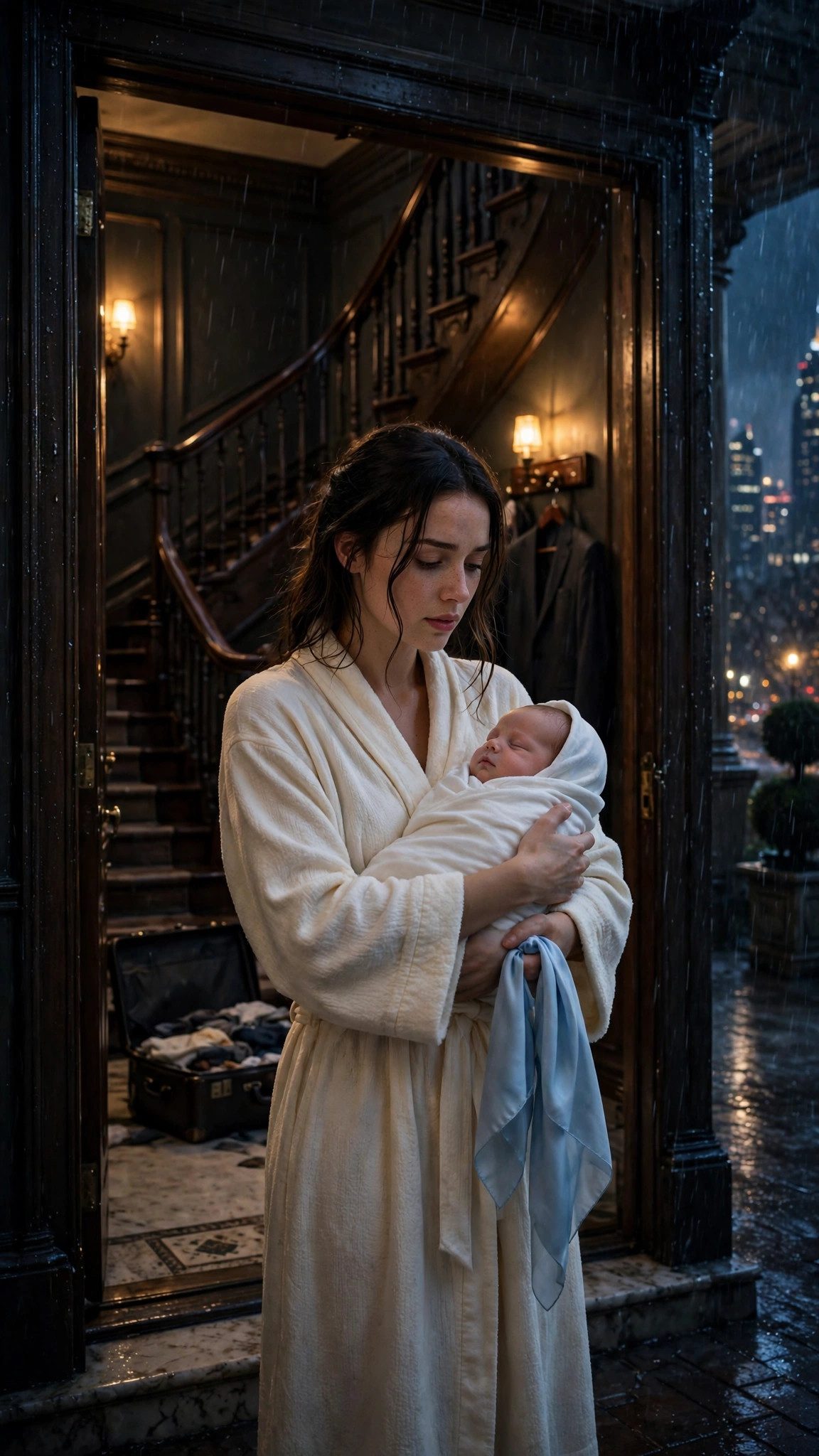
That night, after visiting hours ended, I drove back to Rosa's house in Decatur. Ren was with me, asleep in her car seat, because I could not bear to leave her again, not after I had finally held her in my arms in that hospital room and watched her father look at her for the first time.
Rosa had gone to bed. The house was quiet. I laid Ren in the laundry basket beside the spare bed, the way we had done the night before, and I sat on the edge of the bed in the dark, and I listened to her breathing, and I tried to believe that the worst was over.
It was not over.
At 2:17 in the morning, I heard a sound outside. A car door closing, very softly, on the street. Then footsteps on the gravel path beside the house. Then the sound of someone testing the back door, the handle turning, slowly, carefully.
I did not scream. I had spent three years as an emergency room nurse, and I had learned that panic kills faster than anything else. I picked Ren up out of the basket, wrapped her in her blanket, and I carried her into the closet in Rosa's bedroom, and I laid her down on a pile of folded towels, and I whispered, "Stay quiet, baby. Stay quiet for Mama."
Then I went back into the hallway, and I picked up the heaviest thing I could find, a cast-iron skillet from the kitchen, and I stood behind the bedroom door and waited.
The back door opened. I heard footsteps in the kitchen. Slow. Deliberate. Whoever it was, he was not in a hurry. He knew the house was small. He knew there was nowhere to run.
"Lauren Beckett," a man's voice said, low and calm. "I know you're here. I know the baby is here. I'm not going to hurt you. I just need you to come with me. Mr. Castellano wants to talk to you."
I did not answer. I gripped the skillet tighter.
"Mrs. Beckett," he said, and his voice was closer now, in the hallway. "Your husband is going to testify against my employer. That can't happen. If you come with me, no one gets hurt. Your daughter stays safe. Your aunt stays safe. All I need is for you to disappear for a few days. Just until the trial is over. Just until Castellano's lawyers can make this go away."
He was in the doorway now. I could see his silhouette in the dark. A big man, broad-shouldered, wearing a dark jacket. His hand was inside his jacket, where a gun would be.
"Don't," I said. My voice sounded steady, and I was glad, because my hands were shaking so hard I thought I would drop the skillet. "Don't come any closer. My baby is in this house. I will not let you take her. I will not let you take me. You need to leave."
"I'm sorry, Mrs. Beckett," he said. "I really am. But I have a job to do."
He stepped into the room. I swung the skillet with everything I had. It caught him on the side of the head, and he staggered, and his hand came out of his jacket, and there was a gun in it, and for one terrible second, I thought he was going to shoot me.
Then the front door burst open, and the whole house filled with light and shouting.
"FBI! Drop the weapon! Drop it now!"
There were three of them, in dark vests with yellow letters, moving fast and low, and the man in the doorway froze, and then he dropped the gun, and they were on him, forcing him to the floor, cuffing his hands behind his back, reading him his rights while he stared up at the ceiling with an expression I had never seen on a man's face before.
It was not anger. It was not fear. It was surprise. As if he had truly believed that he could walk into a small brick house in Decatur in the middle of the night and take a woman and her seventeen-day-old baby, and no one would be there to stop him.
Daniel Reyes was the last one through the door. He looked at me, standing in the hallway in my nightgown with a cast-iron skillet in my hands, and he looked at the man on the floor, and he said, "Mrs. Beckett. Are you all right? Is the baby all right?"
"She's in the closet," I said. "She's asleep. She didn't even wake up."
Reyes nodded. He turned to the man on the floor. "Marcus Cole," he said. "You're under arrest for attempted murder, conspiracy, and intimidation of a witness. You have the right to remain silent."
Marcus Cole. The name meant nothing to me. But it meant something to Reyes, and it would mean something to a jury, because Marcus Cole was the second man in the parking garage, the one who had gotten away, the one who had shot my husband and then come to my aunt's house to finish the job.
"How did you know?" I asked Reyes, after they had taken Cole away, after the house was quiet again, after Rosa had come out of her bedroom in her nightgown, holding Ren, rocking her gently, the way she had rocked me when I was sixteen and angry at the whole world.
"I told you I'd have someone watching the house," Reyes said. "Quietly. My agents were parked down the street. They saw his car. They followed him in. They were three minutes behind him, and I am sorry it took three minutes, because three minutes is a long time when a man with a gun is walking toward your bedroom."
"Three minutes," I said. "I counted every second."
"You're braver than you think, Mrs. Beckett," Reyes said. "Most people freeze. You picked up a skillet."
"I wasn't brave," I said. "I was a mother. There's a difference."
He smiled, just a little. "In my experience, there's no difference at all."
After he left, after the house was quiet again, Rosa and I sat at the kitchen table, and Ren slept in her basket between us, and Rosa poured us both tea, and we did not speak for a long time.
Finally, Rosa said, "Lauren. Do you know what today is?"
"What?"
"It's the eighteenth day," she said. "Ren is eighteen days old today."
Eighteen days. Seventeen days after giving birth, I had discovered my husband had booked a one-way flight to Lisbon with his mistress. Eighteen days after giving birth, I had fought a man with a gun in my aunt's hallway with a cast-iron skillet, and I had won.
"I sent the email," a voice said from the doorway.
Jade Foresight was standing in Rosa's kitchen, in the same gray coat, looking smaller than ever. Reyes must have brought her. Or she had come on her own. I didn't know. I didn't care.
"The email to Hannah," Jade said. "The one that said the Lisbon flight is a trap. I sent it. The morning of the flight. I didn't know if she'd read it. I didn't know if she'd believe it. But I had to try. I had already sent you the photograph. I had already done so much damage. I thought, if I could warn one person, maybe I could live with myself."
"Why?" I asked. "Why did you send it?"
"Because I watched your husband hold his daughter's photograph in his wallet," Jade said. "He carried it everywhere. A picture of Ren, taken in the hospital, seventeen days ago. He showed it to me once, in Greece. He said, 'This is my daughter. She's seventeen days old. I've never been so afraid of anything in my life.' And I realized that the man I was supposed to destroy was not a monster. He was a frightened father who had made a terrible mistake. And I realized that Castellano was going to kill him, and then he was going to kill me, and then he was going to come for you and Ren, because that is what men like Castellano do. They don't stop. They take everything, until there's nothing left."
She sat down at the table. Rosa poured her a cup of tea without being asked.
"I'm going to testify," Jade said. "Against Castellano. Against all of them. Reyes says I'll be safe, if I testify. I don't know if I believe him. But I know I can't live with myself if I don't try. And Lauren, I know you have no reason to trust me. I know I destroyed your marriage. But I'm asking you to trust me about one thing. Your husband loves you. He loves Ren. He made a terrible mistake, but he is not the man Castellano wanted you to believe he was. And if you give him a chance to prove that, I think he will spend the rest of his life trying."
I looked at her. I looked at Ren, asleep in her basket. I looked at Rosa, who was watching me with those steady teacher's eyes.
"Thank you," I said to Jade. "For the email. For calling me. For telling me the truth."
She nodded. She stood up to leave. At the door, she turned back.
"Lauren," she said. "The scarf. The blue one. He bought it for you. Not for me. He bought it in Greece, and he told the shopkeeper it was for his wife, and he described you, and he got the color wrong, because he was thinking of the sea, and the sky, and he wanted something beautiful, and he didn't know how to choose. He bought it for you. He just didn't know how to give it to you anymore."
After she left, I sat at the table for a long time, holding Ren, thinking about a blue silk scarf with a silver thread in the hem, bought by a frightened man in a shop in Greece, for a wife he did not know how to talk to anymore.
And I thought about the envelope on his desk, with Jade Foresight's name on it, and the four lines I had written inside it.
She can have the house. She can have the name. She can have the scarf. Ren is mine.
I had been wrong about one thing. The scarf was never hers. It had always been mine. And the house, and the name, and all of it, had never been the point. The point was the man who had carried his daughter's photograph in his wallet, and the baby asleep in her basket, and the choice I had to make now, not about the past, but about the future.
The next morning, the FBI came back to Rosa's house. Not with guns, this time, but with gloves, and cameras, and evidence bags. They dusted the back door for fingerprints. They photographed the broken lock. They took the gun Marcus Cole had dropped, and the skillet I had swung, and they bagged them both, carefully, the way you bag things that are going to be shown to a jury.
Rosa watched them work, standing in her kitchen in her robe, her arms crossed, her face set in the expression she used to wear when a student had done something unforgivable and she was deciding what to do about it.
"My house," she said, to no one in particular. "A man with a gun walked into my house. In my neighborhood. Where children ride their bicycles in the street. Where I have lived for thirty years. A man with a gun."
"I know, Aunt Rosa," I said. "I'm sorry. I'm so sorry I brought this to your door."
"You didn't bring it," she said, firmly. "Castellano brought it. And his man brought it. And they will pay for it. That's what the law is for, Lauren. That's what it's for."
Hannah arrived at noon. She came to Rosa's house, not to the hospital, because she had heard what happened, and she wanted to see me, and she wanted to see Ren. She stood in the doorway, in her dark suit, holding a paper bag from a bakery, and she looked around the small brick house, and she said, "This is a nice house. It's a safe house. It's a good place."
We sat at the kitchen table, the three of us, Rosa and Hannah and me, with Ren asleep in her basket between us, and Hannah told us what she had found. The bug in the office was gone. She had removed it herself, the morning after Colton was shot, before anyone else could find it. She had also found something else: a second device, in Colton's car, and a third, in the phone line at the shipping office. Castellano had been listening to everything, for months.
"I should have told someone sooner," Hannah said. "I should have told Colton. I should have told the police. I was afraid. I thought if I said something, they would come for me. And then I realized that they were going to come for all of us anyway, and that being afraid didn't keep anyone safe. It just kept us quiet."
"You told me," I said. "In your own way. Every evening, you called me. You told me he'd come around. You kept calling. You didn't stop. That mattered, Hannah. It mattered more than you know."
She looked down at her hands. "I never liked you," she said, honestly. "When Colton married you, I thought you were too soft for this life. Too kind. I thought this world would break you. I was wrong. You're not soft. You're the strongest person I know. Stronger than Colton. Stronger than me. You drove away from that house with a seventeen-day-old baby, and you came back, and you stood in a hallway with a skillet, and you faced down a man with a gun. That's not soft, Lauren. That's steel."
Rosa reached across the table and took Hannah's hand. "You're family now," she said. "Whether you like it or not. Family is the people who show up. And you showed up."
After Hannah left, after the FBI left, after the house was quiet again, I sat with Ren, and I thought about what Hannah had said. Steel. I had never thought of myself as steel. I had thought of myself as a nurse, and a wife, and a mother, and a woman who was doing her best. But maybe that was what steel looked like. Not a weapon. Not a wall. Just a woman, doing her best, refusing to break, refusing to run, refusing to let anyone take her daughter from her.
That night, I slept in Rosa's spare room, with Ren in her basket beside me, and I did not dream about men with guns. I dreamed about a garden, and a house with a porch, and a nursery painted pale green, and I woke up in the morning, and I knew, for the first time, that the dream was not impossible. It was a plan. And I was going to make it happen.