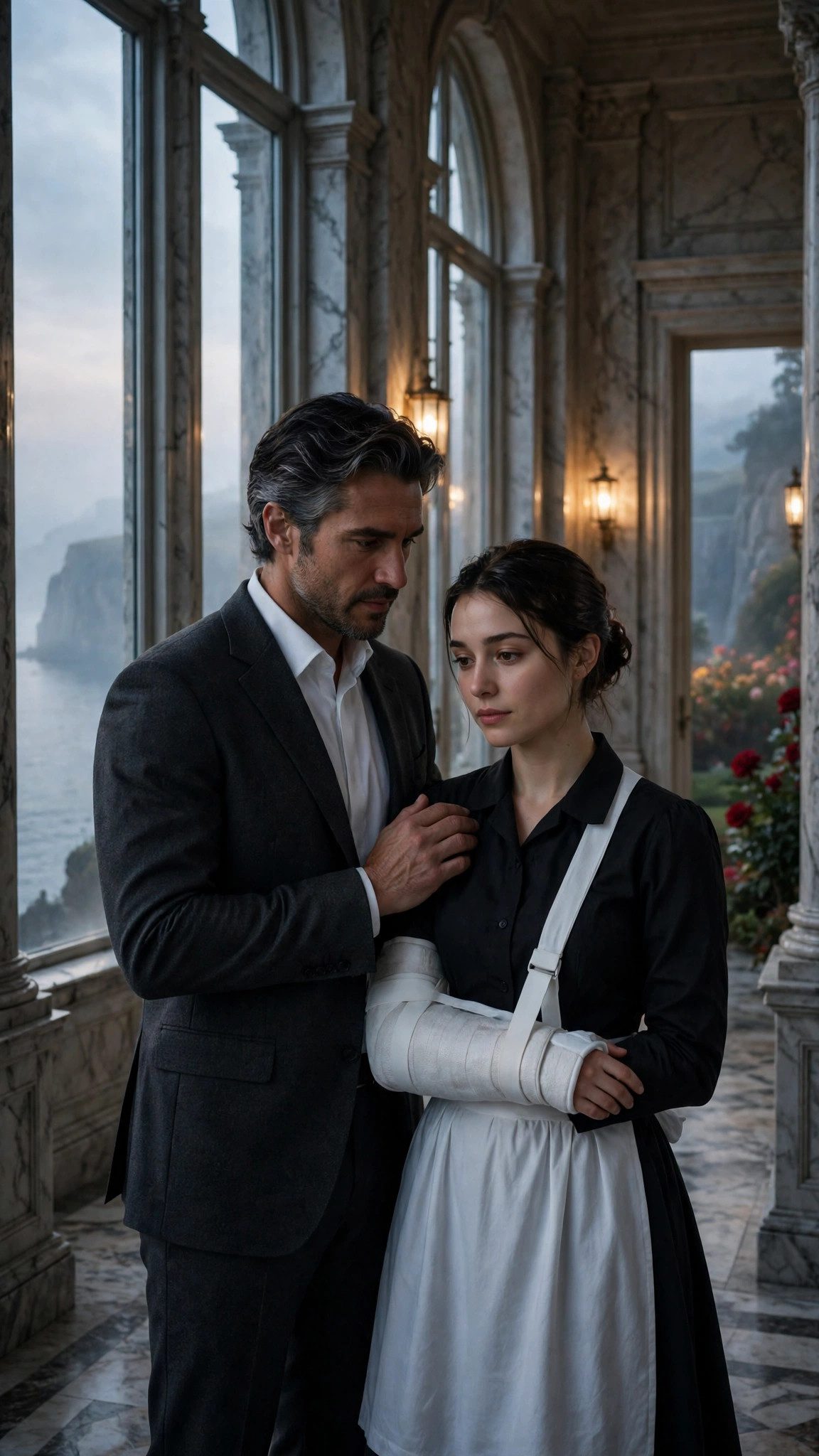
The trouble with learning that a house has been lying to you is that you cannot unlearn it. Once Damon Blackwell knew what his uncle had been doing in his name, in his house, on his waterfront, he could not pretend he did not know, and once he had decided to act, he acted the way his father had taught him to act: quietly, completely, and without warning.
But Victor Blackwell had not survived for sixty-two years by being slow, and he had not built an arms empire by trusting his nephew.
On the third night after the doctor set my arm, I woke to the sound of glass breaking somewhere downstairs.
I sat up in bed, my heart pounding, my splinted arm throbbing, and I listened. The house was dark. The corridor outside my room was silent. And then I heard it again — a window breaking, and then footsteps, heavy and fast, on the stairs.
I got out of bed and went to the door, and I put my ear against it, and I heard voices in the hallway below. One of them was Daniel's voice, low and urgent, and he was saying, "Ten more minutes. That is all I am giving you. Finish it."
My blood went cold. I knew that voice. I knew what those hands could do. I backed away from the door, and I looked around my small room for somewhere to hide, but there was nowhere to hide in a room that had a bed and a chair and a wardrobe, and I was a woman with one good arm, and I was terrified.
Then I heard Damon's voice, and it was calm, and it was close, and it was coming from right outside my door.
"Kate," he said, very quietly. "Do not open the door. Do not make a sound. Stay where you are. I am here."
I pressed my back against the wall beside the door, and I held my breath, and I listened.
Downstairs, the footsteps stopped. There was a long silence. And then I heard Victor's voice, old and smooth and cold, like a knife sliding out of a sheath.
"Damon," he said. "My boy. You have made a mistake. You called the FBI. You gave them my men. Fifteen good men, gone in one night. Do you think that was wise?"
"I think it was necessary," Damon said. His voice was steady, but I could hear the tension in it, the way a wire sounds just before it snaps.
"Necessary," Victor repeated, and he laughed, a short, dry laugh. "You have always been soft, Damon. Your father was soft, too, and it killed him. This family does not survive on softness. It survives on strength, and on men who are willing to do what must be done."
"Breaking a maid's arm is not strength," Damon said. "It is cowardice. And using my house to sell weapons to Russians is not business. It is treason against this family."
"Your house?" Victor said. "This was my brother's house before it was yours. I built the routes you sail on. I built the warehouses you fill. You are a child playing at being a king, and I am tired of watching you play."
There was a sound then, a sound I will never forget: the sound of a gun being cocked, slow and deliberate, in the dark hallway below.
"Daniel," Victor said. "Go upstairs. Bring the girl down. She saw the folder. She talked to the FBI. She is the reason all of this is happening, and she will not live to see the morning."
"No," Damon said, and his voice changed, and it was no longer calm, and it was no longer the voice of a man negotiating. It was the voice of a man who had decided that he would die before he let something happen. "You will not touch her. Not tonight. Not ever."
"Then you will die with her," Victor said.
Damon did not move. He stood in the hallway, between Victor and the stairs, and he thought about Marla, and about the night she had died, and about the car bomb that had been meant for him, and he thought about the fact that Victor had been in this house that night, too, drinking brandy in the library, and that no one had ever asked Victor where he had been when the bomb went off.
He had always wondered. He had never asked. He was asking now, with his whole body, with the way he stood, with the way he did not step aside.
"Five years ago," Damon said, very quietly, "my wife died in a car that was supposed to kill me. I have spent five years wondering who built that bomb, Victor. I have spent five years wondering who told them where she would be that night. And tonight, standing here, listening to you order a girl killed in my house, I think I finally know."
Victor's face did not change, but something in his eyes flickered, just for a second, like a light going out in a window.
"You have no proof," Victor said.
"I do not need proof," Damon said. "I need the FBI. And they are already here."
Upstairs, in my room, I heard the shouting, and I heard the footsteps, and I did not know that Agent Vasquez and her team had been in the house since midnight, hidden in the staff wing, listening through the walls, recording every word. I did not know that Tony had stationed his men at every door, and that the boathouse was already surrounded, and that the fifteen men were already in handcuffs, sitting in FBI vans on the service road, wondering what had happened to their quiet, easy operation.
All I knew was that Daniel was coming up the stairs to kill me, and that Damon was standing between us, and that I was holding a water jug in my good hand, and that I was not going to die quietly, not in this house, not tonight.
I heard footsteps on the stairs, coming up, fast and heavy, and I knew it was Daniel, and I knew he was coming for me, and I backed into the far corner of my room, and I grabbed the only thing I could reach — a heavy glass water jug from my bedside table — and I held it in my good hand, and I waited.
The footsteps stopped outside my door. The handle turned. The door opened, and Daniel stood there, and behind him, in the hallway, I could see the shapes of two more men, and the glint of a gun in one of their hands.
"Hello, Kate," Daniel said, and he smiled, and his smile was the smile of a man who had broken my arm and enjoyed it. "It is time to finish this."
I threw the water jug at him. It missed, and it shattered against the wall, and Daniel laughed, and he came toward me, and I screamed, and then the hallway exploded with light and noise.
Tony, Damon's head of security, came up the stairs with four of his men, and behind them came the FBI, in dark vests, with their weapons drawn, and a woman's voice — clear and commanding — shouted, "Federal agents! Nobody move!"
It was Agent Elena Vasquez, and she had been waiting in the house all night, and she had heard everything, and she had her handcuffs out before Daniel had time to take another step.
"Daniel Blackwell," she said, "you are under arrest for assault, intimidation of a witness, and conspiracy to traffic illegal arms."
Daniel stared at her, and then he stared at Damon, who was standing at the bottom of the stairs, and his face went through a dozen emotions in a single second — anger, disbelief, fear, and finally, something that looked almost like relief, as if a weight he had been carrying for years had finally been lifted off him.
"You set a trap," Daniel said to Damon. His voice was flat. "You let me come here. You let Victor come here. You knew we would come for her."
"I knew you would come for her," Damon said, and he came up the stairs, slowly, and he stood between Daniel and me, and he put his body between us, the way a wall stands between a house and a storm. "And I wanted the FBI to hear you say it. I wanted them to hear Victor order it. I wanted there to be no doubt, no deniability, no way for anyone to say that this was a misunderstanding. You broke her arm, Daniel. You threatened her family. You were going to kill her tonight. And now the whole world knows it."
Victor was shouting from downstairs, and the FBI agents were putting handcuffs on him, and he was saying, "This is my house! I built this family! You cannot do this to me!"
"You are right," Damon said, looking down at him. "It was your brother's house. And then it was mine. And you turned it into a warehouse for weapons, and you used my name to do it, and you broke a woman's arm in my library to keep her quiet. You are not family anymore, Victor. You are a criminal. And this house is done with you."
The FBI took Victor away, and they took Daniel away, and they took the two men with the guns away, and the house went quiet again, and I stood in my room, shaking, with my splinted arm held against my chest, and Damon came to me, and he took my good hand, and he said, "It is over, Kate. It is really over. You are safe now."
I looked at him, and I saw the blood on his shirt cuff, where the shattered glass from the water jug had cut him, and I saw the exhaustion in his eyes, and I saw the way his hands were shaking, just a little, now that the danger was over, and I understood that he had been as frightened as I was, and that he had stood between me and Daniel anyway, and that courage, as he had once told me, was not the absence of fear, but doing the thing anyway.
"Are you hurt?" I asked, touching his cuff.
"It is nothing," he said. "A scratch. You threw a water jug at my brother, Kate. That was either the bravest thing I have ever seen, or the most foolish."
"Perhaps it was both," I said, and for the first time that night, I almost smiled.
Agent Vasquez came into the room then, and she looked at my arm, and at the broken glass on the floor, and at Damon, and she said, "Miss Bennett, I need you to come with me to the station, when you are ready, to give a statement. Everything you saw, everything you heard, everything Daniel said to you. It matters, Kate. Your words are going to put these men in prison."
"Then I will give them," I said. "All of them. Every word."
She nodded, and she went away, and Damon and I were alone in the room, and the house was quiet, and the night was over, and the morning was coming, and for the first time since I had come to the Blackwell estate, I was not afraid of the dark.
"Is it?" I whispered. "Is it really over?"
"It is over," he said. "Victor will spend the rest of his life in prison. Daniel will testify, and he will serve eight years, and when he comes out, he will have a chance to be a different man. The fifteen men are in custody. The Russians are in custody. The boathouse is empty. The house is clean."
I looked at him, and I saw the exhaustion in his face, and the grief, and something else, something I had not seen before, something that looked like hope.
"Thank you," I said. "For standing between us."
"I will always stand between you and anyone who tries to hurt you," he said. "That is a promise, Kate Bennett. And I keep my promises."
That night, for the first time since I had come to the Blackwell estate, I slept without dreaming of broken bones, and when I woke up in the morning, the sun was shining on the bay, and the house was quiet, and the air smelled of roses from the garden, and I knew that something had changed, not just in the house, but in me.
In the morning, Tony came to my room with a report, the way a soldier reports to a commander, and he stood in the doorway, and he said, "Miss Kate, I thought you should know. The fifteen men are all in custody. The boathouse is empty. The trucks are impounded. Mr. Victor's accounts are frozen. Agent Vasquez says the case is solid, and that it will hold."
"Thank you, Tony," I said, and I meant it, because Tony had stood outside my door all night, and he had not left it, not for any reason, and I had heard his footsteps in the hallway, and knowing he was there had been the only thing that let me sleep.
Later, I went down to the garden, and Damon was there, walking among the roses, and he saw me, and he came to me, and he took my good hand, and we walked together, slowly, among the rose beds, and he told me about the night, about the trap, about the months of planning, about the way Agent Vasquez had hidden her team in the staff wing, and about the way his father would have approved, and about the way Marla would have approved, too.
"She always said this house would learn the names of the people who belonged in it," he said, stopping beside a rose bush heavy with red blooms. "I never understood what she meant. I thought she was talking about the family. But she was talking about you, Kate. She was talking about the people like you, the people who keep the house running, the people nobody sees. She knew. She always knew."
I looked at the roses, and I thought about Marla, a woman I had never met, whose photograph I had found in the library, and I felt, for the first time, as if she were not a ghost in this house, but a friend, and as if she were glad that I was here.
I was no longer the girl nobody knew. The house had learned my name. And the man who owned the house had learned it first.