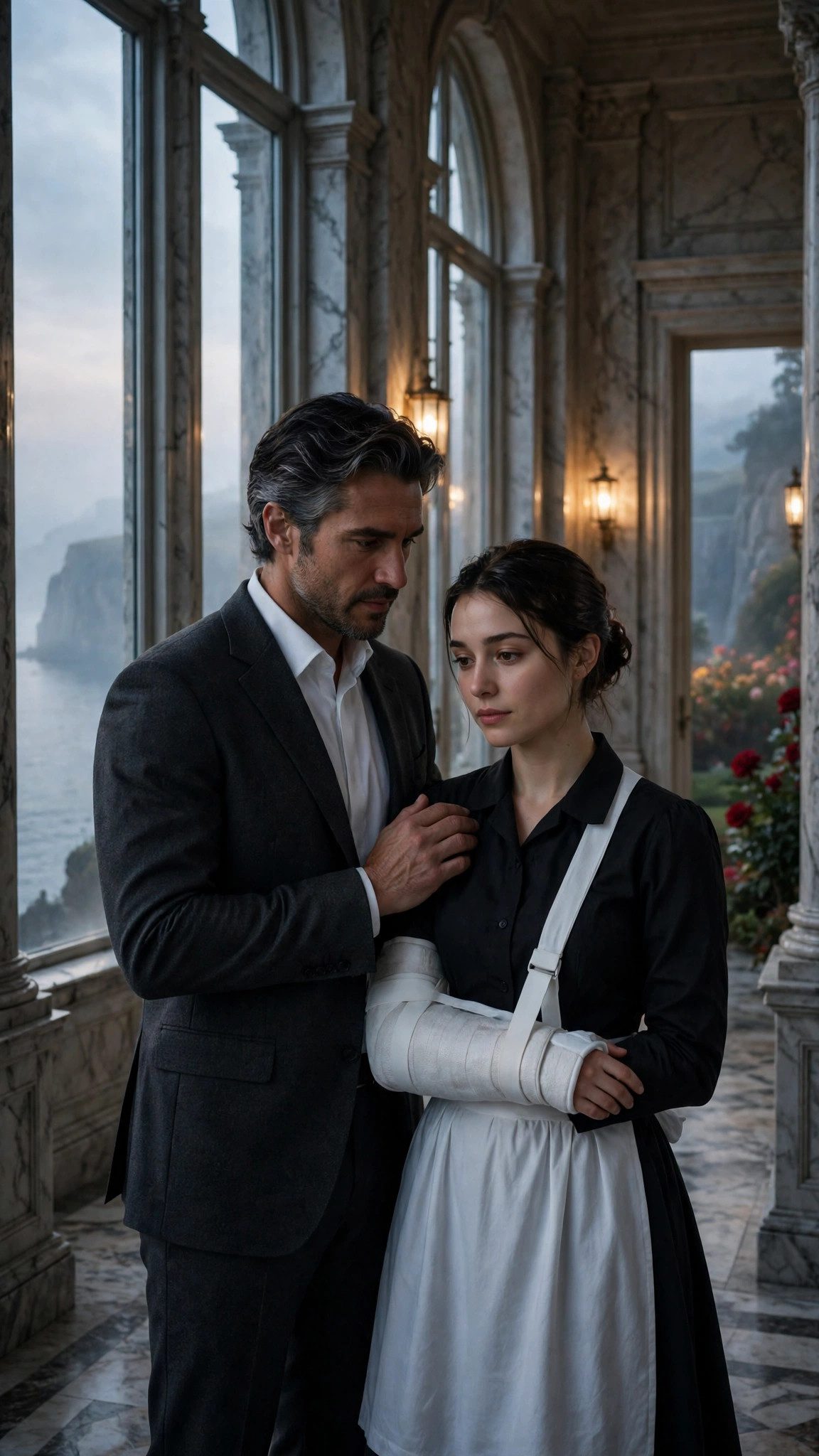
The morning after Damon Blackwell noticed my broken arm, the house changed.
I did not see it happen all at once. It happened the way weather changes, slowly at first, and then all at once, until you look up and realize that the sky is a different color than it was an hour ago.
The doctor came at nine o'clock. He was a quiet man with kind eyes, and he looked at my arm, and he shook his head, and he said, "This has been broken for three days. Why did you not come sooner?"
"I could not afford to stop working," I said, and it was the truth, even though it was not the whole truth.
He set the bone, and he put my arm in a splint, and he gave me medicine for the pain, and he told me not to lift anything, not to work, not to use the arm at all for six weeks. Mrs. Calloway stood in the doorway while he worked, and she wrung her hands, and she said, "Six weeks. What will we do for six weeks?"
"You will manage," Damon said from the doorway, and we all turned to look at him, because he had come down to the kitchen, which he never did. "Miss Bennett will rest. She will still be paid. And no one in this house will ask her to lift anything until the doctor says she can."
Mrs. Calloway stared at him. I stared at him. The cook, who was peeling potatoes at the counter, stared at him.
"Yes, sir," Mrs. Calloway said at last.
After the doctor left, Damon came and sat at the kitchen table across from me, and he looked at my splinted arm, and then he looked at my face, and he said, "Tell me about your mother."
It was such a strange question that I did not know how to answer it. No one had ever asked me about my mother. No one in this house had ever asked me about anything.
"My mother cleaned houses," I said slowly. "For twenty years. She died when I was nineteen."
"What was her name?" he asked.
"Grace," I said. "Grace Bennett."
"Did she ever work in this house?" he asked.
"No," I said. "She worked in houses like this one. But never this one."
He nodded, and he was quiet for a moment, and then he said, "My wife's name was Marla. She died five years ago. A car bomb, meant for me. She planted the roses in the garden. She used to say that a house was a living thing, and that it learned the names of the people who belonged in it."
I did not know what to say. I had found Marla's photograph in the library, and I had wondered about her, and now here was her husband, sitting across from me in the kitchen, telling me about her, and I felt as if I were standing on the edge of something very deep.
"I'm sorry," I said at last. "About your wife."
"Thank you," he said. "I have not spoken her name in this house for five years. The staff stopped saying it. The house forgot it. That is what houses do when the people in them stop saying a name out loud."
He stood up, and he went to the window, and he looked out at the garden, at the roses, and he said, "I want you to tell me who hurt you, Kate."
I froze. "I fell," I said. "I told you. I fell on the stairs."
"Kate," he said, and he turned around, and his eyes were not angry, but they were not gentle either. They were the eyes of a man who had spent his whole life reading people, and who could tell when a person was lying. "A fall does not break a wrist like that. A hand does. A hand that knew what it was doing. I have already asked Tony to find out. He will find out, whether you tell me or not. But I would rather hear it from you."
I looked down at my splinted arm. I thought about Daniel's voice in the library, telling me that if I spoke, I would disappear, and so would my family. I thought about my uncle Ray, and the wooden box with twenty-one dollars in it, and the two-bedroom apartment, and I thought about how little I had, and how easily it could all be taken away.
But I also thought about the way Damon was looking at me, and about the fact that he had sent for a doctor, and that he had told Mrs. Calloway I would still be paid, and that he had sat down in the kitchen and asked me about my mother, and I realized something that surprised me: I was not afraid of him.
I had been afraid of Daniel. I had been afraid of the men who came through the service entrance at night. But I was not afraid of Damon Blackwell, and I did not know why, except that there was something in his face, a kind of weariness, a kind of grief, that I recognized, because I carried the same thing in my own face.
"It was Daniel," I whispered. "Your brother. In the library. I found a folder on the desk, and he caught me, and he told me I would disappear if I spoke, and then he broke my arm."
Damon did not speak for a long time. He stood at the window, looking out at the roses, and his hands were clenched at his sides, and I could see the muscles in his jaw working.
"Thank you," he said at last. "You will be safe now. I promise you that."
After I went back to my room, Damon did not go back to his study. He went to find Tony, and he found him in the security office by the service entrance, watching the camera screens, and he closed the door, and he said, "Show me everything."
Tony showed him the recordings from the library corridor, from three days earlier, and Damon watched his brother walk into the library, and he watched Kate come out twenty minutes later, holding her arm, her face white, and he watched Daniel walk out after her, calm and unhurried, straightening his jacket, as if he had just come from a business meeting.
Then Tony showed him the boathouse recordings, and Damon saw the men coming and going at night, carrying heavy boxes, and he saw the trucks, and he saw his uncle Victor standing on the dock, shaking hands with a man he did not recognize, a man with a thick accent and a heavy coat, and he understood, finally, what his house had become while he was not looking.
"How long?" Damon asked.
"Two years, sir," Tony said. "Maybe longer. Your uncle started small, a few crates at a time, and then it grew, and by the time anyone noticed, it was too big to stop without a war."
"Then we will have a war," Damon said. "But it will be a quiet war. No blood. No noise. I want the FBI. I want Agent Vasquez. I want her to have everything — the names, the routes, the recordings, the boathouse. And I want it done by morning, before Victor knows what is happening."
"Sir," Tony said, "if your uncle finds out before the FBI moves, he will come for the girl. She is the only witness."
"Then we will not let him find out," Damon said. "And tonight, you will stand outside her door, and you will not leave it, not for any reason, until I tell you to. Do you understand?"
"Yes, sir," Tony said.
Damon went back upstairs, and he stood at the window of his study, and he looked out at the bay, and he thought about Marla, and about the roses, and about the girl in the kitchen with a broken arm, and he thought about his father, and about the promise he had made to him ten years earlier, and he knew, with a certainty he had not felt in years, that he was finally keeping it.
That night, I could not sleep, and I went down to the kitchen for a glass of water, and I found Damon in the hallway, standing outside the library, and he was talking on the telephone in a low voice, and I heard him say, "Fifteen men. I want the names. All of them."
He saw me, and he put the telephone down, and he said, "You should be asleep."
"I cannot sleep," I said. "It hurts."
He looked at me, and then he did something I did not expect. He took my good hand, very gently, and he said, "Kate, I need you to stay in your room tonight. Do not come out, no matter what you hear. Do you understand?"
"Yes," I said.
"Good," he said, and he let go of my hand, and he went back to the telephone.
I went back to my room, and I lay awake, listening to the house, and I heard footsteps in the corridors, and doors opening and closing, and cars coming and going in the courtyard, and I thought about the fifteen men, and I wondered who they were, and what was going to happen to them.
Near dawn, I heard a voice in the hallway outside my room. It was Daniel's voice, low and angry, and he was saying, "I'll let you wait for ten more minutes. Finish it."
I froze. I did not know who he was talking to, or what he meant, but I knew his voice, and I knew what his hands could do, and I pulled my blanket up to my chin, and I lay very still, and I listened.
Then I heard Damon's voice, calm and cold, saying, "It is finished, Daniel. It is all finished."
And then there was silence, and the house was quiet, and I fell asleep, and when I woke up in the morning, the sun was shining on the bay, and the gardeners were raking leaves, and the house was waking up the way it always did, except that something was different, and I could not say what it was, only that the air felt lighter, as if a weight had been lifted off the roof.
Later that morning, Mrs. Calloway came to my room with a cup of tea, and she sat on the edge of my bed, and she looked at me, and she said, "Kate, do you know what happened last night?"
"No," I said.
"Fifteen men are gone," she said. "Fifteen men who worked for Mr. Victor, not for Mr. Damon. They came in the night, and they were taken away, and they will not be coming back. And Mr. Daniel is gone too. Mr. Damon sent him away. And Mr. Victor —" She stopped, and she shook her head. "Mr. Victor is gone as well. The FBI came for him at dawn."
I stared at her. "The FBI?"
"Mr. Damon called them himself," she said. "He gave them everything. The names, the routes, the boathouse. All of it." She set the tea down, and she took my good hand, and she said, "Kate, I have worked in this house for thirty years, and I have never seen Mr. Damon do anything like this. Not for anyone. Do you understand what I am telling you?"
I shook my head, because I did not understand, not really.
"This house," she said, "has learned your name."
That evening, Damon came to my room, and he stood in the doorway, and he said, "Kate, I owe you an apology. My brother hurt you in my house, and my uncle used my house to do things I did not know about, and I should have known. I chose not to see, and that is my fault. I am sorry."
"You did not break my arm," I said.
"No," he said. "But it happened in my house, and that makes it mine." He was quiet for a moment, and then he said, "I would like to know you, Kate Bennett. Not as a maid. As a person. Will you have dinner with me tonight? In the dining room. Not in the kitchen."
I looked at him, and I thought about my mother, who had spent twenty years being invisible in other people's houses, and about Tommy, and about the wooden box with twenty-one dollars in it, and I thought about the house, and the roses, and Marla, and I said, "Yes. I would like that."
That night, I sat at the dining room table with Damon Blackwell, and the cook served us dinner, and Mrs. Calloway poured the wine, and for the first time since I had come to the estate, someone in the house said my name out loud at a table where I was sitting, and the house, I swear, leaned in a little closer to listen.
Dinner was simple — roast chicken, and potatoes, and bread, and a salad from the garden — but it was the finest meal I had eaten in years, not because of the food, but because of the way Damon talked to me. He asked me about the books I had been borrowing from the library, and I told him I had been reading a novel about a woman who ran away to sea, and he laughed, and he said, "Marla loved that book. She read it three times." And then he told me about the first time he had taken Marla sailing, and how she had been afraid of the water, and how he had taught her to steer, and how she had laughed when the wind caught the sail.
"She was braver than I was," he said, looking down at his plate. "She was afraid, and she did it anyway. You remind me of her, Kate. Not in the way you look. In the way you do not run away."
I did not know what to say to that, so I said nothing, and we ate in silence for a while, and the silence was comfortable, the way silence is comfortable between two people who have both lost someone, and who understand each other without needing to explain.
After dinner, he walked me to the foot of the stairs, and he said, "Goodnight, Kate Bennett," and he said my name slowly, as if he were tasting it, as if he wanted to remember it, and I went up to my room, and I lay awake for a long time, thinking about the sound of my own name in his voice, and about the house, and about the roses, and about the fact that for the first time in my life, someone had said my name at a dining room table, and meant it.