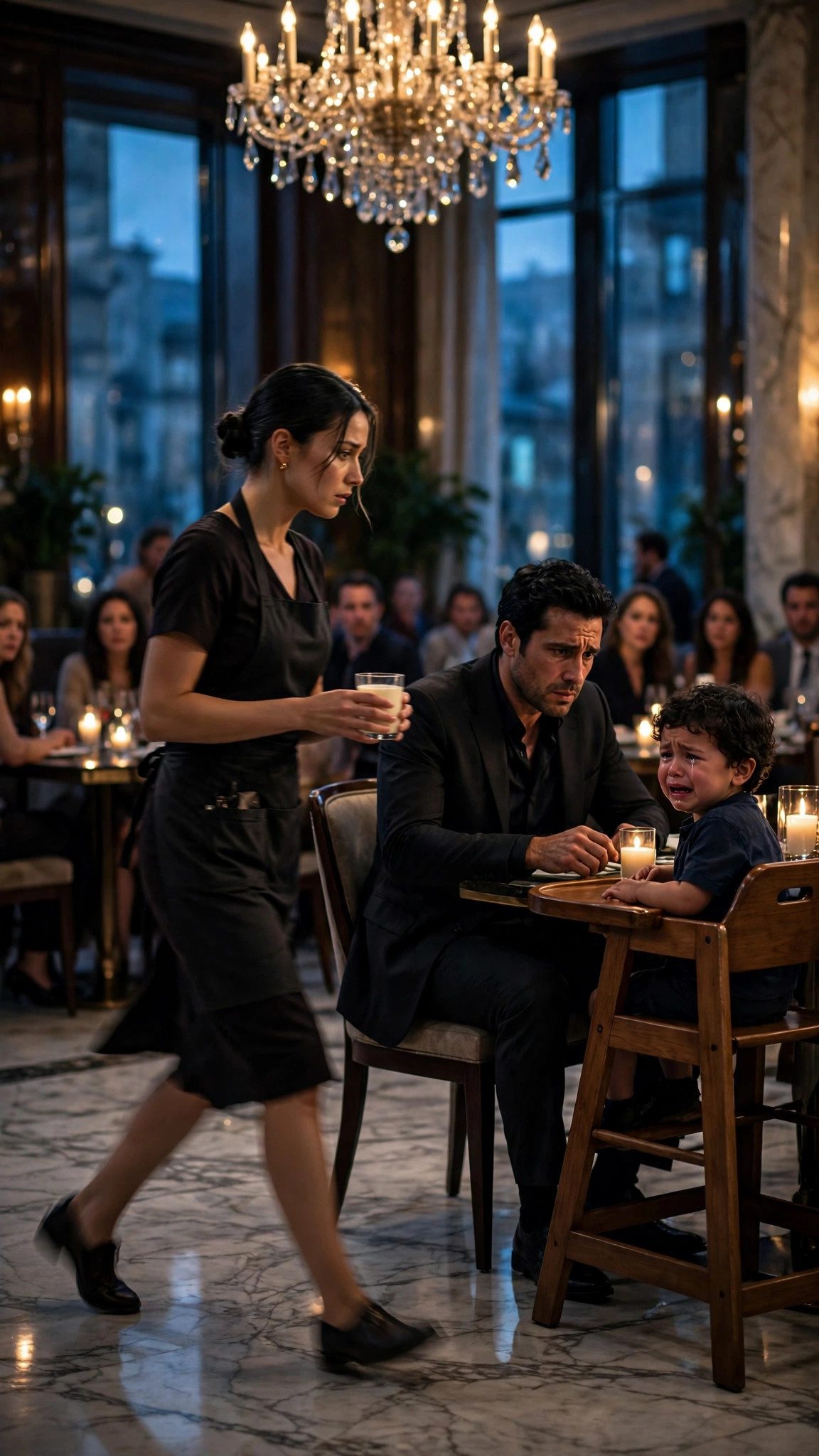
Three weeks before the night of the milk, I had stood outside Il Destino in a borrowed blazer and shoes that pinched, trying to convince myself that I belonged in a place like that.
I did not. I knew it the moment I walked in. The hostess looked at my resume like it was a parking ticket. The dining room smelled like truffle oil and money. The waiters moved like dancers, and the wine list was thicker than any book I had ever finished.
But Marco hired me anyway, because the restaurant was short-staffed on Friday nights and because, as he put it while barely looking up from his clipboard, "You look like you can carry a tray without dropping it, and you look like you will show up."
He was right about the second part. Showing up was the one thing I had never failed at.
My name is Clara Bennett. I am twenty-six years old. I grew up in a two-bedroom apartment in Astoria, Queens, above a laundromat that hummed all night and smelled like detergent and other people's lives. My mother died when I was twelve. Aneurysm. One minute she was braiding my hair at the kitchen table, the next she was on the floor, and the paramedics were saying words I didn't understand yet.
After that, it was my grandmother Rosa and me. Rosa had come from Naples when she was nineteen with a suitcase and a recipe for lemon cake and no English at all. She raised me the way she had raised my mother: with warm milk and one sugar cube when I couldn't sleep, with her hand on my back when I couldn't breathe, with the firm belief that a girl who could survive anything could do anything.
She was right about most things. She was wrong about the panic.
It started when I was fifteen. The first attack came in the middle of algebra class. My chest went tight. My hands went numb. I was sure I was dying, and the school nurse was sure I was faking it to get out of a test. By seventeen, the attacks came at night, and I would sit on the bathroom floor counting my breaths until the sun came up.
One, two, three, four. In. One, two, three, four, five, six. Out.
At twenty-one, after an attack so bad I called an ambulance for a heart I was certain was failing, a doctor at Elmhurst finally gave it a name: panic disorder. She sent me to a therapist named Dr. Patel, a small woman with a calm voice who taught me that panic was not weakness. "Your body," she said, "is a smoke alarm that goes off when there is no fire. It is trying to protect you. You do not have to be ashamed of it. You only have to learn how to answer it."
I learned. Slowly. Breathing. Grounding. Warm milk with one sugar cube, the way Rosa made it. I learned to recognize the signs in myself: the tight chest, the fast shallow breaths, the hands that curled into fists without permission.
What I did not expect was to recognize them in a three-year-old boy at the most feared table in Brooklyn.
Rosa was seventy-nine now, and she lived in a care home in Flushing because her knees had given out and her memory had started to slip in small, frightening ways. The home cost more every year. My rent in a walk-up in Ridgewood cost more every year. I had worked in diners and coffee shops and a catering company that paid late and fired people by text message. Il Destino paid on time. Il Destino paid enough to cover Rosa's home and my rent and the bus fare between them, if I worked doubles and skipped lunch.
That was why I needed the job. That was why Sarah's warning had stopped me cold for those few seconds by the espresso machine. Losing Il Destino would have meant choosing between Rosa's care and my apartment, and I had already decided a long time ago that I would never make that choice.
So I went home that Friday night after the milk and the thank-you, and I sat on my fire escape with a cup of tea and tried to understand what had just happened to my life.
Rico Moretti had thanked me. The Butcher of Brooklyn had thanked a waitress from Queens.
I had heard the stories, of course. Everyone in Brooklyn had. Ricardo Moretti had taken over his father's organization at twenty-four, after old Salvatore Moretti died of a stroke at his desk. They said Rico had consolidated the family's businesses — restaurants, construction, freight, a dozen legitimate companies that everyone suspected were not entirely legitimate — in less than two years, without starting a single war. They said he was cold. They said he was precise. They said he had once walked into a room full of armed men who owed his family money and walked out with every dollar and not a scratch on him.
They called him the Butcher because, the story went, when he was nineteen, a rival crew had tried to take one of his father's warehouses, and Rico had gone in alone and come out with blood on his shirt and the warehouse still his. Nobody ever said exactly what he had done in there. Nobody needed to. The name did the work.
But the man I had seen that night did not look like a butcher. He looked like a father who had run out of answers.
And his wife. Elena. I had heard that story too, from the kitchen staff, whispered between orders.
Elena Moretti had been twenty-nine, beautiful, a former ballet dancer who had given it up to marry Rico. They said she was the only person who could make him laugh. They said she had softened him, that the Butcher of Brooklyn kept a photograph of her in his wallet and that his men had learned to read his mood by whether he had looked at it that morning.
Six months ago, on a Tuesday night in March, Elena had been driving home from a charity gala in Manhattan. Her car stopped at a red light on Atlantic Avenue. A black sedan pulled alongside. The windows came down. The bullets were meant for Rico — everyone knew that, because Rico was supposed to be in that car, driving her home, and at the last minute he had stayed behind to finish a phone call.
Elena died at the scene. She was twenty-nine years old.
Leo was two and a half. He had been asleep in his bed at home. He woke up the next morning to a house full of crying adults and a mother who never came back.
According to the kitchen staff, Leo had barely spoken since then. Before, he had been a chattering, laughing little boy who knew fifty words and used all of them. After, he went silent. He screamed instead. He threw things. He bit. The nannies quit, one after another — four of them in six months. The doctors said it was grief. The doctors said it was a phase. The doctors said he was spoiled and that his father needed to be firmer.
Nobody said he was terrified. Nobody said his chest was too tight to breathe.
Except me. A waitress from Queens who knew what terror looked like when it wore a child's face.
The next morning, Saturday, I woke up at seven and stared at my ceiling for a long time. Rico had said nine o'clock. His house. Dante would give me the address. I had no address. I had no phone call. I had only the memory of a man in a dark suit saying, "We need to talk about my son."
At eight-thirty, my phone buzzed. A text from an unknown number: "Dante. 9 AM. 14 Willow Lane, Brooklyn Heights. Black SUV outside your building at 8:45. Don't be late."
I put on my best clothes, which were not very good clothes: a navy dress I had bought on sale three years ago, a cardigan with one button missing, flat shoes that didn't squeak. I brushed my hair until it shone. I stood in front of my mirror and practiced saying, "Mr. Moretti, I appreciate the opportunity, but I am a waitress, not a nanny," in case he offered me something I couldn't take.
Then I went downstairs, and the black SUV was already there, and Dante was standing beside it with his hand wrapped in a fresh bandage, and he looked at me with an expression I couldn't read at all.
"Miss Bennett," he said.
"Mr. Dante," I said. "How is your hand?"
He looked down at the bandage, surprised, as if he had forgotten it was there. "It will heal," he said. "The little boss has strong teeth."
"He was scared," I said.
Dante nodded slowly. "Yes," he said. "I think maybe you are the first person to understand that."
He opened the car door for me. I got in. The leather seats smelled like polish and money. Dante drove in silence through streets I had only ever seen from a bus window, past brownstones with window boxes and wrought-iron fences, until we turned onto Willow Lane and stopped in front of a house that looked like it belonged in a magazine: red brick, white trim, a garden behind a low iron gate, a porch with a swing.
"This is his house?" I asked.
"This is his home," Dante corrected. "The house is where he works. This is where he lives with the boy."
I followed Dante up the front steps. My heart was beating too fast, and I counted my breaths the way Dr. Patel had taught me. One, two, three, four. In. One, two, three, four, five, six. Out.
The front door opened before we reached it.
Rico Moretti stood in the doorway in a grey sweater and dark trousers, no suit, no tie, no jacket to hide a hand inside. He looked younger without the armor. He looked tired in a way that had nothing to do with sleep.
"Clara Bennett," he said. "You came."
"You said nine o'clock," I said. "I show up."
Something flickered across his face. Almost a smile. Almost.
"Come in," he said. "Leo is in the kitchen. He has been asking for milk since he woke up. Warm milk. One sugar."
My throat went tight. "He asked for it? With words?"
Rico nodded. "He pointed at the kitchen and said, 'Milk.' One word. The first word he has said to anyone in four days."
I followed him inside, past a hallway lined with photographs — Elena laughing on a beach, Elena holding a newborn Leo, Elena in a ballet costume, young and weightless — and into a kitchen that smelled like coffee and toast. Leo sat at a small table in a high chair that was too small for him, his legs swinging, a plastic cup in front of him.
He looked up when I came in. His eyes were still red at the edges, but they were clear. He pointed at me.
"Milk," he said.
And then, to my astonishment, he held out his arms.
I went to him without thinking. I picked him up — he was heavier than he looked, warm and solid — and he buried his face in my shoulder and sighed, a long shaky sigh, like a person setting down something heavy.
Rico stood in the doorway, watching us. His hands were at his sides. He looked like a man standing at the edge of a cliff, trying to decide whether to jump.
"Miss Bennett," he said quietly. "I need to ask you something. And I need you to answer me honestly, because I am tired of people telling me what they think I want to hear."
"All right," I said.
"My son has not spoken in months. He screams. He bites. He throws plates. Four nannies have quit. Three doctors have told me he is spoiled. Last night, in thirty seconds, you did what none of them could do in six months. So tell me the truth. What is wrong with my son?"
I held Leo a little tighter. He was warm against me. His breathing was slow and even now.
"Nothing is wrong with him," I said. "He's grieving. He's three years old and his mother was taken from him, and nobody has told him in a way he can understand that he is safe. He screams because screaming is the only language he has left. And when his chest gets tight and he can't breathe, he panics, and the panic makes him scream more. It's a circle. Someone has to break it gently."
Rico was silent for a long time. Then he said, "Can you break it?"
"I don't know," I said honestly. "I'm a waitress, Mr. Moretti. I'm not a doctor. I'm not a nanny. I just know what panic feels like, and I know what helped me."
"What helped you?"
"Someone sitting with me. Someone breathing with me. Someone who didn't try to fix me or silence me or tell me to stop being afraid. Just someone who stayed."
Rico looked at the photographs in the hallway. At Elena, laughing on a beach.
"Stay," he said.
I blinked. "What?"
"Stay," he said again. "Not as a waitress. As Leo's companion. During the day. While I work. I will pay you three times what the restaurant pays you. You will have your own room here if you want it, or you can go home every night. Whatever you need. Just stay. Help my son."
Three times what the restaurant paid me. That was Rosa's care home and my rent and food and the bus fare, with money left over. That was not having to choose. That was breathing room for the first time in years.
And it was also the most dangerous offer anyone had ever made me. Because the Butcher of Brooklyn was asking a waitress from Queens to walk into his house and hold his son, and everyone in the city knew what happened to people who got close to men like Rico Moretti.
I thought about Rosa, and her knees, and her slipping memory. I thought about my rent. I thought about Leo, warm and heavy in my arms, his face buried in my shoulder.
"I need to think about it," I said.
Rico nodded, as if he had expected that. "Take the weekend," he said. "But Clara — if you say no, I will understand. And you will still have your job at Il Destino. Marco will not fire you. I have already made that clear to him."
"Thank you," I said.
He walked me to the door. At the threshold, he stopped.
"One more thing," he said. "Last night, when you walked across that dining room, every person in the room thought you were going to die. Do you know why you didn't?"
I shook my head.
"Because I saw your hands," he said. "They were steady. A person with steady hands in a moment like that is either very brave or very stupid. I needed to know which one you were."
"And now?" I asked.
"Now," he said, "I think you might be both. And I think my son needs both."
I went home that afternoon and sat on my fire escape again, and this time I didn't have tea. I just sat there and watched the traffic on the street below and thought about a little boy who had asked for milk with one word, and a man who had thanked a waitress, and a choice that felt like standing at the edge of everything I had ever known.
Sarah called me that evening. "Well?" she said. "Are you going to take it?"
"I don't know," I said.
"Clara. He offered you three times your pay to sit with a three-year-old. Take the money. Take it and run."
"It's not that simple."
"It is exactly that simple. You need the money. He needs someone who isn't afraid of his kid. Everybody wins."
"And if the people who killed his wife come back?" I asked quietly. "What happens to the girl sitting with his son then?"
Sarah was silent for a moment. Then she said, "Then you do what you did last night. You stay steady. And you breathe."
I didn't sleep that night. I lay awake and counted my breaths. One, two, three, four. In. One, two, three, four, five, six. Out. And somewhere between the counting and the dark, I made my decision.
On Monday morning, I called the number Dante had texted me from.
"Mr. Moretti," I said. "It's Clara Bennett. I'll stay."