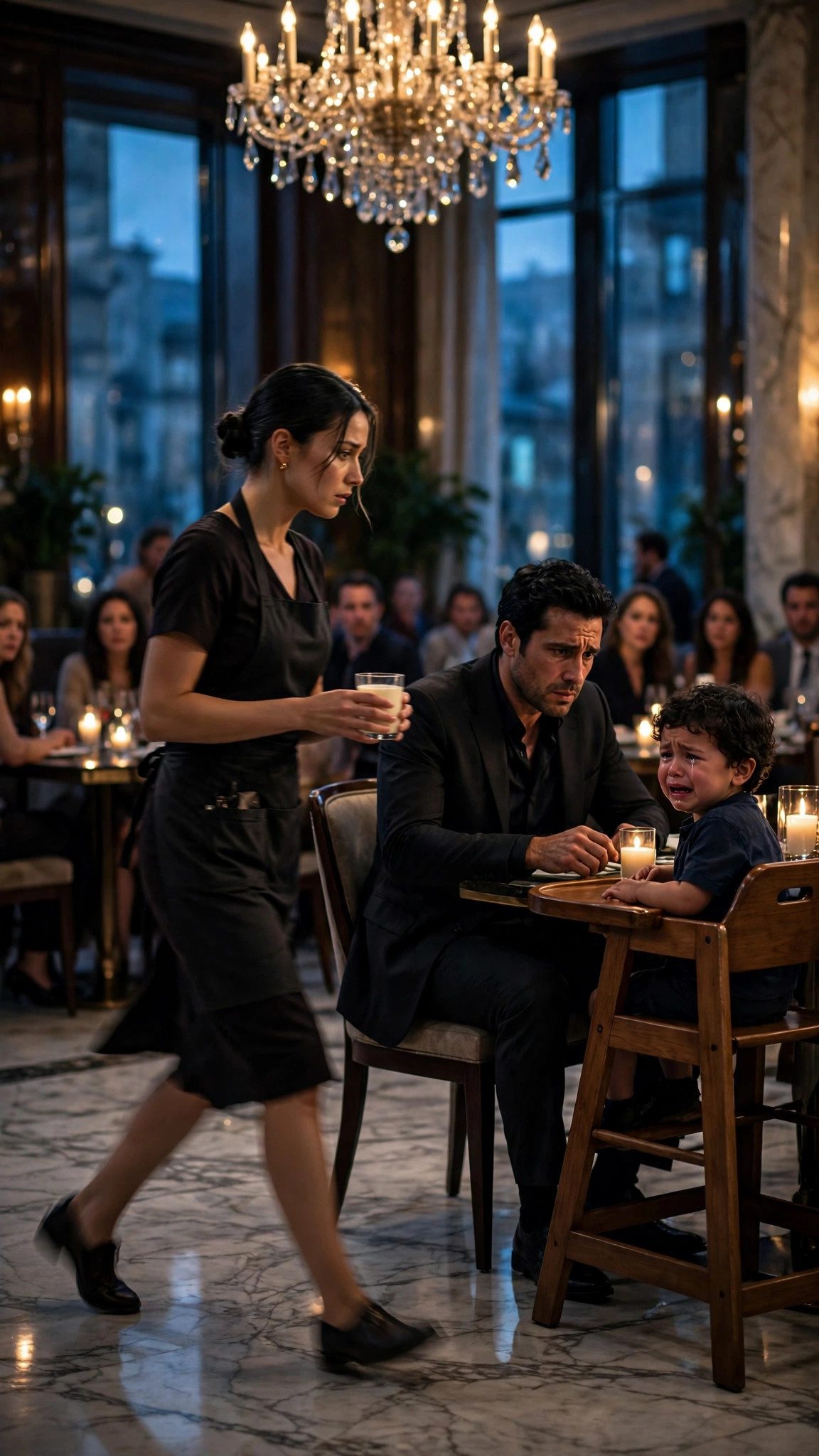
The plate hit the marble floor so hard that everyone in the restaurant flinched.
It was eight o'clock on a Friday night at Il Destino, the kind of restaurant where people whispered over thousand-dollar bottles of wine and men in tailored suits made deals without ever raising their voices. Crystal chandeliers hung from a ceiling painted like a sky. The marble floor had been polished that afternoon until it reflected the candlelight. The tables were dressed in white linen, and every plate on them cost more than I made in a week.
Tonight, nobody was whispering. Nobody was eating. Everyone was watching the child at the center table.
Three-year-old Leo Moretti screamed again, his tiny hands shaking as shattered porcelain scattered beneath the most feared table in Brooklyn. His father slammed one hand against the table, and when Ricardo Moretti looked up, every employee in the room seemed to stop breathing.
"Enough."
But Leo only screamed louder.
I was standing near the kitchen doors when it happened, holding a tray I had completely forgotten about. The crystal chandelier above us trembled faintly with the force of the boy's cries. I had heard his name before I ever started working there. Everyone had. Some called him a businessman. Some called him a capo. The employees used another name only when they were sure no one important could hear them.
The Butcher of Brooklyn.
He was thirty-two, dressed in a dark Brioni suit, his expression carved from stone. But that night, he didn't look powerful. He looked exhausted. Defeated, even. And somehow that frightened everyone more.
"Leo," Rico said through clenched teeth. "Basta."
The boy shook his head violently. "No! No! I want no!"
Then Leo swept another plate toward the edge. A waiter jumped back just before it crashed. The sound echoed across the dining room. One woman near the bar covered her mouth. A man at the next table lowered his eyes as if witnessing something private could become dangerous.
The manager, Marco, approached the Moretti table with the expression of a man walking toward an execution. "Mr. Moretti," he began carefully, "perhaps the young master would prefer something else."
Rico slowly turned toward him. The entire room seemed to shrink. "He doesn't want food, Marco." His voice was quiet. That was worse than shouting. "He wants to torture me."
Marco forced a nervous smile. "Perhaps if we brought him dessert—"
"Do I look like a man who knows how to stop a toddler?"
Nobody answered. Rico dragged one hand through his dark hair and gripped the roots. For just one second, I saw something in his face that didn't match the stories. Pain. Not irritation. Not embarrassment. Pain.
I knew why. Everyone at Il Destino knew. Six months earlier, Rico's wife, Elena, had been killed in a drive-by shooting. The bullets had been meant for him. Leo had lost his mother. And Rico had been left with a three-year-old son who, according to the staff, had barely spoken since then. Mostly, he screamed.
People called it bad behavior. I didn't. I had spent enough nights fighting panic attacks alone to recognize what terror looked like when it wore a child's face. And Leo looked terrified. He clutched the front of his shirt so tightly his knuckles turned pale. His face was red. Tears streamed down both cheeks. Between screams, he dragged in sharp, desperate breaths. Nobody else seemed to notice that part. They only noticed the noise.
Rico's head of security stepped closer. Dante was enormous. I had seen him remove drunk customers without even appearing to strain. Rico pointed toward Leo. "Get him out of here."
Dante hesitated. That caught my attention. Men like Dante weren't supposed to hesitate.
"Come on, little boss," he murmured. He reached toward Leo.
The boy screamed. Then he lunged forward and sank his teeth into Dante's hand. Dante jerked backward. Blood appeared almost instantly. A few people gasped.
"Jesus—"
Leo shrank into his chair and screamed even harder. Rico's palm came down against the table. Silverware jumped. Wine trembled inside crystal glasses.
"Is everyone in my employment incompetent?"
Marco went completely pale. Rico pointed toward his son. "Silence him, or I shut this place down."
The sentence hung in the air. No one laughed. No one assumed he was exaggerating. Il Destino occupied one of the most expensive properties in the neighborhood. Rico Moretti owned the building. According to Marco, he owned enough of the surrounding block that arguing with him about money was beyond pointless.
Beside me, Sarah whispered, "This is bad."
I couldn't answer. I was still watching Leo. Not Rico. Not Dante's bleeding hand. Leo. His breathing had changed. Shorter. Faster. His shoulders were trembling. I had seen that exact look before. In mirrors. On nights when I couldn't breathe and no one was there to tell me I wasn't dying.
"He's panicking," I whispered.
Sarah stared at me. "What?"
"He can't breathe properly."
"He's having a tantrum."
"No." I watched Leo press both hands against his chest. "He's scared."
Sarah grabbed my wrist. "Clara." I looked down. Her fingers were tight around me. "Whatever you're thinking, don't."
"I'm not thinking anything."
"That's a lie."
Leo screamed again. Rico turned toward the nearest waiter. "What are you standing there for?"
The waiter flinched. I set my tray down. Sarah's eyes widened. "No."
I walked toward the service counter. "Clara."
There was a pot of milk warming near the espresso machine. I poured some into a clean glass. My hands were steady. That surprised me. I opened the sugar container. One cube. I dropped it into the milk.
Sarah appeared beside me. Her voice was barely audible. "That's the Butcher of Brooklyn."
"I know."
"If you go over there, you're dead."
I looked toward Leo again. He was gasping between sobs now. Rico was saying something to Dante, but I wasn't listening.
"I'm bringing him milk."
"You're bringing a mafia boss's child milk after his father just threatened to shut down the restaurant."
"Yes."
"Do you hear yourself?"
Probably not. My heartbeat had become too loud. Sarah moved in front of me. "Marco will fire you."
"I know."
"You need this job."
That stopped me. Because she was right. I desperately needed it. Rent was due. I had already worked a double shift. I hadn't eaten since morning because buying lunch at work meant spending money I couldn't afford to spend. Losing Il Destino could mean losing my apartment.
For a few seconds, I stood there staring down at that stupid glass of warm milk. It would have been easier to stay behind the kitchen doors. Everyone else was. Nobody would blame me.
Then Leo made a sound that was different from the others. Not anger. Not screaming. A broken little gasp.
And something inside me refused to stay still.
I stepped around Sarah. "Clara, please."
"I'm only going to talk to him."
"You don't understand people like Moretti."
Maybe I didn't. But I understood fear. And I understood what it felt like when an entire room judged you for falling apart.
So I started walking. My cheap rubber-soled shoes squeaked against the marble floor. Once. Twice. Every step felt louder than the last. People began looking at me. A couple seated near the aisle actually moved their chairs backward as I passed.
Marco saw me coming from halfway across the dining room. His eyes nearly came out of his head. "What are you doing?"
I kept walking. He hurried toward me. "Clara." I didn't stop. He caught my arm. "Get back to the kitchen."
Leo screamed again. I looked at Marco's hand on me. Then at Leo. "Let go."
His face changed. "Are you insane?"
"Maybe."
"If you embarrass him—"
"I'm not trying to embarrass anyone."
"This is not your table."
"No."
"You weren't called."
"No."
"Then turn around."
I pulled my arm free. Marco stared at me like he had already decided how to write my termination notice. I kept moving.
The closer I got to Rico's table, the colder the room felt. Dante noticed me first. His bleeding hand was wrapped in a napkin. His eyes narrowed. Another bodyguard shifted position. I nearly stopped.
Then Leo looked at me. Just for one second. Red eyes. Wet cheeks. Chest rising too quickly. That was enough.
I reached the table. Nobody spoke. I could hear my own breathing. Rico turned his head. Up close, he was more intimidating than the rumors. There was no wasted movement in him. No nervousness. No confusion. His gaze moved from my face to the glass of milk in my hand. Then back to me. His expression hardened.
I noticed his right hand. It had moved toward the inside of his jacket.
My stomach dropped. Everyone else noticed too. Dante straightened. Marco stopped several feet behind me. The entire restaurant went silent except for Leo's crying.
I held the glass with both hands so Rico wouldn't see them beginning to shake. He studied me like he was trying to decide whether I was stupid, dangerous, or both.
Then his voice cut through the silence.
"Who are you?"
I swallowed. My throat was dry. Every eye in the dining room was on me, and somewhere behind me I could hear Sarah breathing too fast, the way people breathe when they are watching someone walk off a cliff.
"My name is Clara," I said. My voice came out quieter than I wanted, but it did not shake. "Clara Bennett. I work here."
Rico's eyes did not leave mine. "And what do you think you are doing, Clara Bennett?"
I looked at Leo. He was watching me now, his sobs breaking apart into hiccups, his small hands still fisted in his shirt. His chest was rising too fast. Too shallow. I had seen that rhythm a hundred times in my own mirror, on nights when the walls of my little apartment seemed to close in and my heart hammered so hard I was sure it would stop.
"He can't breathe," I said.
Rico's jaw tightened. "He is three years old and he is throwing a tantrum in my restaurant."
"No." I shook my head, slowly, because sudden movements felt dangerous in that moment. "He's not throwing a tantrum. He's panicking. His chest is too tight. He can't get enough air. That's why he's screaming. The screaming is the only way his body knows how to ask for help."
A muscle jumped in Rico's cheek. For a moment I thought he would order Dante to throw me out. Instead, he looked at his son. Really looked at him. At the pale knuckles. At the shaking shoulders. At the way Leo's little hands pressed against his own chest, as if he were trying to hold himself together from the outside.
"Leo," Rico said, and his voice was different now. Lower. Uncertain. "Leo, look at me."
Leo didn't. He kept his eyes on me.
I knelt down beside his chair, slowly, so I was smaller than the table and no taller than he was. I set the glass of milk on the table where he could see it, and I put my own hand flat against my chest.
"Hey," I said softly. "Can you do what I do? Just for a second. Breathe in with me. Like this."
I breathed in, slow, through my nose. I counted in my head. One. Two. Three. Four. Then I breathed out through my mouth, even slower.
Leo stared at me. His breath hitched. Then, to my amazement, he copied me. A ragged inhale. A shaky exhale.
"Again," I whispered. "In. One, two, three, four. Out. One, two, three, four, five, six."
He did it again. His shoulders dropped a fraction. The red in his face began to fade at the edges.
"Good," I said. "You're doing so good. One more."
On the third breath, his hands uncurled from his shirt. I picked up the glass and held it out to him. "Warm milk," I said. "One sugar. My grandmother used to make it for me when I couldn't sleep."
Leo reached for it with both hands. His fingers were sticky with tears. He drank. A little dribbled down his chin. He didn't care. He drank half the glass in three long gulps, and then he set it down carefully, like it was something precious, and looked at his father.
The dining room was so quiet I could hear the ice settling in someone's glass three tables away.
Rico was staring at me. Not at Leo. At me. His hand had come away from his jacket. His expression had changed completely, and I couldn't read it at all. It wasn't anger. It wasn't gratitude, either. It was something older and more confused, like a man who had just watched a locked door open by itself.
"Clara Bennett," he said slowly, tasting the name.
"Yes, sir."
"How did you know?"
"Know what?"
"That he couldn't breathe. That it wasn't a tantrum. Every doctor in Brooklyn has told me my son is spoiled. Every nanny has quit. You have worked here for three weeks and you knew in thirty seconds."
I thought about the nights I had spent on my bathroom floor at two in the morning, counting my own breaths. One, two, three, four. In. One, two, three, four, five, six. Out. I thought about my therapist, Dr. Patel, saying, "Panic is not a tantrum, Clara. It is a body that believes it is dying, and it deserves the same gentleness you would give a dying person."
"Because I know what it looks like," I said simply. "That's all."
Rico was quiet for a long moment. Then he reached out and took Leo's small hand in his own. Leo didn't pull away. He leaned against his father's arm, his eyelids heavy, the milk and the breathing finally doing their work.
"Marco," Rico said, without looking away from his son.
Marco stepped forward so fast he nearly tripped over his own feet. "Yes, Mr. Moretti?"
"Miss Bennett is not fired."
Marco blinked. "Of course not, sir. I would never—"
"And from tonight," Rico said, "no one in this restaurant touches that boy's chair, his plate, or his glass without asking her first."
Sarah made a small sound behind me. I didn't turn around. I was still kneeling beside Leo's chair, and my knees were starting to ache, and my heart was beating so hard I was sure the whole room could hear it.
Rico looked down at me. "Stand up, Clara Bennett."
I stood. My legs felt unsteady. He was taller than I had realized, and standing this close to him I could see the exhaustion under his eyes, the kind that doesn't come from one bad night but from six months of nights that never really end.
"Tomorrow morning," he said. "Nine o'clock. My house. Dante will give you the address. We need to talk about my son."
"About Leo?" I asked.
"About Leo," he said. "And about you."
He picked Leo up then, gently, the way a man handles something breakable, and the boy's head fell against his shoulder without a single protest. Rico walked toward the door with his son in his arms, Dante and the other bodyguard falling in behind him, and the whole dining room watched them go in silence.
At the door, Rico stopped. He turned back and looked at me across the length of the restaurant.
"Clara," he said.
"Yes, sir?"
"Thank you."
Then he was gone, and the chandelier kept trembling faintly above the shattered plates, and Sarah grabbed my arm so hard it hurt.
"Clara," she whispered. "Do you have any idea what you just did?"
I looked down at the empty glass on the table. At the milk drying on Leo's chin. At the space where the most feared man in Brooklyn had just thanked a waitress.
"No," I said honestly. "Not even a little."
But my hands had stopped shaking. And for the first time in a very long time, I didn't feel afraid at all.