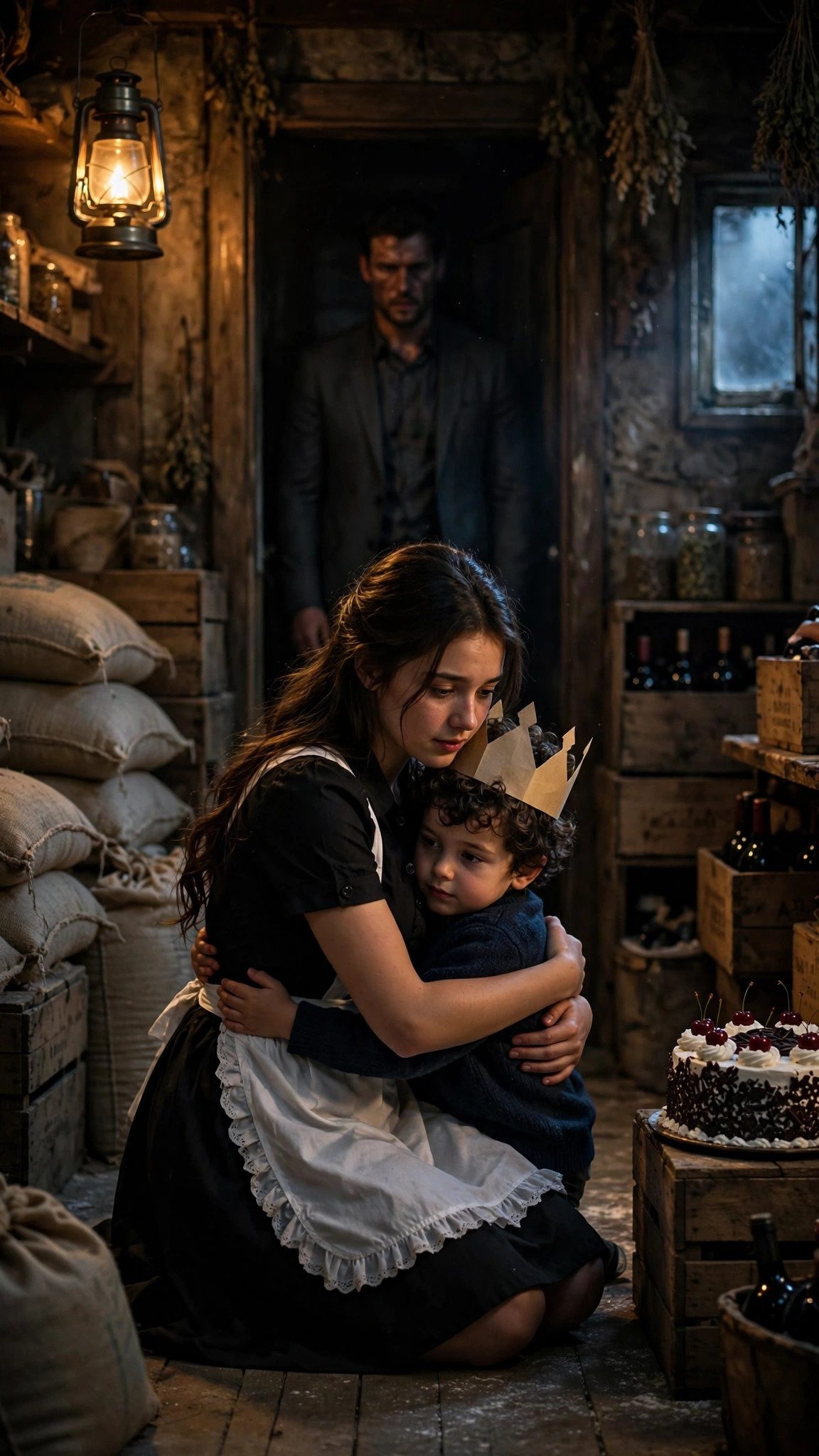
My stepmother was standing outside the storage-room door, telling the men who had come to collect me that I was worth fifty thousand dollars.
I heard her through the thin wood, her voice bright and reasonable, the way she always sounded when she was selling something that did not belong to her.
"Fifty thousand, and she is yours," Regina said. "She is healthy. She is obedient. She will not cause trouble once she understands there is nowhere to run."
I was still dressed in my black maid's uniform. I had sneaked into Bellarosa that Sunday with a cake in my hands, a Black Forest cake I had baked at three in the morning in a kitchen that was not mine, for a little boy who was turning four years old and who had no mother to bake for him.
Zayn.
The boy did not even have his father beside him that afternoon. Kian Moretti was somewhere in the building, shaking hands with men who feared him, and the party was happening without him, the way everything in that house seemed to happen without him.
But Tony's men got there first.
They had cornered me in the storage room, between the sacks of flour and the crates of wine, and one of them had his hand on my arm, and I could not breathe. My body was ready to return, ready to return to Tony's men's custody, the way a body learns to obey when it has been afraid for a very long time.
And then a small sound cut through everything.
Little feet. Running.
Zayn stepped between us at his own birthday celebration, his small body planted in front of mine like a wall, his arms spread wide, his chin lifted, his dark eyes blazing.
"She is my mommy," he said.
His voice was not loud. It did not need to be loud. It was steady, and it was certain, and it shut the whole room down.
"No one will take my mommy."
I could not breathe. I could not move. A four-year-old boy had wrapped his arms around my waist as if nothing in the world could pull him away, and I stood there in my black maid's uniform with my hands full of cake crumbs and fear, and I thought: this is the first time anyone has ever stood between me and the people who wanted to take me.
"This is my future wife," Zayn announced, louder now, to the whole room. "You can't take her away."
His little voice was strong enough to shut down the room, and the adults stared at me with shock. Regina's mouth fell open. Tony's men looked at each other, uncertain, because nobody had told them what to do about a four-year-old boy who refused to move.
My name is Aurora.
I am the daughter of a Brooklyn mob boss, and I worked at a restaurant called Bellarosa as a maid, and Zayn's father, Kian Moretti, owned the entire building.
Every single day, the kitchen had reminded me how much they had loved him since he was only eleven. The old cooks, the waiters who had been there for decades, they spoke about Kian the way people speak about a storm that passed through their town when they were children — with fear, and with awe, and with a strange kind of love.
It was a wonderful speech, though his fierce, tall, and exhausted figure remained unattainable to me. He was the man criminals in New York were afraid to name too loudly. He was the man who owned the building I cleaned. He was the man whose son called me mommy.
That Sunday, I sneaked into Bellarosa for my son's birthday, carrying a cake for Zayn. Not my son. Never my son, not by blood, not by law. But the boy had decided, and a four-year-old's decision has a way of becoming the truth if you let it stand long enough.
It is the twentieth day I have been hiding from my stepmother, Regina, who constantly insists I marry someone. A simple life, she said. A simple life, as if a husband she chose for me would be simple. As if being sold to a man I had never met would be simple.
But now, as we stood frozen, another frightening thing happened.
The door opened.
Cold air swept straight into the small storage room. A tall, broad-shouldered man filled the doorway, and every person in the room went suddenly quiet.
Neither were Tony's men. This man did not need to announce himself. His face showed nothing before he spoke, and that was worse than anger.
Kian Moretti.
The man criminals in New York were afraid to name too loudly. It was Zayn's father.
My stepmother opened her mouth with a clear voice. "I knew that if I had delivered this girl to Tony, the Black Forest cake wouldn't poison any of you," she said, the words tumbling out of her, desperate and strange, and I could not believe what I was hearing.
Because suddenly, she was asking Tony's men not only to take me, but also to buy me from them. Fifty thousand dollars later, and she was just a porcelain doll that could be bought. Because suddenly, she was asking Tony's men not only to take me, but also to buy me from them.
"Well, how many of them do you think are here for me?" one of the men muttered, and I did not know if he was talking about Kian's men or about the whole restaurant, because by then the doorway was full of dark suits, and every man behind Kian was waiting.
"Vince Moretti," the boy said suddenly, pointing at the chef's whites in the corner. "He is a chef."
It made no sense, and it made perfect sense, because Zayn was four and the world to him was divided into people who were safe and people who were not, and the chef was safe, and Tony's men were not.
And yet, Kian did not say a word.
He did not rush. He did not shout. He did not even look surprised.
Kian reached into his suit pocket and took out his phone. He placed his phone into Zayn's hands and let the boy see a message.
"I'm sorry I hurt you already."
"I'm sorry, honey. I'm sorry. I'm sorry."
The words were there on the screen in Kian's own hand, unsent drafts, apologies he had typed in the dark and never had the courage to send. Apologies to me.
Zayn looked at the phone, and then he looked at his father, and then he looked at me, and he tightened his arms around my waist.
"See?" he said. "Daddy is sorry. So you have to stay."
And Kian Moretti, the man criminals in New York were afraid to name too loudly, looked at me across a storage room full of his enemies and his son, and for the first time in four years, he looked like a man who did not know what to do next.
That was the moment everything changed. But to understand it, you have to understand how I got to that storage room in the first place.
I was eighteen years old when I first walked into Bellarosa with a borrowed uniform and a lie on my tongue.
The lie was my name. I told the hiring manager my name was Aurora Bell, because Bellini was a name that closed doors in some rooms and opened graves in others. My father, Salvatore Bellini, had been a Brooklyn mob boss, and he had been dead for two years, and his name was still the kind of name that made men go quiet.
My mother had died when I was nine. Her name was Elena, and she baked Black Forest cake in a kitchen that always smelled of cherries and chocolate, and when she died, the smell went out of our house and never came back.
Regina came into our lives a year later. She was beautiful, and she was patient, and she married my father for his money, and when he died, she inherited the house and the debts and me. She did not want me. She wanted the house. She wanted the money that was already gone.
By the time I was eighteen, Regina had tried to marry me off three times. A grocer's son. A landlord's nephew. A man from her card games who was forty-one and smelled of cigars and looked at me the way you look at a house you are thinking of buying.
So I ran. Not far. Just far enough. I took the maid's job at Bellarosa because it came with a uniform and a paycheck and a reason to be out of the house from seven in the morning until eleven at night, and because the kitchen at Bellarosa smelled like my mother's kitchen used to smell.
The head chef, an old man named Vince Moretti — no relation to Kian, though everyone assumed — took one look at my hands and said, "You bake."
"I used to," I said.
"Then you will bake for us," he said. "The Black Forest cake. Your mother's recipe. I can smell it on you."
I did not ask him how he knew. Old chefs know things. I baked the cake, and the waiters ate it, and the customers asked for it by name, and for the first time since my mother died, I felt like I was somewhere I belonged.
And then, one Tuesday afternoon, a small boy wandered into the kitchen with chocolate on his face and a toy car in his hand, and he looked up at me with enormous dark eyes and said, "Are you my new mommy?"
I was eighteen years old. I was a maid in a black uniform. I was the daughter of a dead mob boss, hiding from a stepmother who wanted to sell me.
And a three-year-old boy looked at me like I was the answer to a question he had been asking since the day he was born.
"No, sweetheart," I said, kneeling down so our eyes were level. "But I can be your friend. I'm Aurora."
"Zayn," he said, very seriously. "I'm three and three-quarters. My daddy owns this building. He owns everything. But he doesn't own you."
"That's right," I said, smiling despite myself. "Nobody owns me."
Zayn considered this with the gravity of a judge. "Good," he said. "Then you can stay."
That was the beginning. I did not know it then. I thought I was just a maid who had made a small boy laugh. I did not know that the boy's father had been watching from the kitchen door, tall and fierce and exhausted, and that he had seen his son laugh for the first time in months.
I did not know that Kian Moretti had buried his wife a year before, and that Zayn had not spoken a full sentence to anyone since the funeral, and that my kneeling down in a flour-dusted kitchen was the first crack in a wall that had been sealed shut for a year.
I did not know any of that. I only knew that a little boy had chocolate on his face, and that he had asked me to stay.
The days that followed were the happiest I had known since my mother died. I learned the shape of Zayn's world, and he learned the shape of mine.
Every morning I arrived at Bellarosa at seven, and the first thing I did was check the small table by the kitchen door, where Zayn and I would eat lunch at one o'clock. I wiped it down myself, even though it was not my job, and I set out two napkins, and sometimes I folded them into little boats, because Zayn liked boats.
Mrs. Kowalski, the nanny, was a stern Polish woman in her sixties who had raised four children of her own and had no patience for nonsense. She watched me for a week with narrowed eyes, and then one morning she said, "You are good with him. He talks to you. He does not talk to me."
"He talks to everyone," I said.
"No," she said. "He does not. He has not spoken a full sentence to anyone since his mother died. Not to me. Not to his father. He speaks to you. Do you know why?"
"Because I kneel down," I said, without thinking. "Everyone else talks down to him from above. I kneel down, so we are the same height. Children can tell the difference."
Mrs. Kowalski looked at me for a long moment, and then she nodded, once, the way a general nods at a soldier who has passed inspection. "Then kneel," she said. "And do not stop."
Zayn had nightmares. I learned that in the second week, when Mrs. Kowalski came to the kitchen at midnight and found me still there, finishing the baking, and asked if I would sit with him for an hour, because he had woken up crying and would not go back to sleep.
I went upstairs to the apartment, and the boy was sitting up in bed with his blanket around his shoulders, his eyes huge in the dark.
"I dreamed Mommy left," he whispered.
"Your mommy did not leave," I said, sitting on the edge of his bed. "Your mommy loved you very much, and she had to go to heaven, but love does not leave. Love stays right here." I put my hand over his heart. "Can you feel it?"
He put his small hand over mine. "It is warm," he said.
"That is your mommy," I said. "That is how you know she is still with you."
"Will you stay until I fall asleep?" he asked.
"Yes," I said. "I will stay."
I sang to him then, the lullaby my mother used to sing to me, in a low voice, in the dark, and his breathing slowed, and his eyes closed, and his hand stayed on top of mine, warm and trusting.
When I finally stood up to go, I saw Kian standing in the doorway. He had been there the whole time, silent, in the dark hallway, listening. His face was unreadable, but his eyes were wet, and he put a finger to his lips, and he nodded at me — a small, broken nod, like a man who had just been handed something he thought he had lost forever.
After that night, the lullaby became part of my job, though no one ever wrote it down. On the nights when Zayn had nightmares, Mrs. Kowalski would send for me, and I would come upstairs in my black uniform, and I would sing, and the boy would sleep.
And on Sundays, I baked the Black Forest cake, and Zayn would stand on a stool beside me in the kitchen, wearing an apron that swallowed him whole, and he would stir the batter with enormous concentration, and old Vince would pretend to taste it and declare it "almost as good as your mother's, little boss," and Zayn would glow with pride.
"One day I will bake it all by myself," Zayn announced one Sunday, licking chocolate off his fingers.
"One day," I agreed. "But not today. Today you are my helper."
"Like you are Mommy's helper?" he asked.
"Exactly like that," I said.
He thought about this, stirring solemnly. "Then when I grow up, I will be a helper too," he decided. "I will help everyone."
"That is a good plan," I said.
It was a good plan. It was the best plan I had ever heard. And I did not know then that the boy's father had been standing in the kitchen door again, listening, with his arms crossed and his face unreadable, and that he was thinking the same thing I was thinking: that this child, who had lost his mother, had found something worth holding on to, and that it would be cruel to take it away.
So I stayed.