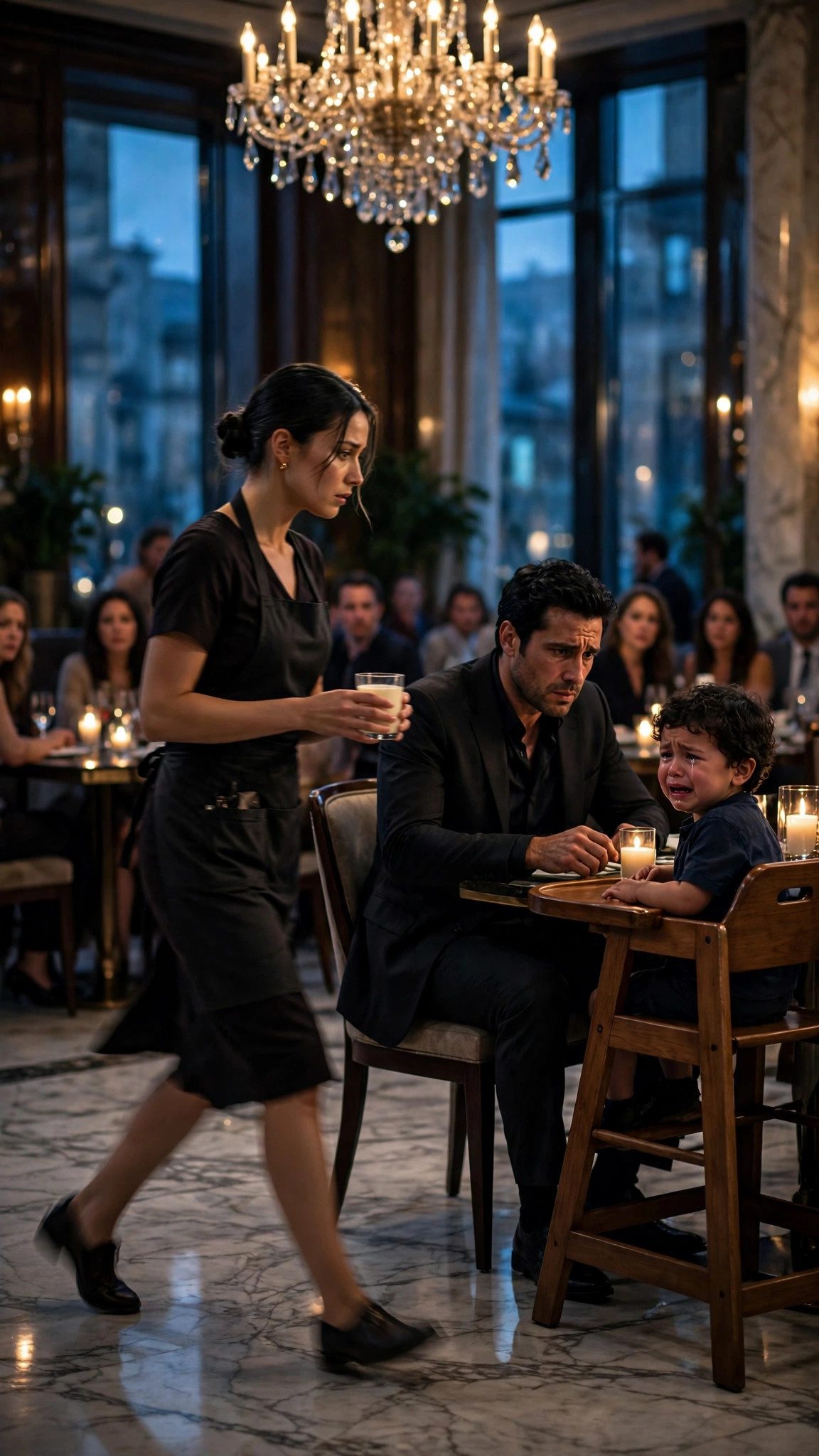
My first day as Leo Moretti's companion began on a Tuesday morning in April, with rain against the windows of the house on Willow Lane and a little boy who would not come out from under the kitchen table.
"He does this sometimes," Dante said, crouching down to look under the table. His bandaged hand rested on his knee. "Since the funeral. He hides when the house is too loud. Or too quiet. Or when someone new comes."
"I'm not new," I said. "He met me on Friday."
"To him, Friday was a dream," Dante said. "Today is real."
I set my bag down by the door and took off my cardigan. Then I did something Dante clearly did not expect. I got down on the kitchen floor, on my hands and knees, and I crawled under the table.
Leo was curled in the far corner, his knees pulled up to his chest, his thumb in his mouth. His eyes were wide and wet. The space under the table smelled like lemon cleaner and old wood.
"Hi," I said quietly. "It's me. Clara. From the milk."
He stared at me.
"I know about hiding," I said. "I used to hide under my grandmother's kitchen table when I was scared. She would pretend she couldn't find me. She would say, 'Clara? Clara, where did you go? Has anyone seen my Clara?' And then she would lift the tablecloth and say, 'There she is!' And I would laugh, even when I was scared, because she always found me."
Leo took his thumb out of his mouth. "Milk?" he whispered.
"After we come out," I said. "Milk is for the table. Not under it. Deal?"
He thought about it for a long moment, the way three-year-olds think about things, with their whole face. Then he nodded, once, and crawled out from under the table, and I crawled out after him, and Dante was standing there with his arms crossed and an expression on his face that I had never seen on a man his size before.
It looked a lot like hope.
That was how the days went. Slowly. Gently. I learned Leo's rhythms the way you learn a language: by listening more than speaking.
He woke up early, before six, and the first hour of the day was the hardest. He would cry for his mother — not with words, but with a sound that came from deep in his chest, a sound that made the whole house go still. I learned to sit with him through it. Not to fix it. Not to distract him. Just to sit on the floor beside his bed and breathe with him until it passed.
One, two, three, four. In. One, two, three, four, five, six. Out.
After breakfast — toast with jam, cut into triangles, always triangles — we went to the garden. The house on Willow Lane had a walled garden behind it, with a lemon tree and a bench and a patch of dirt where Leo liked to dig with a plastic spoon. I brought a blanket and a book of nursery rhymes, and I read to him while he dug, and sometimes he would stop digging and listen, and sometimes he would hand me a worm like it was a treasure, and I would say, "Thank you, Leo, that's a very fine worm," and he would almost smile.
Almost. He never quite smiled. Not yet.
In the afternoons, when he napped, I sat in the kitchen with a cup of tea and tried not to feel like an intruder in someone else's grief. The house was full of Elena. Her photographs lined the hallway. Her ballet shoes sat in a glass case in the living room, pink satin, worn at the toes. Her piano stood in the corner of the sitting room, its lid closed, a layer of dust on the keys that nobody had touched in six months.
Rico came home at different times. Sometimes early, sometimes after Leo was asleep. He would stand in the doorway of the kitchen and ask, "How was he today?" And I would tell him. "He ate all his toast." "He dug up three worms." "He cried for twenty minutes this morning, and then he stopped on his own."
Rico listened to every word like it was a report from a battlefield. And in a way, it was.
On the third day, something changed. We were in the garden, and Leo was digging, and I was reading, and a bee landed on the blanket beside him. Leo froze. His chest started to rise too fast. His hands curled into fists.
I put the book down and moved beside him, slowly. "Hey," I said. "Look at me. Breathe with me. In. One, two, three, four. Out. One, two, three, four, five, six."
He copied me. Once. Twice. The bee flew away. Leo's shoulders dropped.
"Good," I whispered. "You're doing so good."
And then Leo looked at me, and his mouth opened, and he said, very clearly, "More."
I froze. "More what, sweetheart?"
"More," he said, and pointed at the book. "More story."
It was two words. Two ordinary words. But I sat there in the garden with tears running down my face, because in three days, Leo Moretti had gone from hiding under a table to asking for more story, and I knew — I knew — that somewhere inside that frightened little boy, the voice his mother had loved was still alive.
That evening, when Rico came home, I told him. He stood in the kitchen doorway for a long time without speaking. Then he walked into the sitting room and stood in front of Elena's piano, and he put his hand flat on the closed lid, and his shoulders shook once, hard, like a man holding back something enormous.
"He said 'more,'" Rico said, without turning around. "My son said 'more.'"
"He'll say more than that," I said. "Give him time. Give him safety. The words are in there. They're just scared."
Rico turned around then, and his eyes were red, and he didn't try to hide it.
"Clara," he said, "do you know what the doctors told me? They told me my son was spoiled. They told me to be firmer. They told me to stop letting him win. And you — you sat on the floor with him and breathed, and he asked for more story."
"Children don't need to be fixed," I said. "They need to feel safe enough to heal."
He nodded slowly. "Stay for dinner," he said. "Please. Cook is making pasta. Leo eats better when you're at the table."
So I stayed. And Leo ate two whole bowls of pasta, and he pointed at the parmesan and said, "More," and Rico laughed — actually laughed, a real laugh that sounded rusty from disuse — and for one evening, the house on Willow Lane felt less like a house full of grief and more like a home.
It was on the way home that night that I noticed the car.
I took the bus from Brooklyn Heights, the way I always did, changing at Atlantic Avenue for the train to Ridgewood. The bus was half empty. I sat by the window and watched the city go by, tired in the good way, the way you feel tired after a day that mattered.
At Atlantic Avenue, I got off and walked toward the subway entrance. That was when I saw it: a black SUV, parked across the street, its headlights off, its engine running. It had been behind the bus for three stops. I was sure of it. I had noticed it in the window's reflection when we crossed the bridge.
I stopped walking. The SUV didn't move. A man sat in the driver's seat, his face in shadow. He was looking at me. I was sure of it.
My chest went tight. My hands went numb. The old familiar feeling rose up like floodwater.
One, two, three, four. In. One, two, three, four, five, six. Out.
I walked into the subway station without looking back. I took the train. I changed lines twice, even though I only needed to change once. When I got out at my stop in Ridgewood, I stood on the platform for ten minutes, watching the trains come and go, until I was sure no one had followed me.
Then I walked home fast, my keys already in my hand, and I locked my door behind me with both locks and the chain, and I sat on my bed in the dark and tried to tell myself I was imagining things.
But I wasn't imagining things. I knew the feeling of being watched. I had felt it once before, years ago, when a man had followed me home from a late shift at a diner and I had run the last three blocks with my heart hammering. I knew what it felt like.
The next morning, I told Dante.
He listened without interrupting, his face growing harder with every word. When I finished, he said, "What did the car look like?"
"Black SUV. New. Tinted windows. I didn't see the plates."
"And the driver?"
"A man. I couldn't see his face."
Dante nodded once. "From now on, you don't take the bus home. I drive you. Or Sal drives you. Every night. No exceptions."
"Sal?" I asked.
"Sal Ferraro," Dante said. "Mr. Moretti's driver. He's been with the family for twelve years. He knows every street in Brooklyn."
"Is it—" I hesitated. "Is it normal? Being followed?"
Dante was quiet for a moment. Then he said, "Miss Bennett, the people who killed Mrs. Moretti were never caught. The police called it a random shooting. Mr. Moretti has never believed that. And if someone is watching this house now, it means they know about you. It means they know Leo has started to speak again. And it means they think you matter."
"Do I matter?" I asked.
Dante looked toward the garden, where Leo was digging with his plastic spoon.
"To that boy," he said, "you are the only person in the world who understands him. Yes. You matter."
That night, Rico came home early. He found me in the kitchen, making Leo's warm milk. One sugar cube. He stood in the doorway and watched me stir it.
"Dante told me about the car," he said.
"I might have imagined it," I said.
"You didn't," Rico said flatly. "I had Sal check the cameras on the block. A black SUV with no plates was parked across from the bus stop for forty minutes. It left when you went into the station."
My hand stopped stirring. "Who was it?"
"I don't know yet. But I will find out." He stepped into the kitchen. "Clara, I need you to understand something. The people who killed Elena did it because they wanted me dead, and they were willing to kill her to get to me. If they are watching this house, it is because they want Leo. Or they want you, to get to Leo. I will not let that happen. But I need you to be careful. No more buses. No more walking alone at night. Dante or Sal drives you everywhere. Do you understand?"
"I understand," I said.
"And one more thing." He hesitated, and for a moment he looked less like the Butcher of Brooklyn and more like a man asking for something he wasn't sure he deserved. "Thank you. For telling Dante. For not keeping it to yourself. Most people in my world keep things to themselves until it's too late."
I handed him the glass of milk. "I'm not most people in your world, Mr. Moretti."
"No," he said, and for the first time since I had met him, he smiled — a real smile, small and tired and genuine. "You're not. That's the whole problem. And the whole reason Leo is getting better."
He took the milk to Leo, and I stood in the kitchen and listened to them in the other room — Rico's low voice, Leo's small one saying "more" — and I thought about the black SUV and the man in the shadows, and I felt afraid.
But I also felt something else. Something I hadn't felt in a very long time.
I felt needed. And I felt like staying.
The next morning, I woke up before my alarm and lay in bed listening to the rain on my fire escape, thinking about the black SUV and the man in the shadows. My first instinct was to call Rico and tell him I had changed my mind. My second instinct was to get up, get dressed, and go to Willow Lane anyway.
The second instinct won.
When I arrived, Leo was already in the garden, digging in the wet dirt with his plastic spoon, his hair damp from the mist. He looked up when he heard the gate, and his whole face changed, and he dropped the spoon and ran to me across the wet grass, and he threw his arms around my legs.
"Clara!" he said. My name. Clear as a bell. The first time he had ever said it.
I picked him up, mud and all, and I held him tight, and I felt his small heart beating against mine, fast and steady, and I thought about how three days ago this child had hidden under a kitchen table, and now he was running across a garden to greet me by name.
"Good morning, Leo," I said. "Did you sleep well?"
He nodded. "Milk," he said. "More story."
"After breakfast," I said. "First toast. Triangles."
Dante watched us from the kitchen doorway, his arms crossed, his bandaged hand resting on his forearm. When I caught his eye, he gave me a short nod — the kind of nod men like Dante give when they have decided something about you.
"Miss Bennett," he said, as I carried Leo inside. "Mr. Moretti asked me to tell you something. He said to tell you that the car will be outside your building every morning at seven-thirty, and every night at eight. And he said to tell you that if you ever feel unsafe, even for one second, you call me. Not the police. Me. Do you understand?"
"I understand," I said.
"Good." Dante hesitated, and for a moment the big man looked almost awkward. "And Miss Bennett — my mother used to say that God sends the right person at the right time, and you only recognize them afterward. I think the little boss recognized you first."
That afternoon, during Leo's nap, I called Rosa at the care home. I told her about the job, about the house, about the little boy who had said my name. I told her about the black SUV, too, because Rosa had always known when I was hiding something, and there was no point in trying.
"Clara," she said, her voice thin over the phone but clear, "your mother used to say that brave people are not people without fear. Brave people are people who are afraid and do it anyway. You did it anyway. I am proud of you."
"I'm scared, Nonna," I whispered.
"Good," she said. "Scared means you understand what matters. Now go and be brave anyway."