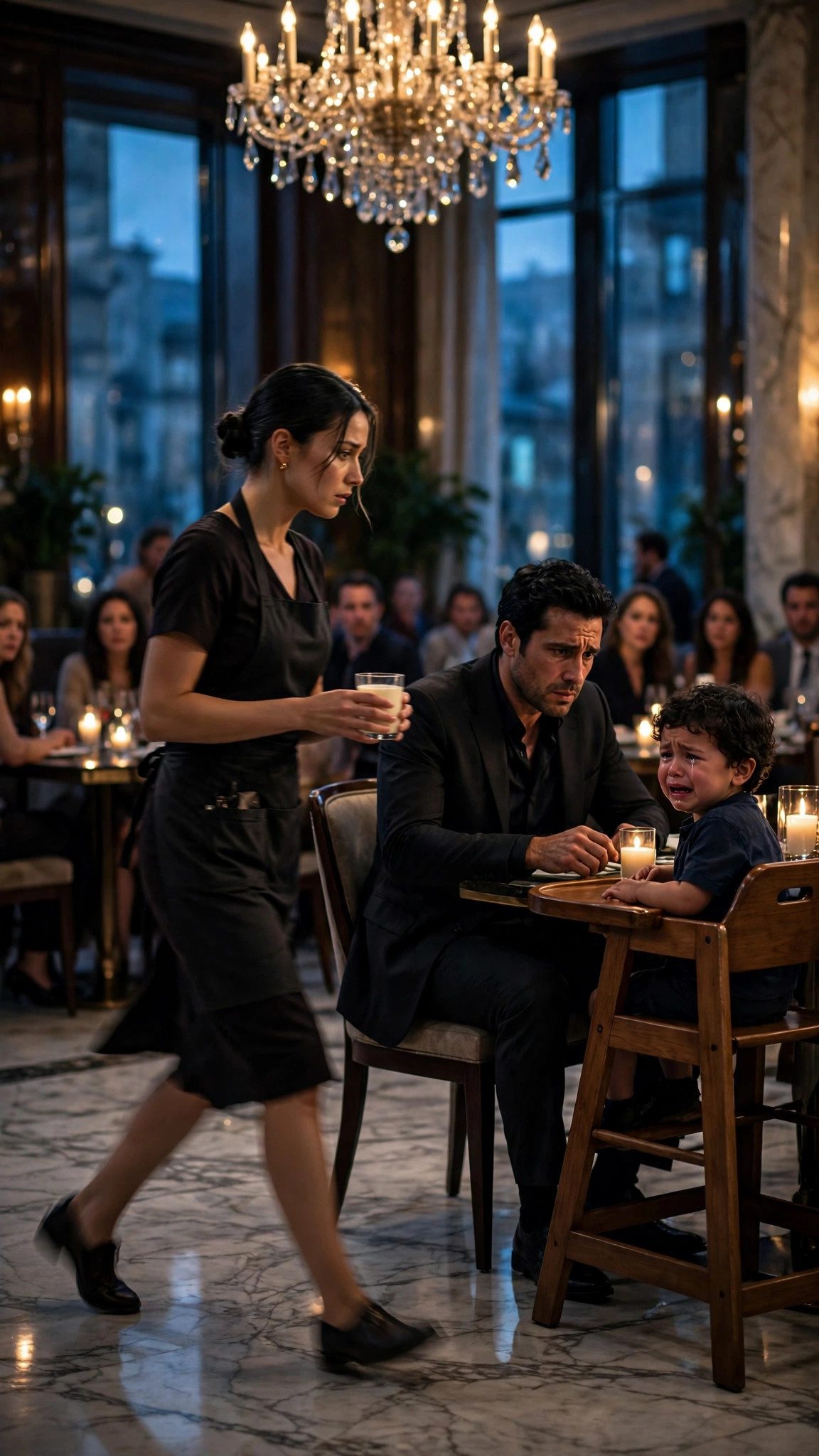
I had been working at the house on Willow Lane for three weeks when I finally asked Rico the question everyone in Brooklyn was afraid to ask.
We were sitting in the garden after Leo had gone to bed. It was a warm evening in early May, and the lemon tree smelled sharp and sweet, and the city hummed beyond the garden wall like a distant sea. Rico had poured two glasses of wine. He handed one to me without asking if I wanted it, and I took it because my hands were steady and my heart was not, and I had learned a long time ago that sometimes you take the wine.
"Mr. Moretti," I said.
"Rico," he said. "When we are alone, and Leo is asleep, I am Rico. 'Mr. Moretti' is for the restaurant."
"Rico," I said, trying the name out. It felt strange in my mouth, like a word in another language. "How did you become the Butcher?"
He was quiet for a long time. He turned his wine glass slowly between his hands, watching the red liquid catch the light from the kitchen window.
"My father," he said at last, "was Salvatore Moretti. He built everything I have from nothing. He came to this country with a suitcase and a temper, and he built restaurants and construction companies and a freight business, and he did it with his hands and his will and, yes, with men who were not always lawful. I grew up in his office. I did my homework at his desk while his men came and went. I learned to read a room before I learned to read a book."
He took a sip of wine. "When I was nineteen, a rival crew tried to take one of my father's warehouses on the docks. They sent six men at night. My father sent me. Alone. Not because he wanted me to fight them. Because he wanted me to show them that the Moretti family did not send armies. We sent one man, and that was enough."
"What happened?" I asked.
"I went in," Rico said. "I talked. I listened. I found out that three of the six men didn't want to be there at all — they were scared kids from the neighborhood who had been promised money they would never see. I sent them home. The other three I fought. I was nineteen and angry and afraid, and I came out with blood on my shirt and a broken rib and the warehouse still ours. And the next morning, one of those men — one of the ones I sent home — told the whole neighborhood that the young Moretti had gone into a warehouse full of armed men and come out like a butcher."
"So the name came from a story," I said.
"The name came from fear," Rico said. "Fear is useful. Fear keeps people from testing you. Fear keeps your family safe. I let the name grow. I let it become something bigger than me, because a name that frightens people is a wall, and I needed walls. But the truth is simpler than the story. I have never enjoyed hurting anyone. I have done what I had to do to protect what was mine. That is all."
He looked at me then, and his eyes were dark in the garden light. "Elena knew that. She was the only person who ever looked at me and saw a man instead of a name. She used to say, 'Rico, you are not the Butcher. You are the boy who came home with blood on his shirt and cried in my arms.' She was the only one who ever saw me cry."
"She sounds like she was extraordinary," I said.
"She was." He set his glass down. "And the night she died, I was supposed to be in that car. I stayed behind to finish a phone call about a freight contract. A contract. I chose a phone call over driving my wife home, and I have lived with that for six months, and I will live with it for the rest of my life."
"That's not your fault," I said quietly.
"Isn't it?" He laughed, a short, bitter sound. "Then whose fault is it, Clara? The police said it was random. A drive-by. Wrong place, wrong time. But Elena was not in the wrong place. She was on Atlantic Avenue, on her way home, on a route she took three times a week. Someone knew that route. Someone knew she would be there. Someone knew I was supposed to be beside her."
"The mole," I said. The word came out before I could stop it. "Dante said someone leaked her route."
Rico nodded slowly. "Someone in my organization told Castellano where she would be. Vincent Castellano. He has wanted the docks for ten years. My father kept him out. I kept him out. Elena's death was a message: I can reach your family. I can reach anyone."
"Castellano," I repeated. The name felt cold in my mouth. "Have you found who helped him?"
"Not yet." Rico's jaw tightened. "I have narrowed it to five men who knew the route that night. Five men I have trusted for years. One of them sold my wife's life for money. I will find him, Clara. And when I do—" He stopped. He looked at his hands. "When I do, I will do what the law allows. Elena would have wanted that. She never wanted me to be the Butcher. She wanted me to be the man who came home."
I thought about that for a long time. About a name that was a wall. About a man who had built his whole life out of fear and was now trying to build something else out of it.
"Leo asked about her today," I said softly.
Rico's head came up. "What did he say?"
"He pointed at her photograph in the hallway and said, 'Mama.' Just that. One word. And then he touched the glass, very gently, like he was afraid it would break."
Rico closed his eyes. For a moment, he didn't speak at all. Then he said, "He remembers her. I was afraid he would forget."
"He won't forget," I said. "He's three years old. He remembers her hands. He remembers her voice. He remembers the way she smelled. Children remember love in their bodies, even when they don't have the words for it yet."
Rico stood up then, and walked to the lemon tree, and stood there with his back to me for a while. When he came back, he sat down and poured himself another glass of wine, and he said, "Tell me about your grandmother."
So I told him. I told him about Rosa, and the lemon cake, and the warm milk with one sugar cube, and the care home in Flushing, and the way her memory slipped a little more every month. I told him about the panic attacks, and Dr. Patel, and the breathing, and the nights on the bathroom floor. I told him about my mother, and the aneurysm, and the braiding of hair at the kitchen table.
I had never told anyone all of it at once. Not Sarah. Not anyone. But sitting in that garden, with the lemon tree and the wine and a man who had lost everything, it felt like the most natural thing in the world.
When I finished, Rico was quiet for a long moment. Then he said, "Your grandmother raised a brave girl."
"I'm not brave," I said. "I'm just stubborn. There's a difference."
"Maybe," he said. "But Leo thinks you're brave. And Leo is a very good judge of people. He bit Dante, you know. Dante is six foot four and two hundred and fifty pounds, and my son bit him. But he has never once tried to bite you."
"He bit Dante because he was scared," I said. "He doesn't bite me because I don't scare him."
Rico nodded. "Exactly."
The next day, Rico's mother came to the house. Isabella Moretti was sixty-eight years old, small and straight-backed, with silver hair pinned in a knot and eyes as dark as her son's. She walked into the kitchen like she owned it — which, in a way, she did — and she looked at me from head to toe without saying a word.
"So," she said at last, in a voice with a thick Italian accent. "You are the girl with the milk."
"Yes, ma'am," I said. "I'm Clara."
She walked closer. She took my chin in her hand — gently, but firmly — and turned my face to the light. "You have kind eyes," she said. "Elena had kind eyes. My son has not looked at anyone with kind eyes in six months, except his son. And now he looks at you."
I didn't know what to say to that, so I said nothing.
Isabella let go of my chin. "My son is a good man," she said. "But he is a man who has lived behind a name for a long time. The name kept him safe, but it also kept him alone. Elena got past the name. You —" she paused. "You got past it too, and you did it with a glass of milk. Do not let him push you away when he gets afraid. He will try. Men like my son always try. They push away the people who see them clearly, because being seen is the most frightening thing of all."
"I won't," I said, and I meant it, even though I wasn't sure what I was promising.
Isabella nodded, satisfied. Then she went into the sitting room and sat at Elena's piano, and she lifted the lid — the first time anyone had lifted it in six months — and she played a few soft notes, and Leo came running from the garden, and he climbed into her lap, and she played while he pressed the keys with one finger, and the house filled with music for the first time since Elena died.
I stood in the doorway and watched them, and my throat went tight, and I thought about Rosa, and about the way love moves through a family even after someone is gone, like light through a window that nobody has closed.
That night, after Isabella left and Leo was asleep, Rico found me in the kitchen, washing the dinner dishes. He stood behind me for a moment without speaking. Then he said, "My mother likes you."
"She's very kind," I said.
"She is never kind to strangers," Rico said. "She interrogates them. She liked you."
He was quiet for a moment. Then he said, "Clara, I want you to know something. The five men who knew Elena's route that night — I have been watching them. One of them is Sal Ferraro."
I turned around, my hands still wet. "Sal? The driver? Dante said he's been with the family for twelve years."
"Twelve years," Rico said. "And in the last six months, he has bought a new car, paid off his mother's house, and taken three trips to Atlantic City. On a driver's salary."
"That doesn't prove anything," I said.
"No," Rico agreed. "It doesn't. But it is a thread. And I am going to pull it. Carefully. Because if Sal is the mole, then Castellano has had a man inside my house for twelve years, and I need to know what else he has told them."
He looked at me then, and his expression was the one I had seen on the first night, at the restaurant: exhausted, and afraid, and trying very hard not to show it.
"If Sal is the mole," he said, "then the black SUV was his. He was watching you. And Clara — I need you to promise me something. If anything ever feels wrong, if anyone ever makes you feel unsafe, you come to me or Dante immediately. You do not try to handle it yourself. Do you promise?"
"I promise," I said.
He nodded. Then he did something I didn't expect. He reached out and took my hand — my wet, soapy hand — and he held it for a moment, just held it, like it was something steady in a world that wasn't.
"Good night, Clara," he said.
"Good night, Rico," I said.
And when he let go, my hand was warm, and my heart was beating too fast, and I stood in the kitchen for a long time after he was gone, listening to the quiet house, and thinking about a name that was a wall, and a man who was trying very hard to climb over it.
The next morning, I found Rico in the sitting room before Leo woke up. He was sitting at Elena's piano, the lid open, his hands resting on the keys without pressing them. He didn't look up when I came in.
"She used to play in the mornings," he said quietly. "Before Leo woke up. Chopin, mostly. She said it was the only time the house was quiet enough for music. After she died, I couldn't open the lid. It felt like opening it would mean she was really gone. My mother opened it yesterday. I thought I would be angry. I wasn't. I was relieved."
He pressed one key. A single note, soft and clear, hung in the air.
"Do you play?" he asked.
"No," I said. "My grandmother sang, but I never learned an instrument. I was always too busy working."
"Leo should learn," Rico said. "Elena would have wanted that. When he's older. When he's ready."
He pressed another key. Then another. Slowly, uncertainly, he began to pick out a simple melody — a lullaby, I thought, though I didn't recognize it. His hands were clumsy on the keys, nothing like the hands that signed contracts and held wine glasses with such precision. But the melody was gentle, and it filled the sitting room like morning light.
"That's the song she sang to him," Rico said, without stopping. "When he was a baby. Before bed. She had a beautiful voice. She would hold him and sing, and he would fall asleep in her arms, and I would stand in the doorway and watch them, and I would think that I was the luckiest man in the world."
His voice cracked on the last word. He stopped playing. He put his hands flat on the keys, and he bowed his head, and his shoulders shook once, twice, the way they had in the kitchen the night Leo said "more."
I didn't say anything. I walked over and stood beside the piano, and I put my hand on his shoulder, and I stayed there until his breathing slowed.
Upstairs, a small voice called out, "Clara?"
Rico lifted his head. He wiped his eyes with the back of his hand. "He's awake," he said.
We went up together. Leo was sitting up in bed, his hair sticking up in every direction, his blanket around his shoulders like a cape. When he saw us, he held out his arms.
"Clara," he said. "Daddy."
Rico froze in the doorway. "Did he just—"
"He said your name," I said softly. "He said 'Daddy.'"
Rico crossed the room in two steps and picked Leo up out of the bed, blanket and all, and he held him against his chest, and Leo wrapped his arms around his father's neck, and Rico closed his eyes, and for a moment the three of us just stood there in the morning light, and nobody said anything at all.
Later that day, after breakfast, Rico called me into his study. He opened a drawer and took out a small leather notebook, worn at the edges.
"This was Elena's," he said. "She kept a list in it. Songs she wanted Leo to hear. Books she wanted to read to him. Places she wanted to take him. The first page says, 'For Leo, when he is ready.' I want you to have it. Not to replace her. Never that. But so you know what she dreamed for him. So we can do it together."
I took the notebook with both hands. On the first page, in neat, looping handwriting, it said: "For Leo, when he is ready." Underneath, in smaller letters: "1. The beach at Coney Island. 2. The Bronx Zoo. 3. The Nutcracker at Christmas."
I turned the page. There were dozens of entries. Songs. Books. Places. All of them ordinary. All of them precious.
"We'll do them all," I said. "One by one. When he's ready."
Rico nodded. "One by one," he said. "Together."