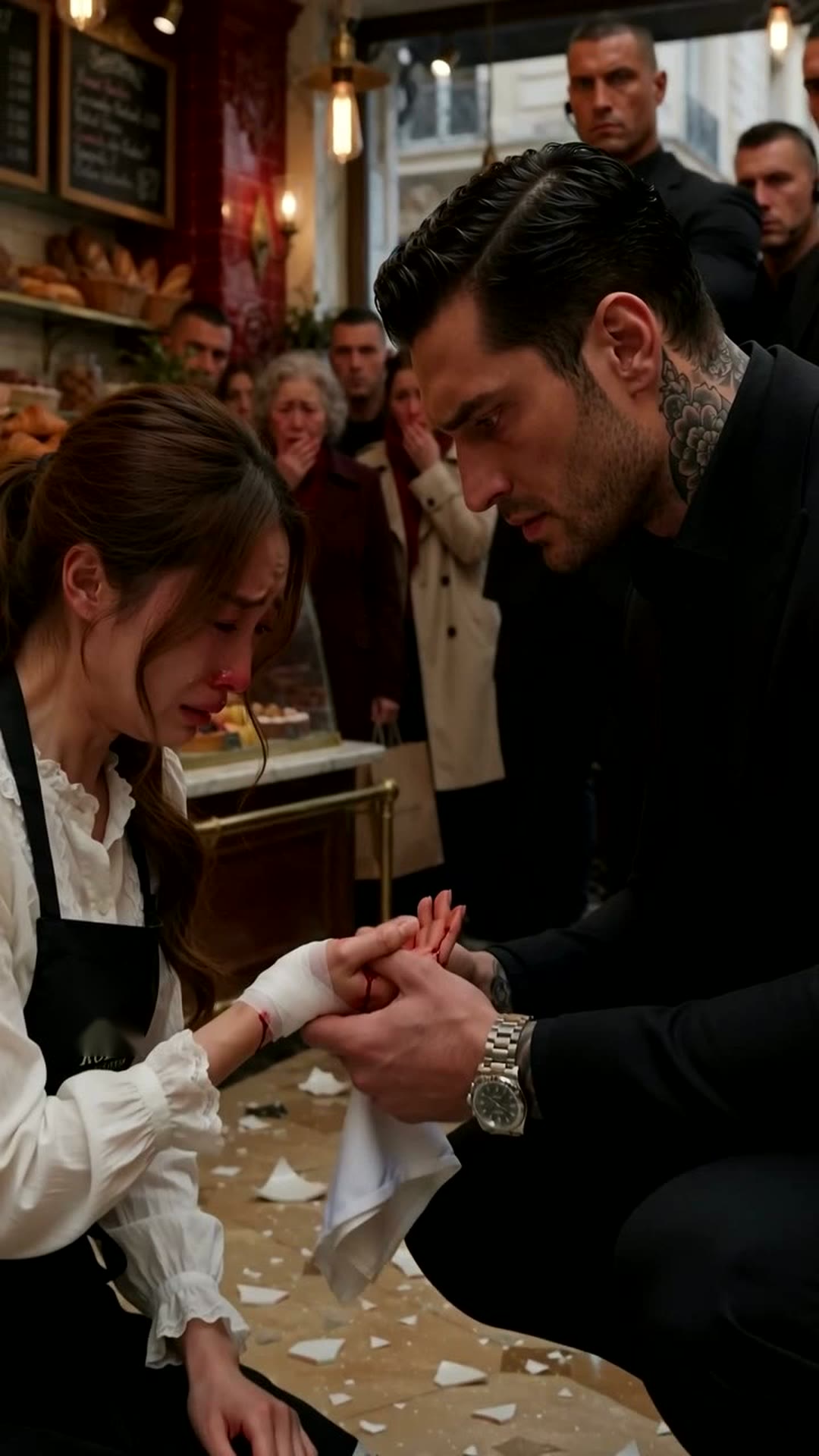
At eighteen, I was forced into a marriage with Alessandro Caruso, one of the most feared mafia bosses in the country. Four years later, I was working twelve-hour shifts in a bakery, barely surviving on leftover bread, when he suddenly walked back into my life. I accidentally spilled coffee on his shoes, and when he saw blood dripping from my hand, he ordered his men to bring a doctor. Then he leaned close and whispered, "I've spent four years trying to find you, Sophia." Before I could ask what he meant, a gunshot shattered the bakery window — and Alessandro threw himself over me.
My name is Sophia Chen.
I was twenty-four years old, broke, exhausted, and working at Moretti's Bakery in Bellhaven.
Every morning, I arrived before sunrise. My alarm went off at four, in a room so cold I could see my breath, and I rode the first bus across a sleeping city with my uniform folded in my bag and my hair still damp from a shower I took in water that never quite got hot.
Every evening, I left with aching feet and barely enough money to pay the bills.
My aunt Marie had raised me after my father's death. She told people she had sacrificed everything for me, and for a long time I believed her, because she said it so often and I had no one else to believe. But over the years, she'd accumulated enormous gambling debts — card rooms first, then horses, then men who did not use card rooms and did not send polite reminders.
And somehow, those debts had become my responsibility.
I paid the rent.
Bought the groceries.
Covered the utilities.
And handed over almost everything I earned to men who kept demanding more.
They came on Thursdays. They never raised their voices in the apartment. They didn't have to. Three days before that rainy morning, one of them had caught my wrist in the stairwell when I told him I was short forty dollars, and he had held it just a little too long, just a little too hard, while he smiled and told me to take care of myself. The bruise had bloomed purple-yellow under my sleeve, and I had learned to reach for the register with my other hand so the customers wouldn't see it.
Sometimes, I went an entire day without a proper meal. Mrs. Moretti let me take the bread that hadn't sold, and I told myself that was kindness, and it was. It was also survival.
But there was something nobody at the bakery knew about me.
At eighteen, I'd been married to a mafia boss.
Alessandro Caruso.
A man whose family controlled shipping companies, luxury hotels, and much of the city's underground empire.
Our marriage had been arranged after my father's death. My father had been in shipping too — a partner, a friend of the Caruso family, people said. He died in a car accident when I was eighteen, and before his grave had settled, the lawyers came, and then the Carusos came, and everyone spoke very quietly and very firmly about what my father would have wanted.
Protection, they called it.
A husband, they called him.
I remembered the ceremony.
The expensive flowers, white and funereal, banked along an altar I didn't choose.
The unfamiliar faces, rows of them, watching me walk down the aisle on my aunt's arm like I was evidence being presented in a courtroom.
The cold silver ring placed on my finger.
And Alessandro standing beside me, tall and still in a black suit, looking as though he'd rather face a firing squad than marry me. He said his vows like he was reading a contract aloud in a language he despised. He never once looked at me — not when the priest spoke, not when the ring went on, not when the room applauded.
I thought he hated me.
For two years I lived in that enormous house like a ghost in good dresses, eating dinners across a table long enough to seat twenty people, while my husband conducted his life at the far end of it and in rooms I was never invited into. The staff were kind to me in the careful way people are kind to furniture they feel sorry for. Alessandro was gone before I woke and home after I slept, and on the rare nights we crossed in a corridor he would stop — actually stop, mid-stride, like he'd forgotten I existed and been caught at it — and ask, with excruciating politeness, whether I had everything I needed.
Everything except a husband, I never said.
Once, in the second winter, I fell ill, the stupid, shivering kind of ill you get from grief and not eating, and I woke at three in the morning to find a tray outside my door: broth, bread, medicine, a note in handwriting I didn't recognize that said only Take all of it. I never learned who left it. I told myself it was the housekeeper. I needed it to be the housekeeper, because if it had been him, then the coldness was a performance — and if the coldness was a performance, then I had spent two years married to a man I didn't know at all.
Then everything fell apart. One night my aunt came for me with two relatives I'd never met, a packed bag I hadn't packed, and a document she showed me in the car — my name, his signature, an annulment. He wanted me gone. He had never wanted me at all. We drove through the night, and in the morning I was in another city, in another small room, being told very clearly: never contact the Caruso family again. It was for my own dignity. He had thrown me away, and decent people did not beg to be taken back.
For years, I believed Alessandro had wanted me gone.
We moved three times in the first year — I understood later that we were always moving. Marie would come home with her face arranged in that particular brightness that meant fear, and by Sunday my life would be in two suitcases again. I stopped enrolling in anything. I stopped making friends whose names I'd have to abandon. I worked cash jobs where I could and wrote Sophie on the application forms, because Sophie was a girl nobody was looking for, and when Marie's debts followed us anyway — they always followed us, no matter the city, which I was too tired to find strange — I paid them out of Sophie's wages and told myself this was simply what my life was: a debt with my name on it, owed to men whose names I never learned.
Until that rainy morning.
It had been raining since before my alarm. The bakery windows were fogged, the ovens were roaring, and by seven I had been on my feet for three hours and had burned my forearm lightly on a tray and hadn't eaten. I was carrying coffee toward table seven when my exhausted fingers slipped.
The cup shattered.
Hot coffee splashed across a stranger's polished black shoes.
I immediately dropped to my knees.
"I'm so sorry!"
I gathered the broken porcelain with my bare hands, the way you do when the floor is wet and the dining room is full and your manager is watching. A sharp piece sliced my palm. Blood ran down my fingers and dripped, bright and stupid, onto the wet floorboards.
Then a man's voice cut through the bakery.
"Stop."
Everyone went silent.
I looked up.
Dark hair.
Black suit.
Cold gray eyes.
My heart nearly stopped.
Alessandro Caruso.
Older. Broader. Even more intimidating than I remembered — the boy of twenty-six I'd married had been honed into something harder, and the tattoo at the side of his neck disappeared into his collar like a warning half-hidden on purpose. Two bodyguards stood behind him. But Alessandro wasn't looking at his ruined shoes.
He was staring at my bleeding hand.
"You're hurt."
"It's nothing."
"Look at me."
I slowly raised my eyes.
He studied my face, and something moved across his — something I had never once seen there in two years of marriage. Then he crouched down in front of me, heedless of the coffee soaking into the knee of a suit that cost more than my rent, took a clean handkerchief from his pocket, and wrapped it around my palm with hands that were almost — almost — not steady.
He leaned close, and whispered my name.
"Sophia."
His voice did something to my chest I had not given it permission to do. He remembered me. Of course he remembered me. But I hadn't expected him to sound like seeing me hurt him.
"I've spent four years trying to find you, Sophia."
"This needs stitches," he said, louder, to the room, to himself.
"I can't afford a hospital."
His jaw tightened. He looked at one of his guards.
"Call Dr. Rosini. Tell him to meet us at the estate."
I pulled away.
"I'm not going anywhere with you."
Alessandro slowly stood. Mrs. Moretti, the bakery owner, had come hurrying out from behind the counter, wiping her hands on her apron, her face arranged into terrified welcome.
"Mr. Caruso! I didn't realize you were coming!"
He barely acknowledged her. Instead, he asked,
"How much does Sophia's family owe?"
My stomach dropped.
"That's none of your business."
He looked at his bodyguard.
"Dante. Find every creditor connected to Marie Chen. I want names, amounts, and every threat they've made."
I grabbed his sleeve.
"No! You don't understand. Those men are dangerous."
Alessandro looked down at me.
"Those men answer to me."
The entire bakery went silent.
I stepped backward.
"Why do you know about my aunt?"
He didn't answer immediately. Instead, his gaze dropped to my wrist, where my sleeve had ridden up as I grabbed him, and his expression turned frighteningly cold at the sight of the bruise.
"Who did this?"
I pulled my sleeve down.
"I bumped into something."
He looked at me. He didn't believe a word.
Then he turned toward Mrs. Moretti.
"Prepare Sophia's final paycheck. Add twelve weeks of severance."
I stared at him.
"You can't just fire me!"
"I didn't fire you."
"You just ended my job!"
He leaned closer.
"I ended the part where people get to hurt you while you work for them."
My eyes burned.
"I don't belong to you, Alessandro."
For a moment, something painful crossed his face. Then he said quietly,
"No, Sophia. You never belonged to me. And that's the mistake I've spent four years trying to explain."
Four years.
I stopped breathing.
"What are you talking about?"
He glanced toward the bakery windows, where the rain was hammering the glass and the street beyond it was gray and empty.
"We need to leave."
"I'm not going anywhere until you tell me why you're here."
Alessandro looked directly into my eyes.
"Because I never agreed to let you go."
My heart pounded. All those years, I'd believed he had abandoned me. Now he was standing in front of me like he'd been searching for me all along.
Outside, a black SUV waited in the pouring rain. Alessandro opened the rear door and stood there getting soaked, waiting for me to decide, and I hated that even this — even now — some traitor part of me was listening to him.
I stopped beside him.
"Did you know where I was this whole time?"
Before he could answer —
BANG!
The bakery window exploded.
Glass scattered across the sidewalk. Someone screamed. Alessandro grabbed me and threw himself over my body, shielding me as another bullet struck the SUV with a sound like a hammer on a bell. His men drew their weapons. Dante shouted into his radio. I could barely breathe. Alessandro held me against the vehicle, one hand protecting my head, his body a wall between me and the street.
"Stay down, Sophia."
I looked at him.
"Who's shooting at us?"
Dante approached, his expression grim, rain running off him like he didn't feel it.
"Boss, they found her sooner than expected."
My blood turned cold.
Found me?
I looked at Alessandro.
"Who found me?"
He glanced at my bandaged hand. Then toward the shattered bakery window. And when he spoke, his voice was colder than I'd ever heard it.
"The people who killed your father."
I stared at him.
My father had supposedly died in a car accident. That's what Aunt Marie had told me. That's what I'd believed for six years.
But Alessandro wasn't finished. He reached inside his jacket and pulled out an old envelope, gone soft at the corners, kept flat against his heart like something carried a long time. On the front was my father's handwriting — I would have known it anywhere, that careful, upright script from a thousand grocery lists and birthday cards.
FOR SOPHIA — WHEN SHE IS SAFE.
I looked at the envelope.
Then at the man I'd once been forced to marry.
And suddenly, I wondered whether everything I'd been told about my father's death, my marriage, and Alessandro's disappearance had been a lie.