One year later, on a warm evening in June, I married Adrian Vale in the garden behind the mansion.
The garden had been my idea. Or rather, it had been my mother's idea, passed down through me. When Adrian asked me what kind of wedding I wanted, I told him I did not want a hotel ballroom, or a cathedral, or a hundred guests I did not know. I wanted the garden, and the people who had been there when it mattered, and the sky above us, and the harbor in the distance, where my mother had sewn canvas and where Adrian's father had started with a single truck.
So we were married in the garden, under a canopy of white lights, with fifty chairs set out on the lawn, and Mrs. Delgado in the front row, crying into a handkerchief, and Tina beside her, crying louder, and Daniel Cross standing at the back with his arms crossed, trying very hard not to cry and failing.
Dr. Ruiz was there too, in a blue dress, with her husband, and she hugged me before the ceremony, and she said, "You saved him twice, Mara. I only cleaned up after you. Don't ever forget that."
Adrian stood at the end of the aisle in a black suit, with his right arm at his side, strong and straight, the scar on his shoulder hidden under the fabric, a scar that would always be there, a thin white line where the cord had burned him, and where the surgeons had cut, and where his body had healed itself, because the poison was gone and the thread was gone and there was nothing left to stop it from healing.
He had done his physical therapy every day for a year. He had lifted the small weight up and down, up and down, until the small weight became a bigger weight, and the bigger weight became a full range of motion, and the doctor had said, "You will never be as strong as you were, Mr. Vale," and Adrian had said, "I don't need to be as strong as I was. I need to be strong enough to hold my wife's hand. And I am."
He held my hand as I walked down the aisle. His hand was warm and strong. And when I reached him, he leaned down and whispered, "You look beautiful," and I whispered back, "You look alive," and he laughed, a real laugh, the kind of laugh I had never heard from him in the nine months I had cleaned his house, because in those nine months, he had never once laughed.
The minister asked us the questions. We answered them. Adrian put a ring on my finger, a simple gold band, and I put a ring on his, and then he kissed me, and the garden erupted, and Mrs. Delgado cried harder, and Tina cheered, and Daniel Cross finally gave up trying not to cry and wiped his eyes with the back of his hand.
And I was wearing my mother's gold earrings.
Not the copies Adrian had made for me, although I loved those too, and I wore them every day. The real ones. The ones my mother had worn on her wedding day, and the ones she had left me in the little velvet box, the ones I had refused to sell outside the pawnshop on Eastern Avenue, twice.
I had taken them out of the sock drawer that morning, and I had put them on, and I had looked at myself in the mirror, and for a moment, I had seen my mother looking back at me, smiling, saying, "Don't identify thread by color, Mara. Look at the twist."
The twist, I thought, as I stood in the garden with my husband's hand in mine, is that the thread that almost killed him was the thread that brought us together. If Victor had not planted the cord, I would never have seen it. If I had never seen it, Adrian would have lost his arm, or his life. If I had not spoken, the kingdom would have fallen to Castellano, and Victor would have taken the docks, and none of us would be standing in this garden.
A single black thread, pulled loose, and the whole thing came apart. That was what my mother used to say about bad seams. Pull one thread, and the whole seam unravels.
But a good seam holds because the thread is right. And the thread that held us together was not black cord, or poison, or lies. It was the truth. It was a maid who saw what eighteen surgeons missed. It was a man who chose the law over revenge. It was a housekeeper who refused charity and earned her place. It was a boss who paid his debts and kept his promises.
After the ceremony, we danced on the lawn, under the white lights, to a song I did not know, and Adrian held me with his right arm, the arm that had almost been cut off, and he did not wince, and he did not falter, and he whispered in my ear, "Thank you for seeing the thread."
"Thank you for listening," I whispered back.
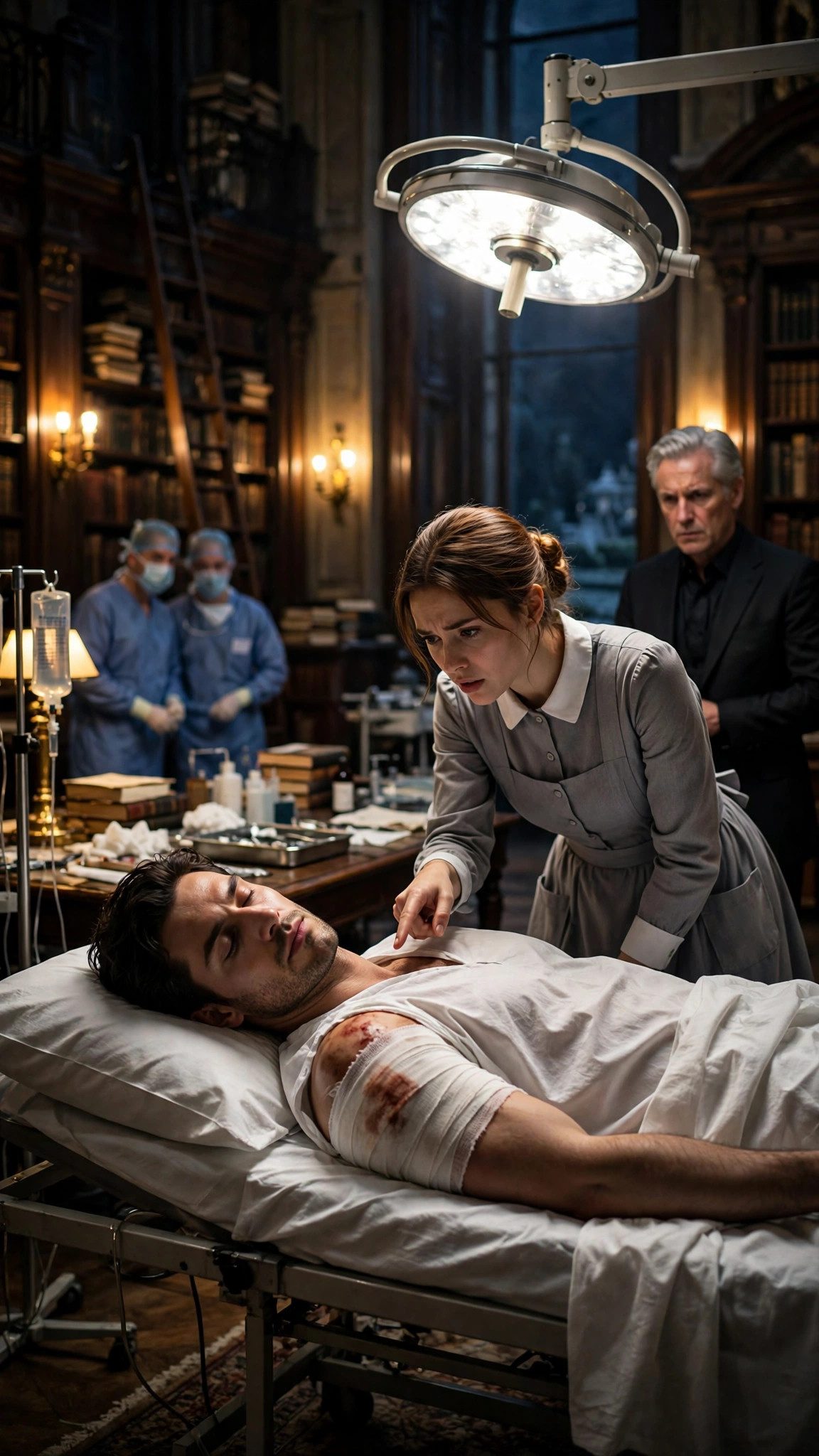
The Vale Foundation, which Adrian had started six months after the trial, now helped the families of dockworkers and seamstresses across Baltimore. It paid for medical bills, and for school, and for rent, when people were down to their last thirty-eight dollars and a FINAL NOTICE on the door. I ran it, with Mrs. Delgado's help, from an office in the mansion, in the room that had once been the library, where the surgical lights had been, where eighteen surgeons had stood around a bed and almost cut off a man's arm.
The library was a library again, but it was also an office, and on the wall, in a glass frame, hung a piece of black cord.
Not the cord that had been inside Adrian's shoulder. That cord was in an evidence locker, in a federal building, in a bag labeled with a case number. The cord on the wall was a clean piece, from the same batch, the same diamond braid, the same black color, mounted on a small plaque that read:
"Don't identify thread by color. Look at the twist. — Elena Bennett."
My mother's words. My mother's lesson. The lesson that had saved a man's life.
Every morning, when I came into the office, I looked at that plaque, and I thought about my mother, sitting beside her sewing machine, holding up a swatch, saying, "Feel this, Mara. This is cotton duck. This is waxed canvas. This is polyester. They look the same to a fool. They are not the same."
And I thought about Adrian, sleeping beside me in the morning, with his scarred shoulder, and his strong right arm, and his honest business, and his garden, and his wife who had once cleaned his floors.
That night, after the wedding, when the guests had gone home and the white lights were still glowing in the garden, Adrian and I sat on the back steps of the mansion, in our wedding clothes, with our shoes off, looking out at the harbor, where the ships came in, and where my mother had sewn canvas, and where his father had started with a single truck.
"Are you happy?" he asked me.
"Yes," I said. "Are you?"
"Yes," he said. "For the first time in my life, I am happy. And it is because a maid with thirty-eight dollars in her bank account looked at my shoulder and saw a thread that didn't belong there, and had the courage to say so."
He took my hand. His hand was warm. The gold earrings caught the light from the garden, and they shone, small and plain and perfect.
"Your mother would be proud of you," he said.
"I know," I said. "She taught me to look at the twist. And the twist told me everything."
We sat there for a long time, on the back steps, in the warm June night, with the harbor lights in the distance, and the garden lights above us, and the whole kingdom, unraveled and rewoven, holding together at last.
The morning of the wedding, Tina came to my apartment at seven o'clock with a garment bag and a box of white lilies and a look on her face like she had been planning this day for months, which, as it turned out, she had.
"I have been waiting for this since the night you screamed in the hallway," she said, unzipping the garment bag. Inside was a simple white dress, not a ball gown, not a princess dress, but a clean, elegant dress with a soft skirt and a lace bodice, the kind of dress my mother would have approved of, because it was beautiful without trying too hard.
"Adrian picked it," Tina said. "He went to the shop himself. He said, 'She won't want anything fancy. She'll want something she can dance in.' Was he right?"
"He was right," I said, and my voice caught, because I had never owned a dress like that in my life.
Mrs. Delgado arrived an hour later, with a pair of pearl earrings she insisted I borrow, and a handkerchief embroidered with my initials, and a small lecture about marriage that I will remember for the rest of my life.
"Marriage is like a seam," she said, while she helped me with my hair. "If the thread is good, and the stitches are even, it holds through anything. If the thread is bad, it fails at the first pull. You and Mr. Vale have already been tested. You have already been pulled. And you held. So do not be afraid. The hard part is over."
Tina did my makeup. Mrs. Delgado did my hair. And then I opened the little velvet box, and I took out my mother's gold earrings, and I put them on, and the three of us stood in front of the mirror, and nobody said anything for a moment, because there was nothing to say.
The vows were simple. Adrian had written them himself, on a piece of paper he kept folded in his pocket, and his hands shook a little when he unfolded it, which made me love him more, because the most feared man in Baltimore was nervous about saying the right words to a maid.
"Mara Bennett," he said, "I promise to listen when you speak, because the first time you spoke, you saved my life. I promise to see what you see, and to trust what you know, even when no one else does. I promise to be honest, and to be kind, and to build a life with you that my father would be proud of, and your mother would be proud of, and that our children will be proud of. And I promise that I will never again be too proud, or too stubborn, or too afraid, to ask for help when I need it."
Then it was my turn, and I had not written anything down, because I had never been good at writing things down, but I knew what I wanted to say.
"Adrian Vale," I said, "I promise to look at the twist, and not just the color. I promise to tell you the truth, even when it is hard to hear. I promise to stand beside you, not behind you, and to save you as many times as you need saving. And I promise to love you, not because you are powerful, or because you are rich, or because you are feared, but because you are a man who chose to do the right thing when it cost him everything, and that is the bravest thing I have ever seen."
Daniel Cross gave the first toast at the reception. He stood up, in a suit that Mrs. Delgado had ironed for him that morning, and he raised his glass, and he said, "I have known Adrian Vale for eighteen years. I have taken a knife for him. I have stood outside his door while men tried to kill him. And I have never once seen him afraid. But the night Mara Bennett pointed at a thread and said it didn't belong there, I saw him afraid for the first time, because he realized that the people he trusted most were the ones trying to kill him. And then I saw him do the bravest thing I have ever seen a man do. He listened to a maid. So here's to Mara, who saw what eighteen surgeons missed, and to Adrian, who was wise enough to listen."
Dr. Ruiz gave the second toast. She stood up, in her blue dress, and she said, "I have been a doctor for twenty-five years. I have seen infections, and poisonings, and wounds that would not heal. But I have never seen a patient saved by a seamstress's daughter. Mara, your mother taught you something no medical school teaches: that knowledge comes from everywhere, and that the person in the room who knows the most is not always the person with the most degrees. Never forget that. And Adrian, take care of her. She is rarer than you know."
We danced then, on the lawn, under the white lights, to a song I did not know, and Adrian held me with his right arm, the arm that had almost been cut off, and he did not wince, and he did not falter, and he whispered in my ear, "Thank you for seeing the thread."
"Thank you for listening," I whispered back.
One year after the wedding, on a warm evening in June, the Elena Bennett Foundation held its first anniversary dinner in the garden behind the mansion. Fifty people came: dockworkers and their families, seamstresses from the old workshop on the docks, nurses from the hospital where my mother had died, and Daniel Cross, and Dr. Ruiz, and Mrs. Delgado, who was supposed to be retired but who still came to the kitchen every morning to make sure the coffee was right.
Adrian stood up to speak, and he told them about a maid who had saved his life with a piece of thread, and about a mother who had taught her daughter to look at the twist, and about a foundation named for a seamstress who had never been famous, but who had been the best woman her daughter ever knew.
And then he put his hand on my shoulder, very gently, and he said, "And next year, there will be one more person at this table. Our daughter. Elena, after her grandmother. She is coming in December, and her mother has already promised to teach her about thread."
The garden erupted. Tina cried. Mrs. Delgado cried harder. Daniel Cross wiped his eyes with the back of his hand and pretended he had something in them.
And I sat there, with my husband's hand on my shoulder, and my hand resting on the small curve of my belly, where our daughter was growing, and I thought about my mother, sitting beside her sewing machine, holding up a swatch, saying, "Feel this, Mara. This is cotton duck. This is waxed canvas. This is polyester. They look the same to a fool. They are not the same."
One day, I would sit beside my own daughter, and I would hold up a piece of thread, and I would say the same words. And she would learn, as I had learned, that a bad seam fails at the thread, but a good seam, sewn with the right thread, by hands that know what they are doing, holds forever.
Because a bad seam fails at the thread. But a good seam, sewn with the right thread, by hands that know what they are doing, holds forever.
And ours, I knew, would hold.
The End.
THE END