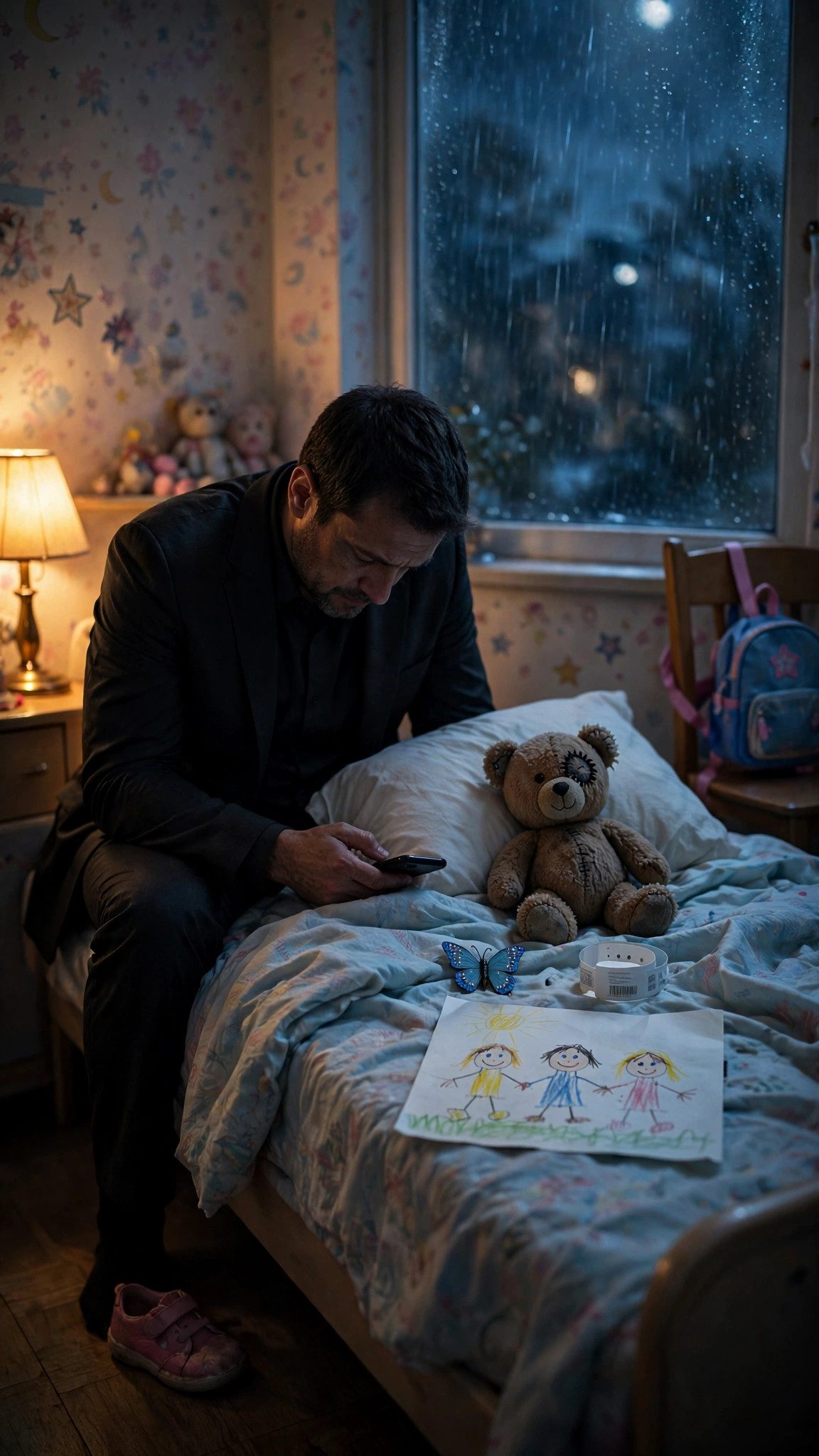
The day Lily died started like any other Tuesday. She woke up before her alarm, the way she always did, and came padding into my bedroom in her bare feet, her hair a wild tangle of brown curls, and climbed into my bed, and whispered in my ear, "Mommy, it's ballet day."
"I know, baby," I said, and I pulled the covers over both of us. "Five more minutes."
"Five minutes is too long," she said, very seriously, and then she giggled, and then she was gone, thundering down the stairs to the kitchen, where Rosa, our housekeeper, was already making pancakes in the shape of butterflies, because Tuesdays were ballet days and ballet days deserved butterfly pancakes.
I watched her eat two whole pancakes, which was a record, and then she went upstairs to choose her outfit, which took forty minutes, because Lily never simply chose an outfit. She held up each dress, considered it, discussed it with her teddy bear, and then rejected it for reasons that were entirely her own. That morning she chose the pink leotard with the sparkles and her favorite jeans and the butterfly hair clip, blue and silver, which she had worn every day for a week.
"Do I look beautiful, Mommy?" she asked me, spinning around in the front hall.
"You look like the most beautiful girl in Chicago," I told her, and she believed me, because six-year-olds believe their mothers about such things, and because it was true.
School was ordinary. She hugged me at the drop-off line, and she ran inside without looking back, the way she always did, and I drove home and did the ordinary things: laundry, groceries, a call to my sister Sarah about Sunday lunch. I remember thinking, as I folded Lily's little socks, that it was a good day. A quiet day. A nothing day. The kind of day you forget by dinner.
At three o'clock, I picked her up from school. She came running out with a drawing clutched in her hand, a family drawing, the one I would later find on her bed. In the drawing, she had drawn the three of us in the garden. She had drawn herself holding my hand. She had drawn Damian standing farther away, near the gate, smaller than the rest of us, as if she had run out of room on the page. Or as if she already knew, in the way children know things before adults do, that he was drifting away from us.
"Look, Mommy!" she said, holding it up. "That's you, and that's me, and that's Daddy. Daddy is coming home on Sunday, right?"
"That's what he said, baby."
"And we're going to the park, and he's going to push me on the swings until I touch the sky."
"That's what he said."
She nodded, satisfied, and folded the drawing carefully into her backpack, and we drove to ballet class, and she chattered the whole way about her teacher and her friends and the new girl who could do a perfect pirouette, and I listened with half an ear, the way mothers do, smiling and nodding and thinking about dinner.
Ballet ended at five. It was raining by then, a thin, cold rain that made the streets shine. Lily came out of the studio with her hair damp and her cheeks pink, and she climbed into the back seat, and she buckled her own seatbelt, because she was six and very proud of being able to do it herself, and she said, "Mommy, can we get ice cream?"
"After dinner, baby."
"Can I have the butterfly clip for my recital?"
"You can wear whatever you want for your recital."
She was quiet for a moment, looking out the window at the rain. Then she said, "Mommy, when Daddy comes home on Sunday, can we all go to the park together? All three of us?"
"Yes, baby. All three of us."
That was the last normal thing she ever said to me.
We were on Lake Shore Drive, coming home, when the truck came across the center line. I saw the headlights swing toward us, and I had time to think, no, and time to turn the wheel, and time to scream her name, and then the world turned sideways. Our car spun twice. The airbags exploded, white and violent, filling the car with smoke and the smell of chemicals. Glass shattered around us. Metal screamed. And then there was silence, a terrible, ringing silence, broken only by the rain on the roof and the ticking of the engine cooling down.
I could not move at first. My chest hurt where the seatbelt had caught me. My ears were ringing. And then I heard her. A small, frightened sound from the back seat.
"Mommy?"
I turned toward her. Blood was running down her forehead in a thin red line. Her butterfly clip had come loose and was hanging by one wing in her hair. Her eyes were wide and scared, and she was reaching for me with one small hand.
"Where's Daddy?"
That was the first time. I unbuckled my seatbelt, and I crawled into the back seat, and I held her, and I told her Daddy was coming, and I called 911 with shaking hands, and I gave them our location, and I stayed on the phone until the sirens came, and all the while Lily kept looking at the door, waiting for her father to appear, because in her mind, that was what fathers did. They appeared. They fixed things. They made the scary things go away.
The paramedics were kind and fast. They put a collar on her neck, and they lifted her onto a stretcher, and they loaded her into the ambulance, and I climbed in beside her, and I held her hand, and I called Damian. No answer. I called again. Nothing. I called a third time, a fourth time, and on the fifth attempt, my phone buzzed with his reply.
"In a meeting."
I stared at those three words. My daughter was in an ambulance with blood on her face, and her father was in a meeting. I typed back with fingers that would not stop shaking: Lily's been in an accident. Call me now.
He didn't respond.
At the hospital, they rushed her into the emergency department, and I ran beside the gurney, and the nurses were asking me questions, what happened, was she wearing a seatbelt, did she lose consciousness, and I answered them as best I could, and all the while Lily was squeezing my hand, and she looked up at me, and she asked me the second time.
"Is Daddy coming?"
"Yes, sweetheart," I said. "Daddy's coming."
They took her into the trauma bay, and there were people everywhere, and monitors were beeping, and someone was cutting away her little pink leotard, the one with the sparkles, and I stood in the corner with my hands over my mouth, watching strangers work on my baby, and Lily found my face through the crowd, and she asked me the third time.
"Where's Daddy, Mommy?"
"He's on his way," I said. "He's on his way, baby. Just hold on."
A nurse came to me with a clipboard and a consent form, and she explained, very gently, that Lily had internal bleeding, and that she needed emergency surgery, and that I needed to sign, and I signed with a hand that shook so badly the signature looked like a child's scribble. And then they were wheeling her toward the operating room, and she reached for me, and I leaned down, and she whispered the fourth question in my ear.
"Does Daddy know I'm hurt?"
"Yes, baby," I said, and I turned my face away so she wouldn't see me cry.
She frowned, confused, the way she did when she was working out a puzzle.
"Then why is he taking so long?"
The fifth time. I had no answer. I kissed her forehead, and I told her that Daddy loved her more than anything, and that he was trying to get to her, and that she had to be brave, just a little bit longer. And then the doors closed, and she was gone, and I was standing in a hallway that smelled like antiseptic, staring at a clock on the wall, watching the minutes crawl by.
I called Damian again. And again. And again. Voicemail, every time. I texted him: She's in surgery. Please. Please call me. Nothing. I called his assistant. I called his driver. I called the office in Chicago, and a woman I did not know told me that Mr. Moreland was traveling and could not be reached, and I wanted to scream at her, to tell her that his daughter was dying, that his six-year-old daughter was in surgery and asking for him, but my voice would not work. I just stood there with the phone in my hand, listening to the dial tone, and thinking about a yacht in Monaco, and a woman named Sabrina, and a man who had chosen all of it over us.
Two hours passed. The surgeon came out once to tell me they were doing everything they could. I nodded. I thanked him. I went back to staring at the clock.
And then, just before they took her back for the second procedure, a nurse let me see her for a few minutes. She was so small in that big hospital bed, so pale, with tubes and wires everywhere, and her eyes fluttered open when I touched her hand, and she smiled at me, a tiny, brave smile, and she said, "Mommy?"
"I'm here, sweetheart."
"Don't let Daddy be sad."
"Why would Daddy be sad?"
Her eyes filled with tears. "Because I ruined his trip."
I have thought about those words every day since. My daughter, six years old, lying in a hospital bed with internal bleeding, worried that she had ruined her father's vacation. She was not angry. She was not afraid for herself. She was worried about him. That was the kind of child she was. That was the kind of heart she had.
"No, Lily," I said. "You didn't ruin anything."
She swallowed. Her voice was barely a whisper.
"Daddy still loves me the most, right?"
The sixth time. I nodded, and I kissed her forehead, and I told her yes, yes, Daddy loves you the most, Daddy loves you more than anything in the world. And then they wheeled her away, and I stood in the hallway, and I prayed. I am not a praying woman, not really, but I prayed that night, to anyone who would listen, to God, to my mother, to the universe, to anyone. Let her live. Let her live, and I will forgive everything. I will forgive the trips and the mistress and the lies. Just let her live.
Damian finally called back two hours and thirty-eight minutes later. I was standing outside the operating room, and my phone rang, and I saw his name, and for one wild, hopeful second I thought: he's coming. He's on a plane. He's on his way.
"What happened?" he said.
"Our daughter is in surgery."
His voice sharpened. "I'm coming home."
"Where are you?"
Silence.
"Damian."
"Monaco."
"With Sabrina?"
He didn't answer. I hung up.
An hour later, the surgeon came out, and I knew before he spoke. I knew from his face. I knew from the way he would not meet my eyes. I knew from the way the nurse behind him was crying.
"I'm sorry, Mrs. Moreland," he said. "We did everything we could."
Lily never woke up after surgery. At 11:07 P.M., my little girl died. And her father wasn't there.
I sat with her for a long time after that. The nurses let me hold her hand, and I talked to her, and I told her about the park, and the swings, and the butterfly cake, and I told her that Daddy was on his way, that he was almost here, that he loved her more than anything. I lied to her one last time, because the truth would have been too cruel, even for a child who was already gone.
And as I sat there, holding her cold little hand, I leaned close to her ear, and I whispered, "Daddy's coming, baby. He's almost here." And her lips moved, just barely, or maybe I only imagined it, or maybe it was only the last breath leaving her body. But I thought I heard her say, "Tell Daddy I waited."
Tell Daddy I waited.
That was the seventh time she asked for him. Seven times in one day. Seven times she reached for her father, and seven times he was not there. And I counted them, sitting in that hospital room, counting them on my fingers the way I had once counted her tiny toes when she was a baby, and I knew, with a certainty that settled into my bones like cold, that I would never forgive him. Not for the affair. Not for the lies. Not for Monaco. For this. For seven times. For a little girl who died believing her father was trying to get home, when he was not trying at all.
There is one more thing I have not told anyone, not even Sarah. In the trauma bay, when Lily asked me the fourth question, when she whispered, "Does Daddy know I'm hurt?" and then, "Then why is he taking so long?" — I had my phone in my hand. I had been holding it for hours, waiting for it to ring, and without thinking about it, without deciding to do it, I pressed the record button. I don't know why. Maybe some part of me already knew that Damian would need to hear it. Maybe some part of me knew that words on a page would never be enough, that he would find a way to explain it away, to soften it, to tell himself a different story. But a child's voice cannot be explained away. A child's voice is the truth, plain and unbearable.
So I recorded it. Eleven seconds. Her small voice, asking where her daddy was. My voice, lying to her. A pause. And then her voice again, asking why he was taking so long.
I kept that recording on my phone all night. I listened to it once, in the family room, while the surgeons worked, and then I never listened to it again, because once was enough to carve it into me forever. But I kept it. I kept it because I knew that one day, Damian Moreland would need to hear what his daughter sounded like when she asked for him. And I knew that when he heard it, there would be nowhere left for him to hide.