Damian Moreland woke up on the morning of the accident in a white suite on a yacht off the coast of Monaco, with the Mediterranean glittering outside the windows and a woman named Sabrina Voss asleep beside him, and he thought, for one brief moment, that he was happy.
He had not been happy in a long time. He had not been happy since the early years with Claire, since the days when Lily was small and the mansion was full of noise and laughter and the smell of pancakes. Somewhere along the way, the empire had swallowed him whole. The shipping company had grown into a fleet. The properties had multiplied. The men who worked for him had multiplied, too, and the problems had multiplied faster than the money, and the only place he felt like himself anymore was on the water, far from Chicago, where no one needed anything from him and the phone could be ignored.
That was the lie he told himself on the yacht. That the phone could be ignored. That his family would wait. That Claire would wait, the way she always waited, and that Lily would wait, the way children wait, patiently, trusting that their father will come home when he says he will.
Sabrina was awake by the time he came back from the deck. She was sitting up in bed, her blonde hair loose around her shoulders, scrolling through her own phone, and she smiled at him, the smile she had perfected over two years, the smile that said: I am not your wife, I am not your responsibility, I am the easy part of your life.
"Good morning," she said. "The captain says the weather will hold. We can swim after lunch."
Damian nodded. He reached for his own phone on the nightstand. It was not there.
"Sabrina," he said. "Have you seen my phone?"
She did not look up. "It's charging in the salon. You left it there last night."
He went to the salon. The phone was on the counter, plugged in, face down. He picked it up. Five missed calls from Claire. A text message. He read it standing in the middle of the salon with the sun coming through the windows and the sea rocking gently beneath his feet.
Lily's been in an accident. Call me now.
His hands went numb. The phone slipped, and he caught it against his chest, and he called her back, and the call went to voicemail, and he called again, and again, and on the third try, a nurse answered, and she told him, in a calm, professional voice, that his daughter was in emergency surgery, and that he should come home, and that he should come home now.
He did not ask Sabrina to come with him. He did not say goodbye to her properly. He shouted for the captain, and he shouted for his pilot, and within an hour he was on his private jet, crossing the Atlantic, staring out the window at the clouds, doing the math in his head, the way he always did the math: distance, speed, time. Two hours and thirty-eight minutes. That was how long it took him to call her back after her first call. Two hours and thirty-eight minutes. He kept repeating the number, as if repeating it would make it smaller.
He called Claire from the jet. He heard her voice, and it was not the voice of his wife. It was the voice of a stranger, cold and flat, a voice that had already made its decision.
"What happened?"
"Our daughter is in surgery."
"I'm coming home."
"Where are you?"
"Monaco."
"With Sabrina?"
He did not answer. He could not answer. There was no answer that would not sound like what it was: a confession. He heard the click as she hung up, and he sat in the leather seat of his jet with the phone in his hand, and he thought about the last time he had seen Lily. She had been clinging to his leg in the front hall, begging him not to go, asking him to stay for her ballet recital. He had promised her the park on Sunday. He had promised her the swings. He had promised her that he would push her until she touched the sky.
He had broken every promise he had ever made to her, one by one, the way you break a chain, link by link, until there is nothing left to hold.
The jet landed in Chicago in the early morning. His driver was waiting. Damian did not go to the hospital. He did not need to. He already knew. He could feel it in the way his driver would not meet his eyes, in the way the man cleared his throat before he spoke, in the way the city looked gray and flat through the tinted windows, as if the color had gone out of it overnight.
"Take me home," Damian said.
The mansion was dark when he arrived. The housekeeper, Rosa, met him in the front hall, and her face was swollen from crying, and she did not say anything, and she did not need to. He walked past her, up the stairs, down the hall, to Lily's bedroom, and he opened the door.
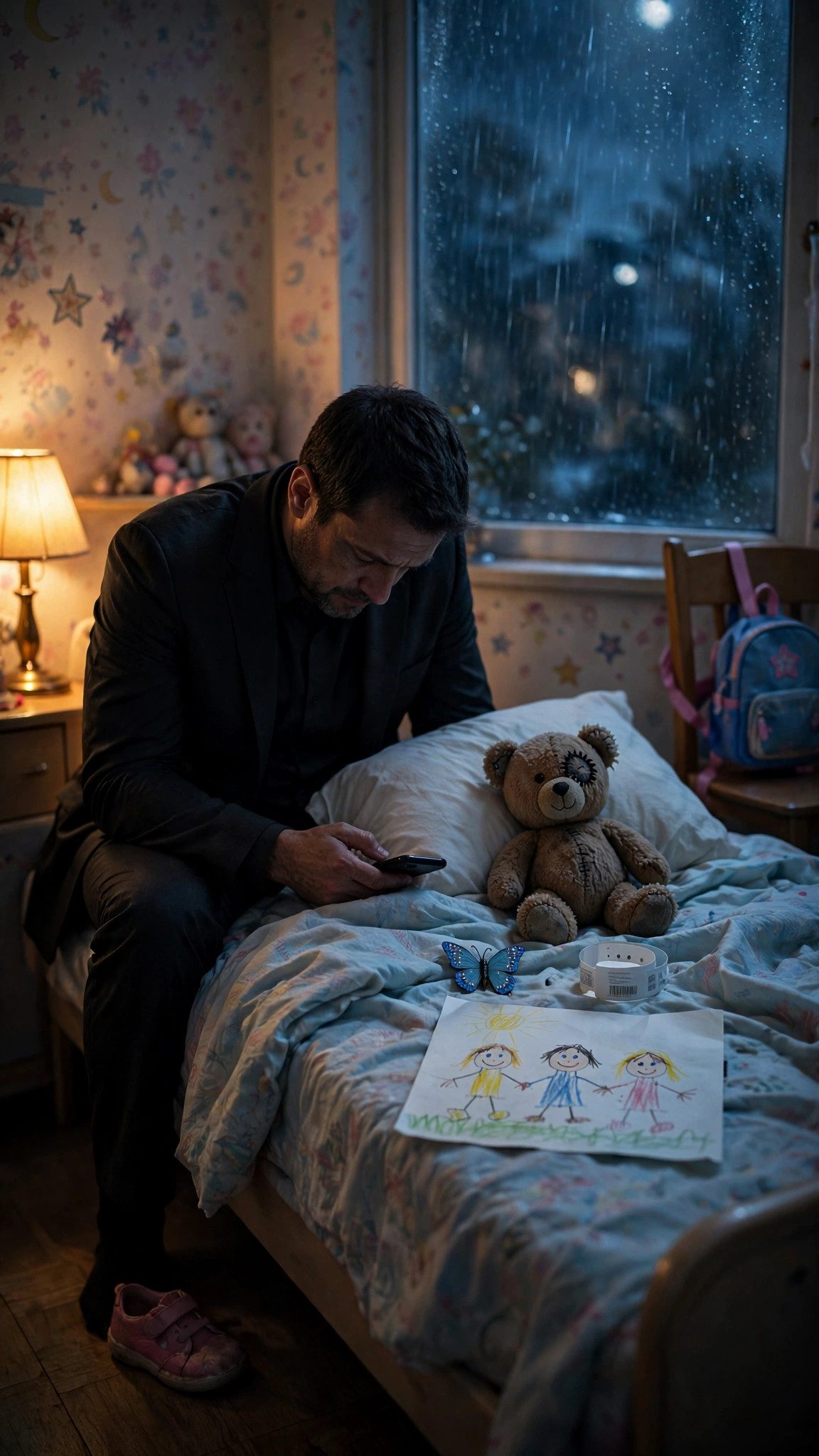
Her backpack still hung from the chair. One little shoe lay beneath the bed. Her one-eyed teddy bear rested against the pillow. On the bed, Claire had left four things. The butterfly hair clip Lily had worn during the accident. Her hospital bracelet. A family drawing she had made the week before. And Claire's phone.
He picked up the drawing first. Lily had drawn the three of them in the garden. She had drawn herself holding Claire's hand. She had drawn him standing farther away, near the gate, smaller than the rest of them. He stared at it for a long time, and he thought about the day she had drawn it, and he wondered if she had drawn him small on purpose, or if she had simply run out of room, and he would never know, and that not knowing was its own kind of punishment.
Then he picked up the phone. One recording was waiting. He pressed play.
Our daughter's tiny voice filled the room.
"Does Daddy know I'm hurt?"
Then Claire's voice. "Yes."
A pause.
"Then why is he taking so long?"
The recording ended. Beneath the phone, Claire had written: "I lied to our daughter until the very end, telling her you were coming. She died believing her father was trying to get home."
Damian sat on the edge of Lily's bed. He didn't call his guards. He didn't order anyone to find Claire. He just stared at the empty space where his daughter should have been, and he listened to the silence of the house, and he thought about the yacht, and the sun, and Sabrina's smile, and the phone face down on the counter in the salon, and he understood, with a clarity that cut through him like a knife, that he had not simply missed the calls.
Sabrina had hidden his phone.
He had left it on the counter the night before, and in the morning it was face down, and Sabrina had said it was charging, and he had believed her, because he had wanted to believe her, because believing her meant he did not have to look at the truth. But now, sitting on his dead daughter's bed, he remembered: Sabrina had been awake when he came back from the deck. She had been scrolling through her phone. She had known. She had seen Claire's name on the screen, and she had turned the phone face down, and she had said nothing, because a dying child in Chicago was an inconvenience, and a husband called home was a husband lost.
He stood up. He walked downstairs. Rosa was waiting in the hall.
"Mr. Moreland?" she said.
Damian didn't look up. "Did Claire leave alone?"
"Yes, sir."
"What did she take?"
"Just one suitcase."
He nodded slowly. Then asked the question he'd been afraid to ask.
"Did Lily ask about me?"
Rosa couldn't answer. She just shook her head, and tears ran down her face, and she turned away, because there was no answer that would not break him.
But the phone lying beside him already had. And Damian had only heard one of the seven times his little girl asked why her daddy hadn't come.
He went to his office then, and he closed the door, and he poured himself a drink, and he did not drink it, and he sat in the dark for a long time, and he thought about everything he had built, and everything he had lost, and he understood, finally, what his life had cost.
The shipping companies. The luxury properties. The empire protected by armed men. The private jets. The money that could buy almost anything. All of it, and none of it had been able to do the one thing that mattered: bring him home to his daughter when she needed him.
He picked up his phone and called Sabrina. She answered on the second ring, her voice bright and careless, as if nothing had happened, as if the world had not ended.
"Damian, darling, where are you? The captain is asking about dinner."
"Did you see the calls?" he said.
A pause. A silence that told him everything.
"Damian, I—"
"Did you see Claire's calls, and did you hide my phone?"
Another pause. Then, quietly: "I didn't want to ruin the trip."
He closed his eyes. His daughter had died worrying that she had ruined his trip. And the woman beside him on the yacht had hidden his phone for the same reason. The symmetry of it was so terrible that he almost laughed.
"Don't call me again," he said. "Don't come to Chicago. Don't come near my family. If you do, you will regret it."
He hung up. He sat in the dark office, and he looked at the walls covered with photographs of ships and buildings, the monuments to his empire, and he thought about Lily's drawing, and the butterfly clip, and the hospital bracelet, and the recording, and he made a decision.
He was going to find Claire. He was going to find his wife, and he was going to tell her the truth, all of it, and he was going to ask her to forgive him, even though he knew she would not, even though he knew he did not deserve it. And then he was going to tear down everything he had built, piece by piece, until there was nothing left of Damian Moreland, the most feared man in Chicago, except a father who had failed his daughter, and who would spend the rest of his life trying to make it right.
It was not enough. He knew it was not enough. Nothing would ever be enough. But it was the only thing he had left.
He stayed in Lily's room that night. He did not sleep. He sat on the edge of her bed with the teddy bear in his lap, and he looked at the things on her small desk: a box of crayons, a half-finished coloring book, a plastic crown from a birthday party, a photograph of the three of them at the lake house, Lily on his shoulders, Claire laughing, the sun going down behind them. He remembered that day. He remembered the way Lily had shrieked when he lifted her up, and the way Claire had said, "Careful, Damian, she's going to fall," and the way he had said, "She's my daughter. She never falls when I'm holding her."
He had believed that. He had believed that as long as he was holding her, she would never fall. He had not understood that the danger was not in the falling. The danger was in the letting go. And he had let go of her hand a long time ago, one trip at a time, one missed dinner at a time, one promise at a time, until she was standing alone in a hospital bed, asking where he was, and there was no one there to hold her at all.
Near midnight, Rosa came to the door with a cup of tea. She set it on the nightstand and stood there for a moment, looking at him, and he saw that she was deciding whether to speak. Rosa had worked for his family for twenty years. She had held Lily when she was a baby. She had more right than anyone to say what she thought.
"Mr. Moreland," she said quietly, "can I tell you something?"
"Yes," he said.
"On her birthday," Rosa said, "she waited by the window all afternoon. She wore her pink dress, and she kept asking when you were coming. And when you called from the airport, Mrs. Moreland told her you had to work, and Lily nodded, and she went to her party, and she was brave about it. But that night, after the children went home, I found her sitting on the stairs in her birthday dress, and she asked me if you had forgotten her birthday. And I told her no. I told her that her daddy loved her more than anything in the world. And she believed me. Because she believed in you, Mr. Moreland. Right up until the end, she believed in you."
Damian closed his eyes. He thought about the birthday party, and the pony, and the cake shaped like a butterfly, and the six candles, and the wish she would not tell anyone, because if you tell your wish, it does not come true. He wondered what she had wished for. He would never know. He thought, with a sudden and terrible certainty, that she had wished for him. She had wished for her father to come home. And her wish had not come true.
"Thank you, Rosa," he said.
She nodded and went out, closing the door softly behind her, and Damian sat alone in his daughter's room, holding her teddy bear, listening to the house settle around him, and he thought about the seven times. He did not know the number yet. He only knew the recording, the one question and the one answer, the small voice asking why he was taking so long. He did not know there had been six more. He did not know about the car, or the ambulance, or the emergency room, or the operating room doors. He did not know that his daughter had asked for him seven times, and that his wife had lied to her seven times, and that the last thing Lily had said was, "Tell Daddy I waited."
He would learn. Claire would make sure he learned. But not tonight. Tonight, there was only the dark room, and the teddy bear, and the butterfly clip, and the sound of his own breathing, and the knowledge that the most feared man in Chicago had been defeated by the simplest thing in the world: a little girl who needed her father, and a father who was not there.